

Pre-accounting is the set of steps that turn raw business documents into ledger-ready data, before anything is posted to the accounting system. It covers collecting the documents, extracting what they contain, standardizing the result, checking it, and handing it over to the accounting platform or the ERP.
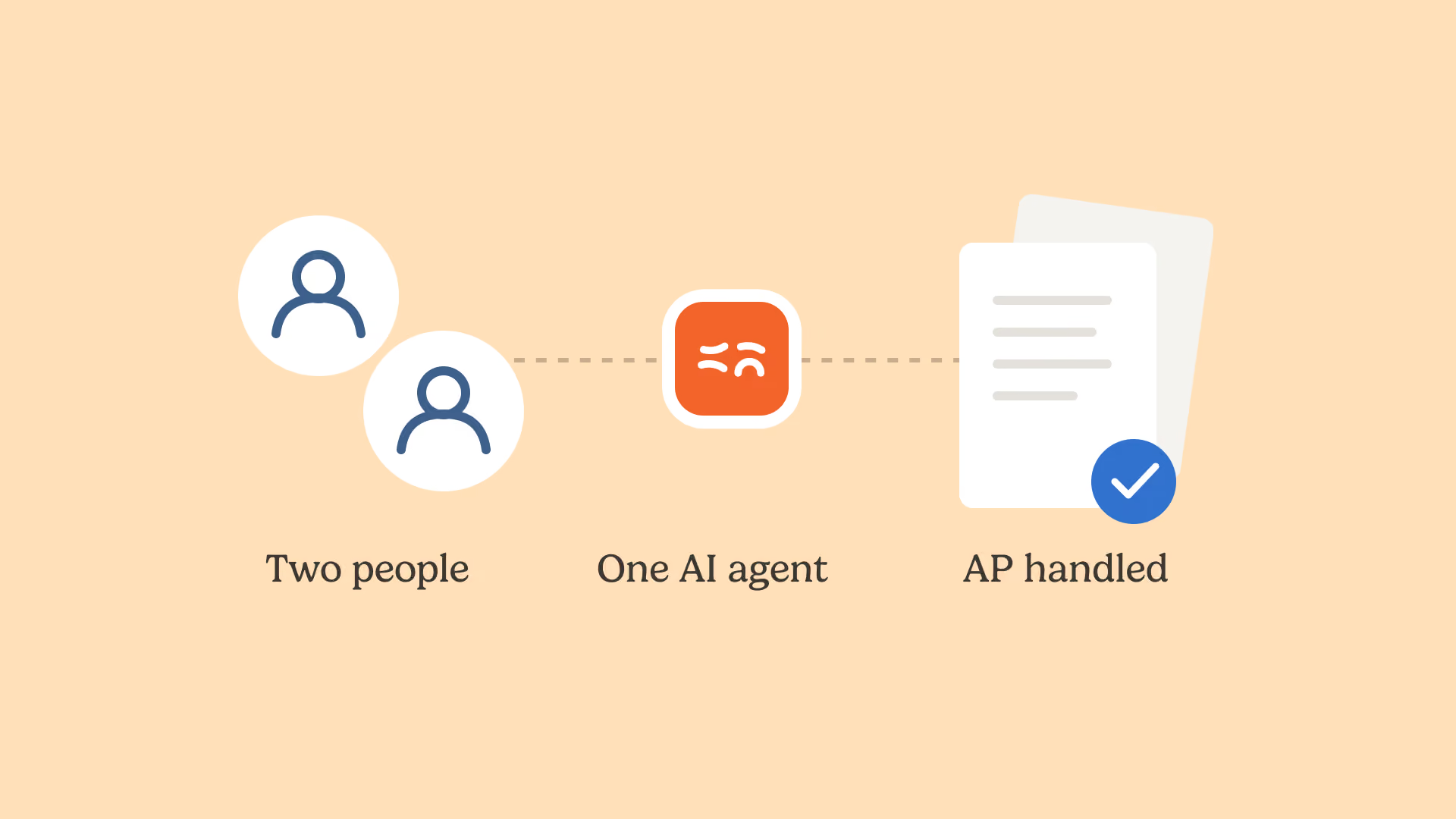
At Astotel, an 18-hotel group in Paris, that upstream stage was where the money was leaking. Purchasing Director Valérie compared invoices to negotiated prices by pulling a few at random. One agent later, the same-reference smoked salmon turned out to be billed with a 6 euros per kilo gap between two hotels, on a shared price list. On a single supplier, the errors added up to up to 400 euros a month, close to 5,000 euros a year.
Nothing in that story is an accounting problem. Every entry was posted correctly. The problem sat one step earlier, in pre-accounting, where nobody was looking.
Key takeaways
- Pre-accounting covers five document families that feed the ledger: supplier invoices, bank statements, receipts and expense claims, revenue and POS data, and payroll data.
- Vendors disagree on the boundary of pre-accounting, some including bank reconciliation and invoicing, others limiting it to document collection.
- The useful line is the posting itself: pre-accounting ends when an entry is written, accounting begins there.
- Control belongs before the entry, because a document can still be refused at that point, while a posted error becomes a credit note, a journal entry or a recovery claim.
- At Astotel, upstream price control on one supplier surfaced up to 400 euros of billing errors per month, close to 5,000 euros a year.
What pre-accounting actually covers
Ask four vendors what pre-accounting covers and you get four answers. One limits it to retrieving bank statements. Another includes bank reconciliation and invoicing, which most accountants would call accounting. A third describes collecting, checking, cleaning, sorting and coding. A fourth sells capture, categorization and publishing to the accounting platform.
They do not even agree on the reader. One vendor states plainly that pre-accounting software is for the business owner and accounting software is for the accountant, while another builds its entire offer for accounting firms.
The disagreement is not academic. It decides what a team believes is covered when it buys a tool, and what quietly stays manual.
The five document families that feed the ledger
A clearer way to define the perimeter is to start from what actually arrives, rather than from what a given product happens to process. Five families feed the ledger in a mid-market company:
- Supplier invoices and credit notes, arriving by email, portal, EDI or paper, usually the highest volume and the one that gets automated first with an accounting inbox agent.
- Bank statements and transactions, which have to be retrieved, normalized and matched before any bank reconciliation can start.
- Receipts and expense claims, low unit value, high policy risk, and the family where expense report controls are most often skipped.
- Revenue and POS data, which never arrives as an invoice and has to be rebuilt from till reports, delivery platforms and payment providers before it can be controlled site by site.
- Payroll data, delivered as files rather than documents, and rarely checked for consistency before it hits the accounts.
Most tools sold as pre-accounting software cover one or two of these families well. The gap is rarely the extraction quality inside a family. It is the families nobody assigned to anyone.
| Document family | How it arrives | Usually covered by pre-accounting tools | What tends to go unchecked |
|---|---|---|---|
| Supplier invoices and credit notes | Email, supplier portal, EDI, paper | Yes, this is the family the whole category was built on | Line-level price against the agreed reference, not just the header total |
| Bank statements and transactions | Bank portal, feed, PDF statement | Partly, statement retrieval is a category of its own | Whether every account and every period is actually present |
| Receipts and expense claims | Mobile capture, email, card feed | Yes, usually through a separate expense product | Policy compliance and duplicates across channels |
| Revenue and POS data | Till reports, delivery platforms, payment providers | Rarely, it never arrives as a document | Reported revenue against cash actually collected, site by site |
| Payroll data | Files from the payroll provider | Almost never | Period-on-period consistency before the accruals are booked |
Why the scope of the category keeps moving
Two forces pull the boundary in opposite directions. Capture vendors push it upward, because the more families they cover, the larger the contract. Accounting platforms pull it downward, because coding and matching now live inside the ledger.
Volume settles the argument in practice. Romain Joussellin, Partner at the accounting firm CPA, puts the daily reality plainly: "On a restaurant invoice, you might have 5 lines or 50." A tool that reads the header and skips the lines has processed the document without processing the information.
Pre-accounting, accounting and bookkeeping: where the line sits
Pre-accounting ends at the posting. Everything that happens before an entry is written to the ledger belongs to pre-accounting. Everything that happens once the entry exists, including its classification, its review and its reporting, belongs to accounting.
That line is more useful than the ones vendors draw, because it does not depend on who does the work. Bank reconciliation sits after the posting, so it is accounting, even when a pre-accounting tool performs it. Retrieving the statement and normalizing it sits before, so it is pre-accounting, even when the accountant does it by hand.
Bookkeeping is a different axis altogether: it describes a job, not a stage. A bookkeeper spends most of the week in pre-accounting and a smaller part in accounting, which is exactly why the terms get mixed up. Keeping the stage and the job separate is what makes it possible to say where data quality is won or lost, and it is won upstream.
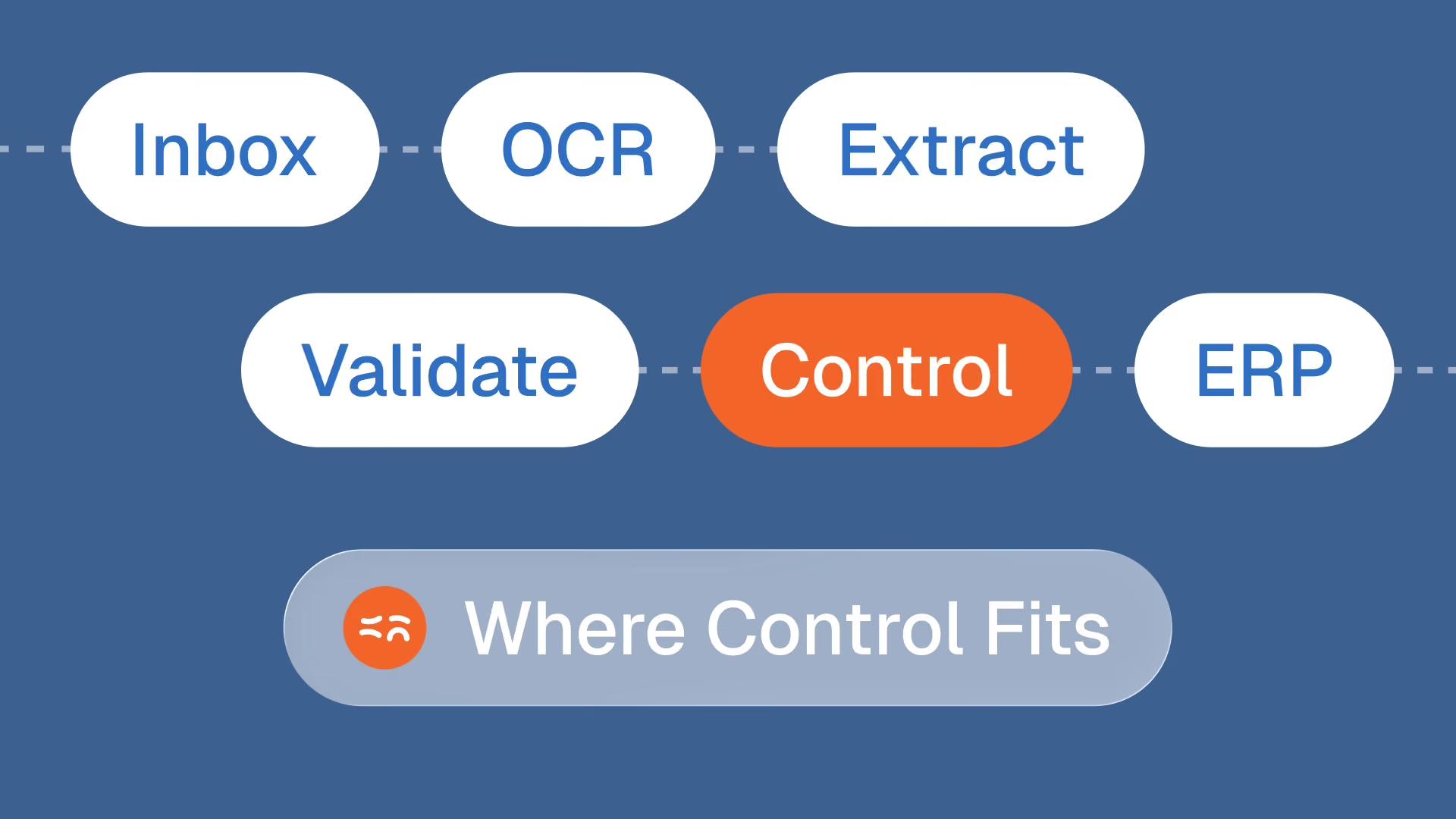
Where control fits: before the entry, not after the report
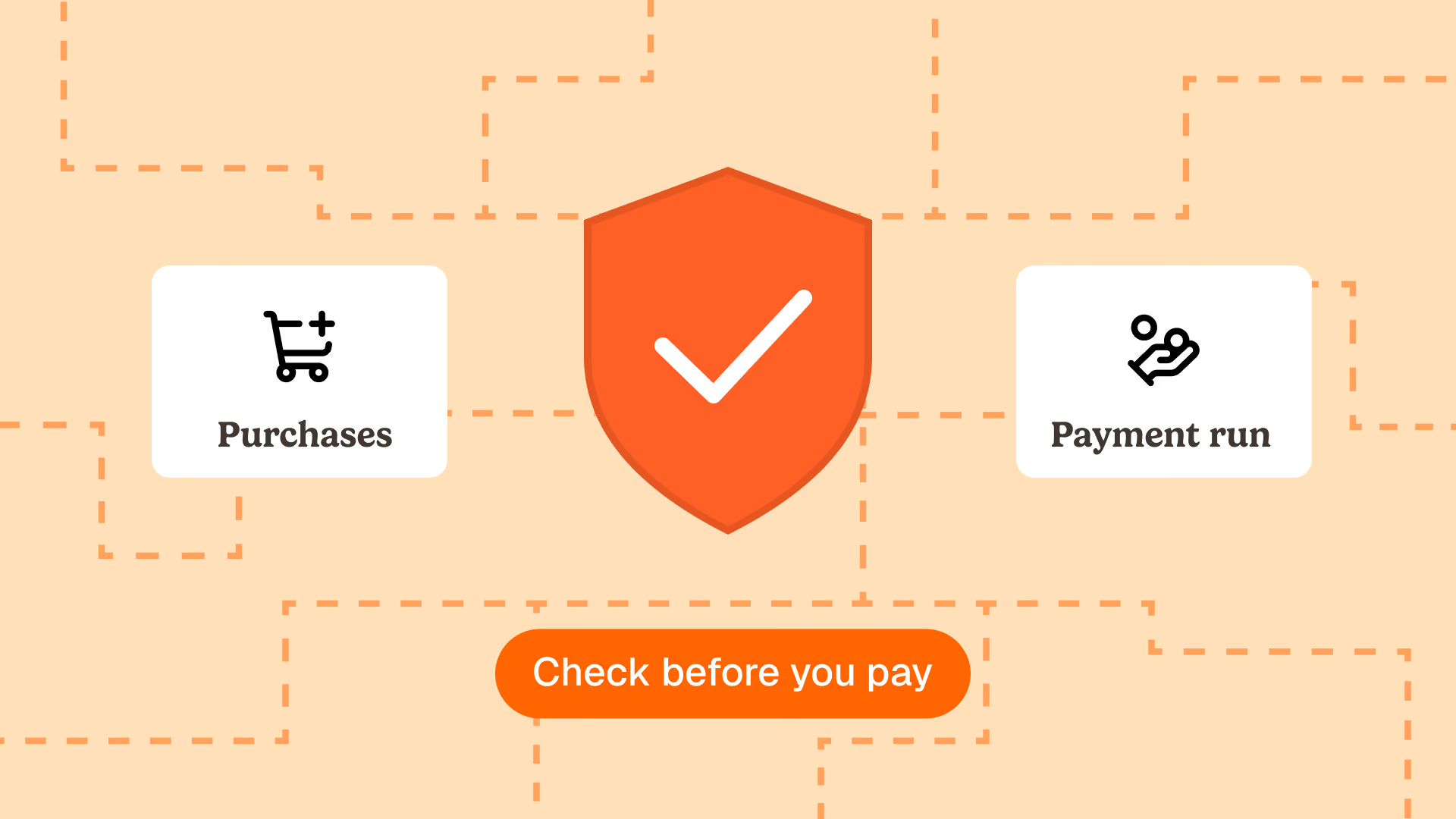
Control belongs in pre-accounting because that is the last moment a document can still be refused. Before the posting, a wrong price is a question sent to a supplier. After it, the same wrong price is a credit note to chase, a journal entry to reverse, a sales tax position to correct, and a margin figure that was already used in a decision.
The cost of a check does not change across that line. The cost of acting on what the check finds changes completely. That asymmetry is the whole argument for controlling before the payment decision rather than after it, and it applies just as much to a till report or an expense claim as to a supplier invoice.
Why sampling was never the answer
Before automation, upstream control meant sampling, because a person can only read so many documents. Valérie at Astotel picked invoices at random to compare prices between hotels, which is exactly what a well-run manual process looks like.
Sampling finds the errors it happens to land on. It never establishes that the rest of the population is clean, which is the only statement a finance team actually needs. The difference between checking a sample and checking every line is not a matter of thoroughness, it is a matter of what you can claim afterwards.
The four checks that belong upstream, whatever the document
Most published control frameworks are invoice-specific. At the level of the whole pre-accounting perimeter, four check families apply to all five document families:
- Reference compliance. Does the document match an agreed reference: a price list, a contract, a rate schedule, a payroll grid. This is what an agreed price list agent checks line by line rather than header by header.
- Uniqueness. Has this document, or this amount, already entered the flow through another channel. Duplicates multiply when the same supplier sends by email, by portal and by post.
- Population completeness. Not whether one document is complete, but whether the set is. A missing statement, an unreported till, a supplier who simply did not invoice this month: none of these produce an error, they produce a silence.
- Coding consistency. Does the same purchase get coded the same way across sites and across months. At Maslow Restaurants, wrong pack sizes in the setup created unexplained stock gaps that no accounting check would ever have flagged, because every entry was individually correct.
Completeness is the one that reliably gets missed, because every other check is triggered by a document arriving. Nothing triggers on a document that never came. That is why a completeness agent works on the expected population rather than on the inbox.
For the invoice-specific detail, the checks that run between extraction and the ERP are covered in depth in invoice data extraction validation, and the contamination patterns that follow a missed check in invoice validation before ERP.
What a pre-accounting setup does, and the step most tools skip
Six capabilities describe any pre-accounting setup, whether it is bought as a product or assembled from a shared inbox and a spreadsheet. Five of them are well served by the market. The sixth is where the offers diverge.
| Capability | Capture-first tools | Phacet | The accounting system or ERP |
|---|---|---|---|
| Multi-channel capture | Yes, email, mobile, portal | Yes, including files and feeds that are not documents | Limited, usually one inbound channel |
| Line-level extraction | Partial, header fields first | Yes, every line of every document | No, it receives what it is given |
| Standardization and coding | Rule-based, per supplier | Yes, consistent across sites and periods | Yes, once the entry exists |
| Control before posting | No, it sorts rather than refuses | Yes, references, duplicates, completeness, coding | After the fact, at review or close |
| Audit trail at decision level | Processing log only | Yes, reasoning and confidence score per line | Entry level, not decision level |
| Handoff to the ledger | Yes, export or sync | Yes, and exceptions routed to a human first | It is the destination |
Capture and extraction are close to solved, and manual data entry is no longer the bottleneck in a well-tooled workflow. OCR reads a document, intelligent document processing reads it in context, and both produce fields. Neither produces a judgment about whether those fields should be accepted.
That is the step Phacet adds between the two. Documents and files become auditable tables through Structure, lines are reconciled against references and against each other through Match, and every decision keeps its reasoning and its confidence score, so the output is showable to an auditor rather than merely trusted. Where it matters, an audit file agent assembles the evidence on its own.
The measured effect lands on the boring part first. At Maslow Restaurants, invoice intake took one to two hours a day before an agent took it over, and CEO Julia Chican is explicit about what that bought: "many controls simply never happen, not because they are not important, but because no one has the bandwidth to run them properly."
At Smartbox, Operations Director Mourad Meraou reports a fourfold productivity increase on matching payments to invoices. At Astotel, Valérie saved at least two hours a day during the test phase.
Who actually runs pre-accounting
The English-language category was built for accounting firms and their small business clients. That is still one answer, and a good one: firms running dozens of files need standardized upstream work more than anyone, which is the whole logic of the accounting firm persona.
It is no longer the only answer. In companies of 50 to 500 people with a finance team of one to three, pre-accounting is not outsourced, it is squeezed between everything else. Nobody owns it, so it defaults to whoever opens the inbox.
The firms themselves are moving too. Romain Joussellin at CPA describes the shift without much sentiment: "The recurring core mission will be automated by e-invoicing. I was looking for a new recurring mission for the firm."
Where e-invoicing mandates are rolling out, transmitting accounting data stops being billable work. What remains billable is what sits around it: watching supplier prices over time, reconciling orders, deliveries and invoices. On the tooling itself, his verdict says a lot about adoption: "Phacet feels like an Excel table powered by AI. We're not disoriented, the format is exactly what we use every day."
Both readers end up in the same place. Pre-accounting stops being a data preparation chore and becomes the stage where internal control actually happens, which is a very different conversation for a finance leader than a discussion about hours saved.
How to evaluate a pre-accounting setup
Feature lists in this category converge, so they separate nothing. Five questions do:
- Which of the five document families does it actually cover? Not which ones it can technically ingest, which ones it processes end to end without someone finishing the job in a spreadsheet.
- Does it read lines, or headers? Header-level extraction cannot check a price against a price list, which rules out most reference compliance work.
- Does it refuse anything, or does it only sort? A tool that never raises an exception is a conveyor belt, and it will move a wrong invoice into the ledger as fast as a right one.
- Can it show its reasoning to a third party? An auditor, an accountant or a supplier in dispute needs the trail, not the conclusion.
- How long until the first flow runs in production? Smartbox had each use case operational within six weeks, and Phacet targets a first agent in production in under two weeks. Anything measured in quarters is an ERP project wearing a smaller name.
The last one matters more than it looks. Upstream control pays back at the first exception it catches, not at go-live, so time to first flow is the metric worth negotiating on. Phacet plans start at 299 euros per month, with 40+ finance agents built on 100+ production deployments.
The upstream stage is where the numbers are decided
By the time a figure reaches a report, it has already been accepted. The reconciliation, the close and the dashboard all inherit whatever passed unchecked at the door. That is why continuous control starts upstream, and why the pre-accounting stage deserves a named owner rather than whoever has a free hour.
The work does not disappear, it changes hands. Agents take the sorting, the extraction and the systematic checking. People take the exceptions, the supplier conversations and the decisions, the part that was getting squeezed out.
Frequently asked questions
What is pre-accounting?
Pre-accounting is everything that happens to a financial document before it is posted to the ledger: collecting it, extracting its content, standardizing it, checking it, and handing it to the accounting system. It covers supplier invoices, bank statements, receipts and expense claims, revenue data and payroll data.
What is the difference between pre-accounting and accounting?
The posting is the line. Pre-accounting prepares and checks data before an entry exists. Accounting records the entry, classifies it, reviews it and reports on it. A price error caught in pre-accounting is a question to a supplier, while the same error caught in accounting is a correcting entry and a credit note to chase.
What is pre-accounting software?
Pre-accounting software is a tool that automates the upstream stage: it captures documents from email, portals or scans, extracts their content, standardizes it and exports it to the accounting platform. Products differ mostly on two points: how many document families they cover, and whether they check what they extract or simply pass it along.
Is pre-accounting the same as bookkeeping?
No. Pre-accounting is a stage in the flow, bookkeeping is a job. A bookkeeper spends much of the week doing pre-accounting work, which is why the terms get used interchangeably, but bookkeeping also covers posting and review, which sit after the entry and therefore belong to accounting.
Who needs pre-accounting software?
Two profiles. Accounting firms handling many client files, where standardizing upstream work is what makes volume possible. And companies of roughly 50 to 500 people with a finance team of one to three, where nobody formally owns the upstream stage and document volume has outgrown a shared inbox and a spreadsheet.