

Invoice Sampling vs. 100% Validation: Why Sampling Is Risky and How to Validate Every Invoice Efficiently
Published on :
March 3, 2026

Nicolas Marchais is co-founder and CEO of Phacet. After seven years at Spendesk, he built Phacet as the agentic layer that orchestrates across ERP, banking and email systems. Reliable, auditable, cross-system, what he calls a Finance Workforce.

Invoice sampling feels like a rational solution. When the volume of incoming supplier invoices exceeds the capacity to review each one manually, finance teams check a subset and extrapolate. The logic is familiar from quality control, audit methodology, and statistical analysis: a well-constructed sample should reveal what is present in the full population.
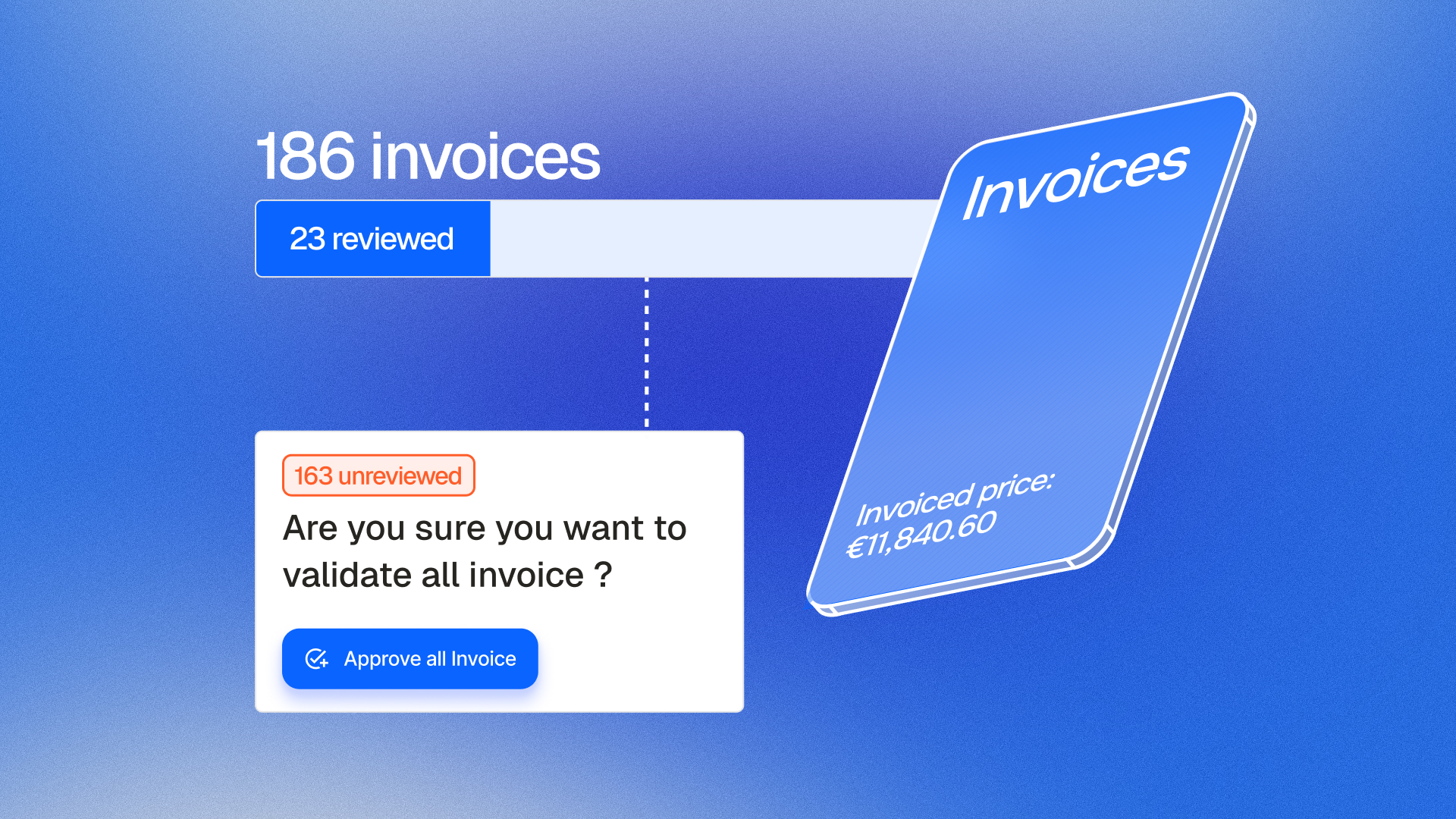
The problem is that supplier invoice errors are not randomly distributed. They concentrate in precisely the patterns, chronic price drift from a specific vendor, duplicate submissions timed across month boundaries, cross-entity routing errors, that sampling is structurally designed to miss. A company processing 400 invoices per month with a 20% sampling rate and a 5% error rate in the unsampled population isn't catching most of its errors. It's documenting the fact that it reviewed some invoices, while 320 per month pass without any validation at all.
This article makes the case for why invoice sampling fails as a risk management strategy, where its blind spots are most costly, and how 100% automated pre-payment validation delivers the coverage sampling promises, without requiring a proportional increase in finance headcount.
The statistical argument against invoice sampling
Sampling works in contexts where errors are randomly distributed and where the cost of missing an individual error is low. Invoice fraud, billing drift, and supplier overcharging share neither of these properties.
Errors are not randomly distributed
Invoice errors cluster around identifiable patterns. A supplier whose billing system has a systematic data entry error overcharges on every invoice, not on a random 5% of them. A duplicate submission strategy exploits the gap between accounting periods, appearing consistently in cross-period scenarios rather than randomly across the invoice population. An IBAN change sent by a fraudulent actor arrives in a single targeted communication, not distributed across a statistical sample of your incoming invoices.
When errors cluster rather than distribute randomly, sampling cannot provide statistical coverage. The probability that a 20% sample catches a systematic error that appears on every invoice from a specific supplier is 100%, eventually. The probability that it catches the error in the same billing cycle it first occurs, before payment has been made, is much lower. And for fraud that occurs once in a targeted event, the probability that a 20% sample happens to catch it in the right month approaches zero.
The unsampled majority carries disproportionate risk
Standard sampling logic treats the unsampled population as statistically representative of the sampled subset. In practice, finance teams don't sample randomly, they sample the invoices that look unusual, come from new vendors, or exceed defined thresholds. The invoices they don't examine are the routine, familiar ones from established suppliers: precisely the population where chronic billing drift accumulates undetected for the longest periods.
Vivason discovered this the costly way. Systematic billing discrepancies from established suppliers, the invoices the team trusted most, had been accumulating for months before systematic comparison against contract rates made the pattern visible. The total reached €180,000 in annual overcharges. None of the individual invoices were large enough to trigger manual review. Together, the pattern was material.
The compounding problem: undetected errors compound across cycles
An error missed in one sampling cycle resets the detection clock rather than accumulating toward eventual detection. A supplier who overcharges by 2% on every invoice isn't more likely to be caught after three months than after one month of sampling, the 80% of unreviewed invoices in month four are as invisible as those in month one. The financial exposure grows linearly with time while detection probability stays constant.
Compare this to 100% validation: a systematic overcharge that appears on the first invoice of a new billing pattern is flagged before payment. The exposure stops at one instance rather than compounding across 12 billing cycles. The difference in annual cost between detecting an error at first occurrence and detecting it after a year of monthly billing, assuming a conservative 2% overcharge on a €50,000 annual supplier, is €1,000 caught once versus €12,000 paid and partially recovered.
Where sampling creates the most dangerous blind spots
Not all unvalidated invoices carry equal risk. The distribution of sampling blind spots maps closely to the distribution of highest-risk invoice scenarios, which is why closing the coverage gap matters most for specific categories.
Established high-frequency suppliers
Counter-intuitively, the suppliers finance teams sample least often are the ones with the highest cumulative billing risk. An established supplier billing 50 invoices per month at an average of €2,000 represents €1.2M in annual payments. A 1% systematic overcharge from that supplier costs €12,000 per year. Because the relationship is trusted and the individual invoices are routine, they rarely make it into a 20% sample. Because they never get checked, the overcharge persists.
Supplier billing control automation addresses this blind spot directly: high-frequency, high-trust suppliers are validated on the same terms as new or flagged suppliers, every invoice, every line, every billing cycle.
Cross-period and cross-entity submissions
As explored in our article on duplicate invoice prevention, cross-period duplicates and cross-entity submissions defeat period-scoped sampling entirely. A sampling process that reviews invoices within the current month won't catch a duplicate from 47 days ago. A per-entity sampling process won't catch a submission that arrived at a different entity's inbox.
The coverage gap here isn't about sample size, it's about scope. Even a 50% sample within the current period would miss cross-period duplicates. Only full-history, cross-entity detection closes this specific risk category.
IBAN and payment detail changes
Supplier banking detail fraud occurs as a targeted event, not as a distributed risk across the invoice population. A fraudulent IBAN change arrives in a specific communication, for a specific supplier, in a specific period. The probability that a random 20% sample happens to check that exact invoice against the verified vendor master in that specific period is, by definition, 20%.
For fraud events where a single missed instance costs €15,000 to €50,000 (the typical range for successful business email compromise in supplier payment fraud), a detection probability of 20% represents an expected loss of €3,000 to €10,000 per incident. Pre-decision control with 100% IBAN verification reduces that expected loss to zero, because every banking detail on every invoice is checked before payment approval.
Small-value invoices in high-volume categories
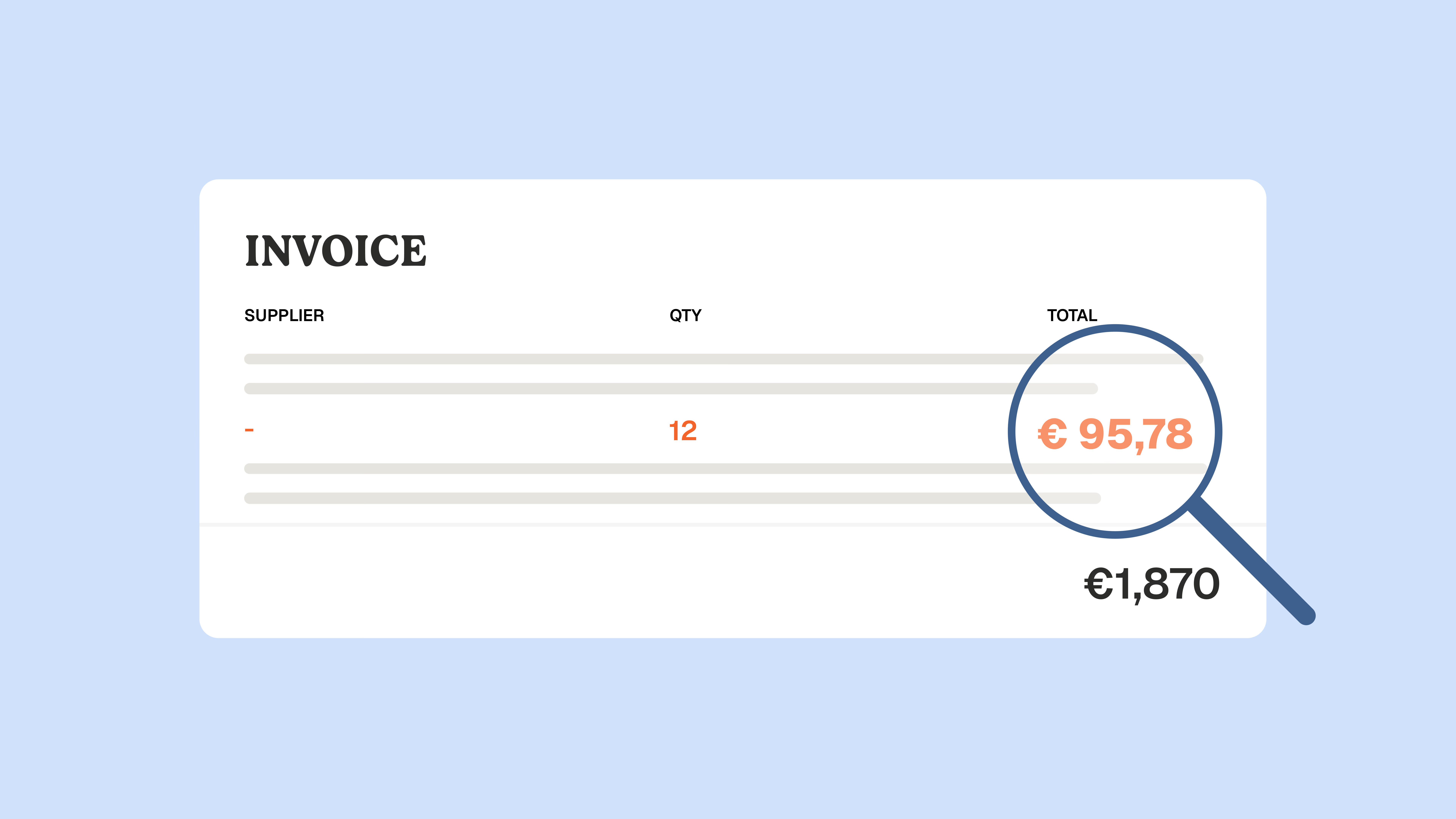
Sampling frequently excludes low-value invoices on the grounds that the individual financial impact doesn't justify review time. This is rational at the individual invoice level and systematically wrong at the portfolio level. A supplier who overbills by €15 on 200 invoices per year generates €3,000 in annual overcharges that never trigger manual review, invisible in any threshold-based sampling approach, visible immediately under 100% automated validation.
The "we can't review everything" objection, and why it misses the point
The most common objection to 100% invoice validation is also the most understandable: the reason sampling exists is that manual review of every invoice is not feasible at scale. A finance team processing 500 invoices per month at 15 minutes per document doesn't have 125 hours of monthly review capacity.
This objection is entirely correct, about manual review. It is irrelevant to automated validation.
The distinction matters because 100% validation does not mean 100% human review. It means that every invoice passes through an automated control sequence, supplier identity verification, price compliance against contracts, duplicate detection, IBAN check, three-way matching, before reaching the payment queue. The automation runs in seconds per invoice, regardless of volume. Human attention applies only to the exceptions that automation flags: typically fewer than 5% of total invoices.
The capacity calculation transforms completely. A team processing 500 invoices per month with 95% automated clearance reviews 25 flagged invoices, not 500. At 15 minutes per exception review, that is 6 hours per month rather than 125. The finance team hasn't scaled its headcount; it has changed what it reviews, shifting from processing the majority to deciding on the genuinely ambiguous minority.
This is the model that human-in-the-loop validation enables: automation handles the coverage, humans handle the judgment. The combination delivers 100% coverage at a human time cost comparable to a well-executed 5% sample, except that the coverage is actually complete.
La Nouvelle Garde validated this model across 14 restaurant locations. Before systematic automated validation, invoice processing consumed significant team time across multiple locations without consistent control coverage. After deployment, 1,794 emails that had accumulated during vacation periods were pre-validated on return, the team reviewed exceptions rather than processing a backlog. Control coverage reached 100% while review time dropped to exception-handling only. Read the full La Nouvelle Garde case study for the implementation detail.
Sampling vs. 100% validation: a direct comparison
The performance difference between sampling and 100% automated validation isn't marginal. It is structural, and it scales with both invoice volume and error rate.
Coverage. A 20% sampling rate provides 20% coverage by definition. 100% automated validation provides 100% coverage regardless of volume. The coverage gap, the 80% of invoices that pass without any check, is the direct source of every overpayment, duplicate, and fraud event that escapes detection in sampling-based environments.
Consistency. Manual sampling varies with reviewer availability, experience, and the time pressure of invoice processing cycles. Month-end rush, vacation periods, and high-volume days all reduce the thoroughness of sampling in practice. Automated validation applies the same rule set to every invoice, regardless of when it arrives or what else is happening in the finance team's workload.
Detection latency. Sampling catches errors in the proportion of invoices reviewed in each cycle. Automated validation catches errors at the moment of invoice receipt, before the document enters any ERP or payment workflow. A systematic overcharge detected by sampling may have been accumulating for multiple billing cycles; the same overcharge detected by automated validation at intake stops at the first occurrence.
Auditability. A sampling record documents which invoices were reviewed and what was found. An automated validation record documents every invoice, every control applied, and every outcome, including the 95% that cleared without exception. The audit trail from 100% automated validation is inherently more complete than any sampling record, because it covers the full population rather than a subset.
Scalability. As invoice volume grows, through business expansion, new supplier relationships, or multi-entity growth, sampling becomes harder to maintain at consistent rates without adding headcount. Automated validation scales directly with volume: doubling the invoice count doubles the work done by automation, not the work done by the finance team.
The French Bastards demonstrated this scalability directly. Expanding from 7 to 14 locations doubled the invoice volume without proportional growth in finance staffing. Automated inbox validation absorbed the increased volume within the same control framework, maintaining 100% coverage through the growth phase. The French Bastards case study details how this was implemented across a rapidly growing multi-site operation.
How to transition from sampling to 100% automated validation
The transition from sampling-based invoice review to systematic pre-payment validation follows a sequence that most finance teams complete in two to four weeks, far shorter than the multi-month implementations typical of ERP configuration projects.
Phase 1 — Connect the intake layer (Week 1).
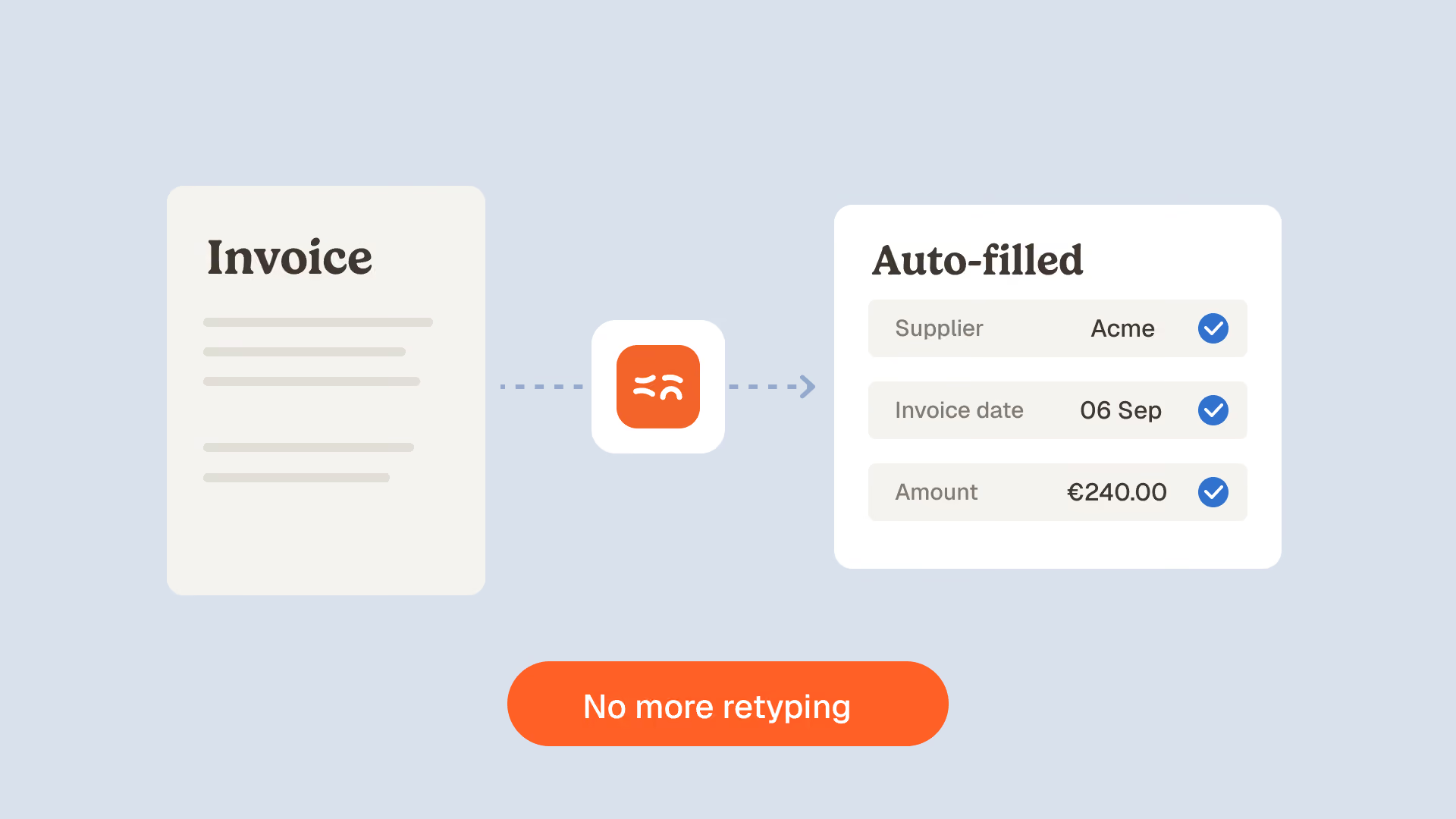
Phacet connects to the accounting mailbox via OAuth, establishes the supplier reference database, and begins capturing all incoming invoices in real time. No ERP configuration is required at this stage; the connection is at the inbox level, upstream of any system of record.
Phase 2 — Configure validation rules (Weeks 1–2).
Control parameters are defined: price tolerance thresholds per supplier category, duplicate detection windows, IBAN verification scope, approval routing thresholds. These rules are configured by the finance team directly, without IT involvement, using Phacet's no-code configuration interface. The no-code automation model means that rule changes, adjusting a price tolerance, extending a duplicate detection window, can be made by the team managing the controls, not by an IT team managing system configuration.
Phase 3 — Calibration on live traffic (Weeks 2–4).
Validation rules are refined against real invoice traffic. False positive rates are measured and thresholds adjusted. The target: fewer than 5% of invoices generating exception flags, with greater than 95% clearing automatically. Most Phacet deployments reach this threshold within the calibration period.
Phase 4 — Exception-based operations (ongoing).
Once calibrated, the team shifts from processing invoices to reviewing exceptions. The time previously spent opening PDFs, looking up contracts, and confirming entity assignments is replaced by reviewing the small proportion of documents that the automated layer identified as genuinely requiring judgment. See how this full workflow integrates in the accounts payable automation platform.
Astotel completed this transition across its hotel portfolio and reduced its invoice error rate from 7% to 2% while moving from partial sampling coverage to systematic validation of every incoming supplier document. The Astotel case study covers the implementation timeline and the operational changes that followed.
Frequently Asked Questions
What is invoice sampling and why do finance teams use it?
Invoice sampling is the practice of selecting a subset of incoming supplier invoices for detailed review, typically 10–25%, and using the results to infer the quality of the full invoice population. Finance teams use it because manual review of every invoice is not feasible at scale: at 10–15 minutes per invoice, a team processing 400 invoices per month would need 67–100 hours of review capacity. Sampling reduces that burden to a manageable level, at the cost of leaving the majority of invoices unchecked.
Why is invoice sampling risky as a control strategy?
Invoice sampling is risky because supplier billing errors and fraud are not randomly distributed across the invoice population. They cluster in patterns, systematic price drift from specific suppliers, duplicate submissions timed to cross period boundaries, targeted IBAN change events, that sampling is unlikely to capture in the billing cycle they first occur. A 20% sample that misses a systematic overcharge in month one still has a 20% detection probability in month two. The error accumulates while the detection probability stays constant.
Is 100% invoice validation actually achievable without adding headcount?
Yes, because 100% validation does not mean 100% human review. Automated validation applies a defined control set, price compliance, duplicate detection, supplier identity, IBAN verification, three-way matching, to every incoming invoice in seconds, without human involvement. Human review applies only to the exceptions the automation flags: typically fewer than 5% of total volume. A team that previously spent 30–50 hours per month on manual sampling review can achieve complete coverage while reducing active review time to 3–6 hours per month.
What is the difference between invoice sampling and invoice auditing?
Invoice sampling is a real-time or near-real-time control that checks a proportion of invoices before or during the payment cycle. Invoice auditing typically refers to a retrospective review, examining invoices after payment to identify errors, fraud, or overpayments that were missed in the standard process. Auditing can recover some losses but cannot prevent them; sampling reduces the probability of catching errors versus the baseline; 100% automated pre-payment validation prevents them systematically before cash moves.
At what invoice volume does the shift from sampling to automated validation make sense financially?
The break-even point depends on error rate and average invoice value, but the operational case is compelling from around 100 invoices per month. Below that volume, manual review of every invoice may be feasible. Above it, the combination of reviewer time cost and coverage risk from sampling typically exceeds the cost of an automated validation platform within the first year. Most Phacet deployments recover their annual cost within four months through prevented overpayments alone.
Does 100% automated validation create a false sense of security?
Only if the validation rules are poorly configured or fail to cover the relevant risk vectors. Well-designed automated validation is explicit about what it checks and what it doesn't, the audit trail shows every control applied, every result, and every exception. This creates more transparency, not less: a finance team using sampling knows it checked 20% and trusts the rest; a team using systematic validation knows exactly which controls ran on every document and what was found. The risk of over-reliance is lower, not higher, because the system's coverage is explicit rather than inferred.
How does automated validation interact with ERP duplicate checks?
Automated validation at the inbox level runs upstream of ERP entry, which means it catches duplicates before they consume data entry time and before they pollute the accounting record. ERP duplicate checks run on already-entered data and catch only exact-match reference duplicates within the same entity. The two controls are complementary, ERP checks catch the subset that reaches the system, automated inbox validation catches the broader population including cross-entity submissions, near-match references, and cross-period resubmissions that ERP checks miss.
Can automated validation handle invoices from hundreds of different suppliers with different formats?
Yes. Phacet's extraction layer normalizes invoice data from any document format, structured PDFs, scanned images, emailed attachments, to a common data structure before applying validation rules. Supplier-specific rules (price reference data, tolerance thresholds, approval routing) are configured per supplier rather than per document format, so the validation logic applies consistently regardless of how different suppliers format their invoices.
The coverage you actually need
Sampling solves a real problem, the impossibility of manually reviewing every invoice at scale, by accepting a tradeoff: reduced coverage in exchange for feasible process. That tradeoff made sense when 100% coverage meant 100% manual review. It no longer does.
When automated validation can cover every invoice in seconds, applying the same controls consistently regardless of volume or reviewer availability, the case for sampling collapses. It does not provide statistical coverage for clustered errors. It does not detect patterns that span multiple billing cycles. It does not provide the audit documentation that full-population validation generates. And it does not scale, as invoice volume grows, maintaining sampling rates requires either more staff or lower coverage.
The companies that have moved to systematic pre-payment validation haven't done so by hiring more reviewers. Vivason stopped €180,000 in annual overcharges. Astotel halved its invoice error rate. Jinchan multiplied its anomaly detection by 5x. Each of these outcomes came from the same change: replacing coverage-by-sample with coverage-by-design, applied before payment, on every invoice.
Book a demo to see how Phacet's 100% pre-payment validation works across your invoice volume and supplier base, and what your current sampling rate is leaving unchecked.


Latest Resources

Unlock your AI potential
Go further with your financial workflows — with AI built around your needs.


