

Invoice validation before ERP: how to stop invoices from polluting your accounting system
Published on :
April 20, 2026

Nicolas Marchais is co-founder and CEO of Phacet. After seven years at Spendesk, he built Phacet as the agentic layer that orchestrates across ERP, banking and email systems. Reliable, auditable, cross-system, what he calls a Finance Workforce.

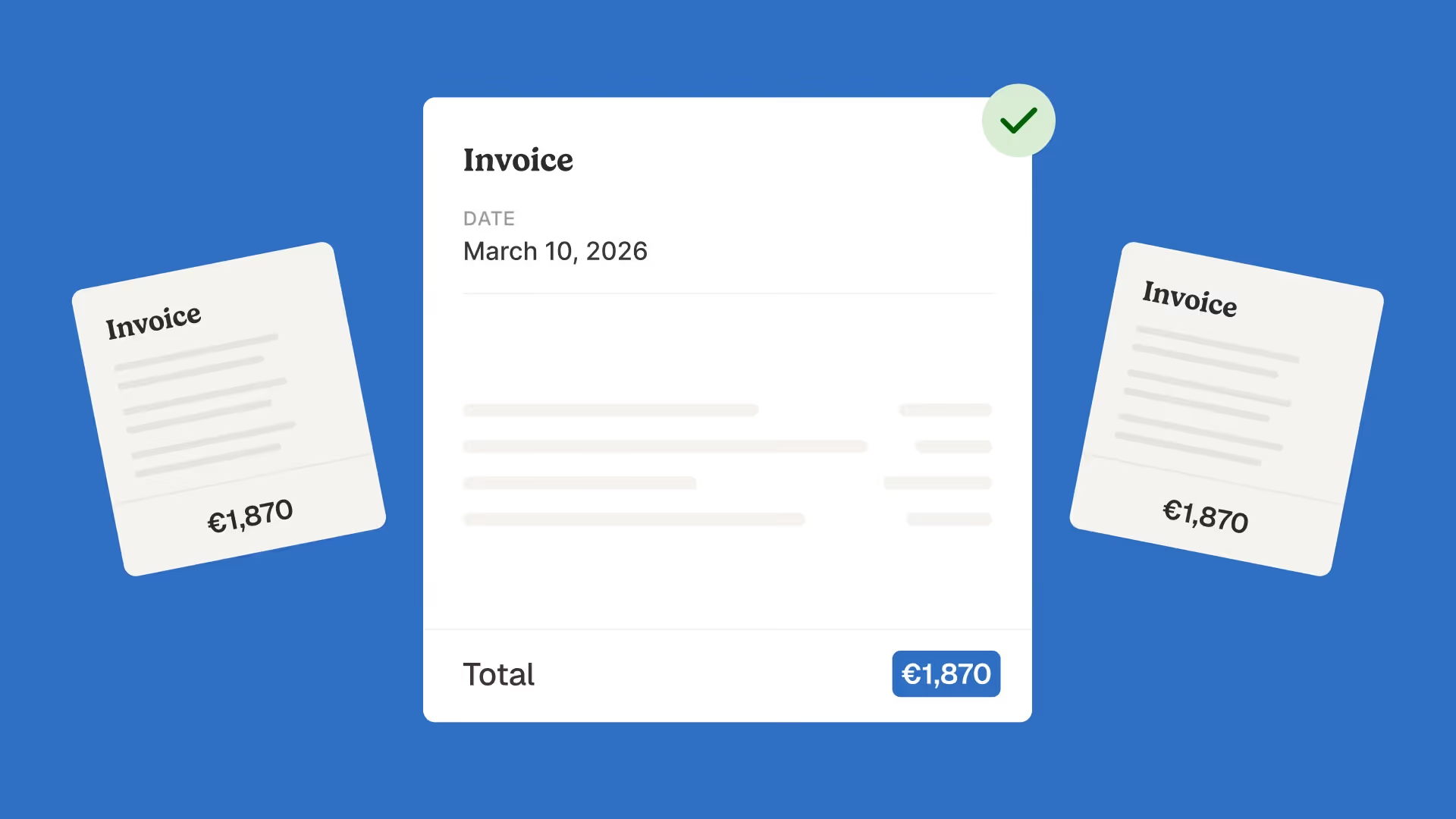
Every invoice that enters an ERP system without being validated first is a potential contaminant. Not in the sense that it will necessarily cause a visible error, most incorrect invoices post cleanly, generate no error message, and sit in the general ledger looking exactly like the correct invoices around them. The contamination is invisible: a price deviation that reduces margin without triggering an alert, a duplicate that doubles a cost-centre balance without being flagged, a misclassified expense that distorts a budget line without anyone realising the categorisation is wrong.
Finance teams discover ERP contamination in three ways: during reconciliations (when two systems disagree and the source of the discrepancy turns out to be a wrongly posted invoice), during audits (when a sampled transaction traces back to a document that doesn't match what the ledger shows), and during management reporting (when a cost figure that looks wrong turns out to be correct, because the underlying invoices were wrong when they were posted).
The third discovery is the most expensive. By the time a wrong number has been used in a board presentation, a budget decision, or a hiring approval, the cost of the data quality failure is not just the correction, it is the decision made on the incorrect data.
Invoice validation before ERP entry is the intervention that prevents all three discovery modes by ensuring that invoices are checked for accuracy, compliance, and completeness before they enter the accounting record. This article explains why validation timing matters, what validation before ERP entry requires, and how to implement it without adding manual overhead to the AP process.
Why the ERP is the wrong place to catch invoice errors
The most common mental model for invoice control is ERP-centric: post the invoice, then catch errors through reconciliation, variance analysis, or the month-end AP review. The ERP becomes the place where problems are discovered and corrected. This model has two structural weaknesses that make it reliably inadequate.
Correction inside the ERP is expensive.
A posting error in the ERP requires a correction entry, a credit note, a reversal, a reclassification journal, that affects at least two accounts, generates additional records in the ledger, and must be traced and documented for audit purposes. The more downstream processes have already consumed the incorrect posting (cost-centre reports, management accounts, VAT returns, intercompany reconciliations), the more places the correction must propagate. What would have been a five-minute fix at the point of invoice receipt becomes a thirty-minute correction exercise involving multiple accounts, a manual journal, and a note in the reconciliation file.
Error detection in the ERP is incomplete.
The ERP validates the format and structural integrity of a posting, it checks that the debit equals the credit, that the account code exists, that the posting date is valid. It does not validate the economic accuracy of the posting, it does not check whether the invoice price matches the contracted rate, whether this invoice is a duplicate of one already posted last week, or whether the delivery the invoice relates to was actually received. These are the errors that produce financial loss and data quality problems, and they are entirely invisible to the ERP's own validation logic.
The result is a system where structurally valid but economically wrong invoices post cleanly and silently, and the only way to find them is to look specifically for them, through price variance reports, duplicate analysis, and reconciliation against purchase orders. For most organisations, this analysis runs monthly or quarterly, which means that errors accumulate for weeks or months before they are detected.
The alternative is to look for them before they enter the ERP, at the point of invoice receipt, before posting, when interception is free and correction is trivial.
What ERP pollution actually looks like: 4 contamination patterns
Understanding the specific ways that unvalidated invoices contaminate the ERP helps identify which validation checks are most critical. Four contamination patterns account for the majority of ERP data quality problems caused by invoice errors.
Pattern 1 - Price contamination: cost accounts posted at incorrect rates
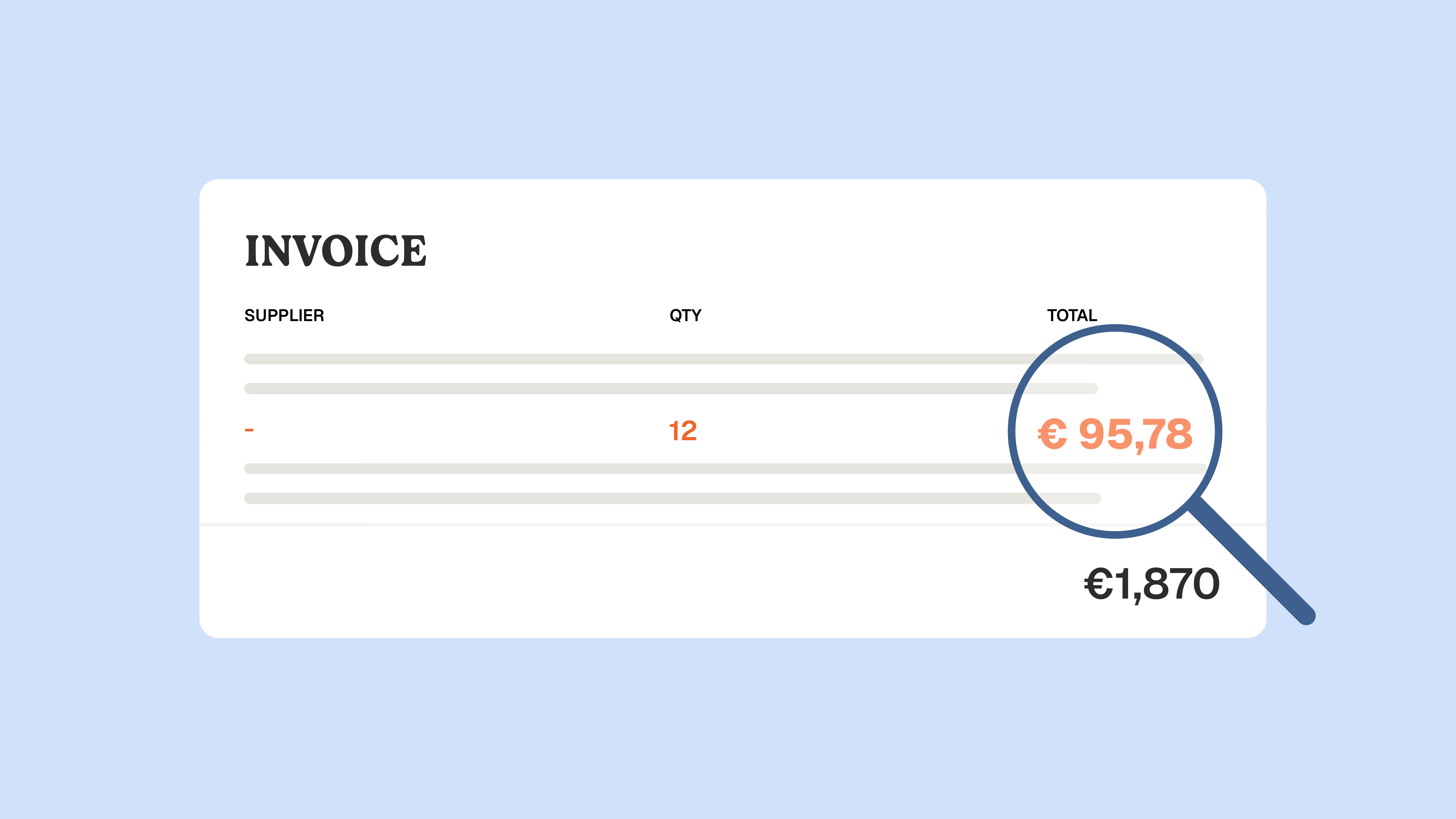
The most common pattern. An invoice arrives at a price that differs from the contracted rate, a supplier has applied a tariff from a superseded price list, added a service charge not specified in the contract, or simply billed at the wrong unit rate. The invoice is approved and posted. The accounts payable balance is now incorrect. The cost-centre account is now incorrect. The supplier accrual for the month is now incorrect.
None of these errors are visible from inside the ERP. The posting is structurally valid. The price on the invoice matches the price recorded in the ERP. The error is that neither of those prices matches the contracted rate, which lives in a contract management system, a supplier master spreadsheet, or someone's memory, not in the ERP's validation logic.
By the time a cost variance report identifies that a particular cost-centre is tracking above budget, weeks of incorrect postings may have accumulated. The correction requires identifying each affected invoice, issuing correction entries for each posting, and updating the budget analysis for the period.
Pre-ERP price validation checks every invoice line against the contracted rate before the invoice is posted. Deviations are flagged as exceptions and routed for resolution before posting occurs. The ERP never receives the incorrect figure. The cost account is never contaminated.
Pattern 2 - Duplicate contamination: the same cost posted twice
Duplicates are the simplest invoice error and the hardest to catch without systematic detection. A supplier sends an invoice for the same delivery twice, one through the supplier portal, one by email. An invoice is resubmitted after a dispute is resolved, without cancelling the original. A consolidated billing invoice covers a period that overlaps with individual invoices already processed.
All three scenarios produce an invoice that, taken individually, looks completely legitimate. The document integrity is valid, the supplier is correct, the amount matches a real transaction. The error is only visible in the context of the full population of invoices from the same supplier, which requires comparing across the invoice history, not just validating the current document against a reference record.
ERP duplicate detection is limited to exact matches, the same invoice number from the same supplier. Near-duplicates, same amount, different invoice number; same invoice number, different date; same line items, different document reference, are rarely caught by ERP-level validation. They post cleanly and sit alongside the original invoice until someone notices that the supplier balance is higher than expected.
Pre-ERP duplicate detection runs population-level comparison across the full invoice history, identifying exact matches and near-duplicates before either is posted. The Jinchan Group's 5x improvement in anomaly detection after deploying Phacet's pre-ERP validation layer reflects precisely this pattern: the near-duplicates that ERP-level validation was missing entirely were being caught at the point of extraction, before posting occurred.
Pattern 3 - Classification contamination: expenses posted to wrong accounts
Classification errors are the quietest form of ERP pollution. An invoice for an IT subscription is posted to "office supplies." A consulting invoice is posted to "training." A capital expenditure invoice is posted to "operating expenses." None of these generate errors, the accounting is balanced, the invoice is paid, the supplier is satisfied. But every management report, cost-centre analysis, and budget variance that uses the affected accounts is now based on incorrect data.
Classification errors compound over time. If the same supplier is consistently misclassified, multiple periods of data carry the same error. If the error isn't identified until a budget review or an audit, the correction requires reversing and reposting across multiple periods, triggering restatements of management accounts that had already been presented.
The root cause of most classification errors is the absence of a classification layer upstream of the ERP. When an invoice arrives without a clear indication of which account it belongs to, the default behaviour is to assign it to the most plausible account based on the invoice description, which introduces human variability at every step. Two analysts classifying the same invoice type may assign different account codes.
Pre-ERP classification using intelligent data extraction applies consistent classification logic at the point of document processing, before any human assignment occurs. The accounting inbox agent that Phacet deploys performs this classification as part of the document triage process, assigning each invoice to the appropriate cost account based on supplier, line item description, and historical classification patterns, with a confidence score that determines whether the classification goes straight to posting or requires human confirmation.
Pattern 4 - Completeness contamination: postings without the reference data they need
The fourth pattern involves invoices that are posted before the reference data required to validate them is available or verified. An invoice posts against a PO that has already been fully consumed. An invoice posts for goods that haven't been confirmed as received. An invoice posts with a supplier reference that doesn't match the supplier master.
These postings are not incorrect in the narrow sense, the amounts are right, the accounts are right. But they are incomplete: the three-way match that should confirm the relationship between the purchase commitment, the delivery, and the invoice hasn't been verified before posting. The ERP holds the accounting record of a transaction that may or may not represent a legitimate, delivered, correctly-priced obligation.
The downstream consequence is that the AP subledger reflects commitments that haven't been validated against the underlying transaction chain. When the three-way match is later performed (at the AP review, during the close), discrepancies between the invoice and the PO or delivery record must be corrected with retroactive journal entries, adding complexity to the close and introducing opportunities for residual error.
Pre-ERP three-way matching confirms the PO, delivery, and invoice correspondence before posting. The 3-way matching agent performs this check at the point of invoice receipt, routing invoices where the three-way match is confirmed directly to the posting queue and routing exceptions for resolution. The use case page for 3-way matching covers the end-to-end logic in detail.
The pre-entry validation architecture
Preventing ERP contamination requires a validation layer that operates between invoice receipt and ERP posting. This is not a new process inserted into the AP workflow, it is a resequencing of existing validation steps so they occur before entry rather than after.
The pre-entry validation architecture has four stages, each of which eliminates one category of ERP contamination:
Stage 1 - Extraction and normalisation.
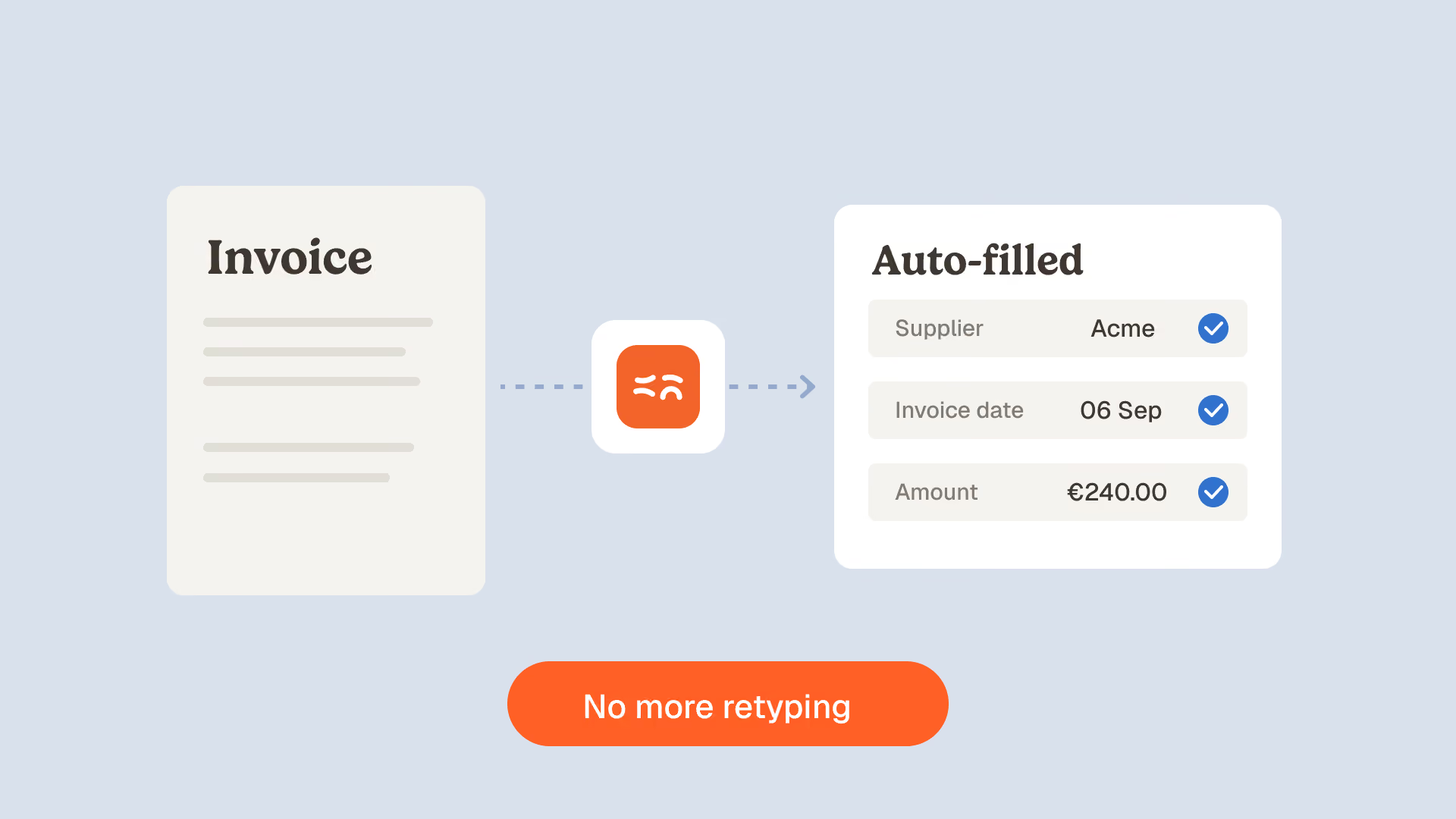
Every incoming invoice, regardless of format, channel, or source, is processed through an extraction layer that reads the relevant fields (supplier, amount, line items, date, payment terms, VAT) and normalises them into a consistent internal format. This stage also applies entity resolution: the supplier name on the invoice is matched against the supplier master to confirm the invoice belongs to a known, active supplier. Invoice data extraction with confidence scoring ensures that ambiguous extractions are flagged before they reach the validation layer, rather than passing through with potentially incorrect values.
Stage 2 - Control checks.
The normalised invoice data is checked against reference data: contracted prices are compared line by line, the invoice population is scanned for duplicates, the payment terms are validated against the supplier master, and the invoice structure is checked for completeness (PO reference, IBAN, required fields). Each check produces a binary result (pass/fail) and a confidence score that determines routing. The pre-payment controls that operate at this stage are the ones documented in our invoice control before payment article, applied comprehensively, to every invoice, before any posting decision is made.
Stage 3 - Three-way matching.
For invoices with an associated PO and delivery confirmation, the three-way match is performed: the invoice amounts are compared against the PO line items, and the quantities are compared against the delivery confirmation. Invoices that pass this check have a confirmed transaction chain, the purchase was authorised, the goods were received, the invoice matches both. Invoices that fail the check are routed for exception resolution before posting.
Stage 4 - Routing and posting.
Invoices that have passed all validation checks are routed to the ERP posting queue, with the classification, account codes, and reference data pre-populated from the validation layer. The human reviewer confirms the posting, a human-in-the-loop control step that maintains accountability for the final posting decision, without having to perform the underlying validation work that the agents have already completed. Invoices with unresolved exceptions are held in the exception workflow until the issue is resolved. They never enter the ERP until they are clean.
This architecture is what decision-grade data preparation means in the AP context: the data that enters the ERP has been validated, normalised, entity-resolved, price-checked, duplicate-checked, and match-confirmed before it arrives. The ERP receives clean inputs, not raw invoice documents passed through OCR and posted without control.
Why "validate in the ERP" is not the same as "validate before the ERP"
A common objection to the pre-entry validation architecture is that modern ERPs already include validation functionality, PO matching modules, duplicate invoice detection, approval workflows. Why add a validation layer before the ERP when the ERP already has validation built in?
The objection conflates two different control objectives.
ERP validation confirms that a posting is structurally valid and consistent with what is already in the ERP. It checks whether the PO number exists, whether the supplier is in the master data, whether the invoice has already been posted. It does not check whether the invoice price matches the contracted rate in the contract management system, because the contracted rate is not in the ERP. It does not check whether the invoice is a near-duplicate with a different reference number, because near-duplicate detection requires population-level comparison across the full invoice history, which the ERP's line-item validation logic doesn't perform. It does not check whether the classification assigned by the AP analyst matches the classification assigned to similar invoices from the same supplier in other periods, because ERP validation doesn't apply cross-period consistency logic.
Pre-entry validation does all of these things. It operates on the full context, contracted rates from the reference system, population-level duplicate comparison, cross-period classification consistency, that ERP-level validation doesn't have access to.
The practical implication: ERP validation and pre-entry validation are complementary, not substitutable. ERP validation ensures that clean, validated data is posted correctly. Pre-entry validation ensures that the data arriving for posting is clean. Both are necessary. Neither alone is sufficient.
For a detailed treatment of the specific controls that pre-entry validation applies and where ERP validation falls short, see the supplier invoice validation software article and the accounts payable automation glossary entry, which covers the full AP control stack.
The downstream benefits of clean ERP data
The most immediate benefit of pre-entry invoice validation is the reduction in AP errors, the price deviations, duplicates, and misclassifications that the validation layer catches before they post. But the downstream benefits of consistently clean ERP data are at least as significant.
Faster, lower-risk month-end close. When every invoice that enters the ERP has been validated before posting, the close-time AP review confirms that the continuous validation worked correctly rather than discovering what it missed. The accrual estimate is built on a validated subledger. The variance analysis reflects real cost deviations, not posting errors. For the relationship between ERP data quality and close efficiency, our analysis of month-end close risks covers this in detail.
Management reports that reflect reality. Cost-centre reports, budget variance analyses, and supplier spend analyses all draw from the AP subledger. When the subledger is clean, every invoice price-validated, classified consistently, and matched against its delivery record, these reports reflect the actual economic position rather than a combination of correct transactions and undetected posting errors. The management decisions that follow are made on data that represents what the business actually spent, not what the invoices claimed it spent.
Audit readiness without preparation effort. An ERP populated with pre-validated invoices, each with an attached validation record showing the checks performed, the reference data used, and the exception path taken, is an audit-ready ledger by construction. The audit trail that Phacet's agents generate for every invoice processed covers exactly the documentation an external auditor needs to trace a transaction: the source document, the validation performed, the reference data against which it was checked, and the human decision that confirmed the posting. No retrospective assembly required.
Reduced supplier disputes and payment friction. Invoices that are validated before posting and paid on the basis of validated amounts generate fewer supplier disputes. When a deviation is caught at the pre-entry stage, the resolution happens before payment, the supplier is contacted, the correct amount is agreed, and the payment is made for the right figure. When the deviation is caught after payment, it requires a credit note, a dispute process, and a correction posting, generating friction on both sides of the relationship and consuming AP team time that pre-entry validation would have freed.
Implementation: What Pre-Entry Validation Requires from the AP Team
Pre-entry validation does not require the AP team to do more work. It requires the work that the AP team is already doing, checking prices, looking for duplicates, classifying expenses, to happen at a different point in the process: before posting rather than after.
In practice, implementing pre-entry validation with Phacet's agents changes the AP team's daily rhythm in four specific ways:
The accounting inbox empties automatically. Incoming invoices are extracted, classified, and routed without manual triage. The AP team's morning inbox review, which, for organisations processing 300+ invoices per month, can consume an hour or more of daily time, is replaced by a review of the agent's routing decisions, typically taking fifteen to twenty minutes. La Nouvelle Garde reduced 1,794 manual processing steps per year to near-zero after deploying the accounting inbox agent.
Price checks run automatically on every invoice. The AP analyst does not need to manually compare invoice prices against contracted rates, the agent does this for every line item on every invoice and surfaces only the exceptions. The analyst reviews the exceptions (typically 3-7% of invoice lines for an organisation with complex supplier pricing) and makes the resolution decision. The 93-97% of lines that match are confirmed automatically. The supplier billing control agent implements this logic.
Duplicate detection covers the full population. The duplicate check is not a manual review of recent invoices from the same supplier, it is an automated cross-reference of the full invoice history, identifying exact matches and near-duplicates across supplier, amount, reference number, and date dimensions. The AP team sees only the duplicates the agent identified, with the matching invoice record surfaced alongside for comparison.
Exceptions are routed with context pre-populated. When an invoice fails a validation check, it is not returned to the AP team as a raw document with a note saying "price doesn't match." It arrives in the exception queue with the specific deviation identified, the contracted price and invoiced price shown side by side, the purchase order reference and delivery confirmation status attached, and a recommended resolution action. The AP team makes the decision; the agent has already assembled the information needed to make it. This is the human-in-the-loop control model applied to invoice exceptions: human judgment concentrated on the decisions that require it, automated preparation for every one of those decisions.
Phacet's no-code automation platform connects to the invoice channels (email, supplier portal, scan) and the ERP through standard integrations, without ERP customisation or IT project resource. Configuration typically takes two to three weeks per document type. The webinar on AI-powered finance workflows covers the implementation model in a live demonstration context.
Frequently Asked Questions
What is invoice validation before ERP entry?
Invoice validation before ERP entry is the practice of applying data quality, accuracy, and compliance checks to every incoming invoice before it is posted to the accounting system. It includes price validation against contracted rates, duplicate detection across the full invoice population, three-way matching against purchase orders and delivery records, and classification checks for correct account coding. Validation occurs at the point of invoice receipt, before any posting decision is made, ensuring that the ERP only receives invoices that have been confirmed as accurate.
Why validate invoices before ERP entry rather than inside the ERP?
ERP-level validation confirms that a posting is structurally valid and consistent with existing ERP records. It does not check whether invoice prices match contracted rates in external reference systems, whether the invoice is a near-duplicate with a different reference number, or whether the classification is consistent with how similar invoices were classified in previous periods. Pre-entry validation performs these checks using the full context, contracted rates, historical invoice population, cross-period classification data, that ERP validation doesn't have access to. The two approaches address different control objectives and are complementary, not substitutable.
What types of invoice errors does pre-ERP validation catch?
Pre-entry validation specifically targets: price deviations (invoice price differs from contracted rate), duplicate invoices (exact or near-duplicate matches across the invoice history), classification errors (incorrect account code assignment), missing reference data (no PO number, unmatched supplier, missing IBAN), and three-way matching failures (invoice not matched against a confirmed purchase and delivery). These are the error types that ERP-level validation typically misses and that, once posted, require expensive correction journal entries to fix.
Does pre-entry validation slow down the invoice processing cycle?
Properly implemented, pre-entry validation reduces total invoice cycle time rather than extending it. The validation that currently happens manually after posting (price checks during the AP review, duplicate analysis at month-end, classification corrections at close) moves to an automated layer before posting. The manual work doesn't disappear, it moves upstream and is performed by AI agents rather than AP analysts, with the analysts' time concentrated on the exceptions that require judgment. For organisations currently running three-day AP review cycles, pre-entry validation with automated exception routing typically compresses the cycle to same-day or next-day processing for the 90-95% of invoices that pass validation cleanly.
How does pre-entry invoice validation interact with ERP approval workflows?
Pre-entry validation operates upstream of the ERP approval workflow. Invoices that pass all validation checks are queued for the ERP approval workflow with validation results attached, the approver sees that price compliance, duplicate status, and three-way match have been confirmed, reducing the time and effort required for the approval review. Invoices with unresolved exceptions are held outside the ERP workflow until the exception is resolved, preventing unvalidated invoices from entering the approval queue and potentially being approved before the issue is identified.
What is the typical error rate in invoices before pre-entry validation is deployed?
Error rates vary significantly by organisation, supplier mix, and the complexity of pricing agreements. In Phacet's experience across client deployments, error rates before systematic pre-entry validation typically range from 3-7% of invoice lines, with the highest rates in organisations with complex multi-tier pricing agreements and high supplier counts. After deploying pre-entry validation, residual error rates in posted invoices typically decrease to under 2%, the Astotel case (7% to 2%) and the Jinchan case (5x anomaly detection improvement) are representative of the pattern rather than exceptional results.
Can pre-entry validation be implemented without replacing the existing ERP?
Yes. Phacet's pre-entry validation layer connects to the existing ERP as an upstream integration, receiving invoices before they reach the ERP's own posting workflow, performing the validation, and passing validated invoices to the ERP's posting queue with the validation results attached. No ERP modification or replacement is required. The implementation uses Phacet's no-code automation platform to configure the connections and validation rules, typically in two to four weeks of configuration work per document type.
Clean data in, clean reports out, the ledger is only as good as its inputs
The ERP is not a validation system. It is a record system, designed to store, process, and report on financial transactions with precision and reliability. Its quality guarantees apply to the structural integrity of what it holds: debits equal credits, account codes are valid, postings are traceable. They do not extend to the economic accuracy of the data it records.
That economic accuracy, whether prices are correct, whether invoices are unique, whether classifications are consistent, whether transactions are matched against their operational reality, is the responsibility of the validation layer that operates before the ERP receives its inputs. When that layer is absent, the ERP faithfully records whatever arrives. When it is present, the ERP receives data that has been confirmed as accurate before it becomes part of the financial record.
The finance team that validates before posting does not spend its close processing corrections. It does not prepare management reports on data that contains undetected errors. It does not face audit findings based on transactions that should have been caught before they were posted. It spends its time on what the finance function is for: ensuring that the numbers that drive decisions are the right ones.
Phacet's pre-entry validation infrastructure, accounting inbox agent, supplier billing control agent, 3-way matching agent, and payment extraction agent, operates as that validation layer, consistently, on every invoice, at the point of receipt. Book a demo to see what the pre-entry validation layer looks like applied to your invoice population and what your current ERP data reveals about the errors that are already inside it.


Latest Resources

Unlock your AI potential
Go further with your financial workflows — with AI built around your needs.


