Accounts payable automation for small business finance teams
Published on :
September 28, 2026

Nicolas Marchais is co-founder and CEO of Phacet. After seven years at Spendesk, he built Phacet as the agentic layer that orchestrates across ERP, banking and email systems. Reliable, auditable, cross-system, what he calls a Finance Workforce.

This guide is for the finance lead who runs accounts payable in a 50 to 200 employee company with exactly one colleague, and who has just been asked, by an auditor, a bank or a new investor, who reviews the payment run.
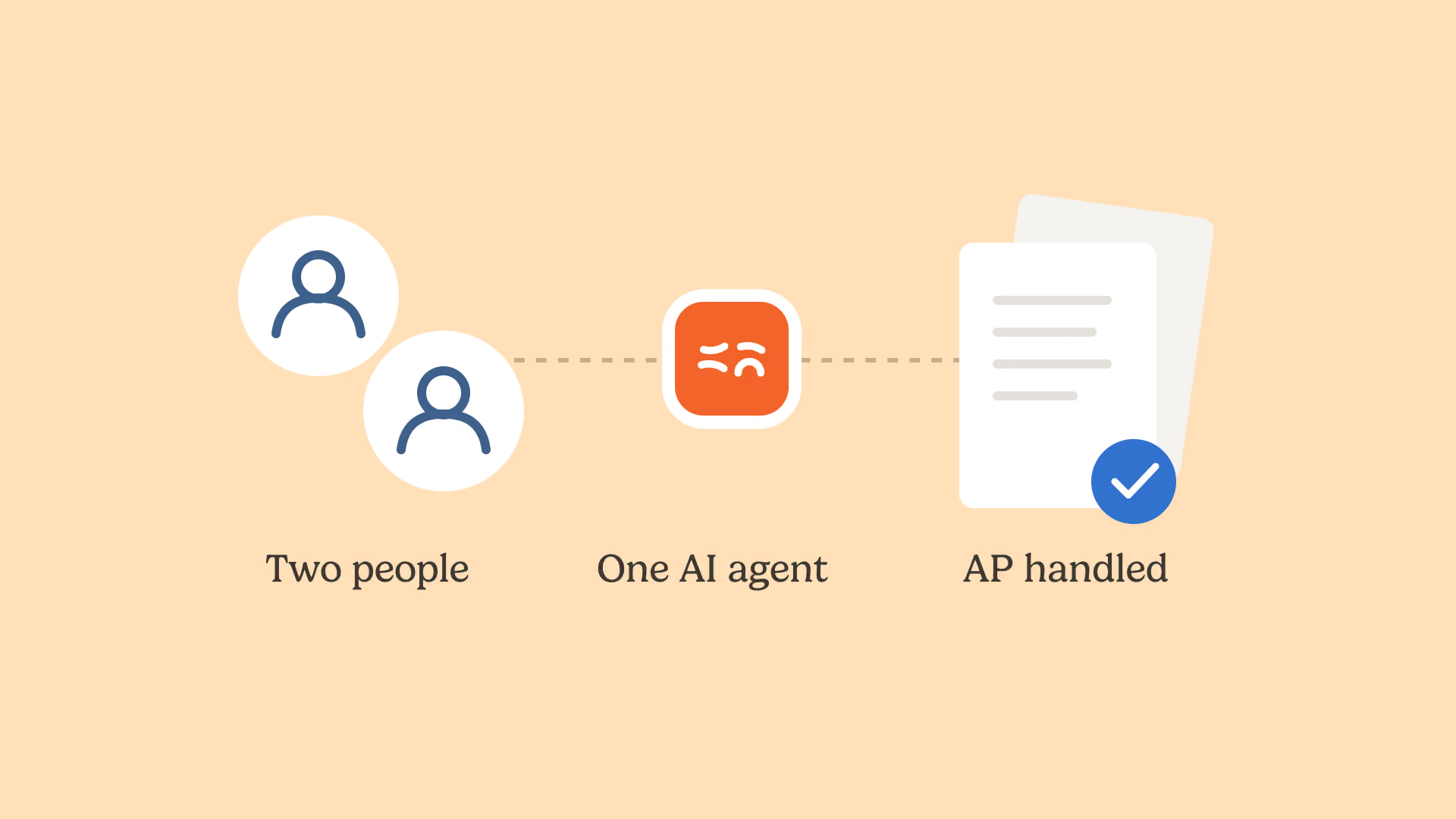
Accounts payable automation for a small business is the practice of moving invoice controls out of people's hands and into a system that applies them to every invoice, because a two-person finance team cannot separate the duties that internal control frameworks expect to be separated. The international auditing standard ISA 315 says so directly: segregation of duties is less practicable in entities with fewer employees. The answer is not to hire a third person. It is to make each control repeatable and auditable: a line-level price check against agreed terms, a match between order, delivery and invoice, a screen for duplicates and changed bank details, and a trail showing what approved each invoice and why. In a team of two, automation is a control mechanism first and a time saver second.
Key takeaways
- Segregation of duties splits four accounts payable jobs across different people: authorising the purchase, holding the payment means, recording the invoice, and reconciling the account. A two-person finance team can hold at most two of them apart.
- ISA 315 (Revised) states that segregation of duties is less practicable in entities with fewer employees, and warns that leaning on owner-manager oversight instead introduces a second risk: management override of controls.
- A compensating control only works for a small team if it runs on every invoice rather than on a sample, because sampling is what a team of two runs out of time to do.
- The three controls that protect the most money in a small AP function are the line-level price check against agreed terms, the three-way match, and the alert on a supplier bank detail change.
- At Astotel, a group of 18 Paris hotels, line-level price checking recovered around 5,000€ a year of billing errors on a single supplier.
Why segregation of duties breaks at two people
Segregation of duties is an internal control principle that splits a transaction across several people so that no single person can both create a payment and conceal it. It is the control that every audit checklist, insurance questionnaire and bank due diligence form asks about first.
It is also the control that a two-person finance team structurally cannot satisfy. This is not a failure of discipline, and it is not something a better process fixes. The auditing standards say it outright. ISA 315 (Revised), the international standard on identifying and assessing risks of material misstatement, addresses smaller entities explicitly:
It may be less practicable to establish segregation of duties in less complex entities that have fewer employees. However, in an owner-managed entity, the owner-manager may be able to exercise more effective oversight through direct involvement than in a larger entity, which may compensate for the generally more limited opportunities for segregation of duties. Although (...) domination of management by a single individual can be a potential control deficiency since there is an opportunity for management override of controls.
ISA 315 (Revised), Identifying and Assessing the Risks of Material Misstatement, application material on scalabilityRead that second half carefully, because it closes the obvious escape route. The standard acknowledges the usual small-company workaround, which is to route everything past the owner or the managing director, and then says that the workaround creates its own control deficiency. You swap a segregation gap for an override gap. For a company of 50 to 200 people with a finance team of two, that trade is rarely an improvement, and an auditor will read it the same way.
So the question is not how to separate duties you do not have the headcount to separate. It is which controls can hold without a third person.
The four accounts payable duties that are meant to be separate
Internal control splits a payment into four jobs. Naming them is useful, because it turns a vague worry into a short list you can actually work through.
| Duty | What it covers | What happens with two people | Control that replaces the separation |
|---|---|---|---|
| Authorising | Approving the purchase and the price before the commitment is made | Usually sits with the budget holder outside finance, so this one is often genuinely separate | Approval thresholds enforced by the system, not by memory |
| Custody | Holding the means of payment: banking access, payment file release | Concentrated on one of the two, often the finance lead | Bank detail change alerts and a payment file that cannot be edited after review |
| Recording | Posting the invoice to the right account and period | Concentrated on the other one, with no second reader | Automated coding with an exception queue, so only the unusual entries need a human |
| Reconciling | Checking the supplier account, the statement and the bank against the ledger | The first thing dropped when the month gets short | Reconciliation run on the full population, with unmatched items surfaced as alerts |
The pattern is consistent. Authorising usually survives, because the person who wanted the spend is not in finance. The other three collapse onto two people, and reconciling is the one that quietly disappears, because it is the only one with no supplier chasing you to complete it.
What the AP automation market leaves out
Vendor content on this subject talks about fraud constantly and about the control that prevents it almost never. Across the three editorial pages ranking in the top 10 for this query on 20 September 2026 (12,527 words in total), "fraud" appears 23 times and "duplicate payment" 9 times, while "segregation of duties", "compensating control", "approval threshold", "goods receipt" and "supplier statement" appear zero times each. The problem is sold, the control is not named.
The same gap shows up in the numbers. Google's AI Overview for this query opens by stating that automation takes invoice processing from roughly 15 dollars per paper invoice down to under 3 dollars, sourcing Airwallex, which gives a range of 12.88 to 19.83 dollars. Set that against APQC's Open Standards Benchmarking, which puts the median cost to process an invoice at 6.00 dollars across 5,846 organisations. CFO.com reports 5.83 dollars across 1,485 organisations, with the most expensive quartile starting at 10 dollars and above.
In other words, the figure sitting at the top of the search results describes organisations in the worst-performing quartile of the actual benchmark, presented as the norm. This matters practically: if you build your internal business case on 15 dollars an invoice, you will overstate the saving, and your CEO will find out. Build it on 6 dollars, and you will find that the cost argument alone rarely justifies the project for a small team. The argument that does hold is the control one, which is harder to put in a spreadsheet and much harder to dismiss after the first double payment.
Compensating controls that do not need a third person
A compensating control is a control that addresses a risk when the primary control, here segregation of duties, is not available. For a team of two, it has one non-negotiable property: it has to run on the full population, not on a sample. Sampling is a control that assumes spare time, and spare time is precisely what a two-person team does not have. Four controls meet that bar.
Check every invoice line against the agreed price
Price drift is the loss that never announces itself. Nobody rejects an invoice that is 4% above the negotiated rate, because nobody has the negotiated rate open while approving. Checking line by line against agreed terms is tedious for a person and trivial for a system, which is why it is usually the first control a small team recovers. At Astotel, a group of 18 Paris hotels, supplier price checks were done by sampling until line-level checking surfaced around 400€ of billing errors a month on a single supplier, close to 5,000€ a year.
I save up to two days a month, and I catch errors I would never have spotted on my own.
Valérie, Purchasing Director, AstotelMatch the order, the delivery and the invoice
Three-way matching compares the purchase order, the goods receipt and the invoice before payment, so that you pay for what was ordered and what actually arrived. It is the control that catches quantity discrepancies and short deliveries, and it is the one small teams abandon first because it requires holding three documents side by side. Automated, it becomes an exception queue: the matched invoices pass, and the two people only look at what did not match.
Screen for duplicates and changed bank details
Two failures account for most of the money that leaves a small company by mistake. The first is the duplicate: the same invoice arriving by email and then again on a supplier statement, paid twice because the two arrivals were handled by different people on different days. The second is the fraudulent bank detail change, where a supplier emails new payment details that are not the supplier's. Both are pattern problems, which makes them suited to automated bank detail screening and duplicate detection running before the payment file is released, rather than to a person remembering to look.
Keep an audit trail that a third party can read
When duties cannot be separated, traceability is what an auditor accepts instead. A native audit trail records what changed, when, on whose instruction, and on what evidence. It does not restore segregation of duties, and it should not be presented as if it did. What it does is make every decision reviewable after the fact, which converts an unverifiable process into a verifiable one.
You see exactly what has been done. Nothing is hidden. No training needed, I understood by testing it.
Alban Cacace, COO, JinchanIf you have just been asked who reviews your payment run, the fastest way to answer is to look at one month of your own invoices and see what a line-level control would have caught. Book a demo and bring a real supplier file.
What to automate first when you are two
Sequence matters more than tool choice here, because each step only works if the previous one has closed. This order reflects what actually holds in production in small finance teams.
- Close the intake first. As long as invoices arrive in three inboxes, a shared drive and someone's phone, no downstream control is complete, because the control can only see what reached it. A single monitored channel is the prerequisite, not a nice-to-have.
- Put the control gate before the payment, not after. Price check, match and duplicate screening belong before the payment file is built. A control that runs after the money has gone is a reporting exercise.
- Automate the coding last. Posting is the step everyone wants to automate first because it is the most boring. It is also the one where an error is cheapest to correct, and it depends on clean upstream data to work at all.
- Leave the exceptions with the humans. The two people should spend their time on what did not match, not on confirming what did. That is the whole return.
The effect on a small team is visible in headcount that does not get added. At La Nouvelle Garde, a group of 10 Paris brasseries, automating invoice intake and control recovered two days a week and allowed planned finance hires to be deferred. At The French Bastards, going from 7 to 14 shops was absorbed without adding to the finance team.
Phacet is like a member of the team, operating 24 hours a day.
Théo Richard, CFO, La Nouvelle GardeTwo practical notes. A first agent in production in under two weeks is a realistic expectation for one well-scoped job, not for a full AP rebuild. And the relevant comparison is never automation against your current process in the abstract: it is which specific control you are not running today, and what it has already cost you. If you want the definitional background on how these systems work end to end, that is covered separately in our guide to what accounts payable automation changes for a lean team and across the accounts payable agent library.
The coverage gap: when one of the two is away
Here is the scenario that no AP automation guide addresses and every two-person team lives through twice a year. One of the two goes on leave, or is off sick, and the team is at one person. Whatever partial separation existed is now zero, at exactly the moment when attention is lowest and the remaining person is doing two jobs.
Most small teams handle this with an informal arrangement: the remaining person does everything, and the returning person "has a look" afterwards. That look almost never happens, because the backlog absorbs the first week back.
The controls above are the ones that survive an absence, precisely because they do not depend on who is at the desk. Three things make the handover work in practice:
- A written delegation threshold. Decide in advance the amount above which nothing is paid during an absence, and put that limit in the system rather than in an email.
- An exception queue that waits. Items that fail a control should hold until someone competent reviews them, rather than defaulting through. A control that defaults to "pass" under load is not a control.
- A reviewable trail on return. The returning person should be able to see everything that was approved in their absence in one list, with the evidence attached, in minutes rather than as a project.
None of this removes the need for judgement, and none of it replaces either of your two people. It moves the repetitive part of the control to something that does not take holiday, so that the two people are spending their attention on the exceptions, the supplier relationships and the negotiations, which is the part of the job that nothing else can do.
Frequently asked questions
How do you automate the accounts payable process?
Start by routing all supplier invoices into one monitored channel, then apply controls before payment rather than after: check invoice lines against agreed prices, match against the order and the delivery, and screen for duplicates and changed bank details. Automate the accounting entry last. Keep humans on the exceptions.
Can AI do accounts payable?
AI can reliably extract invoice data, code entries, match documents and flag anomalies across the full invoice population, which is the part small teams cannot do by hand. It cannot decide commercial questions, such as whether to accept a price increase or dispute a delivery. The practical split is that the system proposes, and a person disposes.
Is AI replacing accounts payable?
No. In small finance teams the observed effect is deferred hiring rather than reduced headcount: the existing people stop keying invoices and start handling exceptions and supplier issues. Phacet's own customers describe it as absorbing growth without adding finance staff, not as replacing the staff they have.
How much does AP automation software cost?
Pricing is usually per user plus a volume component, and for small teams it typically starts in the low hundreds per month. Judge it against the cost of the controls you are not running today, not against your invoice count alone, since a single caught duplicate payment or price drift often covers a year of subscription.
What is the best AP automation software for small businesses?
There is no single answer, and the shortlists you will find are mostly vendor-written. Choose on three criteria: whether it controls invoice lines against agreed prices rather than only capturing data, whether it connects to the accounting system you already use, and whether its audit trail is something you could hand to an auditor unedited.
Latest Resources
Unlock your AI potential
Go further with your financial workflows — with AI built around your needs.