

What is a finance workforce in the AI era?
Published on :
June 1, 2026

Nicolas Marchais is co-founder and CEO of Phacet. After seven years at Spendesk, he built Phacet as the agentic layer that orchestrates across ERP, banking and email systems. Reliable, auditable, cross-system, what he calls a Finance Workforce.

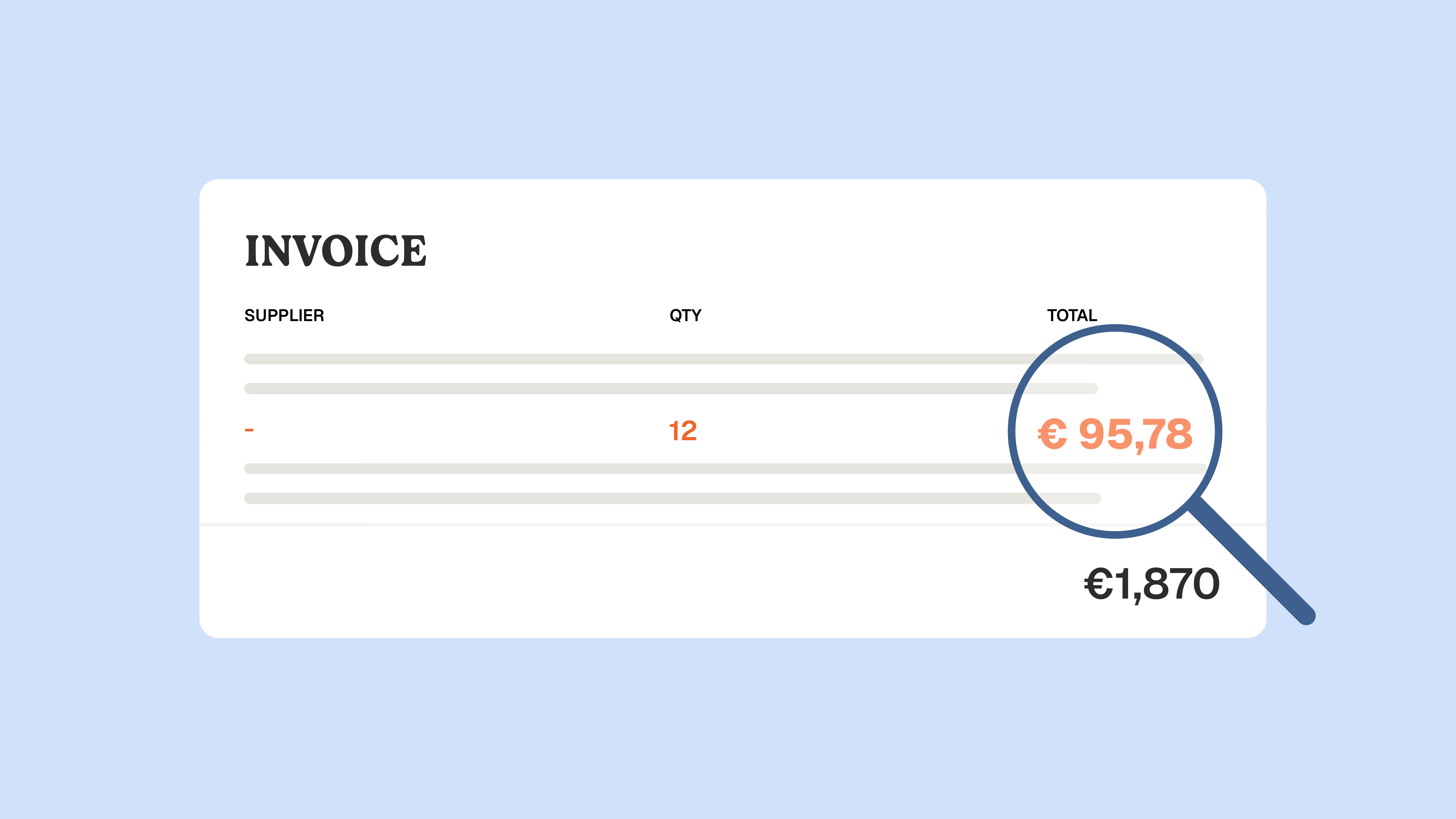
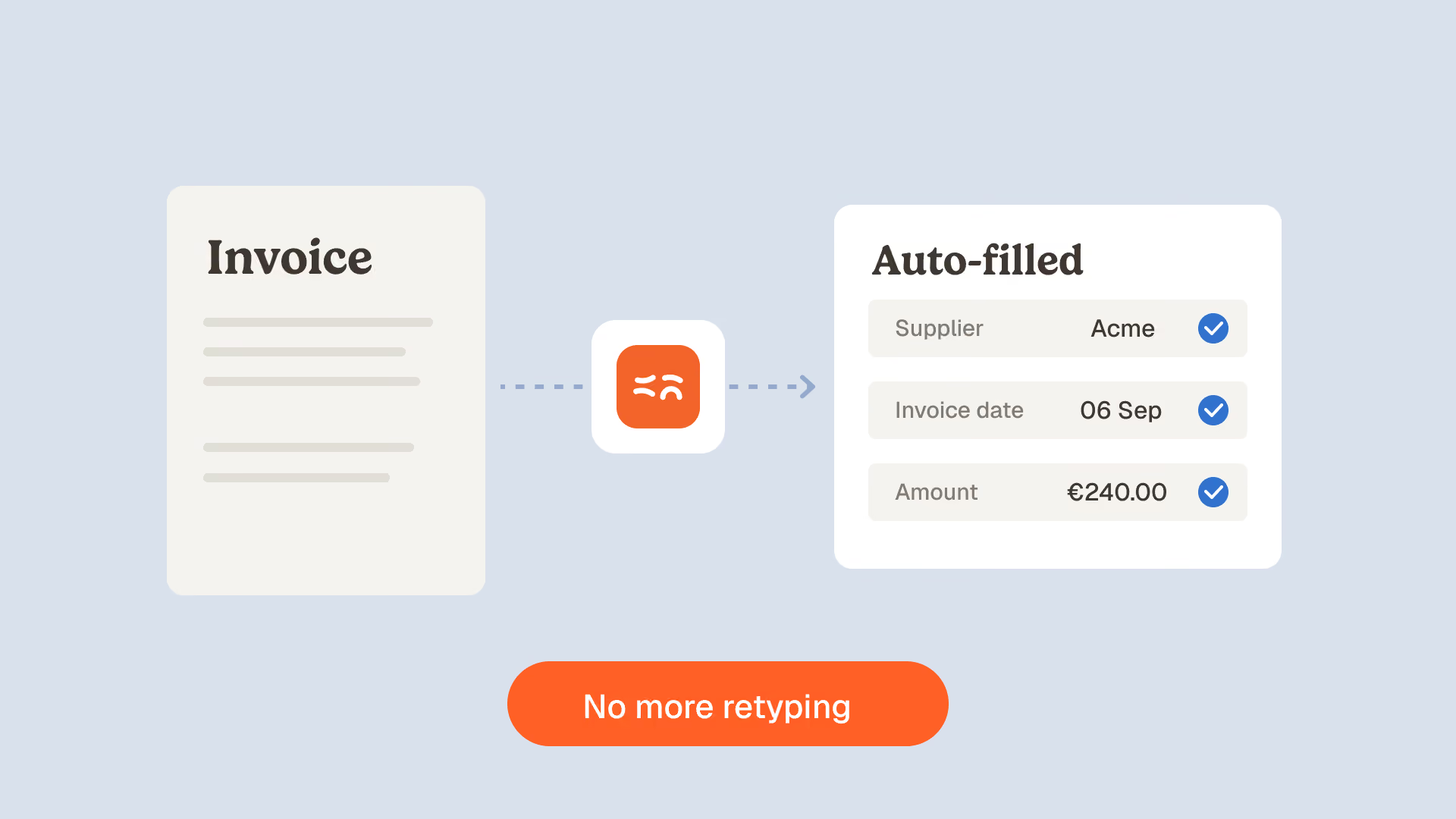
A finance team used to be a list of people on an org chart. In 2026, that definition is incomplete. At a 200-person hospitality group, invoices still arrive by email, prices still drift away from negotiated rates, and the month-end close still runs late. What changed is who does the first pass. A specialized AI agent now reads every supplier invoice, checks each line against the negotiated price, and flags the gaps before payment. The finance professional reviews the exceptions instead of typing the data.
That shift has a name, and most published definitions miss it.
What is a finance workforce?
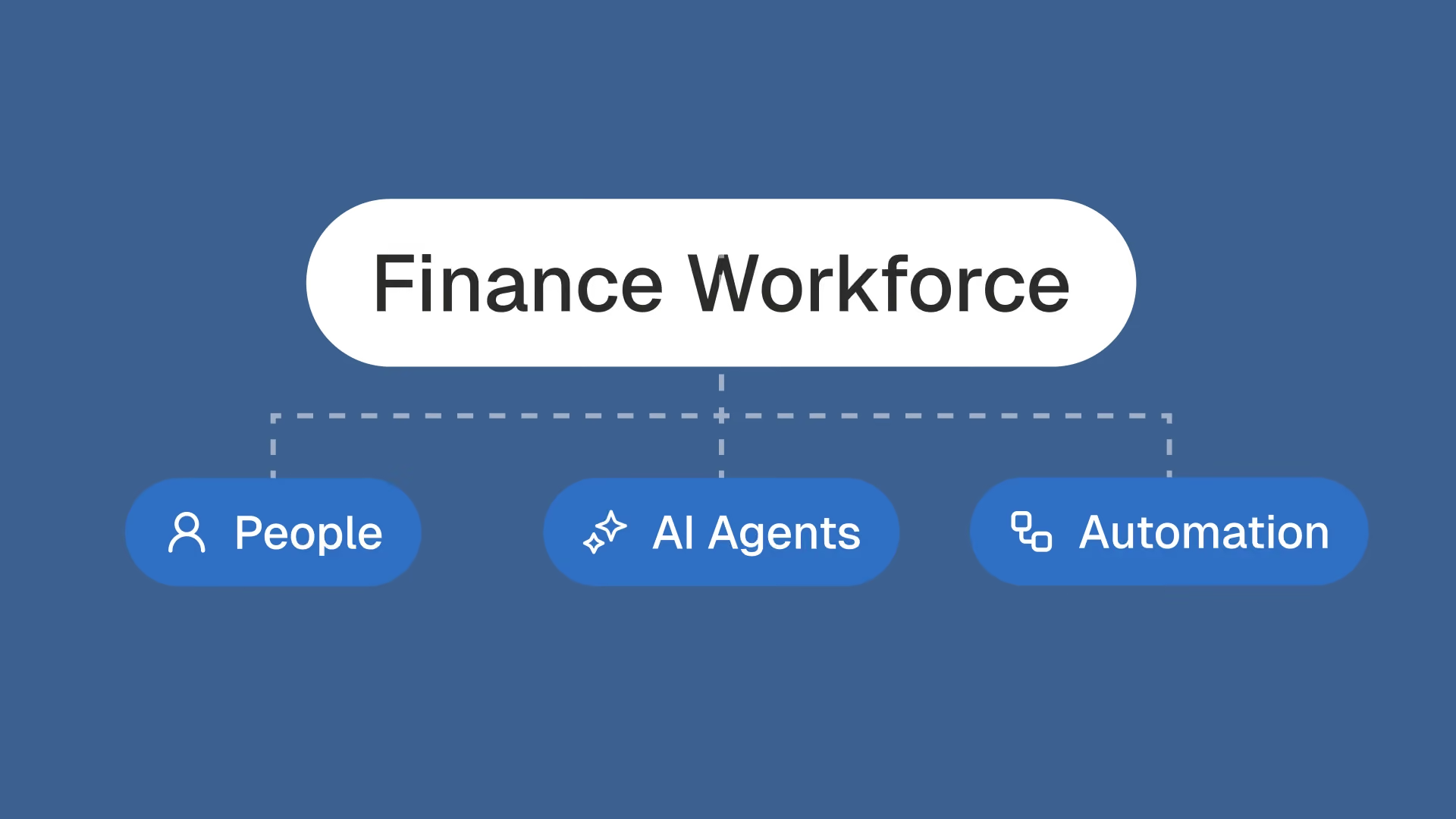
A finance workforce is the full set of resources that carries out a company's finance work: recording transactions, controlling data, reconciling flows, closing the books, and reporting. In 2026, that workforce is hybrid. It combines human finance professionals who decide, judge, and own outcomes, with specialized AI agents that execute the repetitive, data-heavy work at scale.
For most of accounting's history, "finance workforce" meant only people: accountants, controllers, treasurers, a CFO. The modern definition adds a second layer. AI agents now sit alongside the team and handle the structuring, matching, and analysis of financial data. The humans stay accountable. The agents do the volume.
This is the distinction that separates a useful definition from a vague one. Most articles on the "finance workforce" treat it as a talent and culture topic: skills gaps, retention, engagement. Those matter. But they describe the human half only. The defining change of the AI era is that the workforce itself now includes non-human members.
How is the finance workforce changing in the AI era?
The finance workforce is moving from a single-layer model (people doing tasks) to a two-layer model (people directing work, agents doing tasks). The human role shifts from processing data to reviewing exceptions and making decisions.
Three forces are pushing this change at once:
- A talent squeeze. More than 300,000 US accountants and auditors have left the profession in recent years, and fewer students are entering it. The work that drove them away, repetitive data entry and reconciliation, is exactly what agents absorb.
- A maturity jump in AI. Agents are no longer chatbots that wait for prompts. They observe financial data, reason through a task, and take action across systems, such as reading an invoice, matching it to a purchase order, and routing an exception.
- Pressure on the close and on control. Finance leaders consistently want a faster, cheaper, error-free close. A hybrid workforce is how they get there without doubling headcount.
The result is not a smaller finance team. It is a finance team that spends its time differently. The RAF no longer keys in invoices. The RAF reviews the alerts the agent raised.
What is the difference between human work and AI agent work in finance?
In a hybrid finance workforce, humans own judgment, context, and accountability. AI agents own volume, speed, and consistency. Neither replaces the other. The agent proposes, the human disposes.
The clearest way to see the split is side by side.
The principle behind the table matters more than any single row. An agent should never produce an answer without a source. Every output it generates traces back to audited data, which is what makes the human review fast and the result defensible. This is the difference between automation you trust and automation you have to double-check. You can read more in our glossary entry on human-in-the-loop control.
Why do most finance AI projects fail to deliver ROI?
Most finance AI projects underdeliver because they add a generalist tool to the workflow without giving it the company's context, the ability to act across systems, or an audit trail. The technology works in a demo and stalls in production.
The numbers are blunt. Gartner's 2025 research on AI in finance, widely cited across the field, found that roughly 59% of finance teams use AI while around nine in ten report low or only moderate impact. Deloitte's CFO research points to part of the reason: organizations direct close to 93% of their AI budget to technology and only about 7% to people and process. The tool gets bought. The workflow never gets rebuilt around it.
There is a deeper, structural reason too. As Arm's CFO put it at an MIT Sloan CFO summit, finance is deterministic while large language models are probabilistic. Finance has one right number. A general model returns the most likely number. For a marketing draft, likely is fine. For a payment run or a close, likely is a liability.
This is where the choice of workforce member decides the outcome.
General assistants like ChatGPT and Claude are remarkable tools, but they do not know your suppliers, your price references, your accounting rules, or your ERP. They do not produce an audit trail. They do not connect to your mailbox or your SFTP. And they were not built on real finance deployments. A specialized AI agent for finance is. That is why one delivers ROI in production and the other delivers a good demo.
What does an AI agent actually do inside a finance workforce?
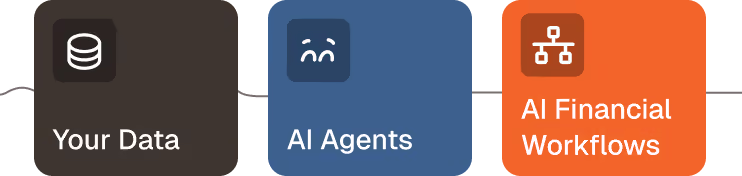
A finance AI agent performs a complete job, not a feature. It follows three steps: it structures raw documents and data into auditable tables, it controls and reconciles every flow against a reference, and it surfaces the result as analysis. Structure, match, analyze.
That sequence is concrete, not abstract. Here is what it looks like for three common agents:
- An invoice inbox agent reads every supplier invoice that lands in a shared mailbox, extracts the lines, standardizes them, and routes anything unusual. This is accounts payable automation that starts the moment an email arrives.
- A price control agent checks each invoice line against the negotiated rate card and alerts before payment when a price drifts. At Astotel, a group of 18 Parisian hotels, this kind of agent surfaced around 400 euros of billing errors per month on a single supplier, close to 5,000 euros a year. See the Astotel deployment.
- A reconciliation agent matches payments to invoices and bank lines, then explains its reasoning at each step. At Smartbox, an EU gift-box leader with 800 employees, payment and invoice reconciliation reached four times the previous productivity. See 3-way matching and cash reconciliation.
In each case the agent does the volume and shows its work. The finance professional checks the exceptions and signs off. That is a finance workforce doing more with the same headcount, with more control rather than less.
What roles make up a modern hybrid finance workforce?
A hybrid finance workforce keeps every traditional finance function and pairs each one with the agents that absorb its repetitive work. The human still owns the function. The agent handles the throughput.
The mapping is not theoretical. It mirrors how finance work is actually organized, from finance leadership and financial control to accounting, treasury, and procurement. The agents change what each role spends its day on, not the role itself.
How do you build an AI finance workforce?
You build a finance workforce of agents the way you would onboard a new hire: start with one clear job, prove it in production, then expand. The fastest teams get a first agent live in under two weeks.
A reliable sequence looks like this:
- Start where the pain is tangible. Pick one repetitive, high-volume job, usually invoice intake or a reconciliation. This gives a fast, visible return and a short time to value.
- Anchor on control before reporting. Make the data reliable first. Dashboards built on unverified data have no value. Reliability and control are the foundation, analysis comes after.
- Keep a human in the loop. Route exceptions to the team and let the agent handle the clean cases. Trust grows as the confidence score proves out.
- Expand to adjacent jobs. Once one agent is trusted, add the next: payables, then bank reconciliation, then closing controls.
- Standardize what works. Turn a proven workflow into a repeatable process so the whole team benefits, not just one analyst.
Phacet's catalog reflects this path. It holds more than 40 ready-to-use agents for finance work, built on more than 100 real production deployments, hosted in Europe on AWS with ISO 27001 certification and GDPR compliance, and with client data never used to train the models. The platform is what keeps those agents reliable, controllable, and auditable in production.
Is AI replacing the finance workforce?
No. AI is changing what the finance workforce does, not removing it. Agents take over repetitive, error-prone tasks so finance professionals can move to analysis, control, and decisions. The accountable human stays in place.
The fear of replacement is understandable, and it is the wrong frame. A finance professional whose day was 80% data processing does not lose their job when an agent takes the processing. They get the 80% back to spend on the work that needs judgment: explaining a variance, challenging a supplier, advising the CEO. The role moves up, not out.
This is the practical meaning of a hybrid finance workforce. The agent proposes, the human disposes. The team becomes faster and more reliable, and the people in it do work that is harder to automate and more valuable to the business. To see the agents that make up this workforce, explore the Phacet agent catalog or book a demo.
FAQ
What is the difference between a finance workforce and a finance team?
A finance team usually refers to the people in the finance function. A finance workforce, in 2026, refers to the full capacity that does the work, which now includes both those people and the AI agents that execute repetitive tasks alongside them.
Is agentic AI in finance and accounting different from a chatbot?
Yes. A chatbot waits for a prompt and answers. An agentic AI in finance observes data, reasons through a multi-step job, and takes action across systems, such as reading an invoice, matching it to a purchase order, and routing an exception for review.
What are examples of AI agents in a finance workforce?
Common examples include an invoice inbox agent for accounts payable, a supplier price control agent, a bank reconciliation agent, an intercompany matching agent, and a closing control agent. Each performs a full job and traces its output to audited data.
What does AI mean for a CFO?
For a CFO, AI means the finance function can scale without the cost of control scaling with it. A hybrid workforce delivers a faster close, more reliable numbers, and a team focused on analysis, which lets the CFO act as a strategic partner rather than a scorekeeper.
How quickly can a company deploy AI agents in finance?
A first agent can be live in production in under two weeks when the team starts with one clear, high-volume job and keeps a human reviewing exceptions. Expansion to adjacent jobs follows once the first agent is trusted.

Latest Resources

Unlock your AI potential
Go further with your financial workflows — with AI built around your needs.


