

Month-end close automation: a solo finance lead's guide
Published on :
June 8, 2026

Nicolas Marchais is co-founder and CEO of Phacet. After seven years at Spendesk, he built Phacet as the agentic layer that orchestrates across ERP, banking and email systems. Reliable, auditable, cross-system, what he calls a Finance Workforce.

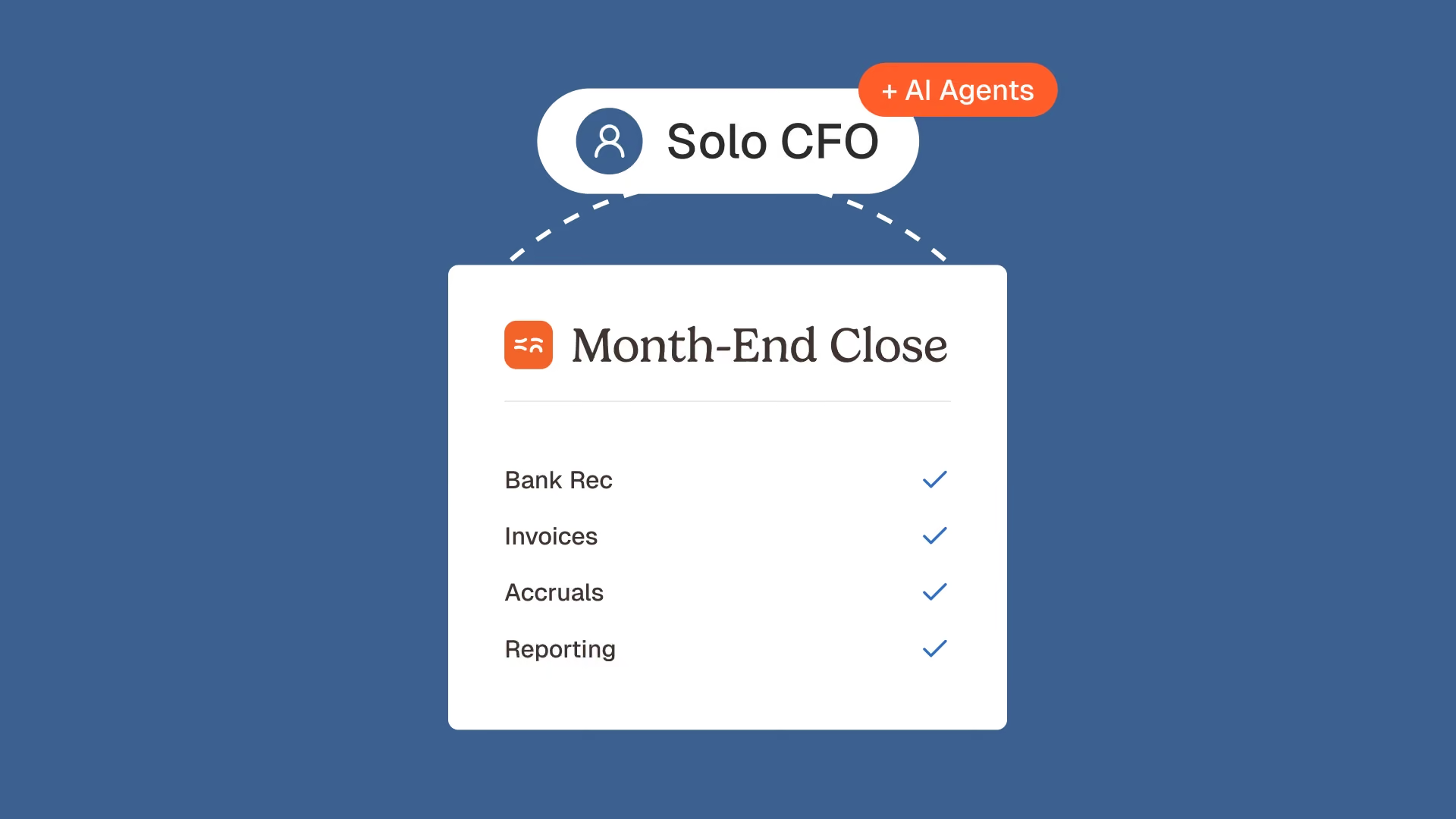
If you run finance alone, the close is the week that tests you. One person reconciles the bank, chases the missing invoices, posts the accruals, explains the variances, and signs off, all against a deadline the board does not move. Month-end close automation changes that equation by putting AI agents on the repetitive work, so the one job that stays human, the sign-off, becomes the only thing you actually do.
This guide is written for the solo finance lead: the single DAF, RAF, or Head of Finance carrying the books for a company of 50 to 500 people, often in food and beverage, hospitality, or retail. Not a ten-person team. Not a fractional CFO with five SaaS clients. You.
Quick answer: Month-end close automation uses AI agents to execute the manual steps of the close (reconciliations, supplier invoice control, accruals, variance analysis, audit file prep) and surface only the exceptions that need your judgment. For a solo finance lead, the value is not just a faster close. It is a close you can trust because the underlying data was controlled during the month, with a full audit trail behind every figure.
What is month-end close automation?
The month-end close is the set of steps a finance function runs to reconcile accounts, validate transactions, and produce accurate financial statements at the end of each period. It is one of the most important workflows in any company, and for most SMEs it still runs on spreadsheets, email threads, and late nights.
Month-end close automation is the practice of handing those repetitive steps to software so the books close faster, with fewer errors and a clear trail of evidence. The newest layer of that practice is the AI agent: a specialized program that does not just move data between systems like older automation, but reads documents, reconciles flows, drafts entries, flags anomalies, and explains its reasoning before a human approves the result.
The difference matters. Classic automation follows a fixed script. An AI agent works at the transaction level, adapts to your patterns, and escalates the cases that need you, which is exactly where a solo finance function loses its evenings.
Why the solo finance lead runs the hardest close of all
Most content on closing automation is written for the wrong reader. It speaks to multi-entity accounting teams with a controller, a manager, and three analysts, or to fractional CFOs serving tech startups. The person actually drowning in the close is rarely addressed: the one finance person inside a growing non-tech SME.
That close is the hardest version of the job for three reasons:
- No second pair of hands. Every reconciliation, every chase, every accrual lands on one desk. There is no one to delegate the mechanical work to, so the strategic work waits.
- Real-world complexity, lean tooling. A multi-site restaurant group or retailer juggles POS revenue, delivery platforms, supplier invoices, multiple bank accounts, and cash takings, with an ERP that records but does not control.
- Personal accountability. When the CEO asks whether the numbers are right, the solo lead answers alone. A late close is stressful. A wrong close is a credibility risk.
The teams that build closing software know this gap exists, yet they keep selling to the team, not the individual. For the solo finance lead, see how Phacet frames the role on the Finance Leadership page.
Speed is the wrong goal: control the data during the month
Almost every tool promises the same thing, close faster. For a solo finance lead, speed alone is a trap. A close that finishes in two days on data nobody verified is not an achievement, it is exposure.
The better goal is a trustworthy close, and trust is not built in the final week. It is built across the month. This is where continuous close control replaces the end-of-month sprint: agents check supplier prices, reconcile flows, and validate documents as transactions happen, so most of the work is already done and verified before the period even ends.
The principle behind Phacet is simple: your ERP records, but it does not control. The control layer is where errors are caught, and for a solo finance lead it is the single highest-value place to put an agent. Reliability first, reporting second. A dashboard built on unverified data only helps you make the wrong decision faster.
The month-end close, agent by agent
Here is the part no generic guide gives you: the close broken into concrete steps, each mapped to an AI agent and grounded in the reality of a goods-and-flow business. The table below is the operational core of this guide.
Step 1: Bridge revenue from POS and platforms to the ledger
For a restaurant group, a retailer, or a hotel, revenue does not arrive as one clean line. It comes from POS terminals, delivery platforms, and card processors, each with its own format and its own timing. An agent can bridge your POS revenue to accounting automatically, mapping every channel to the right account before the close begins.
Step 2: Reconcile bank, cash, and card flows
Reconciliation is the work that eats the solo close. Agents reconcile bank transactions and detect unmatched flows and reconcile cash takings against reported revenue, matching the straightforward items and escalating only the exceptions. You stop comparing rows and start investigating the handful that genuinely need a human.
Step 3: Control supplier invoices before they hit the GL
Errors in supplier billing are silent margin leaks, and they are easiest to catch before payment, not after close. An agent that can control supplier billing and reduce overpayments verifies each invoice line against agreed terms. At Astotel, a group of 18 hotels, this approach surfaced roughly €400 of billing errors per month on a single supplier, close to €5,000 a year.
Step 4: Post accruals and handle cut-off
Accruals and cut-off are where a close goes wrong quietly. Agents can automate revenue recognition and cut-off and reconcile balance sheet accruals against HR and payroll, drafting recurring entries from prior-period logic so you review rather than rebuild.
Step 5: Explain the variances
Leadership does not want a number, it wants to know why the number moved. An agent that can track budget versus actual variances flags material movements and drafts the narrative, turning hours of manual flux analysis into a review task.
Step 6: Build the audit file
The last mile of trust is evidence. An agent that can prepare your audit file automatically assembles the supporting documentation as the close runs, so what you hand an auditor or your accountant is ready, not reconstructed weeks later. Every step lives inside the Closing and Audit category of the Phacet catalog.
How AI agents keep a close trustworthy
Automating the close is only useful if the result holds up to scrutiny. Three things make the difference between a clever demo and a close you can sign.
First, every action is traceable. A native audit trail records what was done, by whom or which agent, and when, so each figure traces back to its source. Second, the human stays in control: the AI proposes, you approve. Agents surface exceptions and reasoning, you make the call, which is the human-in-the-loop principle that keeps accountability where it belongs. Third, the work is finance-specific, not generic.
This is the honest line on general tools: ChatGPT and Claude are remarkable generalists, but they do not know your suppliers, your price lists, your accounting rules, or your ERP. They do not produce an audit trail, they do not connect to your bank feed, and they were not trained on a hundred real finance deployments. A close needs a specialist, in production.
What this changes for a solo finance lead
Strip away the technology and the change is human. The work shifts from doing the close to overseeing it.
- Operationally, the reconciliation hours disappear. You handle alerts, not rows.
- Emotionally, when the CEO asks if the numbers are right, you have the answer, with the evidence behind it.
- Strategically, finance scales with the business without the control cost exploding, which is the difference between a function that grows and one that hires to survive.
The proof is in companies that look like yours. At La Nouvelle Garde, a group of ten brasseries, agents recovered around two days a week and let the team defer hiring. At The French Bastards, the store count doubled without adding a single finance hire. At Astotel, the purchasing director put it plainly: she now spots errors she would never have caught on her own. That is what scaling finance without hiring looks like in practice.
How to start in under two weeks
You do not automate the whole close on day one. The fastest path for a solo lead is to pick the single most painful step, usually reconciliation or supplier control, and put one agent on it.
- Choose one process. Take the task that costs you the most evenings and start there.
- Run it in real conditions. Let the agent work your actual data, with your sign-off on every output.
- Measure and expand. Track days to close, hours per cycle, and errors caught, then add the next agent.
Phacet was built on this approach: more than 40 ready-to-use agents, refined across 100+ real finance deployments, with the first agent typically in production in under two weeks. Plans start from €299 per month. If you want to compare the manual close with the automated one before you commit, the next section lays it out, and you can see the wider picture of financial close automation from J15 to J5.
Frequently asked questions
How long does it take to automate the month-end close?
You can have a single agent live in under two weeks by starting with one high-impact step, such as bank reconciliation or supplier invoice control. A full close is automated step by step, not in one project, so value arrives in the first cycle rather than after a long implementation.
Can a one-person finance team really automate the close?
Yes, and the solo finance lead is the clearest case for it. Agents take the mechanical work that has no one to delegate to, leaving the individual to review exceptions and sign off. The result is closer to having a tireless assistant than to running an enterprise software project.
Do AI agents replace the accountant or controller?
No. Agents execute the repetitive work and propose results, but a human approves every output. The role shifts from manual processing to oversight and analysis, which is why finance teams describe the change as augmentation, not replacement.
Is an AI-automated close auditable?
It should be, and that is the point. A trustworthy close runs on a native audit trail that records every action and links each figure to its source. Without that trail, faster is not safer. With it, the close you sign is the close you can defend.
What is the difference between RPA and AI agents for the close?
RPA follows a fixed script and breaks when the input changes. AI agents work at the transaction level, adapt to your patterns, read unstructured documents, and explain their reasoning. For the variability of a real close, that adaptability is the difference between automation that helps and automation that needs constant babysitting.
The close you can sign, alone
The solo finance lead does not lack tools. The lead lacks hands. AI agents are those hands: they reconcile, control, and assemble the evidence, while you keep the one part of the job that was always yours, deciding the numbers are right and putting your name to them.
Start with one process, control the data through the month, and let the close become the calmest week of your month instead of the hardest. Explore the Phacet product or book a demo to see the agents run on your own data.


Latest Resources

Unlock your AI potential
Go further with your financial workflows — with AI built around your needs.


