

Account reconciliation software for multi-entity SMEs
Published on :
July 20, 2026

Nicolas Marchais is co-founder and CEO of Phacet. After seven years at Spendesk, he built Phacet as the agentic layer that orchestrates across ERP, banking and email systems. Reliable, auditable, cross-system, what he calls a Finance Workforce.

Account reconciliation software is a financial control tool that automatically matches transactions across your bank statements, ERPs, and subledgers, then flags every discrepancy before it reaches your financial statements. For a single-entity business, that job is mostly about closing faster. For a company that has grown into several legal entities, it becomes something harder: knowing that your consolidated numbers are true when your books span multiple sites, currencies, and accounting systems.
That is the gap this guide addresses. Most reconciliation content splits the market in two: small businesses that reconcile a bank account inside QuickBooks or Xero, and large enterprises that run a six-figure platform to consolidate hundreds of entities. The multi-entity SME sits in between, and almost nobody writes for it. If you run finance for a holding with three to eight operating entities and a team of one to three people, you are the reader we had in mind.
What is account reconciliation software?
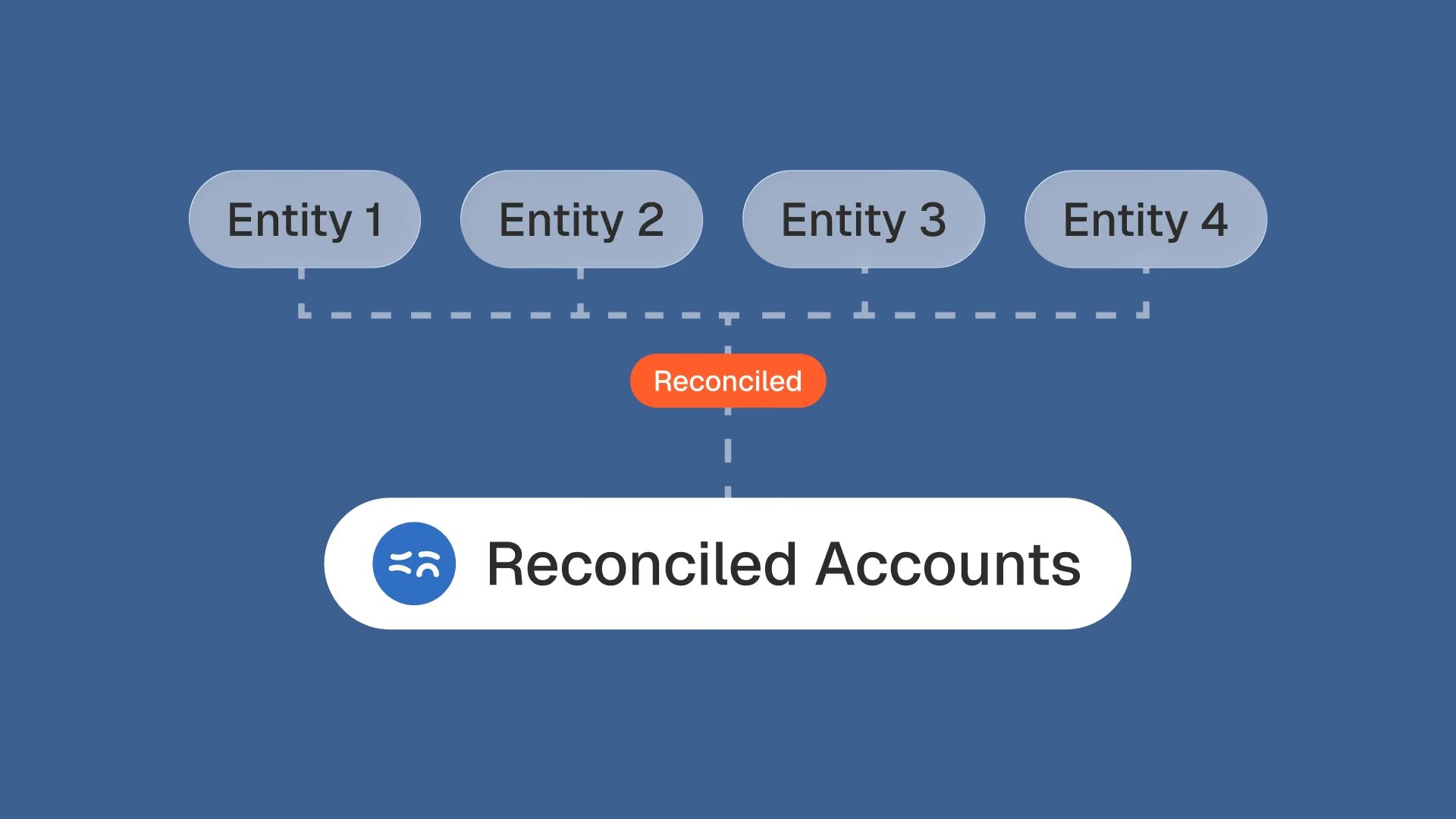
Account reconciliation software compares your internal financial records against external and cross-system sources (bank feeds, payment processors, ERPs, subledgers), matches what agrees, and isolates what does not. Instead of scanning spreadsheets line by line at month-end, your team reviews only the exceptions the software could not resolve on its own.
The core capabilities are consistent across tools: automated transaction matching, exception handling, a native audit trail, and integrations that pull data in without manual re-entry. The differences show up in depth: whether the tool reconciles a single bank account or the whole balance sheet, whether it connects at transaction level or only at trial-balance level, and whether it can reach across several systems or assumes one clean ERP.
Reconciliation is a control, not just a close accelerator
Here is the framing shift that matters for a multi-entity SME. The entire software category is sold on speed: close faster, cut days off the cycle, get audit-ready sooner. Speed is real, but it is not the point of reconciliation. The point is control.
Three-way matching tells you the invoice matches the order. It does not tell you the order was priced right. Reconciliation, done properly, is the layer that verifies your data is trustworthy before money moves and before numbers get consolidated. When you operate several entities, an untrusted intercompany balance or an unreconciled cash account does not just slow your close, it distorts the picture the whole group reports. That is why we treat reconciliation as an internal control first and a close accelerator second.
Why multi-entity SMEs are the segment reconciliation software forgets
Read any buyer's guide and you will see the same split. Under 50 employees, you are told to stay on your ERP's built-in bank reconciliation. Multiple entities, and you are pointed at enterprise platforms built for companies above 100 million dollars in revenue, with four to eight month implementations and a dedicated administrator to keep them running.
Neither fits the multi-entity SME. You have outgrown a single QuickBooks file: you now have a holding, a few operating companies, maybe an acquired entity on a different accounting system, and intercompany flows nobody fully reconciles. But you cannot absorb a six-figure implementation or hire an admin whose only job is to maintain reconciliation software. The market treats "multi-entity" as a synonym for "enterprise", and that assumption leaves you unserved.
The cost of that gap is concrete. Intercompany mismatches accumulate, cash accounts drift, and every consolidation carries a quiet question mark. Industry surveys keep flagging the root cause: the IMA's 2025 Finance Technology Survey found that 58% of finance professionals rated their organization's ERP data as inconsistent or unreliable in at least one material dimension. In a single-entity business that is an annoyance. Across several entities it is a control problem.
The reconciliations a multi-entity SME actually struggles with
Enterprise buyer's guides frame reconciliation as a balance-sheet and general-ledger exercise for the close. That is only half your reality. The reconciliations that break in a goods-heavy, multi-site SME are operational and cross-system, and they happen well before the close. They are the ones that decide whether your revenue, your cash, and your intercompany positions are real.
The table below maps the reconciliations a multi-entity SME faces to the specific job each one solves. Every row is a place where data from two systems has to agree, and where a mismatch means real money or a distorted number.
Two of these deserve a closer look because they are unique to running several entities.
Intercompany flows. When your entities trade with each other, every internal invoice has to match on both sides of the group. Left manual, intercompany reconciliation is where the most consolidation errors hide. Automating it with a dedicated intercompany reconciliation job means the group balances tie out before you consolidate, not after an auditor finds the break.
Multiple ERPs. A multi-entity SME rarely runs one clean system. One entity is on Pennylane, another on Sage, an acquired one still on its legacy tool. Enterprise reconciliation platforms assume a single trial balance, so they struggle here. The work is to consolidate data from multiple ERPs into one auditable view before you even start matching, which is a cross-system problem, not a close problem.
What to look for in account reconciliation software for multiple entities
Once you accept that your problem is control across systems rather than speed within one ledger, the buyer criteria change. These are the ones that actually separate tools for a multi-entity SME.
- Transaction-level integration, not trial-balance only. Many well-known platforms connect only at trial-balance level, which sends your team back to spreadsheets to investigate a break. You want to drill from a discrepancy straight to the underlying transaction, in the software.
- Cross-system reach. The tool has to reconcile between heterogeneous sources (several ERPs, bank feeds, POS, payment processors), not assume one clean system. This is the single most common failure point for multi-entity SMEs.
- Native intercompany handling. Matching flows between your own entities should be a built-in job, not a manual workaround.
- A native audit trail. Every match, every exception, every sign-off traced and timestamped, so the control is provable, not just performed.
- Time-to-value in weeks, not quarters. A four to eight month rollout with a dedicated admin is an enterprise cost you should not have to pay. Look for production use in weeks.
- Pricing that does not scale per entity into enterprise territory. Adding an entity should not trigger an enterprise contract.
Weigh those against the honest question behind the purchase: does the tool make your consolidated numbers more trustworthy, or does it just close the same books faster?
Single-entity, multi-entity SME, or enterprise: which tier fits you
Matching a tool to your situation is mostly about matching it to your entity structure and team size, not to a feature list. The three tiers below describe who each class of tool actually serves, so you can place yourself before you shortlist vendors.
If you are single-entity, the built-in bank reconciliation in your accounting software is usually enough until manual work creates real bottlenecks. If you are a genuine enterprise with dozens of entities and a SOX mandate, a platform like BlackLine or OneStream is built for you, and the implementation cost is justified. The multi-entity SME is the tier where the standard advice breaks, and where a control-first, cross-system approach earns its place.
How Phacet approaches multi-entity reconciliation
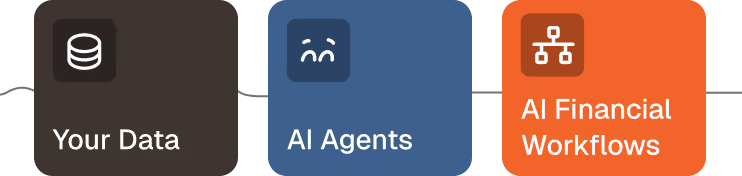
Phacet is a catalog of AI agents for finance work, each one built to run a specific job in production. Rather than a single monolithic platform you configure for months, you activate the agent that matches the reconciliation you need, and it structures, matches, and surfaces the result on data you can audit.
The job comes first. Reconciling intercompany flows, reconciling a payment gateway against bank and ERP, controlling POS cash across all your sites: each is a ready-to-use agent, not a project. Under each one, three steps run in order. The agent structures your documents and flows into an auditable table. It matches them using AI Match, a semantic matching engine that reconciles even when references do not line up perfectly, and it explains its reasoning. Then it surfaces the exceptions and anomalies your team needs to act on, with the source of each one one click away.
What makes it hold in production is the control layer underneath: a native audit trail on every decision, a detail view down to the individual transaction, and a human-in-the-loop model where the agent proposes and your team disposes. That is the difference between a tool that closes faster and one that makes your numbers trustworthy across entities.
The economics fit the SME, not the enterprise. Phacet agents reach production in under two weeks, with no dedicated administrator, starting well below the entry point of legacy platforms. The proof is in production: Astotel recovered 5,000 euros a year of supplier-billing errors on a single supplier through line-level control, and Smartbox multiplied its three-way matching productivity by four. Across 100+ deployments, the pattern is the same: control the data first, and the faster close follows.
If your consolidated numbers depend on entities and systems that never fully reconcile, that is the exact gap Phacet was built to close. You can explore the agent catalog or book a demo to see it run on your own reconciliations.
Frequently asked questions
What is account reconciliation software?
Account reconciliation software automatically compares internal financial records against external and cross-system sources like bank statements, payment processors, ERPs, and subledgers. It matches what agrees, flags discrepancies, and maintains an audit trail, so your team reviews only the exceptions instead of scanning every line by hand.
Do multi-entity SMEs need dedicated reconciliation software, or is QuickBooks or Xero enough?
Built-in bank reconciliation in QuickBooks or Xero is designed for single-entity, cash-account matching. Once you run several entities with intercompany flows and more than one accounting system, that scope no longer covers you. You need a tool that reconciles across systems and handles intercompany matching, without jumping straight to an enterprise platform priced for companies ten times your size.
What is intercompany reconciliation?
Intercompany reconciliation is the process of matching transactions between entities that belong to the same group, so that each internal invoice or transfer agrees on both sides before consolidation. It is one of the most error-prone reconciliations for multi-entity SMEs, and one of the highest-value to automate, because unmatched intercompany balances distort the numbers the whole group reports.
How does account reconciliation software handle multiple ERPs?
Enterprise platforms usually assume a single ERP and a single trial balance. A cross-system tool instead consolidates data from several ERPs into one auditable view before matching, which is what a multi-entity SME running different systems per entity actually needs. This lets you reconcile across a mix of tools like Pennylane, Sage, or a legacy system from an acquisition.
How long does account reconciliation software take to implement?
It varies widely. Enterprise close platforms commonly take four to eight months and require a dedicated administrator. Modern, cross-system tools reach production in weeks. For a multi-entity SME, implementation speed and low administrative overhead usually matter more than the depth of enterprise features you will never use.
Is reconciliation only about closing faster?
No. Speed is a benefit, but the real purpose of reconciliation is control: verifying that your data is trustworthy before money moves and before numbers get consolidated. For a multi-entity SME, an untrusted intercompany balance or an unreconciled cash account distorts group reporting, which is a control problem, not just a slow close.

Latest Resources
Unlock your AI potential
Go further with your financial workflows — with AI built around your needs.


