Finance team scalability without hiring: how to decouple volume from headcount
Published on :
May 11, 2026

Nicolas Marchais is co-founder and CEO of Phacet. After seven years at Spendesk, he built Phacet as the agentic layer that orchestrates across ERP, banking and email systems. Reliable, auditable, cross-system, what he calls a Finance Workforce.

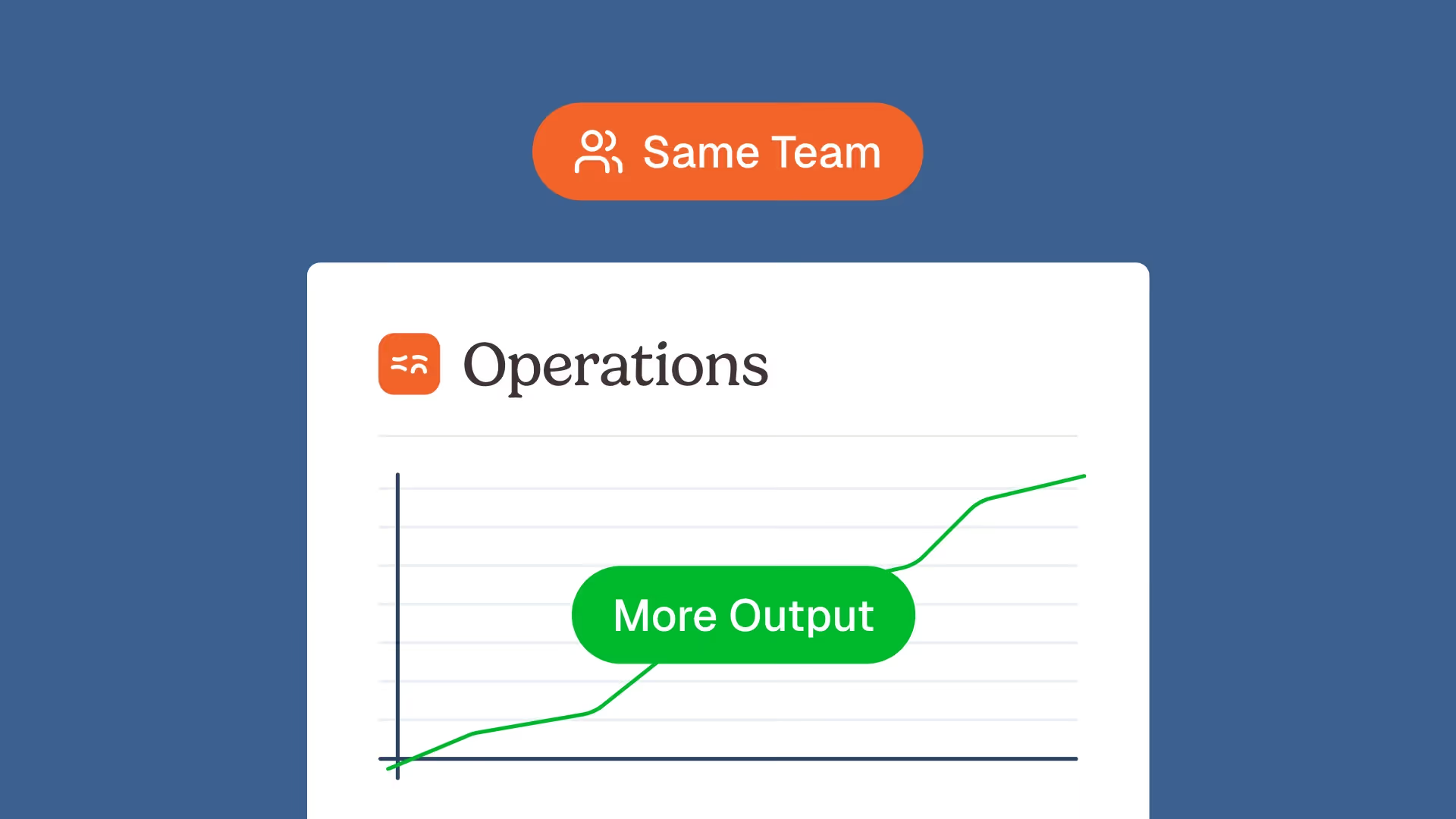
Astotel runs financial operations across 18 hotels with a finance team that would have needed proportional growth a decade ago. The French Bastards absorbed the doubling of their boutique count from 7 to 14 sites without adding a single person to the finance team. The pattern is not "they worked harder." It is structural: the work that used to scale with volume now scales independently of it, because most of it is no longer done by people.
The benchmark behind this gap is concrete. APQC's Finance Organization Open Standards Benchmarking survey of 1,784 organizations found the top-quartile finance functions operate with 36 FTE per $1 billion in revenue, while bottom-quartile ones operate with 141 FTE per $1 billion. That is a nearly fourfold spread, which translates to hundreds of people and millions in cost per year for a single business. The difference between the two quartiles is rarely effort, talent, or budget. It is the composition of the work itself.
This article maps the seven shifts that move finance operations from linear scaling (headcount grows with volume) to sub-linear scaling (headcount stays flat while volume grows). Each shift corresponds to a category of work that compounds the wrong way under growth, and to a structural change that breaks the compounding. The first agent goes live in under two weeks. A meaningful composition shift takes one to three quarters.
Why "hire more" is the default and why it fails
The default response to finance volume growth is to add staff because the work feels linear. Each new invoice needs to be triaged. Each new vendor needs to be onboarded. Each new site needs to be reconciled. The work scales with transactions, so the team scales with transactions.
That logic holds for one category of work and not the other. Manual data entry scales 1:1 with volume: more invoices require more hours, which require more people. Agent-driven processing does not. The teams that have broken the linear curve have identified which operational tasks consume capacity in proportion to volume and structurally moved those tasks out of the human queue, leaving humans to do the work that genuinely needs human judgment.
A second piece of data sharpens the point. According to the IBM Institute for Business Value 2025 CEO Study, only 25% of AI initiatives have delivered expected ROI, and only 16% have scaled enterprise-wide. The implication: most teams that invest in finance automation never break the linear curve, because they automate one slice without reorganizing the work. Gartner reports that 57% of finance teams are implementing or planning agentic AI, but the bottleneck is not technology adoption. It is composition.
The shift this article proposes: stop asking "how do we add headcount efficiently?" and start asking "what fraction of our work has to be done by a human, and what fraction can be done by a system?" The second number is the lever. The first is the consequence.
The 7 shifts from linear to suib-linear scaling
Shift 1: from manual triage to agent-driven intake
Linear failure point: every email, every PDF, every supplier portal needs a human to open it, classify it, and route it. At 200 invoices a month, this is roughly 5 hours of work. At 2,000 a month, it is 50 hours, a near-full-time role. Each new site multiplies the volume proportionally.
Structural shift: an accounting inbox agent ingests, extracts, classifies, and routes every document automatically. The human role moves from "process every invoice" to "handle the exceptions." The processing capacity decouples from volume because the agent runs continuously, not on a controller's schedule. This is the first shift Phacet customers typically deploy, and it is in production in under two weeks.
Shift 2: from sample-based control to 100% coverage
Linear failure point: controls like 3-way matching, price variance, and duplicate detection run at human speed, so they run on samples. A controller can review 5% of invoices in detail. At 10x the volume, the controller still reviews 5%, but the absolute number of unchecked invoices grows tenfold. Risk grows linearly with volume even when the team size doesn't.
Structural shift: agents run controls on 100% of invoices, with exceptions routed to humans for adjudication. This is the control at scale principle: machine coverage replaces sample coverage, and humans see only what the agent flagged. The proof point at Astotel: the supplier billing control agent recovered roughly 5,000€ per year on a single supplier through line-by-line variance checks. As Valérie, the Head of Purchasing, puts it: "Je gagne jusqu'à deux jours par mois, et je repère des erreurs que je n'aurais jamais vues seule." That capability was not feasible at sample coverage. It is only feasible at full coverage.
Shift 3: from exception piles to exception routing
Linear failure point: exceptions (mismatches, missing data, unclear coding) accumulate in queues and surface at month-end, when one or two controllers absorb the entire backlog under deadline pressure. More volume means more exceptions, but they all arrive in the same compressed window. The peak load determines the staffing.
Structural shift: exceptions get routed in real time to the right resolver based on the type of issue, the responsible cost center, the supplier, or the missing piece of data. The pile disappears, the close timeline shortens, and the staffing equation decouples from the close window. This is what exception-based finance review means in production: small batches handled in flight, no end-of-month surge.
Shift 4: from compressed close to continuous close
Linear failure point: month-end close concentrates the work of 30 days into 5. The team is staffed for the peak, which means it is over-staffed for the trough or under-staffed for the peak (usually both, at different times of the month). Adding sites or entities raises the peak height, which raises the staffing required to hit the close deadline.
Structural shift: a continuous close flattens the curve. Reconciliations happen daily, accruals are progressive, variances surface in flight, and the close week becomes a packaging exercise rather than a discovery exercise. The team needed to hit a 5-day close on 18 hotels with continuous close is materially smaller than the team needed to hit the same close on 3 hotels with batch processing.
Shift 5: from data entry to data orchestration across systems
Linear failure point: finance teams spend a large fraction of their time moving data between systems. Email to AP tool. AP tool to ERP. ERP to BI. Card spend to expense tool to ERP. Each integration gap is a manual transfer, and each manual transfer scales linearly with the volume crossing the gap.
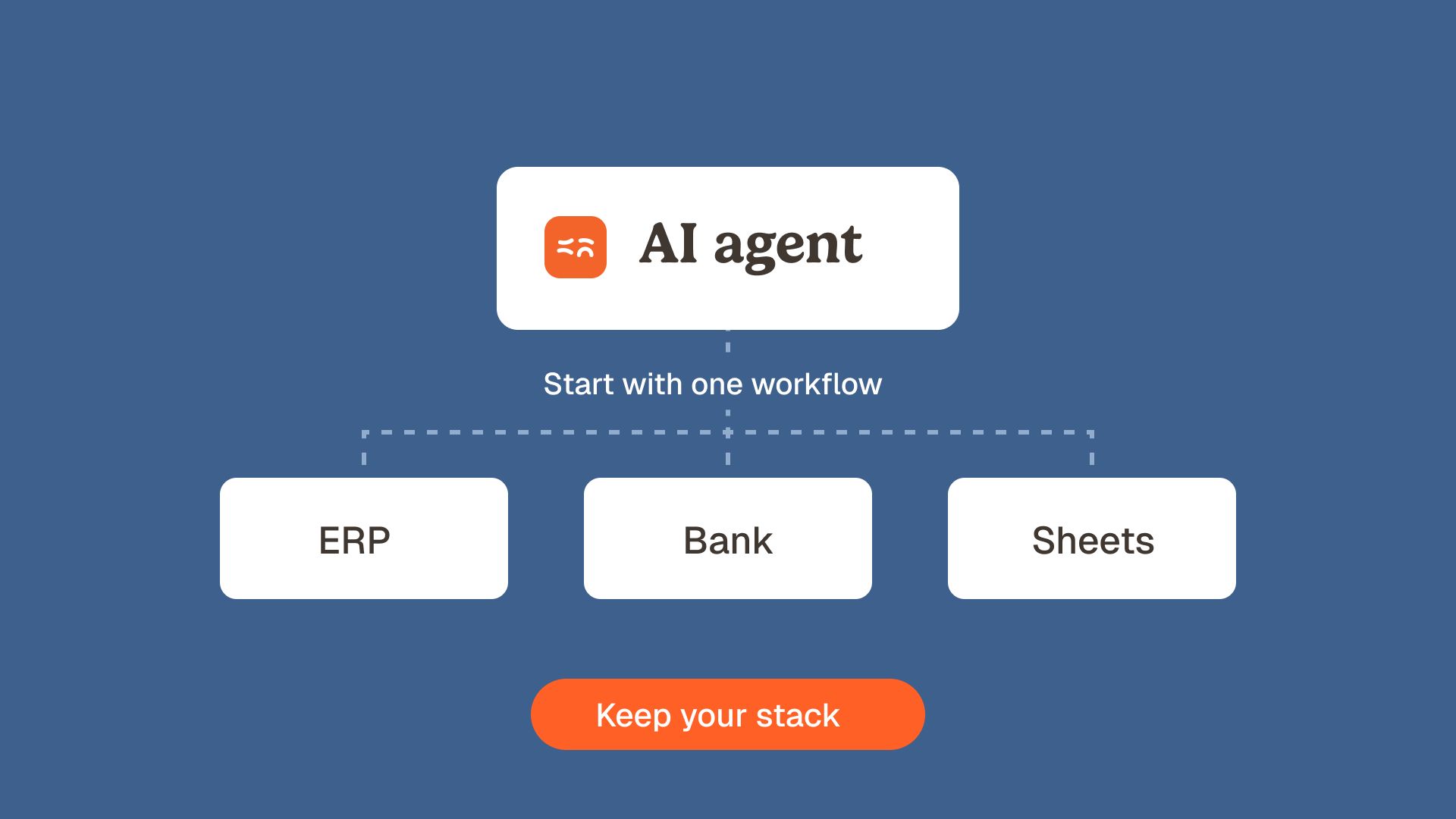
Structural shift: agents act as the orchestration layer between systems, moving data without human transcription. The supplier database stays clean and enriched continuously. ERP/CRM/billing consistency is verified in flight. The orchestration runs across the stack, which is exactly the multi-site finance control pattern that multi-entity businesses need to scale without adding finance hands at each site.
Shift 6: from "hire-the-next-controller" to standardize-the-current-work
Linear failure point: as the business grows, new entities, currencies, tax codes, and cost-center structures pile on. Each adds a layer of "how we do it here" that lives in a controller's head. When a new site opens or a new acquisition closes, the standard answer is "hire another controller who knows this layer."
Structural shift: the standardize and reclassify agent encodes coding rules, cost-center logic, and tax allocation policy directly into the workflow. New sites inherit the standard automatically. Acquisitions get integrated by configuration, not by hiring. The controller's role shifts from "apply the policy on every transaction" to "set the policy and audit the exceptions."
Shift 7: from transactional cost center to value-driver function
Linear failure point: when 80% of finance team time is spent on transactional work, every volume increment requires more transactional capacity. The function never gets to do what the business actually needs from it (planning, scenario modeling, strategic finance partnership, margin analysis) because there is no time left after the transactional load.
Structural shift: once shifts 1 through 6 are in place, the team's available time reallocates toward value-added work. This is not a productivity claim, it is a composition claim. The team is doing fewer hours of transactional work, so the same headcount has more capacity for analysis. This is the structural transition behind moving the finance function from cost center to value driver, and it is the third pillar of the Phacet triad: structurer, contrôler, exploiter (structure, control, leverage).
The capacity equation behind sub-linear scaling
Mapping these shifts back to headcount requires a simple equation:
Team size × Productive hours × Productivity rate = Output capacity
For a finance team of 8 working 40 hours a week at 70% productive time, that is roughly 224 productive hours weekly. If the operation requires 5 hours of human work per unit of output (one invoice fully processed end-to-end), the team handles about 45 units per week.
The seven shifts move the denominator. When 80% of invoices clear without human intervention, the hours per unit drops from 5 to closer to 1, and the same team can handle 5x the volume. That is the source of the spread between the APQC top quartile (36 FTE/$1B) and bottom quartile (141 FTE/$1B): the work composition is different, not the work effort.
The corollary is the inflection point. If the team is already at capacity and nothing shifts, the next volume increment forces hiring. If the shifts happen first, the same volume increment costs zero additional headcount. That is what operational scalability without headcount means in operational terms: the team's capacity grows faster than its size, because the work that consumes capacity moves out of the human queue.
Why most finance teams stay in linear mode
Every CFO recognizes this pattern. Most teams still operate in linear mode. Three structural reasons:
The automation paradox. Teams overwhelmed by manual processes lack the bandwidth to implement automation. The hire-now decision is fast: job posting, interviews, onboarding. The automation decision is slower: selection, integration, change management. Under deadline pressure, the fast decision wins, and the team falls deeper into linear mode.
Point tools automate one layer without breaking the linear curve. OCR speeds up extraction but leaves validation manual. Approval workflows speed up routing but leave exceptions manual. Each point tool delivers a productivity gain on one slice of work, but if the rest of the pipeline is still linear, the bottleneck just shifts. The cost curve doesn't bend until the full pipeline shifts.
Standardization is treated as a tooling problem. Teams adopt new tools without rebuilding the underlying work. New tools layer on top of old workflows, which means the old workflow constraints (human handoffs, manual reconciliations, exception piles) remain. The right order is standardize the work first, then layer the tool. The reverse order is why most automation programs fail to scale.
This is why the architectural difference between agentic platforms and traditional automation matters at the operational level. Rule-based RPA handles deterministic tasks well but breaks on edge cases, so the human team absorbs the residual. AI agents handle the semantic and contextual layer (matching when descriptions vary, coding when context shifts, reasoning when policy interpretation is needed), which is where the residual concentrates. Without that semantic layer, the cost curve doesn't fully bend, because the exception pile remains. The full distinction is mapped in our agents beyond RPA analysis.
How Phacet Agents Make Sub-Linear Scaling Concrete
The Phacet platform decomposes the seven shifts across specialized agents that share the same architecture: each agent structures the input (extracts and normalizes), controls against a reference (master, PO, contract, policy), then exposes its reasoning with a confidence score. Every step is timestamped in a native audit trail, which means the work is reliable, controllable, and auditable by design rather than as an afterthought.
The most relevant agents for the scaling problem:
- The accounting inbox agent covers shift 1: intake, classification, routing.
- The 3-way matching agent and supplier billing control agent cover shift 2: 100% coverage on AP controls.
- The supplier database agent feeds shifts 3 and 5: clean master data and cross-system orchestration.
- The standardize and reclassify agent covers shift 6: encoding tacit controller knowledge into the workflow.
The agents are visible to the user in Tables (a tabular view where each row is a transaction with its source document, extracted fields, confidence indicator, and audit history). When the agent isn't certain, the AI Match component surfaces the proposed match with its reasoning so a controller can validate in the Vue Détail view. The 40+ agents in the catalog were built across 100+ real deployments, which means each one reflects a problem finance teams actually have at scale, not a feature page.
What sub-linear scaling looks like in production
Three customer outcomes show what changes when the seven shifts run together:
The French Bastards, a Parisian artisanal bakery group, absorbed the doubling of their boutique count from 7 to 14 sites without adding finance headcount. Invoices flow from email to ERP-ready records without manual triage, exceptions route in real time, and the close cadence stays predictable as the entity count grows. Marie-Céline, Head of Finance: "On voit Phacet comme un vrai partenaire. Vous nous poussez des idées auxquelles je n'aurais pas pensé." The decoupling of finance capacity from site count is the architectural proof.
La Nouvelle Garde, a group of 10 Parisian brasseries, eliminated roughly 1,800 manual operations per year and intercepted 28,000€ of attempted fraud, while reducing the time spent in Gmail and Pennylane by 70%. Théo Richard, CFO: "Phacet est comme un membre de l'équipe, qui opère 24h/24." The team gained a non-headcount capacity unit that does the work that doesn't have to be done by a human.
Astotel, a group of 18 Parisian hotels, runs financial operations with a structure that would have demanded proportional growth a decade ago. The 5,000€ per year recovered on a single supplier, plus broader continuous control coverage, demonstrates the composition shift: the team is doing more high-value work because the low-value work is no longer consuming their hours.
The pattern across all three: operational complexity grew faster than the finance team. The volume-to-headcount ratio shifted from 1:1 to something closer to 4:1 or 5:1, which is precisely the spread the APQC benchmark shows between top-quartile and bottom-quartile finance functions.
FAQ
What does "scale finance without hiring" actually mean?
It means growing the volume of finance work (transactions, sites, entities, revenue) faster than the finance team grows in headcount. The ratio of volume growth to headcount growth shifts from 1:1 (linear) to 3:1 or 5:1 (sub-linear). The team can still grow, but at a fraction of the rate it would under manual operations. The reference framework is APQC's finance benchmarking: top-quartile teams operate with about 36 FTE per $1B revenue, bottom-quartile teams with about 141 FTE. The four-fold spread is the lever. See our glossary entry on operational scalability without headcount for the framework.
What are the first signals a finance team is hitting a capacity ceiling?
Four signals are reliable. Close week stretches longer each month. Exception piles grow faster than the team can resolve them. Senior controllers spend the majority of their time on transactional work that should be done at a more junior level. The "hire now" conversation becomes the default response to volume growth. If two or more are true, the team is in linear mode and adding headcount will not solve the underlying composition problem.
How long does the shift from linear to sub-linear scaling take?
The first Phacet agent is in production in under two weeks. Each subsequent agent extends the coverage of the seven shifts. A meaningful composition shift (50% of transactional work moved out of the human queue) typically takes one quarter. A full multi-site, multi-agent deployment takes two to three quarters, depending on the number of entities and the complexity of the integrations.
Does scaling without hiring mean the team eventually stops growing?
No. It means the team grows in a different direction. Transactional headcount stops growing with volume, but specialized roles (FP&A, strategic finance, business partnering) often expand because the freed capacity creates demand for higher-leverage work. The pattern is composition change, not size reduction.
What's the difference between AI agents and traditional automation for this problem?
Rule-based automation handles deterministic tasks well but breaks on edge cases, so the human team absorbs the exceptions. AI agents handle the semantic and contextual layer (matching when descriptions vary, coding when context shifts, reasoning when policy interpretation is needed), which is where the residual concentrates. Without the semantic layer, the cost curve doesn't fully bend. The mechanics are detailed in our agents beyond RPA analysis and the broader vision in autonomous finance teams.
Composition Is the Lever
The question "how can finance teams scale operations without adding headcount?" is really a question about which work belongs in the human queue and which work belongs in the system. The teams that stay in linear mode treat it as a productivity problem. The teams that break out treat it as a composition problem.
The composition shift requires seven structural changes, not seven new tools. Each shift moves a category of work out of the linear bucket and into the sub-linear bucket. None of them eliminate the human role: they relocate it from "do every transaction" to "review the exceptions and own the policy."
Phacet customers typically deploy the accounting inbox agent first (shift 1), the matching and supplier billing control agents next (shifts 2 and 5), and the standardization agent to close out the multi-entity scaling problem (shift 6). The first agent is in production in under two weeks. The full pipeline rebuild that bends the cost curve takes one to three quarters, depending on the operational footprint.
The teams that scaled without hiring weren't smaller. They were composed differently. Hiring keeps the composition the same. Composition is the lever.
Latest Resources

Unlock your AI potential
Go further with your financial workflows — with AI built around your needs.