

Phacet plus Xero: what the integration automates
Published on :
July 20, 2026

Nicolas Marchais is co-founder and CEO of Phacet. After seven years at Spendesk, he built Phacet as the agentic layer that orchestrates across ERP, banking and email systems. Reliable, auditable, cross-system, what he calls a Finance Workforce.

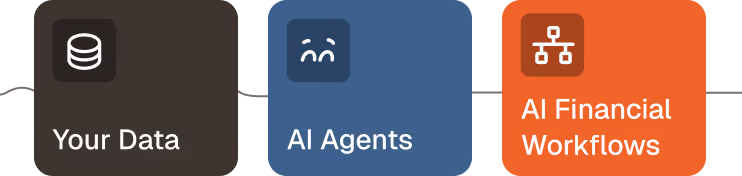
Phacet is an AI agent platform for finance work that sits on top of Xero and checks supplier invoices before they are paid. The integration automates four jobs that Xero does not cover: sorting the invoice inbox, verifying each invoice line against your agreed prices, matching purchase orders to delivery notes to invoices, and flagging duplicates and fraudulent bank details. What reaches your Xero ledger has already been verified. What does not pass a control stops and waits for a human.
That is the short version. The longer version starts with a question almost nobody asks about Xero integrations.
What does a Xero integration actually do?
A Xero integration is a connection between Xero and another application that lets data move between the two systems automatically, without exports, re-keying or copy-paste. Xero's marketplace hosts over 1,000 of them across more than 30 categories, and the accounts payable category alone lists 19 apps in the US store.
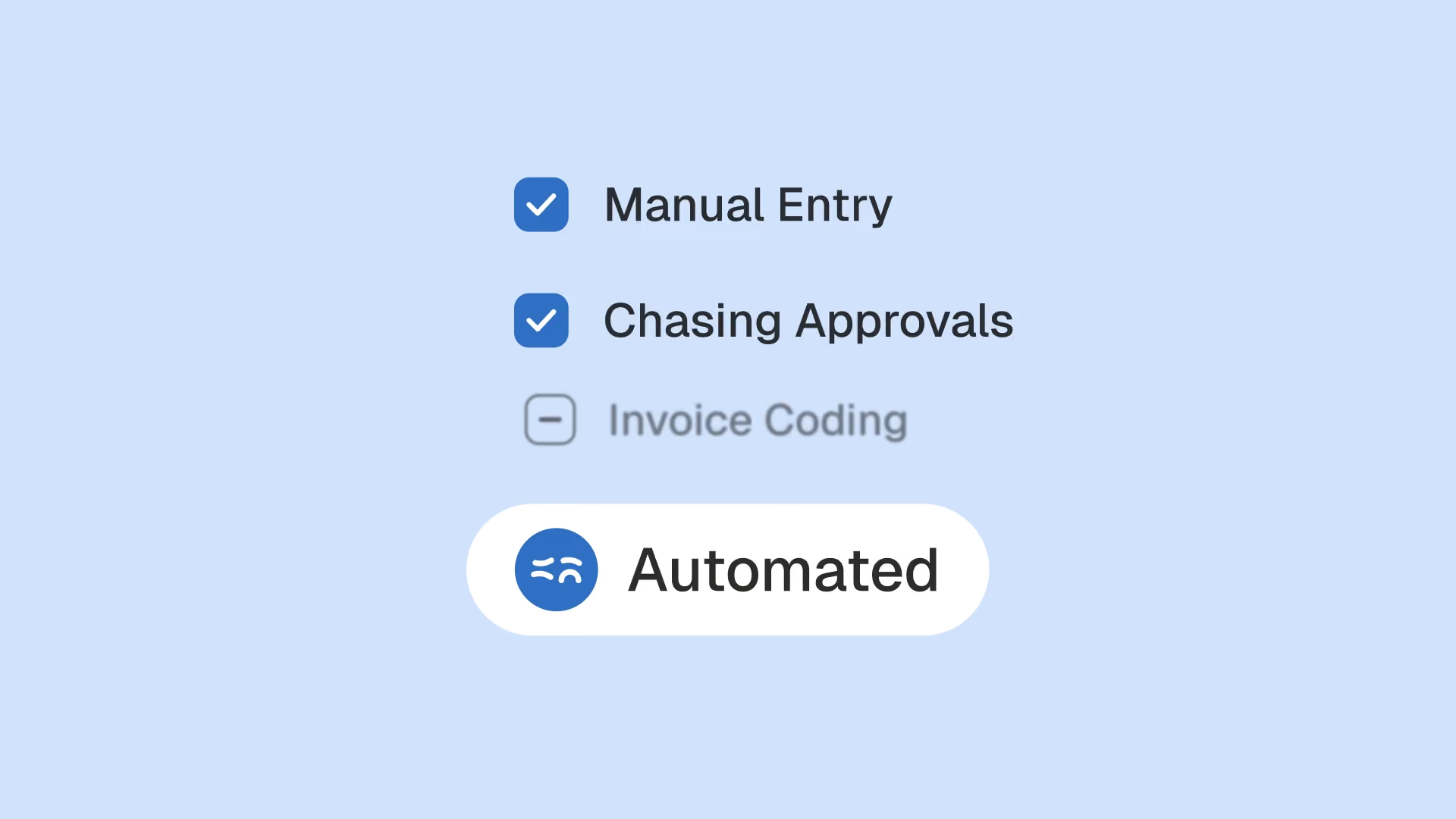
Read what those 19 apps promise and a pattern appears immediately. Xero's own category page sums it up in four benefits: categorize expenses consistently, run flexible approval workflows, automate three-way matching, and improve data accuracy by syncing everything back to Xero. Every one of those is a statement about speed and synchronization. The invoice arrives faster, it gets coded faster, it gets approved faster, it lands in the ledger faster.
Which is genuinely useful. It is also not the same thing as control.
Where Xero stops: it records, it does not challenge
Xero's bank reconciliation matches transactions to accounting entries automatically. What it does not do is ask whether the underlying transaction was correct in the first place.
A supplier who invoiced at 4.10€ per kilo when the signed price list says 3.60€. A duplicate invoice resubmitted three weeks later under a slightly different reference. A payment routed to an IBAN that changed last month because someone sent a convincing email. All three pass through Xero cleanly. All three get reconciled. All three are recorded, accurately, as errors.
This is not a flaw in Xero. It is the job description. A ledger records what happened. It is not built to argue with it.
The same limit applies to the AP layer sitting on top. Approval workflows control who signed off, not whether the amount was right. And three-way matching, as sold across the Xero marketplace, checks that the invoice matches the purchase order. It does not tell you the purchase order was priced right. If the wrong price entered the system at ordering, a perfect three-way match will confirm it and pay it.
The gap is not automation. Nineteen apps automate the path an invoice takes to your ledger. The gap is that none of them challenge the content of the invoice on the way.
What the Phacet Xero integration automates, job by job
Phacet does not replace Xero and does not ask you to migrate. It runs the controls upstream, then lets Xero do what Xero is good at. Here is what each agent handles.
Sorting the supplier invoice inbox
Most invoices still arrive by email, mixed with statements, credit notes, delivery confirmations and supplier chasers. The accounting inbox agent reads the mailbox, identifies each document type, extracts the data and routes it. Nothing is retyped. Maslow Restaurants recovered 1 to 2 hours a day on invoice handling with this single agent.
Checking every line against your agreed prices
This is the control the Xero marketplace has no answer for. The supplier billing control agent compares each invoice line against your negotiated price list, contract terms or price book, and flags every deviation before payment. At Astotel, an 18-hotel group, this recovered 5,000€ a year of billing errors on a single supplier. Their purchasing director puts it plainly: "I save up to two days a month, and I spot errors I would never have caught on my own."
Matching orders, deliveries and invoices
The three-way matching agent reconciles purchase order, delivery note and invoice at line level, including partial deliveries and quantity gaps. Unlike a rules engine, it uses AI Match, Phacet's semantic reconciliation engine, so a line described differently on each document still matches. Smartbox, a 14-country retailer with 800 employees, hit 4x productivity on payment and invoice reconciliation this way.
Catching duplicates and fraudulent bank details
The duplicate detection and fake IBAN fraud agent run before the payment file is built, not during the month-end review. A duplicate caught after payment is a recovery process. A duplicate caught before payment is a non-event.
Reconciling what Xero already recorded
Downstream, the bank reconciliation agent surfaces unmatched flows between your bank, your operational tools and the Xero ledger. This is where Phacet complements Xero's native reconciliation rather than competing with it: Xero matches what it can, Phacet explains what is left.
Why it holds in production, not just in a demo
Any AI tool can extract an invoice. The difference shows up in month three, when an auditor asks why a payment was blocked.
Every Phacet agent writes to a Table, a structured view where each column is a configurable AI operation: extraction, categorization, standardization, alerting, confidence scoring. Nothing lives in a black box. The Detail view exposes the source document and the reasoning behind each decision, line by line. And the native audit trail timestamps every transformation, so any output can be shown to an auditor or an external accountant without reconstruction work.
That last point is what "human-in-the-loop" actually means here. The AI proposes, the human decides. A flagged deviation is not auto-rejected: it is surfaced with the evidence attached, and someone chooses.
Phacet's 40+ agents were not designed in a workshop. They were built from 100+ real finance deployments, which is why the first one is typically running in production in under two weeks.
Who this is for: Xero scale-ups and accounting firms
Xero's position in the US is specific. QuickBooks Online holds roughly 80% of the US small business accounting market, so Xero users here tend to be businesses with international operations, or clients whose accountant actively recommended it. Two profiles get the most out of this integration.
Scale-ups running on Xero. You picked Xero because it is clean, fast and does not require an ERP project. Growth is now producing invoice volume your team cannot verify line by line. Phacet adds the verification layer without the 500K€ migration to a bigger ERP. This is the finance leadership problem: you can close the books, but you cannot honestly say every euro that left was correct.
Accounting firms using Xero Adviser. Managing dozens of client ledgers from one interface is a data entry model. Running Phacet controls across those ledgers in parallel turns it into an advisory model. At CPA, a French accounting firm, this opened a new revenue line worth 2 to 4 margin points they could communicate to clients. Their view: "It is like an Excel sheet on AI steroids. We are not lost in it." More on the accounting firm model.
Both cases follow the same move in the finance maturity model: from Execute, where the work is recording, to Verify, where the work is control. Xero already solved Execute. Phacet handles Verify.
How Phacet and Xero divide the work
The division is simple and worth stating explicitly, because "AI for Xero" is a crowded phrase.
Xero is the system of record. It holds the chart of accounts, the ledger, the bank feeds, the VAT position, the reporting. None of that moves.
Phacet is the gate before the record. It reads the documents, structures them, checks them against your own rules, and passes on what is verified. Its scope is deliberately upstream: the accounts payable and internal controls layers, where an error still costs nothing to fix.
Yooz captures. Xero records. Phacet controls between the two.
Getting started
Phacet connects to the systems that surround your Xero ledger: the supplier mailbox, SFTP drops, your operational tools and your bank exports. A native Xero connector is on the roadmap alongside Pennylane, Sage, NetSuite, Qonto, Agicap and Spendesk.
The realistic entry point is one agent on one painful supplier, not a platform rollout. Pick the supplier you suspect. Run the price control agent for a month. Look at what it finds. Plans start at 299€/month, and most teams have their first agent in production in under two weeks.
If it finds nothing, you have proof your controls work. Nobody has that proof today.
You can book a demo or browse the full agent catalogue.
Frequently asked questions
Does Phacet replace Xero?
No. Phacet runs on top of Xero and does not touch the ledger's role. Xero stays your system of record for the chart of accounts, bank feeds, reporting and tax. Phacet verifies supplier invoices before they reach that ledger.
What is the difference between Phacet and a Xero AP automation app?
AP automation apps in the Xero marketplace automate the path of an invoice: capture, coding, approval routing, sync. Phacet automates the challenge of an invoice: is this price the one we agreed, is this a duplicate, does this quantity match what we received, has this bank detail changed. Both matter, they solve different problems.
Does Phacet do three-way matching for Xero?
Yes, at line level across purchase order, delivery note and invoice, using semantic matching rather than fixed rules. It also adds the layer three-way matching misses: whether the purchase order itself was priced according to your agreement. See the three-way matching use case.
Can accounting firms use Phacet across several Xero client files?
Yes. Firms using the Xero Adviser dashboard can run the same controls across multiple client ledgers in parallel, which is what turns bookkeeping volume into an advisory offer.
Is my Xero data used to train AI models?
No. Phacet data is hosted in Europe on AWS Bedrock, the platform is ISO 27001 certified and GDPR compliant, and client data is never used to train models. This is a deliberate difference from general-purpose AI assistants.
Does Phacet work with QuickBooks or NetSuite too?
Yes. The same control layer applies regardless of the ledger underneath. See QuickBooks accounts payable automation and NetSuite accounts payable automation.
How long does it take to get value?
The first agent is typically in production in under two weeks. Smartbox brought each use case live in six weeks across a considerably larger scope.
Related reading


Latest Resources

Unlock your AI potential
Go further with your financial workflows — with AI built around your needs.


