

Phacet vs. Yooz: beyond capture, the control layer
Published on :
June 8, 2026

Nicolas Marchais is co-founder and CEO of Phacet. After seven years at Spendesk, he built Phacet as the agentic layer that orchestrates across ERP, banking and email systems. Reliable, auditable, cross-system, what he calls a Finance Workforce.

In short: Yooz is an accounts payable automation tool. It captures, dematerializes, routes and approves supplier invoices. Phacet is the control layer that sits on top: it verifies that those invoices are financially correct before payment, checking prices, quantities and contract terms line by line. Yooz answers "did we receive and record the invoice?". Phacet answers "is what we are about to pay correct?". They are complementary, not interchangeable.
At Astotel, a group of 18 Paris hotels, supplier price checks used to happen by sampling. The invoices were already digitized and routed cleanly. Then a Phacet agent checked every line against the negotiated rates and surfaced around 400 euros of billing errors per month on a single supplier, close to 5,000 euros a year.
The invoices were never the problem at capture. They were captured fine. The problem was that no one had time to verify whether what each supplier billed was actually right. "I catch errors I would never have spotted on my own." says Valérie, Procurement Director, in the Astotel case.
That gap is the whole subject of this comparison. If you are weighing Yooz against an alternative, the more useful question is not "which tool captures invoices better?" but "once the invoice is captured, what verifies it?".
What Yooz does well
Yooz is one of the most widely deployed AP automation tools, especially across European SMEs. It is genuinely good at what it is built for.
It receives supplier invoices by email or EDI, extracts the data with OCR, and runs documents through configurable approval workflows before they reach the ERP. It connects to most accounting systems, deploys in days rather than months, and is easy enough that finance teams adopt it with little training. Public user reviews consistently praise its capture accuracy, its simplicity and its fast time to value.
In the language of the finance stack, Yooz owns the capture layer. It digitizes intake, removes manual data entry, and moves invoices through approvals. For a team whose bottleneck is still paper, email and keying invoices in by hand, that is real value.
So this is not an article about Yooz being weak at its job. It is about where its job ends.
Where capture ends and control begins
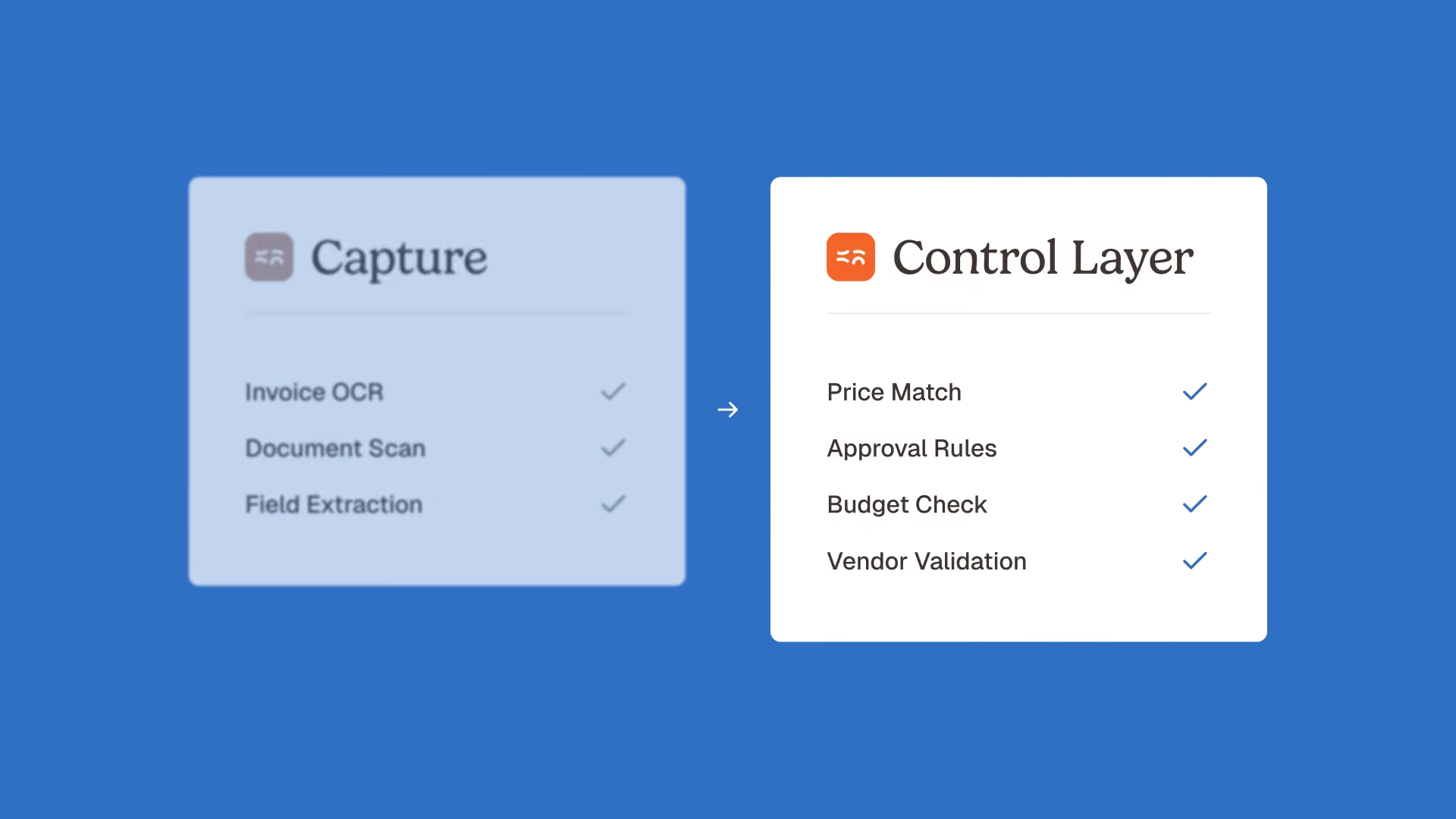
Capture confirms that an invoice was received and recorded. Control confirms that the amount is correct before the money leaves the company. These are two different jobs, and most AP automation tools, Yooz included, are built for the first.
A clean capture is not the same as a correct invoice. A digitized invoice can carry a unit price above the negotiated rate, a quantity that does not match the delivery note, an off-contract line, or a duplicate under a new reference. Capture tools are built to process invoices efficiently, so these pass through the workflow and reach the ERP unchallenged. Verifying them is the job of pre-payment controls, and that is a control layer, not a capture feature.
The table below shows the split on a single invoice.
This is why "control" needs a precise definition here. In most AP tools, control means workflow control: who approves, in what order. The control layer we are describing is financial: it checks the numbers themselves against a reference (a contract, a price list, a delivery note) before payment. That is the layer Yooz leaves open and the layer Phacet was built to hold.
Phacet vs Yooz: the full comparison
Here is how the two compare across the dimensions finance teams actually evaluate. Where Yooz is strong, the table says so.
The pattern is consistent. Yooz is the better answer for capturing and routing volume. Phacet is the better answer for verifying accuracy and controlling spend before payment. The most common mistake is to treat them as competing for the same slot. They are not.
How Phacet controls what Yooz captures
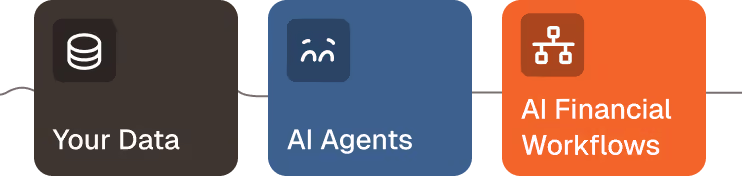
Phacet is built on AI agents that follow three steps: Structure, Match, Analyze. Each agent turns finance work into something reliable, controllable and auditable.
Structure. The agent transforms documents and data into auditable tables. Captured invoices, contracts and price lists become structured rows the agent can reason over, with a confidence score on each field.
Match. This is the control step. AI Match reconciles invoice lines against the reference, a purchase order, a delivery note, or a negotiated price list, at line level, not just header level. It exposes its reasoning at every step, so a flagged line shows why it was flagged. This is where line-level 3-way matching catches what header-level matching misses.
Analyze. Once the data is verified, the agent surfaces variances, duplicates and anomalies, and can build dashboards on top of data that has already been controlled, not raw data.
Concretely, these are named agents you switch on, part of a catalogue of 40+ agents built on 100+ real deployments, not a platform you configure for months:
- The Control supplier billing agent verifies invoice amounts and reduces overpayments.
- The line-level matching agent catches supplier mismatches across order, delivery and invoice.
- The contract terms agent checks each line against the agreed contract.
- The price list control agent checks invoices against your negotiated price list, line by line.
Every result is reviewable. The AI proposes, the human validates, corrects or escalates, with a native audit trail that records every step. That is the difference between an internal control you can show an auditor and a number you simply trust. It also means supplier price variance and duplicate invoices stop being things you discover after payment.
Replacing Yooz vs adding a control layer
Most "Yooz alternatives" articles list other capture tools and ask you to rip out Yooz and replace it. If capture is working, that is a disruptive answer to the wrong problem.
Phacet takes the opposite approach. It sits on top of your existing accounts payable stack, between capture and payment, and connects through API, email, SFTP and native connectors. There is no migration and no IT project. You keep Yooz for what it does well, and you add control where it was missing.
The result is simple to state. What exits your capture tool into the ERP has been verified, not just processed.
Proof: what control catches in production
The value of a control layer is only visible in the numbers it returns.
At La Nouvelle Garde, a group of 10 brasseries, finance recovered close to 2 days per week and eliminated about 70% of the time spent moving between Gmail and the accounting tool. "Phacet is like a team member that operates 24 hours a day." says Théo Richard, CFO.
At The French Bastards, a fast-growing bakery group, the team absorbed a doubling of its locations without new finance hires. At Jinchan, directors save 10 to 15 minutes a day and, as COO Alban Cacace puts it, "we see exactly what is being done. Nothing is hidden."
These are not capture wins. Capture was already handled. They are control and reliability wins, the layer that turns a clean invoice into a verified one.
When Yooz is enough, and when it is not
Honesty makes this comparison useful. If all you need is to capture and route invoices, Yooz is a capable tool and you may not need anything else. Phacet is not a capture tool and will not replace that function.
The decision comes down to where your bottleneck is.
If you still check invoices by sampling, it is worth reading why sampling leaves money on the table compared with 100% validation. For most finance leaders running lean teams, capture stopped being the hard part a while ago. Control is what scales badly, and it is exactly what a control layer is for.
Frequently asked questions
What is the difference between Phacet and Yooz?
Yooz captures, dematerializes, routes and approves supplier invoices. Phacet verifies the accuracy of those invoices before payment, checking prices, quantities and contract terms at line level. Yooz confirms the invoice was received and recorded. Phacet confirms what you are about to pay is correct.
Is Phacet an alternative to Yooz?
Not in the usual sense. Most alternatives replace Yooz with another capture tool. Phacet is complementary: it sits on top, between capture and payment, and adds the financial control that capture tools are not built to perform.
Does Yooz verify that an invoice is correct before payment?
Yooz captures and routes what the supplier sent and supports approval workflows. It is built to process invoices, not to verify their financial accuracy, so a price above the negotiated rate or a quantity mismatch can pass through. That verification is what a control layer such as Phacet adds.
Can Phacet and Yooz work together?
Yes. Phacet connects through API, email, SFTP and native connectors with no migration. Yooz handles capture and routing, Phacet verifies prices, quantities, duplicates and contract terms before payment.
Does Yooz do 3-way matching?
Yooz supports 3-way matching, commonly reported at header level, which leaves line-level gaps to manual handling. Phacet matches at line level with AI Match and exposes the reasoning, so price and quantity gaps are surfaced automatically.
Which is better for an SME finance team, Phacet or Yooz?
It depends on the bottleneck. If you need to digitize invoices and automate approvals, Yooz is strong. If invoices are already captured but no one verifies them before payment, Phacet adds the missing control and works across multiple sites and entities.
How much does Phacet cost?
Phacet starts at 299 euros per month, with credits per document processed and AI costs passed through at cost. The first agent is typically live in under 2 weeks. Yooz uses a volume-based subscription with a 15-day trial.
The bottom line
Comparing Phacet and Yooz on capture quality misses the point. They sit on different layers of the same flow. Yooz makes sure the invoice arrives and gets recorded. Phacet makes sure it is right before you pay.
If capture is your bottleneck, a capture tool is the answer. If you already capture invoices but cannot verify them at scale, the answer is a control layer, on top of what you have, with your team in the loop rather than replaced.
See how the control layer works on your own invoices: book a demo or review Phacet pricing.


Latest Resources

Unlock your AI potential
Go further with your financial workflows — with AI built around your needs.


