

Phacet vs Spendesk: finance control vs spend management
Published on :
September 7, 2026

Nicolas Marchais is co-founder and CEO of Phacet. After seven years at Spendesk, he built Phacet as the agentic layer that orchestrates across ERP, banking and email systems. Reliable, auditable, cross-system, what he calls a Finance Workforce.

This comparison is for the finance lead, controller or owner of a 50-to-500-person company in Europe or the UK that runs cards, expenses or supplier invoices through Spendesk, or is about to, and has just found an invoice that was approved, paid and wrong.
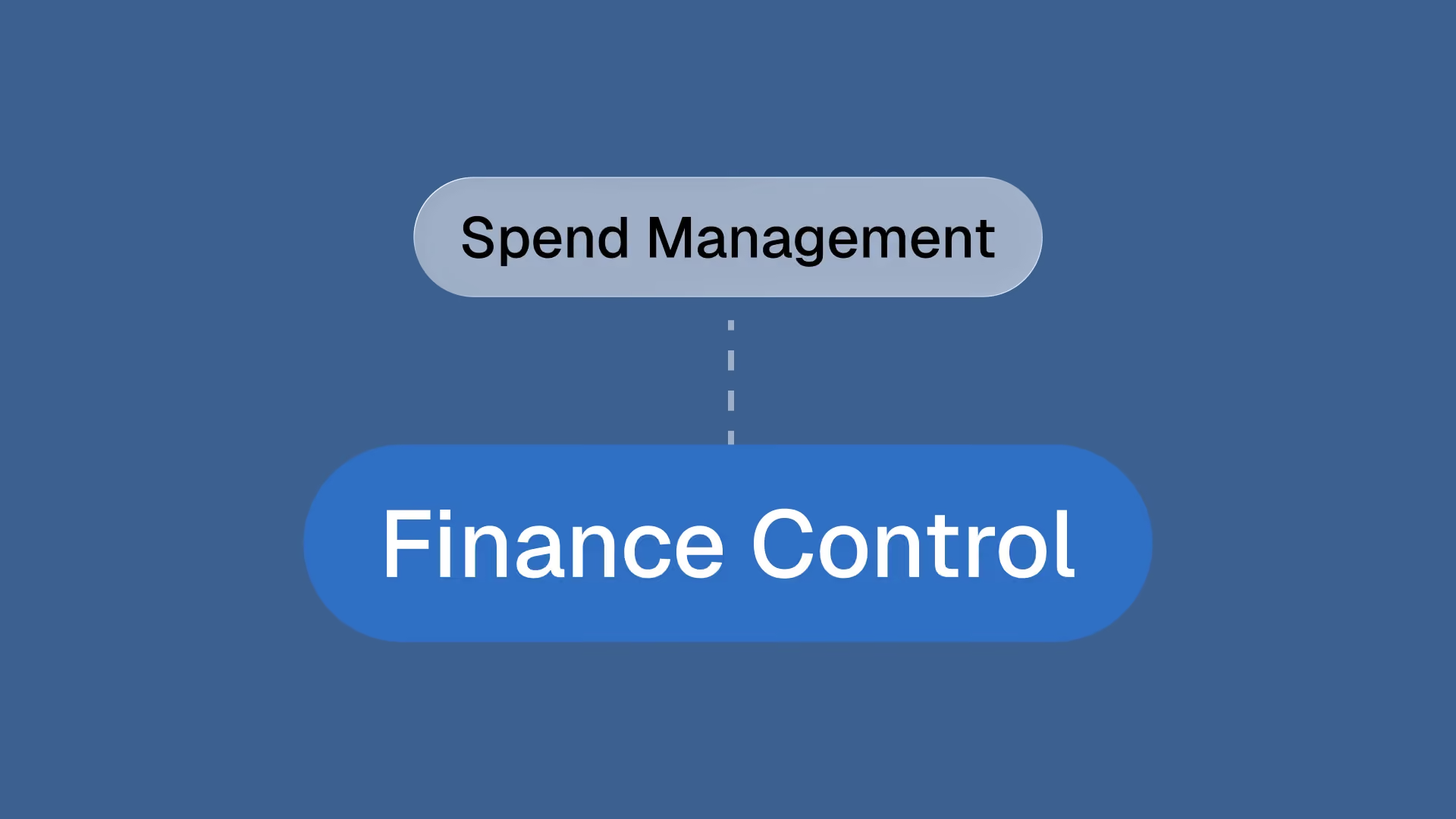
Spendesk is a spend management platform: it governs the spend your company initiates, from cards and expense claims to purchase orders and the supplier invoices it captures, approves and pays. Phacet is a finance control layer: AI agents that check what suppliers actually charge against the prices you negotiated, line by line, with or without a purchase order, and reconcile flows across your bank, POS, ERP and delivery notes. They are not substitutes. Spendesk controls the decision to spend; Phacet controls the reality of what was billed and recorded, whichever tool pays.
Last checked: September 4, 2026. Vendor facts below were read on that date from spendesk.com and phacetlabs.com, and may change.
Key takeaways
- Spendesk covers cards, expenses, procurement and accounts payable, with purchase order matching and duplicate detection by supplier, amount and date; Phacet checks invoice lines against negotiated price lists and compares each invoice with the full payment history.
- On September 4, 2026, none of Spendesk's seven product pages, and none of the six editorial pages ranking for Spendesk alternatives, mentions checking invoiced prices against a negotiated price list: 0 occurrences.
- Phacet's CEO, Nicolas Marchais, co-founded Spendesk and built it for seven years; Phacet's expense and card agents read Spendesk exports directly.
- At Astotel, an 18-hotel group, line-level price control found a 6 euro per kilo gap on the same smoked salmon between two hotels and up to 400 euros of billing errors a month on a single supplier.
- Spendesk is priced on quote, with no public price list on September 4, 2026; Phacet starts at 299€ per month, and a supplier invoice extracted and controlled costs 20 credits.
What Spendesk does, and what spend management means
Spend management is the practice of governing every euro a company chooses to spend, before and while it is spent: who can request it, on which card or purchase order, within which budget, with which approval, and how it lands in the books. Spendesk is a French spend management platform founded in 2016 for exactly that, and on September 4, 2026 its own homepage describes it as "the complete spend management solution" that "connects every type of company spend, from corporate cards and expenses to accounts payable, procurement, and budgets, into one system."
Five modules make up that system, as listed on spendesk.com the same day:
- Cards. Physical, virtual and single-use corporate cards with spend limits, recurring subscriptions, and receipts chased automatically.
- Expense management. Expense claims and mileage, submitted from the mobile app, routed through approval workflows, coded by machine learning.
- Procurement. Purchase requests, purchase orders generated once a request is approved, contract renewal alerts, a supplier dashboard.
- Accounts payable. Invoice capture by email, AI extraction of supplier name, amount, due date and line items, matching to the purchase order and delivery note, approval, and payment to the supplier from the platform.
- Budgets and multi-entity. Budget owners see the impact of each request in real time; entities, currencies and countries sit under one set of controls.
The scale is real. Spendesk's accounts payable page states that companies processed 7 billion euros worth of invoices through it in 2025, that more than 1,000 companies process invoices with it across Europe and the UK, and that its OCR pre-fills invoice data with 90% accuracy. The homepage adds more than 10 billion pounds of processed spend, finance teams in 35+ countries, ISO 27001:2022 certification, and a milestone that answers a question Google users ask a lot: "in 2025 we became the first spend management platform to reach profitability."
Which is to say: if a comparison page tells you Spendesk is only an expense card tool, it is out of date. Spendesk captures, matches, approves and pays supplier invoices. The interesting question is what "matches" means, and where it stops.
Where does spend management stop and finance control begin?
A spend management platform controls a decision. Someone asks to spend, a rule or a manager says yes, a card or a purchase order carries the authorisation, and when the invoice arrives it is checked against that authorisation. Spendesk's AI and automation page, read September 4, 2026, is precise about how: every incoming invoice is "checked against previously submitted ones by supplier, amount, and date" to catch duplicates, invoices are connected to purchase orders in 2-way matching, delivery notes can be added for 3-way matching, and "any discrepancies are flagged before approval." That is a genuine control, and it is the one most spend tools sell.
Finance control asks a different question: was what the supplier billed, and what your systems recorded, actually right? Not "was it authorised" but "was it correct". The two questions come apart in three common situations.
The first is the purchase with no purchase order. A restaurant group receives hundreds of deliveries a week from food suppliers under a negotiated price list. Nobody raises a PO for each crate of salmon. The invoice arrives, matches nothing, gets approved because the supplier is known and the total is plausible, and a unit price that drifted 6% above the agreed rate goes through unread. The second is the duplicate that does not look like one: same supplier, same amount, but re-issued four months later with a new date and a new number, so a check by supplier, amount and date within the current flow does not catch it. The third is everything that is not an invoice at all: the POS revenue that should match the bank deposit, the meal voucher settlement, the delivery note quantities, the intercompany balance.
Here is the measurable version of that boundary. We read seven Spendesk product pages on September 4, 2026: the homepage, pricing, accounts payable, procurement, AI and automation, spend controls, and invoice processing. The terms "price list", "negotiated price", "contract price" and "unit price" appear 0 times across the seven. Then we took the six editorial pages ranking on Google for this query and for Spendesk alternatives, from Brex, Airwallex, Tipalti, Volopay, Wise and Spendesk's own blog, about 17,400 words of main text, and counted again. "Negotiated price" and "price list": 0 occurrences on 6 pages. "Before payment" as a control step: 1 occurrence, on 1 page. "Human-in-the-loop": 0. "AI agent": 0. Seventeen thousand words comparing spend management tools, and not one asks whether the invoiced price was the negotiated one.
That gap is not a criticism of Spendesk. It is the gap Phacet was built for, by someone who knows the first tool from the inside. In an interview published by La Jaune et la Rouge in May 2025, Nicolas Marchais, Phacet's co-founder and CEO, described Spendesk as his first entrepreneurial project, "a payments management solution for SMBs and mid-caps, which I co-founded and developed for seven years." Phacet's own definition of the finance workforce, published June 9, 2026, puts the residual problem in one line: at a 200-person hospitality group, "prices still drift away from negotiated rates," even with invoices flowing through modern tools.
What an approved invoice can still get wrong
An approval answers one question: did the right person say yes. It does not answer a second one: was the document correct. Three documented cases show what the second question costs.
Price drift across sites. The purchasing director of Astotel, an 18-hotel Paris group, checked prices by picking invoices at random and comparing them between hotels. In her words, from the customer story published June 11, 2025 and updated May 2, 2026: "For the same reference of smoked salmon and the same quantity, I found up to a €6 difference per kilo between two hotels." The group had a shared price list. The orders were legitimate. The prices were not. Once every line was compared to the list, one supplier alone showed up to 400 euros of errors a month, close to 5,000 euros a year, and Valérie's own example of the leverage is a 1 to 2 euro difference per litre of orange juice multiplied across 18 establishments. "AI has helped me become more efficient by quickly identifying price discrepancies, and even catching some errors I wouldn't have noticed on my own."
Delivery notes that nobody reconciles. At La Nouvelle Garde, a group of ten Paris brasseries, the reconciliation between delivery notes and invoices was done by sampling, and the finance team spent close to 70% of its time between Gmail and the accounting system. Théo Richard, its CFO, put the stake in one sentence in the customer story published September 18, 2025: "A ten-cent difference on a delivery note, at our volumes, can mean half a margin point lost."
The workflow that fits the tool, not the company. Spendesk's own users describe the third case. On Capterra, a verified reviewer in operations wrote on February 5, 2025: "Approval across multiple entities is very elementary. Workflow is rigid." Julien G., a RevOps specialist in staffing, noted on October 27, 2025 a "lack of native automations to sync receipts from other tools." Neither says the approval failed. They say the control the company needed did not fit the approval the tool offered.
If the invoice that sent you here was a wrong price, a re-issued duplicate or a quantity that did not match the delivery note, that is the gap you are trying to close, and it sits outside what an approval chain checks. Phacet's supplier billing control agent is built for it: it reads every invoice line, compares the invoiced price to the negotiated price list, and flags each discrepancy with the reason, before the payment run, whether the invoice came through Spendesk, an email inbox or your ERP.
Phacet vs Spendesk: the comparison
Here is the comparison as it stands on September 4, 2026, read from both vendors' public documentation. The point is not to crown a winner between two pieces of finance software. It is to show that the two answer different questions, and to make visible which question yours is.
| Criterion | Spendesk | Phacet |
|---|---|---|
| Primary job | Govern company spend end to end: request, authorise, pay, book | Verify what was billed and recorded against your rules, then feed the result back to your tools |
| Corporate cards | ✓ Physical, virtual, single-use, with limits and subscriptions | ✗ Does not issue cards; monitors card statements exported from Spendesk, Qonto or Ramp |
| Expense claims | ✓ Mobile capture, policy limits, approval, machine-learning coding | ✓ Re-checks submitted claims against your policy, duplicates and missing receipts, from a Spendesk export |
| Purchase requests and orders | ✓ Intake forms, approval routing, PO generation, contract renewals | ✗ Not a procurement tool; reads POs as a reference for matching |
| Invoice capture | ✓ Email inbox, AI extraction of header and line items | ✓ PDF, scans, email, ERP exports, into auditable tables |
| Paying the supplier | ✓ From the platform, with Verification of Payee in the EEA | ✗ None, by design; payment stays with Spendesk, your bank or your ERP |
| PO and delivery note matching | ✓ 2-way and 3-way, when a PO exists in Spendesk | ✓ Line by line, reference by reference, with or without a PO |
| Price check against negotiated price list | Not mentioned on the seven product pages read September 4, 2026 | ✓ Core function: every line of every invoice, by supplier and by site |
| Duplicate detection | ✓ By supplier, amount and date against previously submitted invoices | ✓ Against the full payment history, not only the current batch |
| Reconciliations beyond AP | ✗ Spend data only | ✓ Bank, POS revenue, card settlements, meal vouchers, intercompany, payroll accruals |
| Data sources | Spend that runs through Spendesk, plus accounting sync | Any file, mailbox, ERP, bank or tool export, including Spendesk exports |
| Human-in-the-loop and audit trail | ✓ Approver decides; every request, approval and payment logged and exportable | ✓ Your team validates each flagged line; every result traced to its source with reasoning |
| Pricing model | On quote: Foundations package plus Procurement and Accounts Payable modules | From 299€ per month, fixed credit cost per action, 20 credits per supplier invoice controlled |
Read on September 4, 2026 from spendesk.com (homepage, pricing, accounts payable, procurement, AI and automation, June 2026 product update) and phacetlabs.com (agent pages, Match, pricing). Spendesk features vary by package.
Read the two columns as two layers rather than two options. Spendesk holds the authorisation and the payment. Phacet holds the verification. The cells where Spendesk shows a cross are jobs it was never built for; the cells where Phacet shows one are jobs it refuses on purpose.
Where Phacet wins: what suppliers charge and what systems record
Phacet is a catalogue of 40+ AI agents for finance work, each doing one job on your finance data in a table your team can audit. Three of them sit exactly where spend management stops.
The supplier billing control agent, published June 18, 2026, reads every line of every invoice, standardises the product references, and compares the invoiced unit price to the negotiated price list, supplier by supplier, site by site. Its documentation states its purpose plainly: move from "occasional sampling to 100% invoice checks." Every discrepancy is flagged with the line, the variance and the source document. It does not need a purchase order to exist, which is why it works on the food, beverage, linen and consumables deliveries that never get one.
The invoice validation agent, published June 19, 2026, checks a payment batch before it goes out: duplicates compared "against the full payment history, not just the current batch," due dates, budget, and changes of bank details. Non-compliant invoices are blocked; the audit trail is exportable. This is the check that catches the invoice re-issued in March for a delivery paid in November.
The third is not one agent but a capability, Match: Phacet's reconciliation engine, applied "to 100% of flows, not just a sample," across documents that spend management never sees. Bank transactions against the ledger, card settlements against reported revenue, meal voucher settlements, delivery notes against invoices, intercompany flows. At Smartbox, the European gift box leader, the first Phacet application matched payments and invoices in the finance department, "previously a very manual task," and the group reports a fourfold increase in productivity on that process, with every use case operational within six weeks.
Three properties make this hold in production rather than in a demo:
- Every result is traceable. Each flag links back to the PDF page, the ERP row or the bank line it came from, with the reasoning attached, so "why did it flag this" always has an answer for an auditor.
- Exceptions go to a person. The agent proposes; your team validates, corrects or rejects each line, and every decision is logged. Nothing is paid or booked by the agent alone.
- It reads what you already have. Price lists in Excel or a supplier PDF, invoices from a mailbox, statements exported from Spendesk. Nothing in your spend tool has to move.
Where Spendesk wins: cards, expenses, procure-to-pay and payment
A comparison that never says where the other tool wins is an advertisement. Spendesk wins in four places, and if your problem lives there, Phacet is not your answer.
Cards and employee expenses. Phacet does not issue a single card. Spendesk issues physical, virtual and single-use ones, applies limits per person and per subscription, and chases receipts so finance does not. If your pain is untracked employee spending, this is the product category to compare, and Phacet is not in it.
Procure-to-pay in one flow. Request, approval, purchase order, invoice matched to that order and to the delivery note, payment, accounting entry: Spendesk runs the whole chain in one system, and its June 2026 update added Verification of Payee for EEA payments, a two-way sync with Microsoft Business Central and a Pennylane integration. Phacet reads the outputs of that chain; it does not run it.
Paying suppliers. Phacet never moves money. Spendesk pays from the platform, in the right currency, with status visible to the approver. For an SMB whose accounts payable pain is late or misdirected payments, the fix is a payment platform, not a control layer.
Making spend data conversational. Spendesk AI Connect, presented in Spendesk's June 2026 product update, exposes live Spendesk data to AI assistants such as Claude and Dust through a read-only connection, so a finance manager can ask "what did we spend with this supplier this quarter" in plain language. It is a good idea, and it is a question about spend, which is Spendesk's data. Whether the amount spent was the right amount is the other question.
The honest summary is the one Spendesk's own product pages support: it is a mature procure-to-pay and card platform, profitable, certified, live in three to four weeks for most customers, with matching and duplicate checks built in. Those checks work on what Spendesk authorised. What nobody authorised, because it never needed a PO, is where the next layer starts.
How much does Spendesk cost, and how much does Phacet cost?
"How much does Spendesk cost" is one of the three questions Google shows under this search, and the published answers disagree. Airwallex's comparison says Spendesk uses "modular pricing" at "a bespoke price". A French comparison site lists "on quote (not published)". We checked the primary source on September 4, 2026: Spendesk's pricing page shows no figure. It describes a Foundations package with "unlimited cards, users and control settings", two add-on modules, Procurement and Accounts Payable, and one instruction: "Contact us to request a quote." Transactions counted in the plan "include card purchases, invoice payments and expense claims." So the honest answer is that Spendesk is priced per company, on quote, and the only way to know your number is to ask.
Phacet publishes its numbers. Studio starts at 299€ per month with 30,000 credits and one user; Studio Max at 799€ per month with 80,000 credits and three users; custom above. Each action has a fixed credit cost known in advance, and the Phacet pricing page lists it: extracting and controlling a supplier invoice costs 20 credits, so a 30,000-credit plan covers on the order of 1,500 controlled invoices a month if it does nothing else. AI costs are passed through at cost, and in Phacet's words, "when models get cheaper, your credits go further." Extra credits are 10€ per 10,000, and the 14-day trial includes up to 2,000 credits on your own data.
| Cost line | Spendesk, read September 4, 2026 | Phacet, read September 4, 2026 |
|---|---|---|
| Subscription | On quote: Foundations package, Procurement and Accounts Payable modules | Studio 299€ per month, 1 user; Studio Max 799€ per month, 3 users; custom above |
| Usage | Transactions counted per plan: card purchases, invoice payments, expense claims | Monthly credit envelope; 20 credits per supplier invoice extracted and controlled |
| AI cost | Included in the package | Passed through at cost, no markup |
| Time to first value | Most customers fully live within 3 to 4 weeks, per spendesk.com | First agent in production in under 2 weeks; 14-day trial on real data |
Sources: spendesk.com/pricing, spendesk.com homepage and phacetlabs.com/pricing, all read September 4, 2026.
The two lines do not compete for the same budget. One pays for governing and executing spend. The other pays for checking what came back. A company that adds the second does not drop the first.
When is Spendesk enough, and when do you need a control layer?
Airwallex and Tipalti both ask, in their own comparisons, why a business would move away from Spendesk, and answer with feature lists. A better answer is a list of situations, because the right move differs in each, and in most of them the right move is not to move at all.
| Your situation | What is actually missing | Right move |
|---|---|---|
| Every purchase has a PO in Spendesk, invoices match, cards are under control | Nothing yet | Spendesk is enough; revisit when PO-less supplier volume grows |
| Invoices get approved and paid, then a wrong unit price surfaces | Line-level price control against negotiated lists | Keep Spendesk, add a control layer on supplier invoices |
| Food, beverage or consumables deliveries arrive weekly with no PO per delivery | A check that does not depend on a purchase order | Add price list control; the spend tool is not the problem |
| A re-issued invoice was paid twice, months apart | Duplicate check against full payment history | Add invoice validation before the payment run |
| POS takings, card settlements or meal vouchers do not match the bank | Reconciliation outside spend data | A control layer on those flows; Spendesk does not see them |
| Your pain is cards, receipts or approval speed | Spend management features | Compare Spendesk with Pleo, Payhawk or Qonto; a control layer will not help |
| Multi-entity approval rules feel rigid | Workflow flexibility in the spend tool | Raise it with Spendesk or benchmark spend tools; control is a separate question |
The second, third and fourth rows are the most common in Phacet's customer base, and they are the ones the alternatives lists get wrong. A finance team that replaces its spend tool because a wrong-priced invoice got through will spend a quarter re-issuing cards, rebuilding approval flows and redoing the accounting sync, and end up with a new platform that still does not read the price list.
The French Bastards, a bakery group that went from 7 to 14 shops in a few months, chose the sequence deliberately. Its Head of Finance, Marie-Céline Kauff, first automated the accounting inbox so that 100% of invoices were captured, then added what the customer story published December 8, 2025 describes as "a second agent, dedicated to price control," which "verifies supplier prices against the mercuriale." The old model would have required an additional headcount. Théo Richard at La Nouvelle Garde applies the same rule: "Hiring should only come after we've automated."
Using Phacet and Spendesk together: what it looks like in practice
The clearest proof that the two are layers rather than rivals is in Phacet's own documentation. The expense report control agent, published June 17, 2026, starts with "upload your expense reports (export from Spendesk, Pennylane or Excel) and your expense policy," and its FAQ states that "Phacet imports expense data from Spendesk, Ramp, Payhawk, Per Augusta or any CSV export." The card spend monitoring agent loads card statements "via CSV or direct connection (Spendesk, Qonto, Ramp)," recommends 6 to 12 months of history, and reports 5 to 15% savings on tools and subscriptions by finding functional duplicates and forgotten renewals. Spendesk holds the card; Phacet re-reads the statement.
For supplier invoices the sequence is short:
- Week one: load the references. Negotiated price lists, supplier references, purchase orders where they exist, and the invoice history exported from Spendesk or your accounting software. Phacet reads PDFs, scans and CSV exports as they are.
- Week one to two: run on real invoices. The agent extracts each line, matches it to the price list and to the order, and produces its first list of discrepancies. This is where the team sees what sampling had hidden. Phacet's pricing page gives one to two weeks and two to three iterations on real data for a standard agent.
- Every payment run afterwards: only checked invoices go through. Flagged lines go to the right person with the source document; the rest is cleared. Spendesk keeps approving and paying. What changed is what reaches it.
Both companies describe the destination in the same terms. Rodolphe Ardant, Spendesk's founder and CEO, said on Phacet's podcast, published September 11, 2025: "Humans will no longer produce financial data. They'll supervise AI assistants that run continuously." Quentin Vigneau, Spendesk's Chief Product Officer, told FinTech Magazine on June 16, 2026 that "finance teams live in some kind of a software archipelago where each software is like an island with its own use case," and that "trust is a defining challenge." Phacet's answer to both is the same: the agent proposes, the human disposes, and every line carries its source.
Frequently asked questions
Is Spendesk profitable?
Yes, according to Spendesk itself. Its homepage, read September 4, 2026, states that "in 2025 we became the first spend management platform to reach profitability," alongside more than 10 billion pounds of processed spend and finance teams in 35+ countries. For a buyer, profitability lowers the risk of a forced pivot or a price shock after signature.
Is Spendesk a unicorn?
Yes. In a press release dated London, January 18, 2022, Spendesk announced an additional 100 million euros from Tiger Global, as an extension of its July 2021 Series C, at a unicorn valuation. The round was joined by General Atlantic, Eight Roads Ventures, Index Ventures and eFounders, and the stated goal was to hire 300 people in 2022.
Does Spendesk integrate with accounting and ERP systems?
Yes. Spendesk's June 2026 product update lists a two-way sync with Microsoft Business Central, a Pennylane integration with daily syncing, and customisable bank journal exports, while its accounts payable page cites a customer choosing it for its NetSuite integration. Reviewers on Capterra report that exports to some tools, such as NetSuite or Datev, took effort to set up.
Does Spendesk do 3-way matching?
Yes, when the purchase order exists in Spendesk. Its AI and automation page describes 2-way matching that connects invoices to purchase orders and pre-fills amount, date and cost centre from the PO, and 3-way matching where delivery notes verify receipt of goods, with discrepancies flagged before approval. Purchases that never had a PO are outside that check.
Can Phacet and Spendesk work together?
Yes, and that is the usual set-up. Spendesk keeps the cards, expense claims, purchase orders, approvals and payments. Phacet reads the Spendesk exports and the supplier invoices, checks every line against negotiated prices, compares each invoice with the full payment history and reconciles flows Spendesk does not see, then returns the exceptions to your team.
The bottom line
Phacet vs Spendesk is not a choice between two spend tools. Spendesk governs and executes the spend your company decides on, and does it well: cards, expenses, purchase orders, invoice matching, payment, profitable and certified. Phacet checks what your suppliers actually charged and what your systems actually recorded, line by line, before the payment run, and shows its reasoning. A company that keeps finding approved invoices that were wrong needs the second, and keeps the first.
The boundary fits in one sentence, and it is the one Phacet's glossary already uses: Spendesk controls what your team spends; Phacet controls what your suppliers charge.
Your approvals are working. Are your prices being checked?
See how the agent compares every invoice line to your negotiated prices before payment, with the reason for every flag.

Latest Resources
Unlock your AI potential
Go further with your financial workflows — with AI built around your needs.


