

Phacet vs. Dext: why extraction is not enough
Published on :
June 8, 2026

Nicolas Marchais is co-founder and CEO of Phacet. After seven years at Spendesk, he built Phacet as the agentic layer that orchestrates across ERP, banking and email systems. Reliable, auditable, cross-system, what he calls a Finance Workforce.

At Astotel, a group of 18 Paris hotels, supplier price checks used to happen by sampling. Then a Phacet agent reviewed every invoice line against the negotiated prices and surfaced close to 5,000 euros a year of billing errors on a single supplier. A document capture tool would have read those same invoices perfectly, character for character, and flagged none of them.
That gap is the whole point of this comparison. Dext extracts what is printed on a document. It does not verify whether what is printed is financially correct. Both jobs matter. They are not the same job.
Quick answer. Dext is a pre-accounting tool that captures and extracts data from receipts and invoices, then pushes it into your accounting software. Phacet is a financial control layer that verifies that data before payment: price compliance, 3-way matching, duplicate and anomaly detection, all with a native audit trail. The two solve different problems and work well together. Dext feeds the data, Phacet controls it.
What is Dext, and what does it actually do?
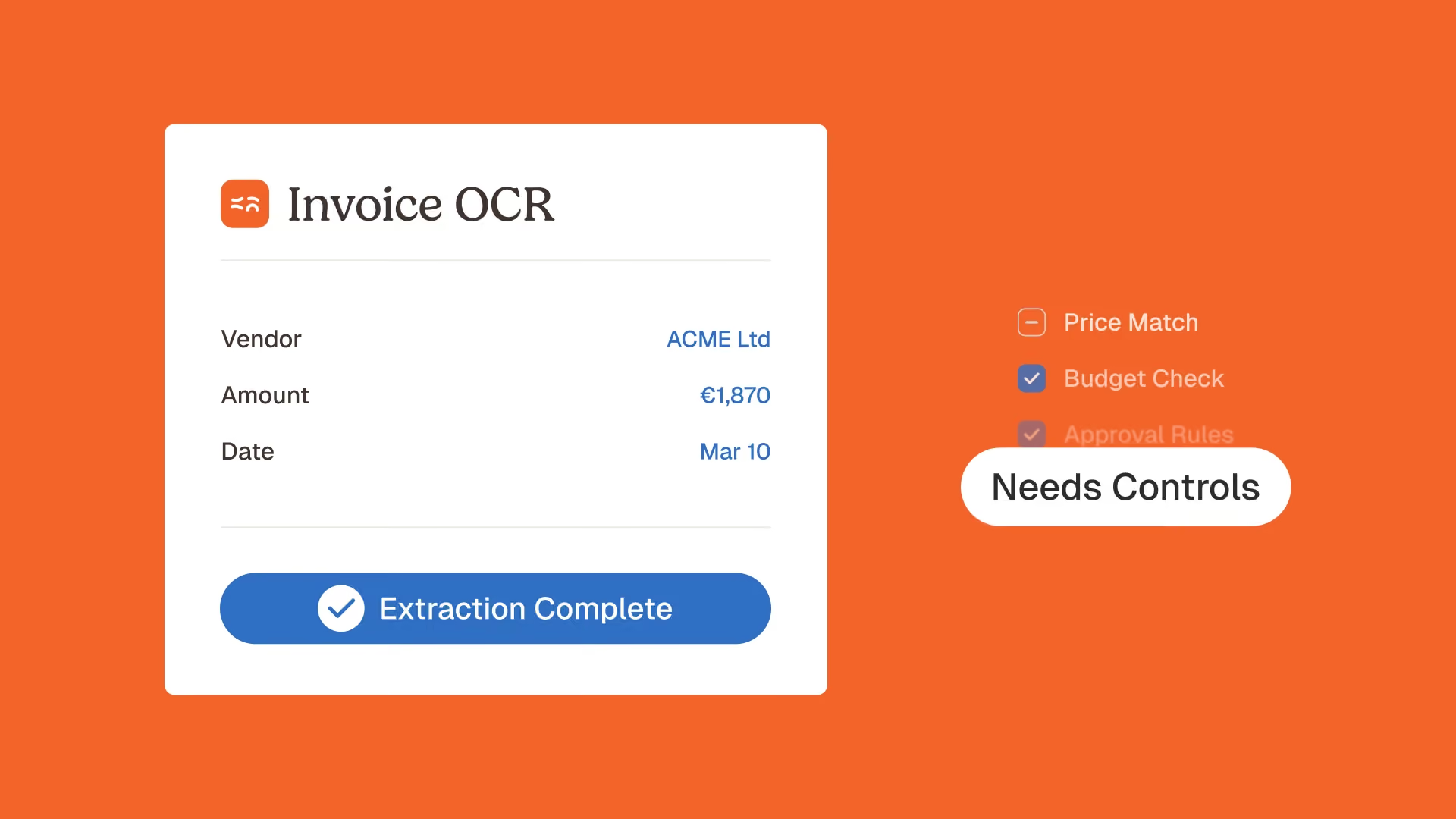
Dext (formerly Receipt Bank) is a document capture and data extraction platform used by accounting firms and their clients. It reads the supplier name, date, amounts, tax, and line items from a receipt or invoice using OCR and AI, then publishes structured entries into accounting software such as Xero, QuickBooks, Sage, or Pennylane.
Data extraction is the process of reading the values printed on a document and turning them into clean, structured fields. It is the step that removes manual data entry.
For that job, Dext is good. The strengths are real:
- High OCR accuracy on standard receipts and invoices
- Mobile capture and email forwarding that clients actually use
- Auto-fetch of statements from some banks and suppliers
- Broad platform support across the main accounting tools
- A mature product trusted by thousands of practices
If your problem is getting documents out of inboxes and into the ledger, Dext does that well. You can read more in our reference entry on Dext (Receipt Bank).
Where extraction stops, and why it matters
Extraction captures what is on the document. It does not check whether what is on the document is correct. That is the boundary, and it is where the money leaks out.
Here is what a tool that ends at extraction will read accurately and still let through:
- A unit price that differs from the negotiated contract or price list
- A quantity that does not match the delivery note
- A duplicate invoice billed and paid twice
- A supplier drifting prices upward, a few percent at a time, month after month
- A line that should never have been on the invoice at all
These are not data-entry mistakes. They are money mistakes. They pass straight through any tool whose job ends at extraction, and then they get paid. Sampling-based controls, the manual fallback most teams rely on, catch only a fraction of them, which is exactly the problem we cover in invoice sampling vs 100% validation.
Put simply: Dext extracts what is on the invoice. Phacet checks whether it should be paid.
Phacet vs Dext: the core difference
Dext operates at the extraction layer. Phacet operates at the control layer above it.
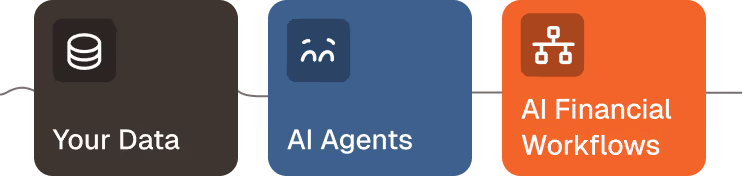
Phacet is a catalog of 40+ AI agents for finance work, built on more than 100 real deployments. Each agent follows the same path: it structures your data, controls it, then lets you exploit it.
An AI agent here means software you give an intention to (control these prices, match these invoices) and that executes the task end to end, exposing its reasoning at each step. It is not a black box, and it is not generic automation.
What does "financial control before payment" actually mean?
It means verifying three things on every supplier invoice, automatically, before the money goes out. Not on a sample. On all of them.
Invoice price compliance
Price compliance checks each invoiced price against the price you actually agreed to. The agent compares every line to the contract or the price list, then flags any deviation before approval. This is the invoice price compliance problem, and it is what the agent that controls supplier billing and reduces overpayments is built for.
3-way matching
3-way matching is the control that compares the invoice against the purchase order and the delivery note (or goods receipt) before payment, so you only pay for what you ordered and actually received. Extraction tools do not do this. Phacet does, through the 3-way matching use case and the dedicated agent that stops losing money on supplier mismatches.
Duplicate and anomaly detection
Duplicate invoice detection catches the same invoice billed twice, and anomaly detection surfaces the unusual: a sudden quantity jump, a new bank detail, a price that breaks the pattern. Phacet flags these with the reasoning shown, not just a score, as covered in financial anomaly detection with AI.
A real example: 5,000 euros a year a capture tool would have missed
Astotel ran price checks by sampling, like most teams. A few invoices spot-checked, the rest trusted. The Phacet agent verified every line of every invoice against the negotiated mercuriale and found recurring billing errors on a single supplier worth close to 5,000 euros a year.
"I save up to two days a month, and I catch errors I would never have spotted on my own." Valerie, Head of Purchasing, Astotel.
None of those errors were extraction failures. The numbers were captured correctly. They were control failures, and control is a different layer. The same logic applies on the accounting-firm side: at CPA, adding purchasing control turned captured data into an advisory line worth 2 to 4 margin points the firm could communicate to clients. That is the move from data entry to advisory that accounting firms are looking for.
Do you need to replace Dext?
No. Phacet does not replace Dext, and it does not replace your accounting software. It sits above your capture tool and your ERP, controls the data, and writes the verified results back.
Many teams keep their capture tool and add Phacet for the control layer on top. Dext feeds the data. Phacet controls it.
Two principles make that control trustworthy. First, human-in-the-loop control: the AI proposes, the human disposes, and every flag can be reviewed, corrected, or validated. Second, a native audit trail: every check is timestamped and traceable to its source, so any output can be shown to an auditor or an accountant with the reasoning attached.
Phacet vs Dext: which one do you need?
The right choice depends on which problem is costing you. If the bottleneck is getting documents into the ledger, that is a capture problem. If the bottleneck is knowing whether what you are about to pay is correct, that is a control problem.
On the finance maturity model, the two tools sit at different stages. Dext handles Execution: getting data in. Phacet adds Verification: making sure the data is right before it drives a payment or a decision. Most finance teams need both, in that order.
Frequently asked questions
What does Dext do?
Dext captures receipts, invoices, and statements and extracts their data with OCR and AI, then publishes it to your accounting software as draft entries. It handles document intake and data entry. It does not check prices against contracts, run 3-way matching, or detect anomalies before payment.
Is there an alternative to Dext?
There are several extraction-focused alternatives, but most do the same job Dext does. Phacet is different: instead of competing on capture, it adds the control layer that extraction tools leave out, so it complements a capture tool rather than swapping it out.
Can I use Dext and Phacet together?
Yes, and many teams do. Dext (or any capture tool) brings the documents in. Phacet verifies prices, matches invoices to orders and delivery notes, and flags anomalies before payment, then writes the results back to your ERP.
Does Phacet replace my accounting software?
No. Phacet sits above your accounting platform and ERP. It controls the data and returns verified results through its API. Your system of record stays your system of record.
What is the difference between data extraction and financial control?
Extraction reads what is printed on a document and structures it. Financial control verifies whether what is printed is correct: the right price, the right quantity, no duplicate, no anomaly. Extraction saves time. Control protects money.
Is Phacet built for in-house finance teams?
Yes. Phacet is built for in-house finance, control, and procurement teams at goods and flow businesses, the people who own financial control and need every supplier invoice verified before it is paid. Accounting firms use it too, to add advisory-grade control on top of their intake.
The takeaway
Extraction is necessary, but it is the first step, not the finish line. The cost in most finance teams is not data entry. It is the errors that get captured cleanly and paid anyway. Dext gets the data in. Phacet makes sure the data is right before it costs you anything.
See the full catalog of AI agents for finance control, or book a demo to see the control layer run on your own invoices. Plans start at 299 euros per month, with the first agent in production in under two weeks.


Latest Resources

Unlock your AI potential
Go further with your financial workflows — with AI built around your needs.


