

Continuous close finance: what it is, and why validation matters more than speed
Published on :
April 16, 2026

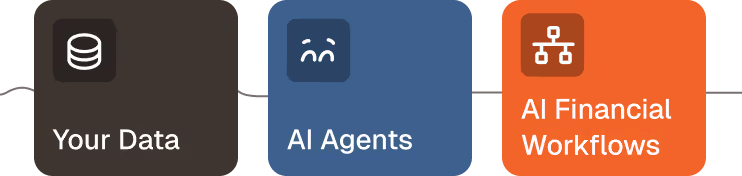
Nicolas Marchais is co-founder and CEO of Phacet. After seven years at Spendesk, he built Phacet as the agentic layer that orchestrates across ERP, banking and email systems. Reliable, auditable, cross-system, what he calls a Finance Workforce.

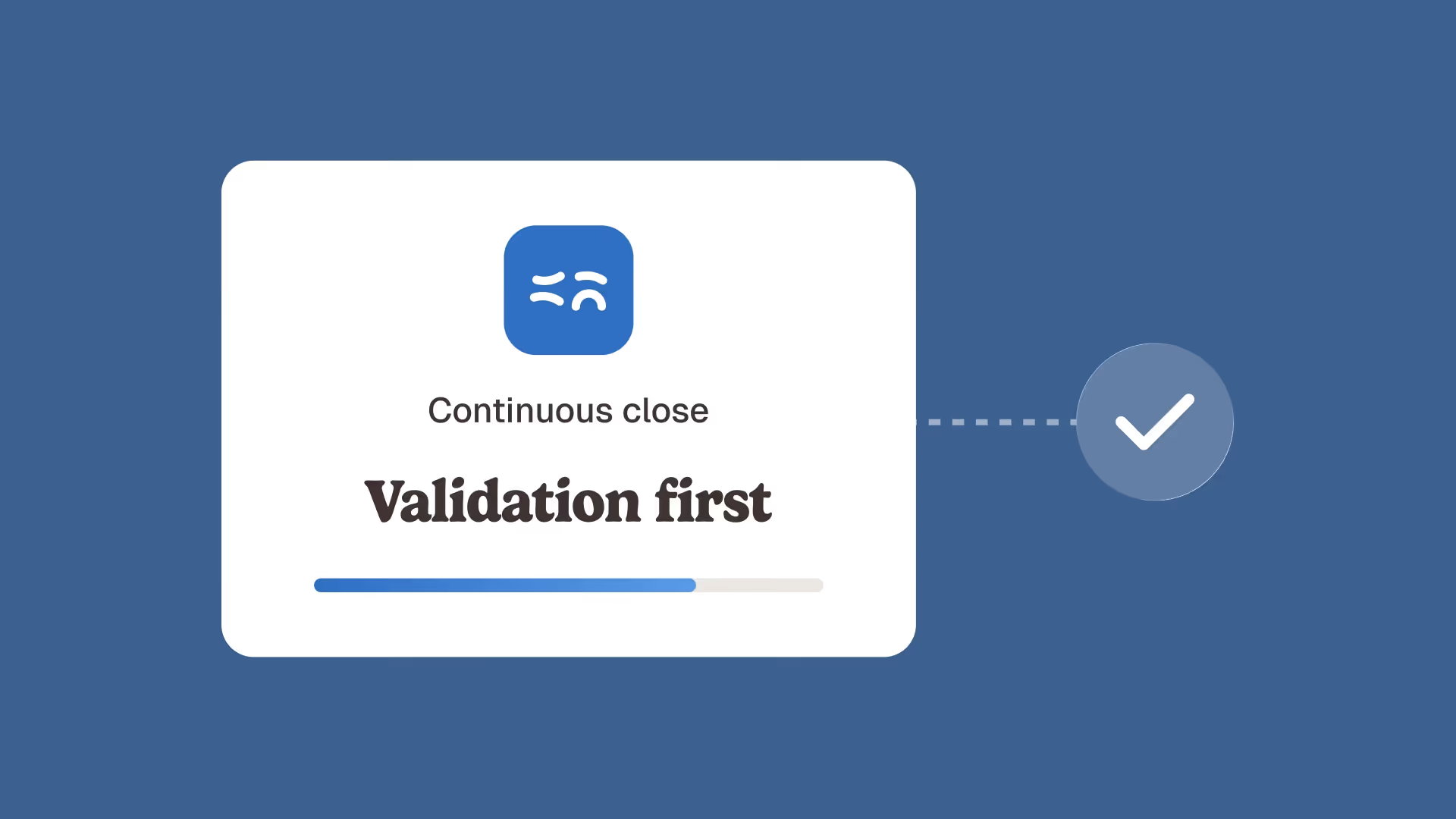
"Continuous close" has become one of those finance technology terms that everyone uses and few people define consistently. To some, it means closing faster, compressing the month-end cycle from ten days to three. To others, it means closing more frequently, weekly or even daily financial snapshots instead of monthly statements. To technology vendors, it often means whatever their software happens to automate.
These definitions are not wrong, exactly. But they share a common flaw: they make continuous close primarily a question of speed and frequency, when the harder and more consequential question is validity. A financial close that happens in two days but rests on unvalidated data is not better than a close that happens in eight days on validated data. It is faster, and more dangerous.
This article defines continuous close precisely, distinguishes it from close acceleration, and explains why the organisations that have genuinely transformed their close cycles did so by prioritising validation throughout the period rather than speed at the deadline.
What continuous close actually means
Continuous close is not a faster monthly close. It is a different relationship between validation and time.
In the traditional close model, validation is an event, it happens at the end of the period, under deadline pressure, on a batch of data that has accumulated for thirty days without being checked. The close is the moment when the finance team finds out what the period's data looks like. Errors, discrepancies, and data quality problems are discovered during the close, corrected under time pressure, and the resulting numbers carry whatever residual uncertainty the available time couldn't resolve.
In the continuous close model, validation is a state, it operates continuously throughout the period, on every transaction as it occurs. By the time the period ends, the data has already been validated. The close is not a discovery event; it is a confirmation event. The finance team is not finding out what the period's data looks like, they already know, because validation has been running all month.
This distinction is fundamental. Continuous close is not about how long the formal close process takes. It is about when validation happens relative to the close deadline. In a genuine continuous close model:
- Bank transactions are matched to ERP records as they settle, not at month-end.
- Invoices are validated against contracted prices and purchase orders as they arrive, not during the AP subledger review.
- Accounting entries are classified consistently at the point of processing, not reclassified during close.
- Exceptions are identified and resolved within days of occurring, while context is current, not accumulated for thirty days and resolved under deadline pressure.
The close itself still happens, the formal period-end accounting adjustments, the sign-off process, the production of statutory and management reports. What continuous close eliminates is the data recovery component of the close: the discovery and correction of accumulated errors that typically consume the majority of close time.
For a detailed analysis of how unvalidated data creates close-time failure modes, see our article on month-end close risks. For the practical sequencing of how to move work upstream, see how to shorten month-end close without increasing risk.
Why the speed definition of continuous close gets it backwards
The speed-centric definition of continuous close, close faster, compress the cycle, gets the causality backwards. Speed is not the mechanism of continuous close; it is a consequence of it.
When validation runs continuously throughout the period, the close takes less time not because the close process is faster but because there is less work to do at the close. A bank reconciliation covering two days of transactions (the period's final settlement window) takes a morning. A bank reconciliation covering thirty days of unmatched transactions takes three days. The difference in duration reflects the difference in work deferred to the close, not a difference in close process efficiency.
Pursuing speed directly, without the upstream validation infrastructure, produces close acceleration, not continuous close. And close acceleration, as discussed in how to shorten month-end close without increasing risk, is a fundamentally different proposition. It makes the same work happen faster. Continuous close makes less work happen at close, because more work has already happened during the period.
This distinction matters for a practical reason: close acceleration reaches a performance limit, and pushing past it means skipping validation steps. The three-day close achieved by deferring the AP exception review to the following period is not an improvement in financial accuracy, it is a transfer of validation risk from this period to the next.
A genuine continuous close, by contrast, has no theoretical lower bound on close duration, because the validation it requires does not have to happen at close at all. The close becomes as short as the period-end-specific tasks require, accruals, adjustments, sign-off, with no additional time required for data recovery.
The 4 conditions that define a genuine continuous close
Not every finance team that closes in three days operates a genuine continuous close. A short close can be achieved through various combinations of cut corners, accepted risk, and deferred resolution. Genuine continuous close is defined by four conditions, all four must be met for the model to deliver both speed and validity.
Condition 1 - Transactions are validated at the point of occurrence, not at the point of reporting
Every transaction that enters the financial record, a bank movement, an incoming invoice, an accounting entry, is validated when it is processed, not when it is included in a period-end report. The AP invoice checked against contracted prices at arrival, not at month-end review. The bank transaction matched to its ERP counterpart on the day it settles, not thirty days later.
This is the core condition. Everything else follows from it. When transactions are validated at occurrence, close-time validation is unnecessary, the work has already been done. When transactions are validated at reporting, close-time validation is mandatory, and the volume makes speed and thoroughness trade off against each other.
Continuous finance control is the operational expression of this condition: a control architecture where every transaction is checked against defined rules and reference data as it flows through the financial record, continuously, rather than periodically. The pre-decision control layer that validates each transaction before it is committed to the financial record is the specific mechanism that makes close-time recovery unnecessary.
Condition 2 - Exceptions are resolved with current context, not stale context
An exception in a continuous close model is identified within days, sometimes hours, of the underlying transaction. The person who processed it is available. The documentation is accessible. The context for resolution is complete. Resolution is fast, reliable, and produces a correct outcome.
An exception in a deferred-validation model is identified thirty days after the underlying transaction. The context has degraded: the analyst may not remember, the documentation may have been archived, the supplier contact may have changed. Resolution requires reconstruction of circumstances rather than investigation of recent events. It takes longer, produces a less certain outcome, and carries higher residual error risk.
The resolution quality difference between current-context and stale-context exceptions is substantial, and it is the primary reason that continuous close produces not just shorter cycles but better data quality. Exception-based finance review concentrated on exceptions identified within the current operating window consistently produces higher resolution accuracy than the same volume of exceptions accumulated over a period and resolved at close.
Condition 3 - Data quality is measured and maintained throughout the period, not validated at close
Continuous close requires a data quality posture, an active, ongoing measurement of whether the financial data in connected systems accurately represents the underlying economic reality, rather than a periodic reconciliation posture.
The difference is between asking "does our data agree with itself as of the close deadline?" (reconciliation posture) and "does our data accurately represent reality at every point in the period?" (data quality posture).
Data trustworthiness as a continuous property requires that the finance function actively monitors cross-system consistency, extraction accuracy, and classification coherence throughout the period, not just at close. This is what ensures that the data available for management decisions made in week two of the period is as reliable as the data published in the month-end report. Without this continuous quality posture, a fast close can produce accurate period-end numbers while the data that drove week-two decisions was materially unreliable.
The data governance framework that supports this, defining authoritative sources for each data type, maintaining entity resolution mappings, versioning reference data changes, is what makes the continuous quality posture operational rather than aspirational.
Condition 4 - The audit trail is built during the period, not assembled at close or during audit preparation
A close that happens in three days is only audit-defensible if the three-day close is backed by documentation covering the full period. A periodic close that takes eight days may actually produce more comprehensive documentation, precisely because it spent more time assembling the validation record.
Genuine continuous close generates a complete, timestamped audit record as a by-product of the continuous validation process. Every transaction validated, every exception identified, every resolution path taken, every human decision made, all documented automatically, as it happens, linked to the underlying transaction record.
This audit trail does not have to be assembled at close or during audit preparation. It exists, complete and searchable, from the moment the period's transactions begin. The short close is also the fully documented close, not because audit documentation was prioritised over close speed, but because continuous validation generates documentation as its primary output.
Audit-ready finance processes are not a separate preparation exercise; they are the natural state of a finance function running continuous validation with proper documentation infrastructure.
Why validation matters more than speed in continuous close
The prevailing conversation about continuous close focuses on the speed benefit: faster close, earlier reporting, more management time with current numbers. These benefits are real. But they are consequences of correct implementation, not goals in themselves.
The deeper value of continuous close is not the speed of the formal close process. It is the validity of the financial data throughout the period, the property that every decision, every report, and every commitment made during the month rests on data that has been validated at or near the point it was created, rather than data that will be validated at the end of the month under deadline pressure.
This distinction has direct commercial consequences.
Management decisions made in week two.
A company that can rely on its week-two AP position, cash balance, and revenue figure being as accurate as its month-end close figures can make better resource allocation, pricing, and purchasing decisions throughout the month. A company that can only rely on its data accuracy at month-end is making three weeks of mid-period decisions on numbers that haven't been validated since the previous close.
Investor and board reporting confidence.
A CFO who can state with confidence that the ARR figure presented to the board reflects a validated, reconciled position, not a preliminary figure that will potentially be revised when the close completes, is in a fundamentally different position from one who presents preliminary figures with unstated uncertainty. The continuous close model produces board-ready figures throughout the period, not just at the close deadline.
Audit risk and efficiency.
An external auditor who finds that an organisation reconciles its bank accounts monthly has a different view of the control environment than one who finds that bank reconciliation runs daily with continuous exception resolution. The former suggests that material errors could accumulate for a full period before detection. The latter suggests a control environment where errors are detected and resolved within days. This distinction affects the scope, duration, and cost of the external audit.
Error cost and recovery complexity.
A payment error identified and stopped before execution costs nothing to correct. The same error identified during a monthly AP review, after payment has been made, costs time, friction, and partial recovery at best. The financial cost of catching errors before commitment, which is what pre-payment controls and continuous validation enable, is systematically lower than the cost of catching errors after commitment. This is not primarily a close-efficiency argument; it is a financial control argument.
Speed is a side effect of getting validation right. It is not the goal.
Continuous close vs. virtual close vs. soft close: distinguishing the terms
Several related concepts appear in the literature around continuous close, and they are frequently conflated. It is worth distinguishing them clearly.
Virtual close refers to the technical capability to generate financial statements on demand, at any point in the month, not just at period-end, using automated reporting tools connected to the ERP and related systems. Virtual close is a reporting capability. It tells you what the numbers look like right now, based on whatever data is in the system. It does not tell you whether that data is validated. A virtual close on unvalidated data produces fast, wrong numbers.
Soft close refers to the practice of accepting some reconciling items as immaterial and deferring their resolution to the following period, in order to meet a compressed close deadline. Soft close is a risk acceptance practice. It makes the close faster by explicitly accepting that some data quality issues will carry over. It is the opposite of continuous close on the validity dimension, it achieves speed by reducing validation thoroughness.
Continuous close is the model described throughout this article: validation as a continuous operating state throughout the period, making the formal close a confirmation event rather than a discovery event. Continuous close achieves both speed and validity, but validity is the mechanism, not the trade-off.
The practical implication: implementing a virtual close reporting layer on top of a traditional periodic validation process does not produce continuous close. It produces faster reporting of unvalidated data. Implementing a soft close policy does not produce continuous close. It produces a shorter close at the cost of increased residual error risk. Genuine continuous close requires the upstream validation infrastructure, continuous bank reconciliation, continuous AP validation, continuous data classification, that makes the period-end data already validated when the formal close begins.
What changes for the finance team in a continuous close model
The transition to continuous close changes the daily rhythm of finance operations in ways that are distinct from a close process improvement.
Under the traditional model, the finance team's work has a pronounced monthly cadence: relatively lighter during the first three weeks of the month, extremely intense during the close window. The skills applied are weighted toward the close-specific tasks, reconciliation, journal preparation, exception clearing, report generation.
Under the continuous close model, the work distributes more evenly across the month. Daily bank reconciliation review replaces monthly bank reconciliation. AP exception resolution happens within days of invoice receipt, not within days of the close deadline. Accounting data classification is checked continuously, not reclassified at close. The close window itself is shorter and less intense, it focuses on the period-end-specific tasks (accruals, adjustments, sign-off) rather than data recovery.
This is not simply a different allocation of the same total work. The total work is lower, because continuous validation is more efficient than deferred validation. Exceptions resolved at occurrence take less time than exceptions resolved at thirty days' distance. Classification decisions made at the point of entry are more accurate and less labour-intensive than reclassification decisions made at close. The audit documentation that builds itself continuously requires no assembly effort at close.
The finance team operating a continuous close does not need to be larger than one operating a periodic close. It needs to be differently organised, with daily exception review workflows, standardised resolution paths, and monitoring infrastructure that makes the continuous validation visible and manageable throughout the period.
Human-in-the-loop control remains central to the continuous close model. The automated validation agents identify exceptions, categorise them, and route them for resolution, but the resolution decisions that require judgment (disputed invoices, unusual transaction patterns, ambiguous bank items) remain in human hands. The team's effort concentrates on genuine exceptions rather than routine scanning, which is both more efficient and more aligned with the finance professional's expertise.
The infrastructure that makes continuous close possible
Continuous close is not a process change that can be implemented without technology infrastructure. The continuous validation it requires, across bank transactions, AP invoices, accounting classifications, and cross-system consistency, cannot be sustained by manual processes at any meaningful transaction volume.
The infrastructure has three layers:
Data ingestion and normalisation.
Every transaction entering the financial record, bank movements, incoming invoices, expense claims, accounting entries from connected systems, is ingested through a layer that applies extraction validation, format normalisation, and entity resolution before the transaction is processed. This layer is what ensures that the validation applied throughout the period operates on clean, comparable data rather than raw, system-specific outputs. Phacet's accounting inbox agent and intelligent data extraction infrastructure implement this layer, ensuring that every document and transaction record is standardised before it enters the validation workflow.
Continuous validation agents. AI agents that run perpetually, processing each transaction as it occurs and comparing it against the relevant reference data, contracted prices, purchase orders, delivery records, bank counterparts, classification schemes. The agents that Phacet deploys for this layer include the bank reconciliation agent, the supplier billing control agent, the accounting data standardisation agent, and the cash flow labelling agent. Each operates on the same principle: validate at occurrence, route exceptions immediately, document everything.
Exception management and audit trail. The output of the validation agents, match results, exception classifications, resolution recommendations, is captured in a structured exception management workflow that routes each exception to the appropriate human reviewer with the relevant context pre-populated. The resolution record, once completed, joins the audit trail for the period, building the complete documentation record that the close and audit preparation will require. Explainable decision control ensures that every automated decision is traceable to its inputs, its logic, and the human sign-off that confirmed it.
This infrastructure connects to existing ERP, banking, AP, and billing systems through standard integrations, it does not replace them. Phacet's no-code automation platform makes the configuration practical without dedicated IT project resource, typically in three to six weeks per domain.
FAQ
What is continuous close in finance?
Continuous close is a financial close model in which validation, the process of confirming that financial data accurately represents the underlying economic reality, runs throughout the accounting period rather than being concentrated at the period-end close deadline. In a continuous close model, bank transactions are matched daily, invoices are validated as they arrive, accounting data is classified consistently at the point of processing, and exceptions are resolved within days of occurrence. By the time the formal period-end close begins, the data has already been validated, making the close a confirmation exercise rather than a data recovery operation.
What is the difference between continuous close and fast close?
Fast close, or accelerated close, aims to compress the duration of the formal close process, doing the same close-time validation work more quickly. Continuous close eliminates much of the close-time work by moving validation upstream, into the period. Fast close shortens the close by doing existing tasks faster. Continuous close shortens the close by ensuring that fewer tasks remain to be done at close. The practical difference: a fast close can reach a performance limit after which further compression requires skipping validation steps. Continuous close has no such limit, because the validation doesn't happen at close in the first place.
Does continuous close require real-time reporting?
No. Continuous close is about when validation happens, not when reporting happens. A finance team can run continuous validation throughout the period, validating every transaction as it occurs, and still produce management reports on a weekly or monthly cadence. The continuous validation ensures that whenever a report is produced, the data it reflects has been validated. Real-time reporting (on-demand dashboards showing current figures) is a separate capability that benefits from continuous close infrastructure but is not required by it.
What is the relationship between continuous close and external audit?
Continuous close strengthens the external audit position in two ways. First, the control environment that continuous validation demonstrates, every transaction validated, exceptions resolved promptly, complete audit trail by construction, represents a higher standard of internal control than the periodic validation model. Auditors conducting risk assessment typically scope their testing relative to the demonstrated control environment; a stronger environment typically means a narrower audit scope. Second, the audit trail generated by continuous validation provides the transaction-level documentation auditors need without requiring the finance team to reconstruct it from working papers and email records. Audit preparation time typically decreases significantly for organisations running continuous validation.
Is continuous close the same as virtual close?
No. Virtual close is a reporting capability, the ability to generate financial statements on demand at any point in the period. It is technically possible to build virtual close on top of unvalidated data, producing fast reports that may contain material errors. Continuous close is a validation posture, the property that the data underlying those reports has been validated throughout the period. Virtual close tells you how fast you can produce numbers. Continuous close tells you whether those numbers can be trusted.
How long does it take to implement continuous close?
The infrastructure components that enable continuous close can be implemented incrementally, typically in three to six months for the core validation domains. Continuous bank reconciliation (the highest-impact single component) typically takes one to two weeks to configure and deploy. Continuous AP invoice validation takes three to four weeks. Accounting data standardisation and cash flow labelling each take two to four weeks. The full implementation, covering bank reconciliation, AP validation, data classification, and cash flow labelling, typically produces a measurably shortened close cycle within the second or third period after deployment, with the reduction in close duration increasing as each domain is activated.
Continuous close is a data posture, not a calendar reform
The most important misconception about continuous close is that it is about the close calendar, weekly closes instead of monthly, daily snapshot reports instead of period-end statements. These scheduling changes may follow from continuous close infrastructure, but they are not what continuous close is.
Continuous close is a data posture: the commitment that the financial data available to the organisation at any point in the period is validated, reconciled, and trustworthy, not just at the moment when the close forces a validation event.
The finance function operating with this posture does not experience a "close crisis" at the end of each period, because there is no accumulated backlog of unvalidated data to work through. The close is genuinely shorter, genuinely less stressful, and genuinely more accurate, because the work that used to create the crisis was done continuously throughout the period, at the point of occurrence, with better context and lower cost.
Speed is what you get when you get the validation right. Validation is the only part that matters.
Phacet's continuous validation infrastructure, bank reconciliation, AP invoice control, supplier transaction labelling, cash movement classification, and accounting data standardisation, implements this posture across the financial data domains where validation matters most. The close gets shorter because the period gets better controlled. Book a demo to see what continuous close looks like applied to your transaction environment.


Latest Resources

Unlock your AI potential
Go further with your financial workflows — with AI built around your needs.


