

Supplier statement reconciliation at month-end, automated
Published on :
July 28, 2026

Nicolas Marchais is co-founder and CEO of Phacet. After seven years at Spendesk, he built Phacet as the agentic layer that orchestrates across ERP, banking and email systems. Reliable, auditable, cross-system, what he calls a Finance Workforce.

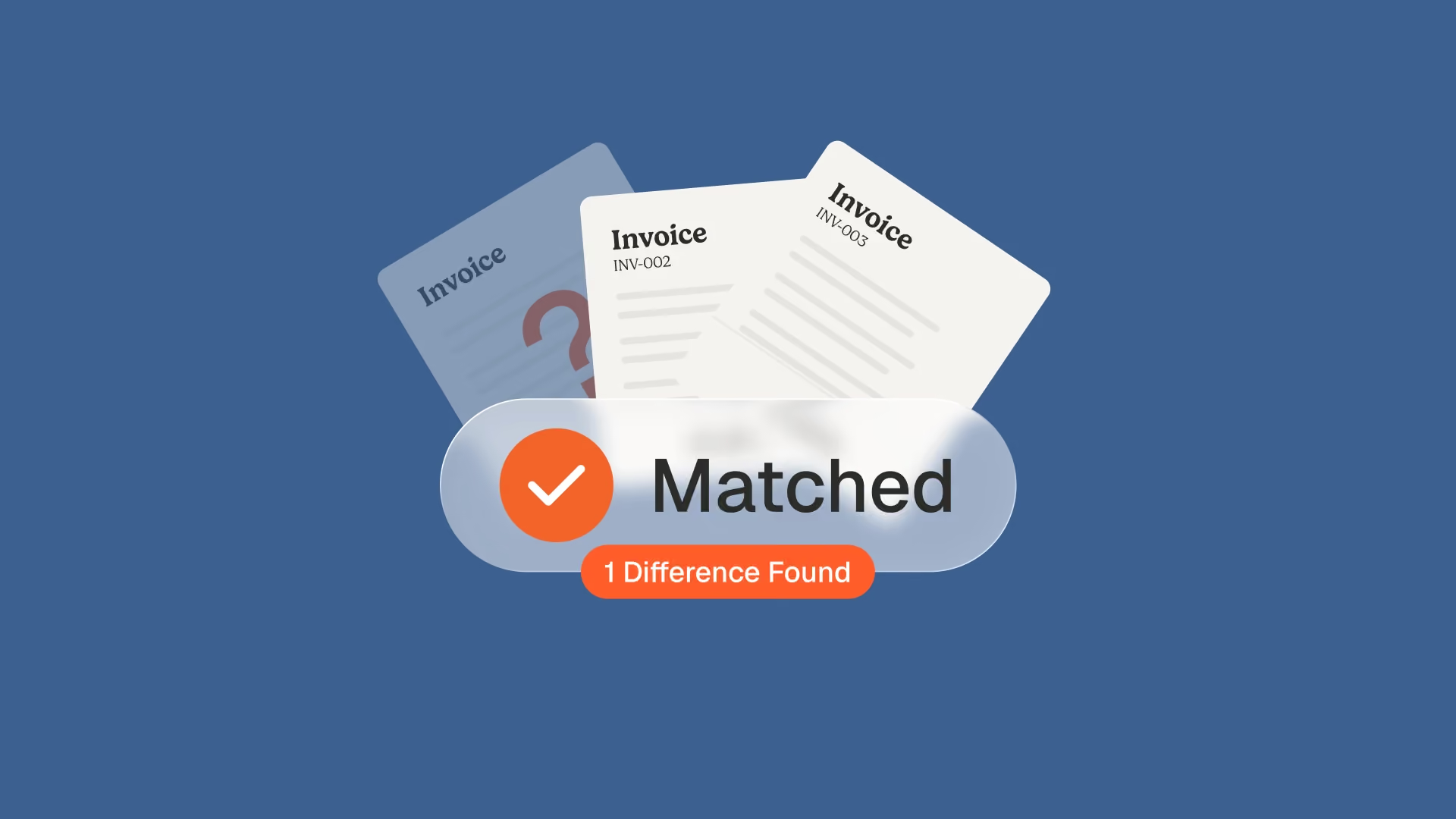
Supplier statement reconciliation is the financial control that compares a vendor's statement against your accounts payable ledger to confirm every invoice, credit, and payment matches on both sides. It is where finance teams recover overpayments, unclaimed credits, and price drift before they harden into the closed books. It is also the control most teams run on a fraction of their suppliers, because doing it by hand does not scale.
The result is a familiar month-end trap. You reconcile your ten or twenty biggest vendors, sign off the close, and let the rest of the ledger go unchecked. The discrepancies you never looked at do not disappear. They become duplicate payments already sent, credit notes never claimed, and negotiated prices quietly ignored on the invoice.
This guide covers what supplier statement reconciliation is, why it breaks at close, the step by step process, how it differs from bank reconciliation and three-way matching, and how an AI agent turns a monthly recovery hunt into a control you run on every supplier.
What is supplier statement reconciliation?
Supplier statement reconciliation, also called vendor statement reconciliation, is the process of matching the statement a supplier sends you against the balance and line items recorded in your AP subledger, then investigating and resolving every difference.
A supplier statement is the vendor's own record of your relationship over a period, usually a month. It lists outstanding invoices, credit notes owed back to you, payments they have applied, adjustments, and an opening and closing balance. Reconciling it answers one question: does what the supplier thinks you owe match what your ledger says you owe, line by line?
When the two disagree, the difference points to something specific: a duplicate invoice booked twice, a credit note the supplier issued but you never recorded, a payment in transit, a price variance between the negotiated rate and the invoiced rate, or a missing invoice that will surface as a surprise later. For the full definition, see the supplier statement reconciliation glossary entry.
Why supplier statement reconciliation breaks at month-end
Statement reconciliation is one of the highest-value controls in accounts payable, and one of the first to be dropped when the close gets tight. The reason is simple: it is manual, slow, and it competes for time with the payment run.
The typical workflow is a person, a highlighter, and two documents side by side. Line by line, they tick off what matches and flag what does not. On a supplier with dozens of transactions a month, that is thirty minutes of concentration. Across hundreds of suppliers, it is unmanageable, so teams reconcile the top ten or twenty accounts and leave the rest.
That coverage gap is where the money leaks. The suppliers you skip are still capable of double-billing you, forgetting to apply a credit, or invoicing last quarter's price on this quarter's order. Because you never reconcile them, the error is only caught if it happens to be large, and usually only after the cash has left your account. The recovery then costs more time than the reconciliation would have.
At Astotel, an 18-hotel group in Paris, price checks on supplier invoices were done by sampling, the same way most teams handle statements: a few suppliers, some of the time. A Phacet agent checking every line against negotiated prices surfaced around 400 euros of billing errors a month on a single supplier, close to 5,000 euros a year, on a vendor no one had flagged. "I catch errors I would never have spotted on my own," says Valerie, the group's Head of Purchasing. The lesson is not that Astotel had a bad supplier. It is that sampling hides the errors you are not looking at.
Control before payment, not recovery after the fact
Here is the reframe that changes the economics. Most teams run supplier reconciliation as a recovery exercise: reconcile the statement at month-end to find money that already left the building, then spend weeks clawing it back. It works, but it is detective by design. You are auditing a payment you already made.
The alternative is to move the control upstream. When every invoice line is checked against the purchase order, the delivery note, and the negotiated price list before it posts, most discrepancies never reach the ledger in the first place. Three-way matching and line-level price compliance catch the double-bill and the price drift at the gate. Statement reconciliation at close then becomes a verification that a controlled ledger is clean, not a treasure hunt through a leaky one.
This is the difference between chasing errors and preventing them. Both models reconcile the statement. Only one stops the cash from leaving.
The point is not to abandon statement reconciliation. It is to stop relying on it as your only line of defense. Pair it with continuous, 100 percent line-level validation and the monthly reconciliation gets shorter, cleaner, and far less expensive.
The supplier statement reconciliation process, step by step
Whether you run it by hand or with an agent, supplier statement reconciliation follows the same sequence. Treated as a control rather than a chore, each step has a clear owner and a clear output.
- Gather the records. Collect the supplier statement for the period alongside your matching AP data: invoices, purchase orders, delivery notes, credit notes, and payments.
- Confirm the opening balance. Check that the opening balance on the statement equals the opening balance in your ledger. A break here means an unresolved issue carried over from a prior period.
- Match line by line. Compare each transaction on the statement to your records: invoice number, amount, date, and quantity. Everything that ties out is removed from the working set.
- Type the exceptions. For every remaining difference, name the cause: duplicate, missing invoice, unapplied credit, payment in transit, or price variance. Typing the exception tells you who resolves it and how.
- Investigate the root cause. Pull the order confirmation, the delivery note, or the email trail behind each exception.
- Resolve with the supplier. Contact the vendor to claim the credit, correct the invoice, or confirm the timing difference. Prompt, documented communication protects the relationship.
- Adjust and record. Correct the ledger, confirm the closing balances now agree, and keep an audit trail of what was found, what was changed, and why.
The manual version breaks at step three, where fatigue lets a transposed digit or a mistaken character slip through, and at coverage, where there is simply not enough time to reach every supplier.
Supplier statement reconciliation vs bank reconciliation vs three-way matching
These three controls get confused constantly, because they all "reconcile" and they all live in finance. They answer different questions and use different source documents.
Bank reconciliation matches your cash ledger to your bank statement, confirming that recorded cash movements actually cleared. Supplier statement reconciliation matches your AP subledger to a vendor's statement, confirming what you owe. Three-way matching validates a single invoice against its purchase order and delivery note before payment, confirming you are billed for what you ordered and received.
Put simply: three-way matching controls the invoice at the gate, statement reconciliation verifies the whole supplier balance at close, and bank reconciliation confirms the cash after it moves.
How agentic supplier statement reconciliation works
Vendors have said "AI matches statements in seconds" for years without explaining the mechanism. Here is what actually happens when an agent reconciles a supplier statement, and why it differs from generic OCR or a scripted rule.
An AI agent is a specialized program that reads documents, applies finance logic, and produces a traceable result a human can review, rather than a black box that returns a number. In a supplier statement reconciliation, the agent works in three moves that map to how any Phacet agent operates: structure, match, analyze.
First it structures the statement. Supplier statements arrive as PDFs, emails, and portal exports in dozens of layouts. The agent extracts each line into a clean, auditable table: invoice reference, date, amount, credit, balance, with a confidence score on every field it reads.
Then it matches the structured statement against your AP subledger. This is not a spreadsheet VLOOKUP on invoice numbers. Semantic matching aligns transactions even when references are formatted differently, amounts are split across partial payments, or a credit offsets an invoice, and it exposes its reasoning for each pairing so a reviewer can see why two lines were tied together.
Finally it analyzes what did not match. Instead of a fresh list to eyeball, you get a short queue of typed exceptions: this credit was never applied, this invoice appears twice, this line was billed above the agreed price. Every step is recorded in a native audit trail, so the output is something you can hand to an auditor or an accountant, not just a total.
Because the agent runs on every supplier, not just the top twenty, coverage stops being the constraint. The work shifts from matching to deciding, which is the part that actually needs a person.
Supplier statement reconciliation for multi-site, high-volume operators
The teams that feel this most are goods-heavy operators with many suppliers across many locations: hospitality groups, food and beverage chains, and retail and distribution networks. Every site orders from overlapping vendors, price lists change often, and volume makes sampling look reasonable when it is actually a blind spot.
Smartbox, a European retail leader with 800 employees across 14 countries, moved payment and invoice reconciliation to Phacet and saw reconciliation productivity multiply by four, with each use case live in about six weeks. "Phacet operates as an extension of our teams," says Mourad Meraou, Operations Director. For a controller or AP manager in this profile, the win is not a faster highlighter. It is 100 percent supplier coverage at close, on a ledger that was already controlled before the statement ever arrived.
Frequently asked questions
How often should you do supplier statement reconciliation?
Monthly is the standard, aligned to when suppliers issue statements and to your close calendar. Reconciling monthly keeps errors small and stops discrepancies from compounding across periods. High-volume vendors and strategic suppliers can warrant more frequent checks.
What is the difference between supplier statement reconciliation and vendor statement reconciliation?
They are the same process. "Supplier" and "vendor" are interchangeable here, so supplier statement reconciliation and vendor statement reconciliation both mean matching a supplier's statement against your accounts payable records.
What percentage of suppliers should you reconcile?
Aim for 100 percent of supplier spend. The common practice of reconciling only the top ten or twenty accounts leaves most of the ledger unchecked, which is exactly where duplicate payments and missed credits hide. Automation is what makes full coverage realistic.
Can supplier statement reconciliation be automated?
Yes. An AI agent structures each statement, matches it against your AP subledger with reasoning exposed, and returns a short list of typed exceptions for review, with a full audit trail. That removes the line-by-line matching and makes reconciling every supplier feasible.
What discrepancies does supplier statement reconciliation catch?
Duplicate invoices, missing invoices, unapplied credit notes, missed rebates and early-payment discounts, payments in transit, and price variances between the negotiated and invoiced rate.
Turn reconciliation into a control you run on every supplier
Supplier statement reconciliation is too valuable to run on twenty suppliers and too slow to run by hand on all of them. The way out is not more hours at close. It is moving the control upstream so most discrepancies never post, and letting an agent reconcile the rest of your suppliers with the coverage, speed, and audit trail a person cannot match alone.
Your ledger stops being something you audit after the fact. It becomes something you trust, because it was controlled before payment, not after. See how Phacet's supplier control agents fit on top of your existing ERP, or explore the accounts payable library to see where reconciliation fits in the wider control layer.

Latest Resources
Unlock your AI potential
Go further with your financial workflows — with AI built around your needs.


