

Tipalti alternatives: control layer or payments platform?
Published on :
September 2, 2026

Nicolas Marchais is co-founder and CEO of Phacet. After seven years at Spendesk, he built Phacet as the agentic layer that orchestrates across ERP, banking and email systems. Reliable, auditable, cross-system, what he calls a Finance Workforce.

This page is for finance leaders at 50 to 500-person groups who already run AP automation, or are about to buy it, and keep finding billing errors it never flagged. If you are a freelancer or a supplier waiting on a Tipalti payment, this is not the page you want: you need Tipalti's payee support, not an alternative.
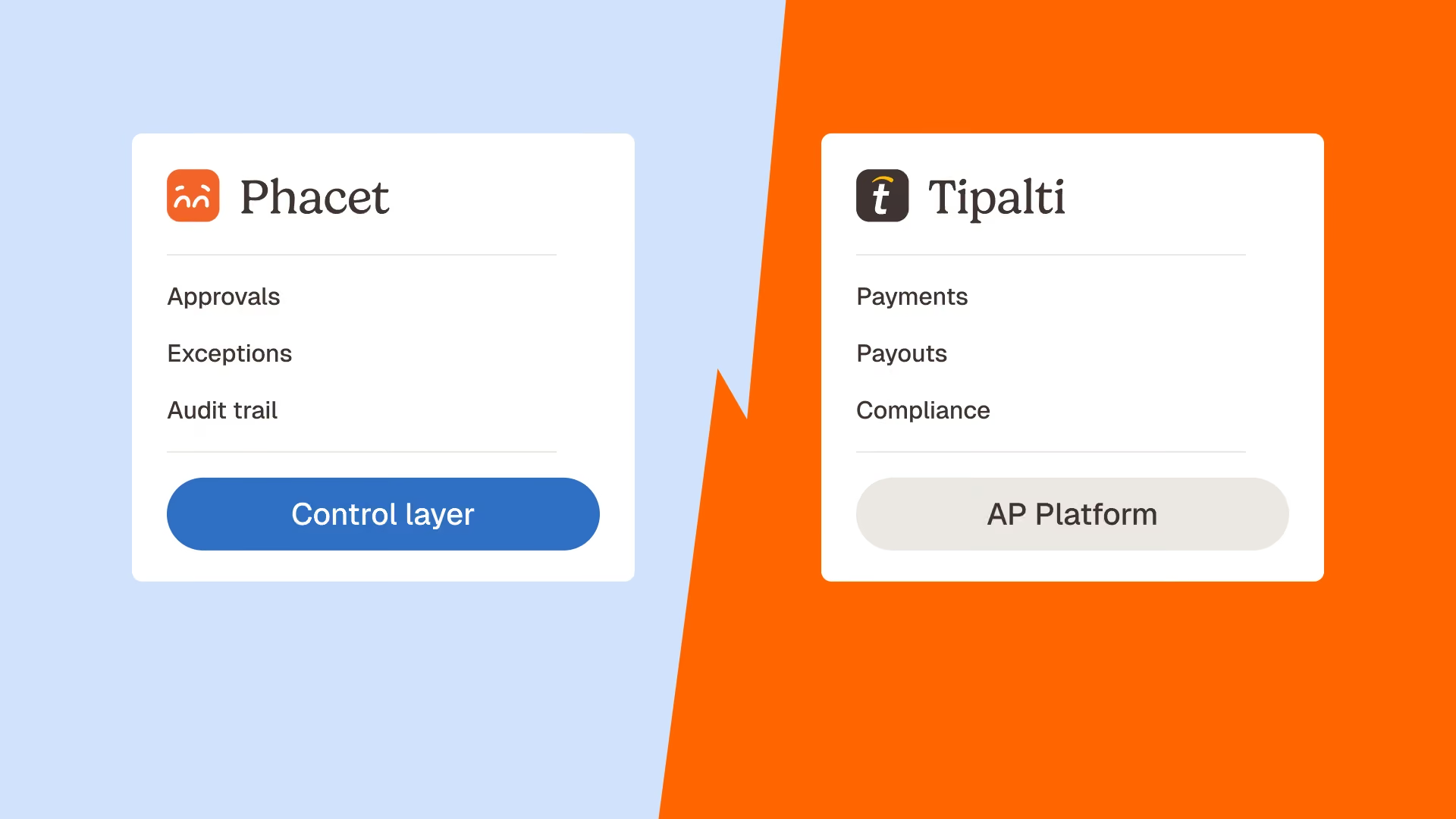
Tipalti is an accounts payable automation platform built on a licensed global payment rail. It captures invoices, routes approvals, matches invoices to purchase orders, and pays suppliers in 120 currencies across more than 200 countries and territories, using more than 50 payment methods. Almost every published Tipalti alternative replaces those same functions, so switching changes your vendor, not your level of control. The narrower question is worth asking first: when an invoice arrives at the right quantity but the wrong price, does anything in your stack stop it before payment? If the answer is no, what you need is not another AP platform but a control layer on top of the one you already run.
Key takeaways
- Tipalti runs two-way and three-way PO matching, but no published alternative checks invoice lines against a negotiated price list, which is a different control entirely.
- Across the six highest-ranking "Tipalti alternative" pages, roughly 19,500 words in total, the terms "negotiated price", "price list" and "overbilling" appear zero times (measured 27 August 2026).
- Five of those six comparison pages are published by a direct competitor that ranks itself first, which is why every list gives a different answer.
- At Astotel, an 18-hotel Paris group, checking invoices against the negotiated price list surfaced up to 6 euros per kilo of difference on the same smoked salmon between two hotels, and nearly 5,000 euros a year of billing errors on a single supplier.
- Tipalti scores 4.4/5 on G2 across 421 reviews and 2.7/5 on Trustpilot across 102 reviews: the first is written by finance buyers, the second largely by payees. Read the one that matches your job.
Is Tipalti a payment processor, or an AP automation platform?
Both, and that is exactly what makes the comparison confusing. As of August 2026, Tipalti describes itself as an agentic AI platform for finance operations, covering accounts payable, mass payments, procurement, expenses and treasury in a single connected suite.
Underneath the software sits a payments business. On its own product page Tipalti presents itself as a licensed money transmitter, a status that lets it execute transfers directly rather than handing them to your bank. That explains the reach: more than 200 countries and territories, 120 currencies, more than 50 payment methods, and automatic tax ID validation across more than 60 countries.
This dual nature has a direct consequence for your decision. If you are looking for an alternative because you want to pay differently, you are shopping for a payment rail, and the shortlist is short: BILL, Trolley, Routable, Payhawk. If you are looking for an alternative because errors are slipping through, you are not shopping for a rail, you are shopping for a control. And there, the published shortlist does not answer your question.
What are the disadvantages of using Tipalti?
Three families of objection come up repeatedly in verified reviews, and they are attributable, dated and publicly readable.
Implementation cost and transaction fees. On r/Accounting, one practitioner sums it up: "Tipalti: seems the only one with truly unified global compliance. But not the cheapest, implementation fees and transaction costs add up." The same thread notes that configuration complexity grows with each additional module.
Process rigidity once an invoice is in flight. Neetu K., a controller, writes on Capterra on 22 June 2026 that administrators cannot edit bills after approval and that the process must be restarted from scratch. Maira C., an accounting manager at a 201 to 500-employee bank, describes a full workaround on 8 November 2025: export the transactions to Excel, attach them to a legacy approval form, and route them through DocuSign.
Friction on matching. Again on r/Accounting: "Tipalti is clunky and it takes too many clicks. For 3-way matching, you need to click around a lot and the PO takes 20 seconds to load." And James L., a director of finance, notes on Capterra on 26 December 2025 that there are "a great many hoops to jump through to prove compliance."
A fourth objection appears less often but costs far more when it applies to you: ERP sync reliability. A G2 reviewer quoted in a third-party comparison goes as far as saying that on NetSuite you cannot trust the product to work consistently. Others describe repeated sync errors and slow support escalation.
Take that family seriously during evaluation, whichever vendor you are looking at. An integration that fails silently does not show up in a demo. It shows up three months later, when your accountant spends Fridays reconciling by hand what the tool was supposed to reconcile alone. Ask to see error handling, not the happy path.
None of this disqualifies Tipalti. It describes what a full platform costs, and much of it applies to its direct competitors, several of which collect the same complaints on the same review sites. The point that matters for your decision is elsewhere: none of these objections is about what the tool checks. They are all about how it does what it already does.
The detail nobody points out about Tipalti's ratings
Tipalti scores 4.4 out of 5 on G2 across 421 reviews, and 4.6 out of 5 on Capterra across 178 reviews. It scores 2.7 out of 5 on Trustpilot across 102 reviews, as of 2 April 2026.
That is not a contradiction. It is one product serving two audiences. G2 and Capterra are populated by finance buyers evaluating software. Trustpilot is populated by payees, freelancers, creators and suppliers evaluating whether a transfer arrived. Search data says the same thing: in the United States, "tipalti login" draws 3,600 searches a month against 390 for "tipalti accounts payable automation."
The practical consequence when you build a shortlist: read the platform that matches your job. A finance director who leans on Trustpilot is reading their suppliers' experience, not their own.
Why every "best Tipalti alternative" list gives a different answer
Ask Google which alternative to Tipalti is best, and six sources ranking on the same page will give you six answers. This is not a disagreement between experts. It is a market structure.
| Ranking source | Answer given | Who publishes it |
|---|---|---|
| stampli.com | Spendesk | Stampli, direct competitor |
| rillion.com | Rillion, first on its own list of 12 | Rillion, direct competitor |
| brex.com | Brex, first on its own list of 5 | Brex, direct competitor |
| routable.com | Routable, first on its own list of 8 | Routable, direct competitor |
| spendesk.com | Spendesk, European angle | Spendesk, direct competitor |
| gartner.com | Basware AP Automation | Analyst, vendor-funded model |
Measured 27 August 2026 on the ranking results for "tipalti alternatives" and "alternative tipalti".
Five of the six editorial pages that rank are written by a vendor selling the product it puts at the top. That is not dishonest, it is ordinary content marketing, and everyone does it. But it means none of those pages can tell you something that would hurt its author, and in particular not this: the problem you are trying to solve may not be a platform problem at all.
Worth stating plainly: Phacet does not sell a payment rail and appears on none of those lists. That is not a claim to neutrality, it is a fact about scope. We have nothing to gain from moving you off your payments platform, which makes the rest of this page easier to write.
Tipalti alternatives, sorted by the function they actually replace
Since the existing lists mix everything together, here is the same material arranged differently: not by preference, but by the function each tool actually replaces. The names below are the ones that recur most often in ranking comparisons and in Google's generative answer, measured 27 August 2026.
| The function you want to replace | Names that recur | What switching does not solve |
|---|---|---|
| International payment rail and mass payouts | Trolley, Routable, Payhawk, BILL | Checking the invoiced price |
| Invoice capture and approval | Stampli, Medius, Basware, AvidXchange | Checking the invoiced price |
| Cards, expenses and spend | Brex, Ramp, Spendesk, Airbase | Checking the invoiced price |
| Procurement coverage | Coupa, Precoro, SAP Concur | Checking prices on non-PO spend |
| Line-level invoice control before payment | A control layer on top of what you run | Payment, which stays with your current tool |
Names collected 27 August 2026 from the ranking comparisons and Google's generative answer. Not exhaustive, and deliberately unranked.
Read the right-hand column. On the first four rows it says the same thing. That is not a writing shortcut, it is the result of the count in the next section: those four families differentiate from each other on payments, usability, price and geographic coverage, and none of them differentiates on verifying the invoiced price, because none of them addresses it.
This grid has an immediate practical use during scoping. If you cannot place your need on a single row, you have two distinct problems, and it is better to know that before the RFP than after. Plenty of teams open a "replace our AP tool" evaluation when in reality they have a solved payments problem and an unsolved control problem. They come out of the process with a new tool for the first, and the second untouched.
A simple three-question test. How many euros or dollars did you recover on supplier billing errors over the past twelve months? If you cannot answer, who should have caught them? And if the answer is "nobody, we check on a sample basis," you have just identified the missing function, and it is on none of the published lists.
The question no alternatives list asks: what does your AP automation actually catch?
Across the six highest-ranking pages, roughly 19,500 words in total, here is what a term-by-term count returns, run on 27 August 2026 against the rendered text, with a word-boundary regular expression to discard substring false positives:
- "price list", "negotiated price", "contract price": zero occurrences
- "overbilling", "overcharge", "overpayment", "billing error": zero occurrences
- "cross-system": zero occurrences
- "before payment", "pre-payment control": one occurrence across all six pages
- "audit trail": two occurrences across all six pages
Nineteen thousand five hundred words comparing platforms on payments, ERP integration, currencies and price. Not one word on what control recovers in money.
Matching to a purchase order is not matching to a price list
Precision matters here, because the confusion is easy and it sits at the heart of the subject. Tipalti does two-way and three-way matching: it verifies that the invoice lines up with the purchase order and the receipt. That is a real control, a serious one, and one of the reasons teams choose it.
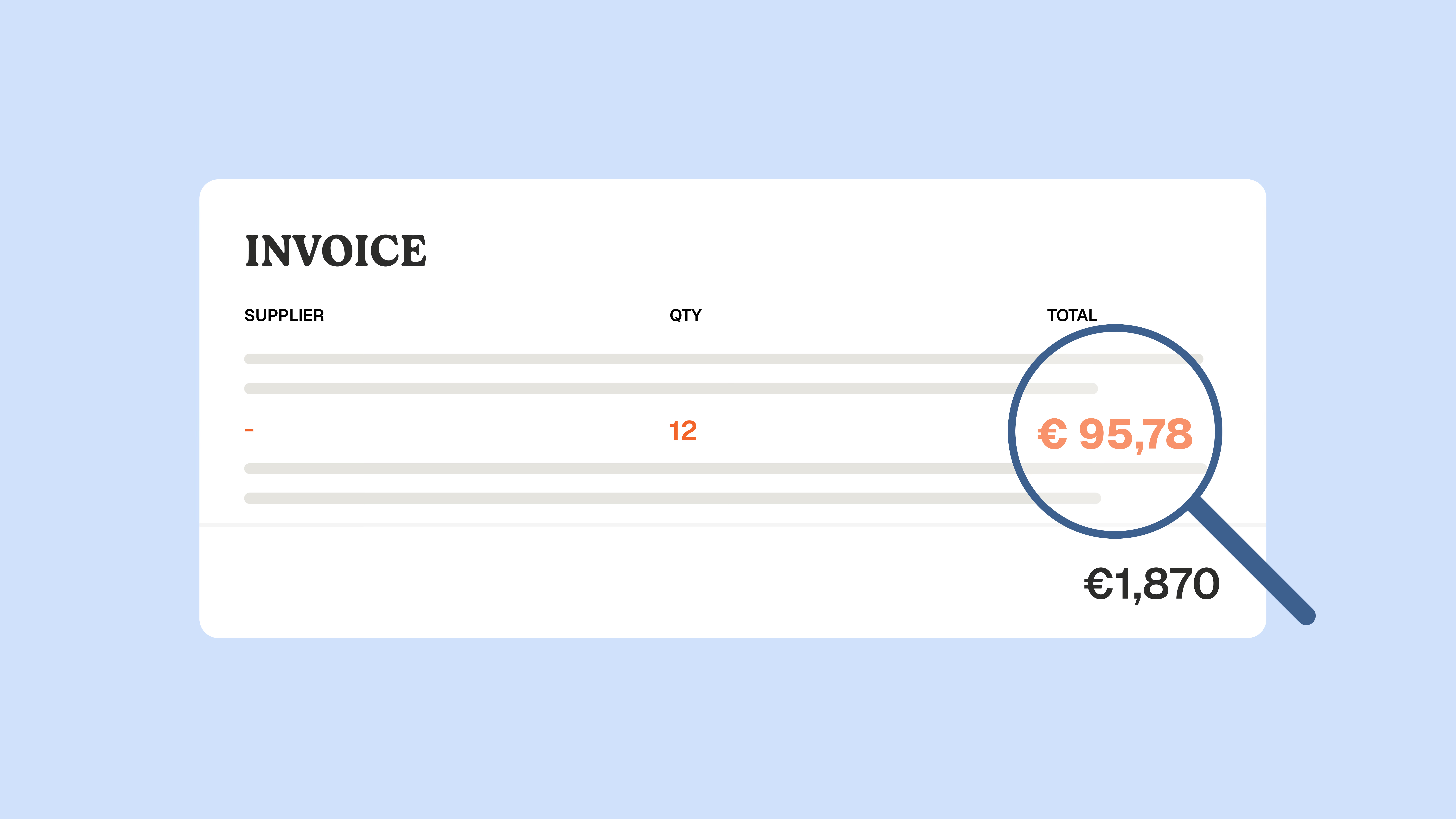
Three-way matching answers the question "did we order and receive what is being billed." It does not answer the question "is the price we are billed the price we negotiated." If the purchase order already carries the drifted price, or if there is no purchase order at all, which is the norm for recurring supply in hospitality, food service and retail, three-way matching passes and the invoice goes out for payment.
That is precisely what happened to Astotel's procurement team, an 18-hotel Paris group. Valérie, the group's purchasing director, had until then been checking by randomly selecting invoices to compare prices across properties. In her words:
"For the same reference of smoked salmon and the same quantity, I found up to a 6 euro difference per kilo between two hotels." And that despite a shared price list.
The order was correct. The delivery was correct. The price was not. No purchase order match would have raised the flag.
Once systematic line-level checking was in place, the agent that enforces negotiated price lists put a number on the gap: up to 400 euros of errors per month on a single supplier, close to 5,000 euros a year. Valérie describes the leverage: a difference of 1 to 2 euros per litre of orange juice, multiplied across 18 properties, has an immediate financial impact.
"Since working with Phacet, I've saved precious time on purchase analysis. I no longer get lost in Excel sheets or PDFs, I save up to two days per month and catch mistakes I would never have spotted on my own." Valérie, Purchasing Director, Astotel
Your automation pays faster. Does it check prices?
Phacet's accounts payable hub brings together the agents that verify every invoice line against your negotiated terms, before payment, with a trace of every decision.
Control layer versus payments platform: the comparison
Here is the comparison as it actually presents itself, between three kinds of tool rather than between brands. Measured 27 August 2026 against public vendor documentation.
| Function | AP platform with payments | Control layer | ERP alone |
|---|---|---|---|
| Executing the supplier payment | ✓ Licensed rail, 200+ countries | ✗ None, by design | ✗ Through your bank |
| Invoice capture and coding | ✓ OCR and AI | ✓ Extraction into auditable tables | ✗ Manual entry |
| Three-way matching, invoice, PO, receipt | ✓ Standard | ✓ Standard | ✓ Partial, in-system |
| Line-level price check against the negotiated list | ✗ Out of scope | ✓ Core function | ✗ Out of scope |
| Control on spend with no purchase order | ✗ The PO is the reference | ✓ The contract or price list is the reference | ✗ No |
| Scope beyond accounts payable | ✗ Closed suite | ✓ Bank, cash, payroll, intercompany | ✗ In-system only |
| Reasoning exposed to an auditor | Approval log | ✓ Sources and intermediate steps visible | Journal entries |
| Migration required | Replace the AP tool | None, it sits on top | 6 to 18 months |
Measured 27 August 2026 against public documentation. The "AP platform with payments" column describes the category, not one specific vendor.
What is the best software for accounts payable automation?
There is no universal answer, and any page that gives one is selling something. There are, however, three criteria that settle it, and curiously they are the ones AI search engines ask themselves when you request a Tipalti alternative: monthly invoice volume, the accounting system or ERP in place, and whether you have multi-entity or multi-currency needs.
1. Your monthly invoice volume. Below a few hundred invoices a month, a full AP platform costs more in subscription and transaction fees than it saves. Above that, automating data entry pays for itself. This criterion decides whether to buy a platform. It says nothing about control.
2. Your ERP or accounting system. This is the criterion that sinks the most projects. An integration that resyncs badly produces discrepancies your team will spend its time correcting, which cancels the gain. Ask to see sync error handling in the demo, not the nominal sync.
3. Your entities and currencies. If you run several entities, the hard part is not paying, it is getting each document to the right place. Coiro handled this with a single entry point for all incoming supplier documents, with an agent that sorts, classifies and routes to the correct entity, and that catches duplicate invoices and documents sent to the wrong address along the way.
What about spend with no purchase order?
This is the blind spot that no comparison covers, and it is larger than most finance teams assume. Recurring supply, utilities, professional fees, maintenance, marketing retainers: a great deal of spend arrives without a purchase order, or against a blanket order that carries no line-level pricing.
On that spend, three-way matching has nothing to match against. The invoice is approved by whoever owns the budget, on the basis of whether the amount looks plausible. Plausible is not the same as contractual, and the gap between the two is exactly where price drift lives.
The reference for non-PO spend is the contract or the price list, not the order. That is a different data source, a different comparison, and it is the reason a control layer is not simply a better-configured AP platform.
What evidence should you request on GDPR and data residency?
American comparisons never ask this, and it becomes blocking in Europe the moment a legal team looks at the file. Three concrete requests to make during evaluation:
- The physical hosting location, region by region, not just a "GDPR compliant" line on the pricing page. Ask for the cloud provider name and the region.
- A current ISO 27001 certificate, with its expiry date and the scope it covers, which does not always include the product you are buying.
- A written commitment on model training. Are your invoices, your negotiated prices and your supplier names used to train a third-party model? The answer needs to be contractual, not commercial.
Those are the three points Phacet's security page details on EU hosting, ISO 27001 certification and the no-training commitment.
When Tipalti is the right answer, and when it is not
A comparison that never says when the competitor wins is not a comparison. Here is where Tipalti is the right call, and where switching would be a mistake.
Tipalti is the right answer if your dominant need is international mass payout: paying hundreds or thousands of recipients across many countries, with tax form collection, compliance screening and currency management. Few vendors do that at this level, and a control layer never will. Sarah S., an SVP of Finance, writes on Capterra on 4 March 2025 that she chose Tipalti specifically for its three-way matching, judging it better than the alternatives she evaluated.
Tipalti is not the right answer if your suppliers are mostly domestic or European, paid by standard bank transfer, and your pain is not payment but the reliability of what is being billed. In that case you would be buying a global payment rail to solve a price control problem, which is expensive and would not solve it.
And the most common case, the one the alternatives lists ignore entirely: Tipalti is doing its job well, and the problem is somewhere else. Switching platforms would then cost several months of project work to reproduce what you already have.
What switching actually costs
Comparisons price the subscription. They almost never price the migration, which is the heaviest line item and the only irreversible one.
Every supplier has to be re-onboarded, which means asking each one again for banking details and tax forms. On a portfolio of several hundred suppliers, that step is measured in weeks of follow-up, and it occupies your accounting team at exactly the moment they also have to learn a new tool. Then you rebuild approval workflows, remap the chart of accounts and cost centres, redo the ERP integration, and run both systems in parallel through one or two closes.
On r/Netsuite, one practitioner sums up the calculation many teams make too late: on top of implementation cost come change management and data integrity considerations during the cutover. Another thread describes how an AP automation project nearly cost a finance chief their job, when the new tool pushed a payment method the company's main vendor refused to accept.
None of that is an argument against switching when switching is warranted. It is an argument for checking that it is. If the trigger for your evaluation was a billing error that slipped through, the migration will cost you a quarter and land you in exactly the same place: a new platform that still does not check your negotiated prices.
Adding a control layer on top involves none of those steps. Your suppliers see nothing, your approval workflows do not move, your payment tool stays yours. What changes is that a wrong-priced invoice raises an alert before it goes out.
Replacing versus adding a layer: what it looks like in practice
Three accounts from finance teams that added a layer rather than replacing their foundation.
Le Wagon, on auditability. Guillaume Morin, its CFO, describes the problem of two systems that do not talk to each other: "Having both is good. What is not good is when both live their own parallel lives." Monthly reconciliation represented several days of work. But his real requirement is less about time saved than about what makes a result defensible at close:
"You cannot afford, as a finance professional, to have a black box: to hand over your data and receive an output in return. You have to understand how that output was constructed." Guillaume Morin, CFO, Le Wagon, June 2026
That is the difference between a tool that produces a number and a tool that exposes the source data, the calculation and the intermediate steps. On implementation he adds: "It is not magic. You are not left alone in front of your agent."
Coiro, on multi-entity. Francis Messiaen, CFO, states the objective in one sentence: "The objective is to be in supervision of the process rather than in its execution." The gain he quantifies is the equivalent of half an accountant's time, freed from repetitive administrative work. On trusting the tool he is blunt: "Having control over it. Understanding how it works. Having full mastery of it."
Smartbox, on time to value. The group, 800 employees across 14 countries, put in place an application matching payments against invoices, previously entirely manual: productivity increased fourfold. And on the question that worries buyers most, the project that never lands: "We didn't need extensive training. The tool is intuitive, and its integration didn't require complex modifications to our existing systems." Every use case was operational within six weeks.
Frequently asked questions
How much does Tipalti charge?
Tipalti does not publish a full price list and works from custom quotes. Public reviews mention implementation fees and per-transaction fees on top of the subscription. Ask for the fully loaded twelve-month cost, including transaction and foreign exchange fees, rather than the monthly subscription alone.
Can you automate accounts payable?
Yes, in three distinct stages. Structure first, extracting each invoice into a usable format automatically. Control next, matching that data against purchase orders, contracts and negotiated prices. Then exploit, surfacing discrepancies and anomalies before payment rather than discovering them at close.
How does AP automation software integrate with ERP systems?
Through an API connector or a file-based sync that pushes invoices, coding and payment status into the ERP. The quality difference between vendors is not the nominal sync, it is error handling: what happens when a record fails to write. Ask to see that path demonstrated.
Do you need an alternative to Tipalti accounts payable automation?
Only if the function you want to change is one Tipalti performs. If your issue is payment coverage, pricing or usability, an alternative platform makes sense. If your issue is that wrong-priced invoices get approved, no platform on the published lists addresses it, so switching would not help.
How do you calculate the ROI of automating accounts payable?
Count three things: hours saved on data entry, late payment penalties avoided, and money recovered on billing errors. Most calculations include the first two and skip the third, which is often the largest. At one hotel group, a single supplier accounted for close to 5,000 euros a year.
The bottom line
Tipalti alternative guides all answer the same question: which platform should you install instead. That is a legitimate question if your problem is payment, price or integration. It is beside the point if your problem is that an invoice at the wrong price clears approval and goes out for payment.
The useful distinction is not between brands, it is between two controls with confusingly similar names. Matching an invoice to a purchase order verifies what was ordered. Matching an invoice line to a negotiated price list verifies what was agreed. The first is standard across every AP platform. The second, across the six highest-ranking comparison pages on the market, is not mentioned once.
Six euros a kilo on smoked salmon, between two hotels in the same group, on the same price list. That is the kind of gap no payment rail will ever see, and that systematic checking catches on the first invoice.

Latest Resources

Unlock your AI potential
Go further with your financial workflows — with AI built around your needs.


