

Meal voucher reconciliation: verify every settlement
Published on :
September 2, 2026

Nicolas Marchais is co-founder and CEO of Phacet. After seven years at Spendesk, he built Phacet as the agentic layer that orchestrates across ERP, banking and email systems. Reliable, auditable, cross-system, what he calls a Finance Workforce.


This page is for finance teams running multi-site food, hospitality or retail groups in Continental Europe whose meal voucher balance sheet account never quite clears at close. If you are an employee looking up your daily limit, or a merchant applying for accreditation, this is not for you.
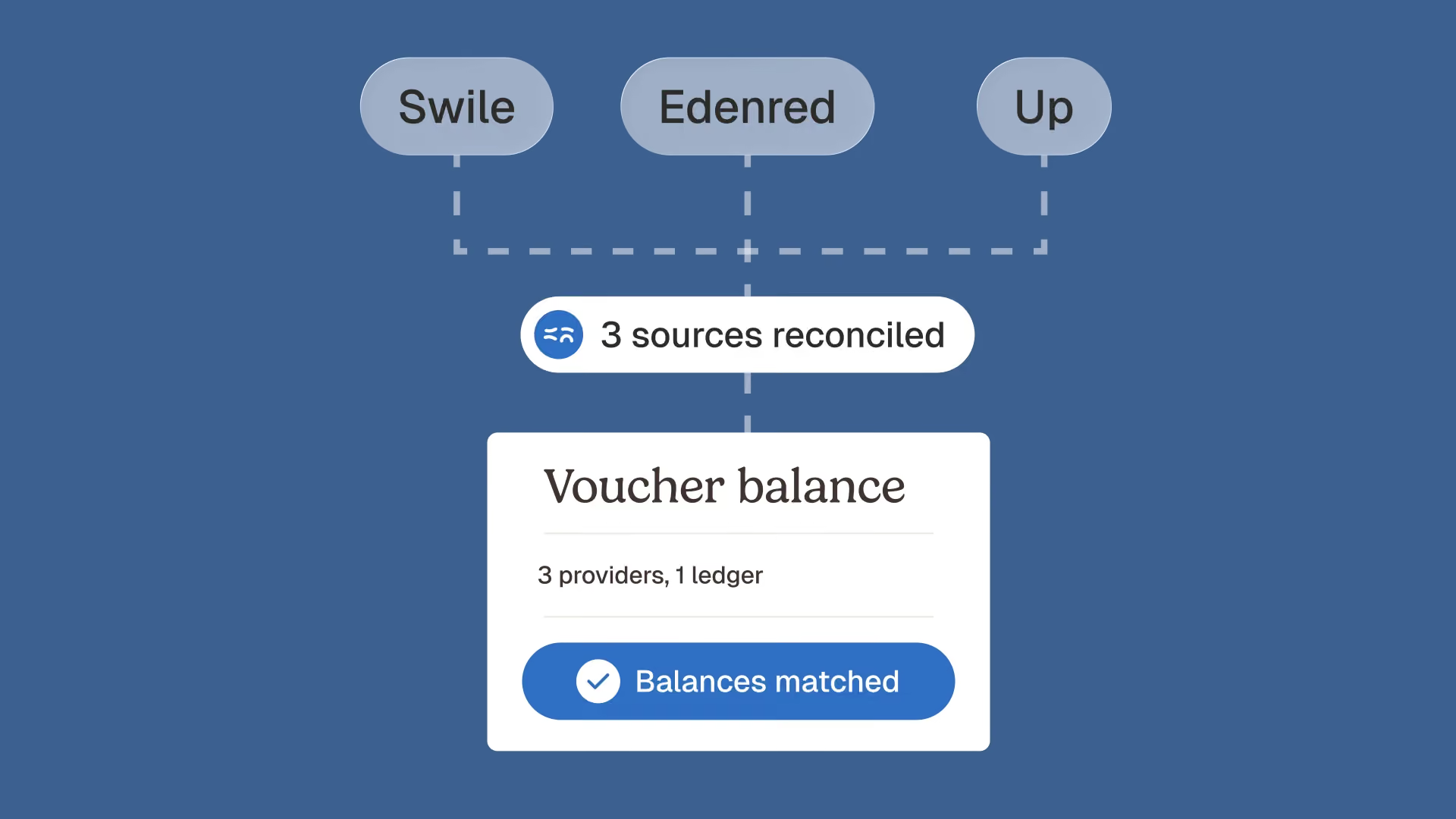
Meal voucher reconciliation is the control that matches what a merchant collected in meal vouchers against what each issuer actually paid back, net of commission. In France, the largest market for the scheme, issuers must settle within twenty-one days, so the problem is rarely the delay. The problem is proving the amount is right. Three mechanisms make that impossible without a dedicated reconciliation: the point of sale does not split takings by issuer, each issuer settles on its own date range, and some bundle paper and card flows into a single transfer. The control therefore means matching three sources that never align on their own: the issuer invoice, the meal voucher revenue recorded at the till, and the bank credit.
Key takeaways
- Under French law, the twenty-one day settlement deadline runs from the issuer's receipt of the voucher, not from the merchant's dispatch, so postal transit sits on the merchant's side (Labour Code, article R3262-25).
- Merchant commissions range from 1.5% to 5% of the amount collected across sources reviewed in August 2026, with some issuers adding a fixed fee of 3 to 8 cents per transaction.
- Four issuers held more than 99% of the French market in 2022, and each holds a monopoly on redeeming its own vouchers, which leaves merchants with no negotiating power (Autorité de la concurrence, opinion 23-A-16, 12 October 2023).
- Across the six editorial pages reviewed in the French top 20 on 27 August 2026, the word "reconciliation" appears zero times: the control itself is covered nowhere.
Why meal voucher settlements do not behave like card settlements
A card settlement is easy to check. The batch lands the next day, for an amount that maps to one identifiable trading day. Any gap shows up immediately.
Meal vouchers behave differently. Every issuer has its own invoice format, its own settlement calendar and its own fee grid. Payments arrive weekly, often grouped across several sites on a single invoice. Nothing lines up on its own.
A merchant described it precisely in a public thread on the Pennylane community forum in June 2025:
"We are a business that accepts meal vouchers in every form, paper and card, and it is very hard to find our way around, to reconcile the settlements from the different providers against what was recorded at the till. That makes reconciling the till with the settlements close to impossible as things stand. Is anyone else facing this? And above all, how do you fix it?"
Valentin Boucher, Pennylane community, 19 June 2025, translated from French. The thread received no reply.
That silence is the subject of this article. Across the six editorial pages reviewed in the French top 20 for this query on 27 August 2026, the word "reconciliation" appears zero times, and neither do "discrepancy" or "balance sheet account". Everything published explains how to get reimbursed. Nothing explains how to verify that you were.
The gap gets expensive as soon as there are several sites. A single restaurant can still eyeball it. A ten-site group with five issuers and grouped invoices cannot. That is daily life for multi-site food and beverage groups, where data arrives from everywhere and reconciles nowhere.
The three discrepancies nobody looks for
The money does not vanish. It becomes unverifiable, which amounts to the same thing at close. Three specific mechanisms produce that effect, and they compound.
1. The till does not split takings by issuer
On most point of sale systems there is no separate payment method per issuer. A Swile payment, an Edenred payment and an ordinary card payment fall into the same bucket.
The consequence is immediate: the day's meal voucher revenue cannot be isolated from the Z report. Comparing an Edenred settlement against what was genuinely collected in Edenred vouchers is impossible. The control fails at step one.
2. Settlement windows do not align between issuers
Issuers do not credit day by day. They settle weekly, over periods of their own choosing that align neither with each other nor with your accounting month. One settles the 2nd to the 8th, another the 4th to the 10th.
At close, a transfer received on the 3rd can therefore cover takings straddling two periods. Cut-off becomes an estimate, and an estimate cannot be controlled.
3. Paper and card sometimes arrive in one transfer
Some issuers settle paper vouchers and card payments in a single transfer, with no breakdown to separate them. The two flows carry different deadlines and different commissions.
This third mechanism removes whatever control was left. You receive one net amount, without knowing which period or which medium it covers.
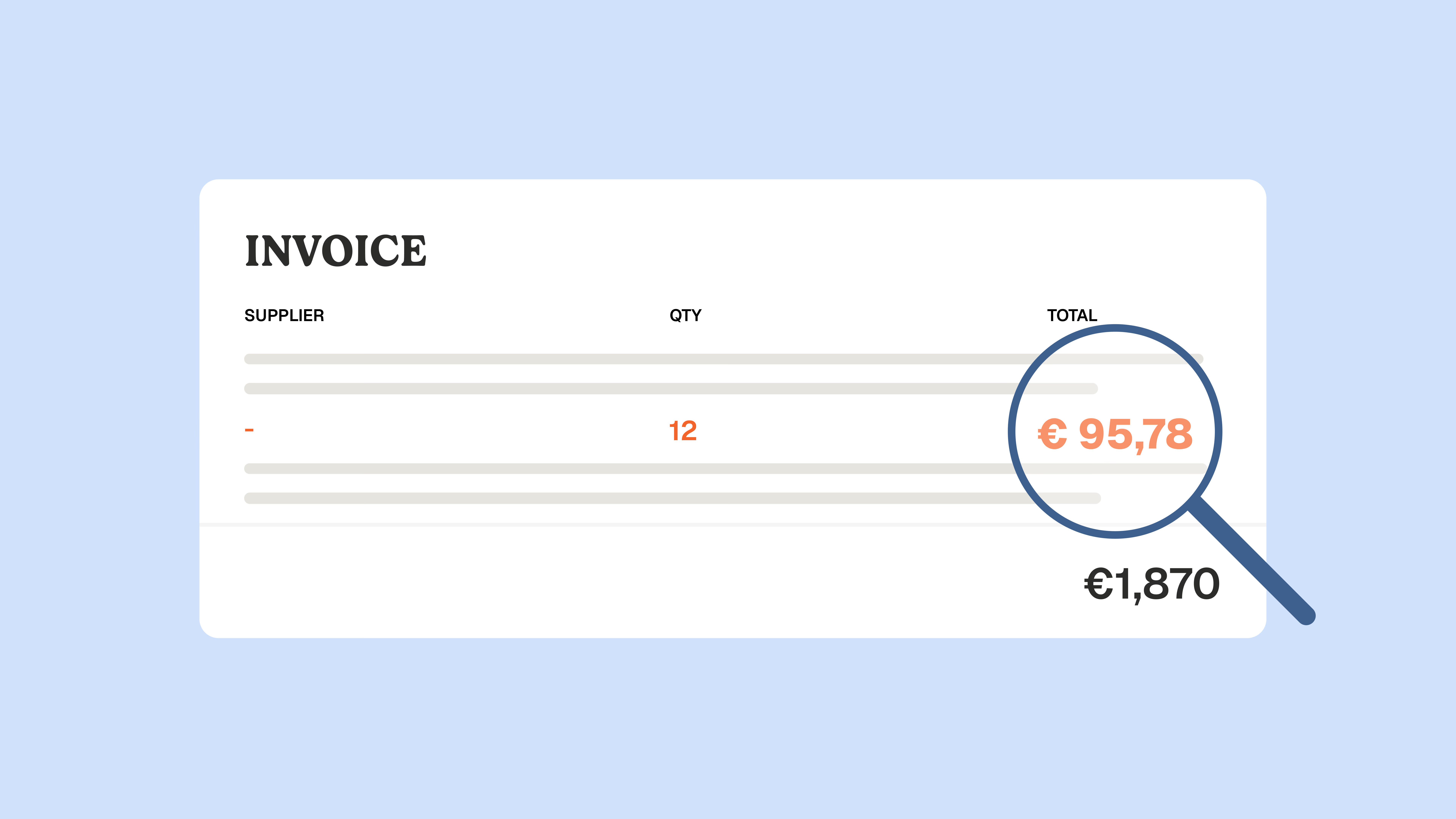
Line-by-line control in other flows shows what these blind spots cost. At Astotel, a group of 18 Paris hotels, systematically checking supplier invoices against negotiated prices surfaced up to 400 € of errors per month on a single supplier, close to 5,000 € a year. "I spot errors I would never have seen on my own," says Valérie, head of procurement. Different flow, same mechanism: what is not checked line by line is not checked at all. The same logic applies to controlling POS cash across every site.
Deadlines and commissions: what the law says, what issuers say
Before you can control, you need a benchmark. Two are enforceable: the statutory deadline and your contractual rate. Both circulate online in approximate form.
The statutory deadline is in calendar days, and it starts on receipt. Article R3262-25 of the French Labour Code states that payment "shall be made within a period that may not exceed twenty-one days from receipt of the voucher for settlement". Two details matter. These are calendar days, not working days, contrary to what several well-ranked pages claim. And the clock starts when the issuer receives the vouchers, not when you send them, so postal transit is on you. The phrasing "from handover", common even on institutional sites, misleads on exactly this point.
The commission rate has no stable reference value. A review of the best-ranked sources on 27 August 2026 returns three different ranges for the same reality.
| Source | Type | Commission stated | Settlement time stated |
|---|---|---|---|
| French Labour Code, art. R3262-25 | Primary source | Not regulated | 21 calendar days maximum, from receipt |
| Edenred | Issuer | 3% to 5% of transactions | Not stated in the article |
| Openeat | Competing issuer | 3% to 5%, plus 3 to 8 cents fixed per transaction. Positions itself at 1.5% maximum | Not stated |
| Lucca | HR software publisher | 1.5% to 5% | 24 to 48 hours on card, 5 to 7 working days on paper |
| GHR | Industry federation | Not covered | 7 days on average for Edenred, Up and Sodexo. 7 or 21 days by election for Bimpli |
Three different floors for one question, and one source pricing itself inside its own comparison. Treat the upper end as your working assumption and demand your contractual rate in writing, issuer by issuer. That is the only enforceable figure.
Why the rate does not move. The French competition authority investigated in 2023. Its opinion 23-A-16 of 12 October 2023 established that four incumbent issuers, Edenred France, Bimpli-Swile, Sodexo Pass France and Up Coop, held more than 99% of the market in 2022, on a total face value of close to 8.5 billion euros. Critically, each issuer holds exclusivity over the vouchers it issues: it is the only party able to acquire them for redemption. Against 234,000 accredited merchants, the balance of power is structurally lopsided.
The authority also found that merchant-side commissions rose between 2018 and 2022 while the commissions paid by client companies fell, turning negative at some issuers. It recommended against capping fees and in favour of ending the redemption monopoly. Until that reform lands, the operational conclusion is blunt: you cannot negotiate your commission, so your only lever is verifying it is applied correctly.
One last marker: the Centrale de règlement des titres, which processed paper vouchers for some fifty years, closed in 2023. Issuers took redemption back in house, each with its own address and remittance slip. Several pages still ranking on this topic point to the CRT. They are out of date.
How to reconcile meal voucher settlements in practice
The control rests on a three-way match. No mainstream tool does it natively, because it requires three systems that do not know each other to talk.
The method runs in five steps.
- Collect every issuer invoice for the period, in its original format. They arrive as PDFs, sometimes by email, sometimes from a different portal per issuer.
- Extract three amounts per invoice: gross collected, commission withheld, net settled. Check that the net equals the gross less your contractual rate, not some other rate.
- Rebuild till-level meal voucher revenue over the same date range as the invoice, site by site. This is the step the till's lack of breakdown makes hard, and it decides everything.
- Match the net settled against the bank line, allowing for value-date lag and for transfers that bundle paper and card.
- Isolate and qualify each discrepancy: amount never settled, commission above contract, multi-site invoice wrongly allocated, missing period.
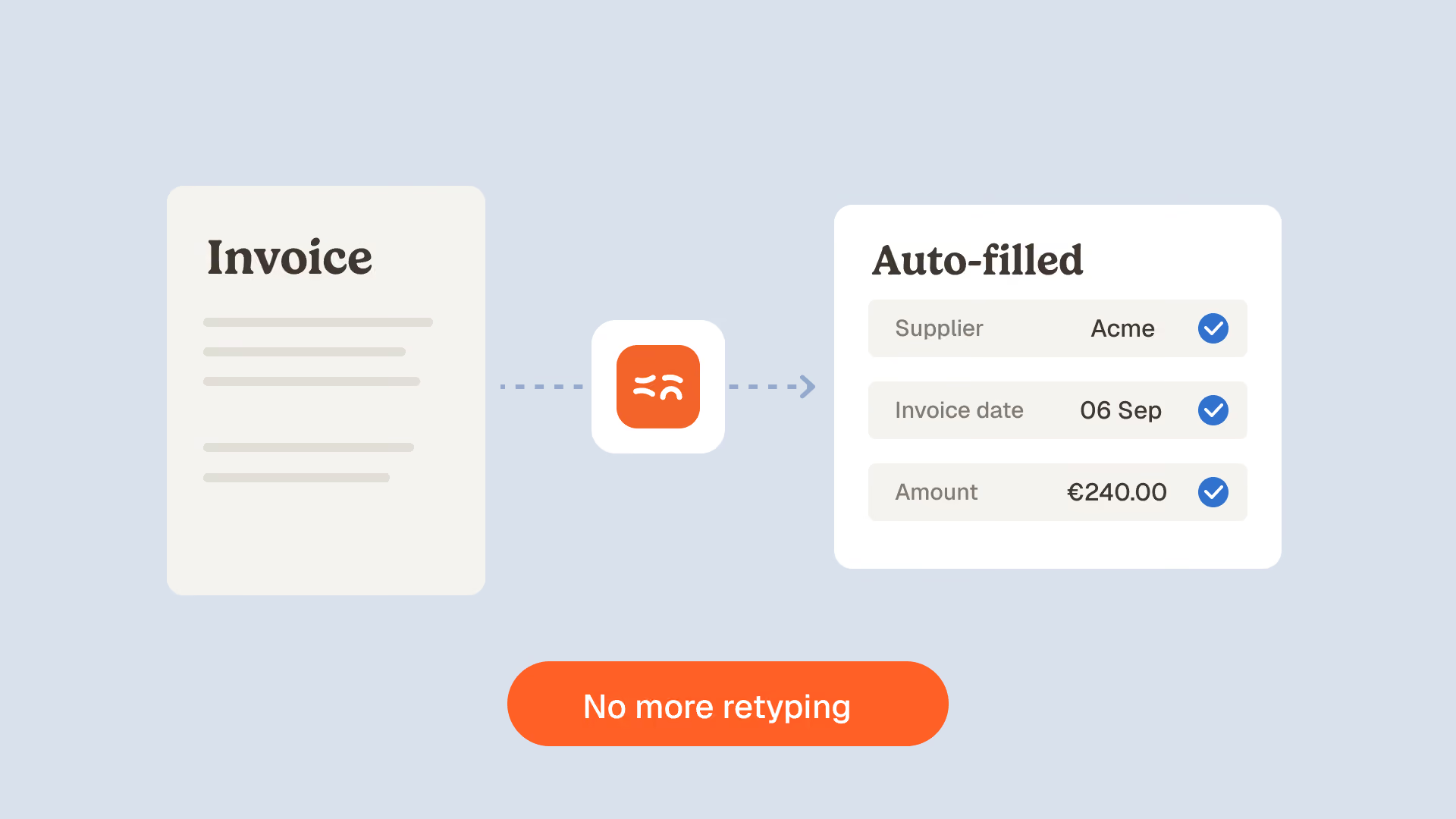
By hand, this takes hours per month per issuer, which is why it is almost never done. It is exactly the kind of repetitive control an AI agent absorbs. Phacet built a dedicated agent that reconciles electronic meal voucher settlements: it reads Swile, Edenred, Bimpli, Pluxee and Up invoices whatever their format, cross-checks them against POS revenue and bank flows, isolates commissions and surfaces discrepancies. That three-way match existed in no tool, and it runs on Phacet's semantic matching engine, which exposes its reasoning at every step rather than returning an opaque verdict.
Clearing the meal voucher balance sheet account at close
Everything above has one final symptom with an accounting name: a meal voucher balance sheet account that never clears. Amounts collected but not yet settled pile up month after month, and the balance grows without explanation.
A residual balance is normal. One that grows without being decomposable is not. The difference is whether you can answer one question: what is this balance made of?
Four checks settle it, and they belong before close, not during.
- Match every paper remittance slip to its settlement, and flag those past twenty-one days from the issuer's receipt.
- Verify face value collected against face value redeemed, before commission, on every invoice.
- Allocate grouped invoices by site, so each location's analytics reflect its own takings.
- Check your list of active issuers against your accreditation and affiliation contracts, including flows routed through the Conecs scheme and the open banking network.
A decomposed balance is no longer an unexplained provision. It becomes an identified receivable, claimable, and documented for your accountant and your auditor alike.
Settlement is regulated, the control is not
The law sets a deadline. The competition authority documented the imbalance and issued its recommendations. But no statute, no issuer and no tool guarantees that this week's transfer matches what you collected. That control belongs to you, and on a market where you do not negotiate your commission, it is the only lever you have.
The good news is that it automates. At La Nouvelle Garde, a group of ten Paris brasseries, finance teams spent close to 70% of their time between Gmail and Pennylane before automating their controls. "Phacet is like a team member who operates around the clock," says Théo Richard, its CFO. The agent does not replace the controller: it does the matching and hands over the discrepancies, so the time goes into explaining them rather than hunting for them.
Frequently asked questions
What is the legal deadline for meal voucher settlement?
In France the maximum is twenty-one calendar days, set by article R3262-25 of the Labour Code. It runs from the issuer's receipt of the voucher for settlement, not from the date you sent it. In practice, electronic vouchers settle within a few days, well inside that statutory ceiling.
What commission do issuers charge merchants?
Public sources reviewed in August 2026 give ranges from 1.5% to 5% of the amount collected, with some issuers adding a fixed fee of 3 to 8 cents per transaction. No regulatory cap exists: the French competition authority explicitly recommended against introducing one in 2023. Only your affiliation contract is enforceable.
How do merchants redeem paper meal vouchers now the CRT has closed?
Since the Centrale de règlement des titres ceased operations in 2023, you send paper vouchers directly to each issuer, with a remittance slip generated from its affiliation portal. Every issuer has its own address and its own slip. Vouchers from different issuers can no longer be remitted together.
What can I do if an issuer settles late?
Start by checking when the issuer received your vouchers, since that is what starts the twenty-one day clock, not your dispatch date. Then contact the issuer's affiliation desk with your remittance slip number. In France, the national meal voucher commission can be approached if the dispute persists.
Why does my meal voucher balance sheet account never clear?
Because takings and settlements do not cover the same periods. Issuers settle weekly on windows of their own, often straddling your accounting month, and sometimes group several sites onto one invoice. Without a three-way reconciliation, the residual balance stays undecomposable and grows at every close.


Latest Resources

Unlock your AI potential
Go further with your financial workflows — with AI built around your needs.


