
Detect fake IBAN fraud
Check every supplier bank detail change and score the fraud risk.

Introduction
Fake IBAN fraud is the leading corporate fraud in France. A credible email requesting a bank detail change, and the payment goes to the wrong beneficiary. Manual checks are insufficient and not systematic.
Phacet extracts data from every new IBAN received, compares it against your existing supplier database (country, bank, name, history), checks consistency and scores the risk. Suspicious changes trigger a validation workflow before any payment.
When to use this Phacet
Built for CFOs, AP accountants or treasurers who want to:
• Systematically check every supplier bank detail change request.
• Score fraud risk before updating bank details.
• Set up a validation workflow for suspicious changes.
• Protect the company against fake IBAN fraud (average amount: 50K€).
AI skills involved

Automatically pull key data points from your documents
Phacet identifies and extracts the fields that matter — invoice numbers, amounts, due dates, IBANs, supplier references, VAT codes, contract terms — even from unstructured or inconsistent documents. Data comes out clean and ready to use in the next step.

Validate every line against your rules, thresholds and references
Define your rules once - negotiated prices, spending caps, expense policy, contract conditions, approval thresholds - and Phacet applies them to every single row, every time. Every discrepancy is flagged with the exact reason, ready for review.

Cross-check your data against trusted external sources
Phacet can query external databases to verify or enrich your data - SIRET numbers and legal details via INSEE, intra-community VAT via VIES, bank details, official FX rates. Ideal for supplier onboarding controls, compliance checks and fraud prevention.

Spot duplicates, outliers and suspicious patterns in your data
Phacet scans your full dataset to surface what shouldn't be there - duplicate payments, abnormal amounts, unknown suppliers, unusual timing patterns, RIB changes. It catches what rules alone can't predict, without requiring you to define every possible scenario upfront.

Get notified on what matters and share results without manual work
Phacet sends alerts the moment a threshold is crossed or an anomaly is detected by email, Slack or in-app. It also generates summaries, dashboards and structured exports ready to send to your ERP, your team or your management. Results reach the right people at the right time, automatically.
Business impact

Fraud prevented: average amount €50K
Every bank detail change fraud attempt is detected and blocked before payment. One prevented case pays for the investment.
100% systematic control
Every bank detail change is verified — not just suspicious-looking ones. Fraud exploits exactly the cases that seem normal.
Confidence in supplier payments
Your teams know every transfer goes to the right beneficiary. The audit trail is complete.
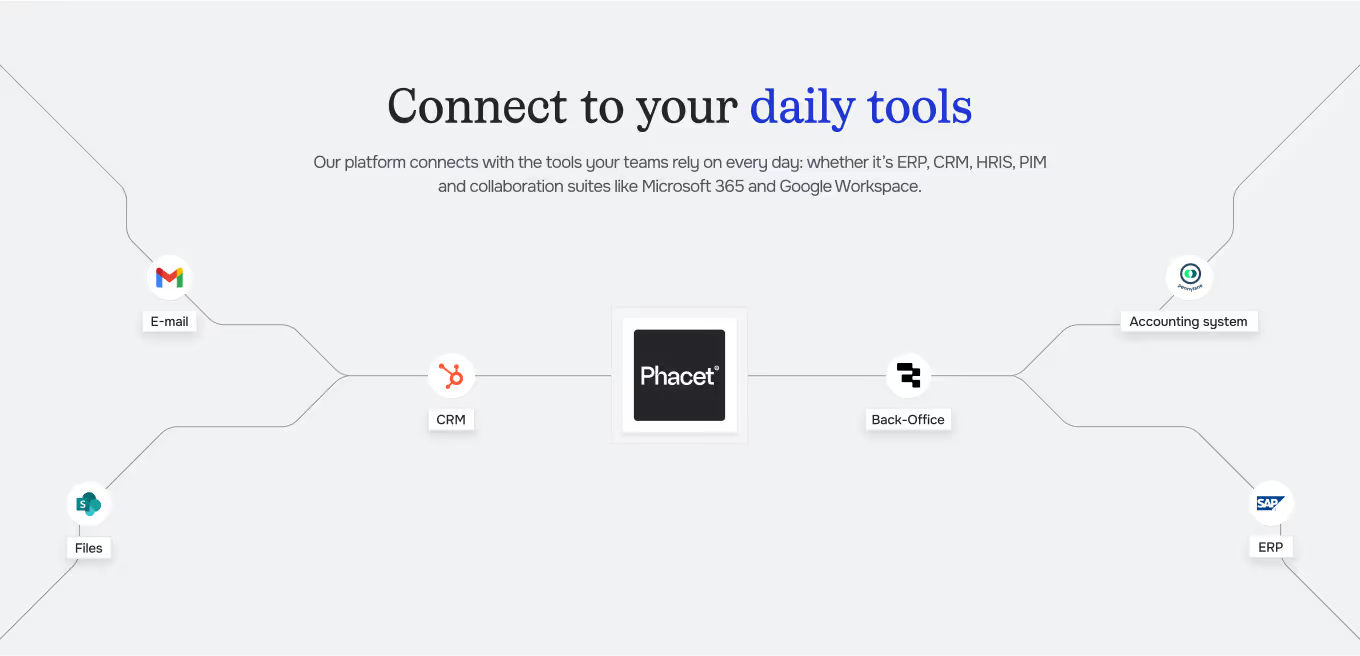
Integrated with everything











Steps to get Started
Configure your control rules
Import your existing supplier database (names IBANs, countries) and define your risk criteria.
The AI analyzes every change
Phacet compares the new IBAN against history (country bank, name, frequency) and calculates a risk score.
Suspicious changes blocked
A validation workflow triggers for high-risk scores The change is only applied after approval.
Validate and trace
Every decision (accepted rejected, pending) is recorded in the audit trail.
Unlock your AI potential
Do more with your existing resources using tailored AI solutions.
Frequently Asked Questions
Phacet combines multiple signals: country change, bank change, request by email vs. mail, change frequency, name consistency.
Yes. Phacet can cross-reference IBANs with external databases to verify bank/country/account holder consistency.
A simple export with name, IBAN and country is enough to start. A richer database improves scoring precision.
You define the approvers (CFO, treasurer). The workflow can include dual control for high-value amounts.
Yes. New supplier creations are also analyzed (name/IBAN/country consistency, SIRET verification).



GUIDE
The AI CFO guide
For accounting teams, accounting firms and CFOs of SMEs and mid-sized companies who want to know where to start.