

AI finance pilot: how to run a Proof of Value in 2 weeks
Published on :

Nicolas Marchais is co-founder and CEO of Phacet. After seven years at Spendesk, he built Phacet as the agentic layer that orchestrates across ERP, banking and email systems. Reliable, auditable, cross-system, what he calls a Finance Workforce.

Written for CFOs and finance leads of 50 to 500 person companies who have seen the AI demos and now owe a yes or no on one finance agent. Not about AI trading tools, nor about building your own model.
An AI finance pilot proves value in two weeks when it tests one agent on one process, using data the company already has. Replay last month's supplier invoices, delivery notes or bank lines through the agent, then compare what it flags with what your team caught. Week one sets up the agent and runs that history; week two runs two or three iterations on real data. The readout ranks the evidence: findings in money first, review time second, annual ROI last.
Last updated 27 September 2026.
Key takeaways
- A proof of concept tests whether a tool can be built; a proof of value tests what an existing agent finds in your own data.
- Replaying one closed month of supplier invoices through an agent produces findings you can verify line by line before any live payment is touched.
- Findings in money are facts, review time is a measurement and annual ROI is a projection: base the go or no-go on the first.
- Gartner expected at least 30% of generative AI projects to be abandoned after proof of concept, with unclear business value among the causes.
- Astotel's test phase saved its purchasing director at least two hours a day and exposed up to €400 a month of errors on one supplier.
Proof of concept, pilot or proof of value: which one fits in two weeks?
A proof of value, because it is the only one of the three that does not build anything. A proof of concept asks whether a tool can be made to work. A pilot runs a solution on a limited scope long enough to see how people use it. A proof of value asks a narrower question: what does an existing solution find in your own data, and is that worth paying for?
Phacet's glossary defines a proof of value as "a structured, time-bound pilot that demonstrates the measurable impact of a solution on a company's real data and processes, before any long-term commitment is made." The word that matters is existing. Nobody writes code during a proof of value. The time goes into configuring rules and checking results.
That difference explains why published timelines vary so much. A widely read guide to AI pilot projects by Kanerika suggests allocating "a 6-month timeline for a pilot project", with two months for model development and testing and two more for evaluation. That is a build schedule. MIT's NANDA initiative, in its 2025 report The GenAI Divide, found that external partnerships with customized tools "reached deployment ~67% of the time, compared to ~33% for internally built tools". Buying does not guarantee success. It does remove the months spent proving that something can be built at all.
| Criterion | Proof of concept | Pilot | Proof of value |
|---|---|---|---|
| Question it answers | Can this be built? | Will people use it? | What does it find in our data, and is it worth paying for? |
| What is tested | A prototype or a model | A solution on a limited scope | An existing agent on one process |
| Data used | Samples, often cleaned | Live flow on a subset | One closed month of real documents, then the live flow |
| Typical length | Weeks to months of build | Several months | About two weeks |
| Output | A feasibility verdict | Adoption feedback | Findings in money, review time, projected ROI |
| Main risk | Works on 20 cases, fails on 2,000 | Drifts without a decision date | Success criteria written after the results |
Why do so many AI pilots in finance never reach production?
Because most of them are asked to prove feasibility when the real question is value. The failure figures quoted everywhere do not measure the same thing, and only one of them is about proofs of concept.
| Figure | Source and date | What it actually measures |
|---|---|---|
| More than 80% | RAND Corporation, 13 August 2024 | AI projects of every kind, "by some estimates", about twice the failure rate of IT projects without AI |
| 95% | MIT NANDA, The GenAI Divide, 2025 | Organizations getting "zero return" on generative AI, from interviews with 52 organizations, a survey of 153 senior leaders and a review of over 300 public initiatives (January to June 2025) |
| At least 30% | Gartner on generative AI, 29 July 2024 | Generative AI projects expected to be abandoned after proof of concept by the end of 2025 |
| Over 40% | Gartner on agentic AI, 25 June 2025 | Agentic AI projects expected to be canceled by the end of 2027 |
The guides that repeat these numbers often blur them. Kanerika writes that "according to Gartner, about 30% of AI projects are expected to fail due to such misaligned expectations". Gartner's release says something else: at least 30% of generative AI projects abandoned after proof of concept "due to poor data quality, inadequate risk controls, escalating costs or unclear business value". A 2026 guide on first agent pilots in finance by Proforma Global turns the MIT figure into "95% of enterprise AI deployments", while the report counts organizations, not deployments.
The distinction is not pedantic. Misaligned expectations call for better communication. Unclear business value and poor data quality call for a test on real data with an amount at the end. That is the job of a proof of value. Practitioners ask for exactly this in their own words: an r/fintech thread asks where AI is "actually creating measurable value" beyond pilots. The answer starts with how the pilot is scoped, far more than with the technology.
What should the pilot run on? One process and one closed month
Choose a process your team already checks by hand, that repeats every week, and where a mistake has a price. Then run the agent on a month that is already closed, so every flag can be compared with what really happened.
Nicolas Marchais, co-founder and CEO of Phacet, gave Les Echos a simple test for where to start: tasks "that take two hours a day, repeatedly, are a good base to start introducing AI" (translated from French). Five more conditions make such a task ready for a two-week pilot:
- The outcome counts in money. A price above the negotiated rate, an invoice paid twice, a delivery invoiced but never received. Each finding carries an amount.
- The reference exists. A price list or contract, purchase orders, delivery notes, bank statements. The agent compares documents against something, and that something must be exportable.
- History is available. One closed month is the minimum. A quarter gives rarer errors a chance to show up.
- Today it runs on sampling. At La Nouvelle Garde, a group of ten brasseries, delivery notes and invoices were reconciled only by sampling before the check was automated. The case story puts a price on that gap: "A ten-cent difference on a delivery note, at our volumes, can mean half a margin point lost."
- One owner knows what "right" looks like. Someone who can confirm or reject each flag in minutes, because the review is the pilot.
Three processes pass these tests in most goods-heavy companies, and they are the ones Phacet's glossary names for a two-week proof of value: supplier price control, 3-way matching of purchase orders, delivery notes and invoices, and bank reconciliation. A supplier billing control agent is often the first candidate because its findings are the easiest to value: each one is an invoice line and a gap in euros or dollars.
Why a closed month rather than live traffic from day one? Because history already holds the answer. Developers make the same point: on r/LocalLLaMA, a developer criticizing most "AI accounting" tools describes a ledger holding "a decade of data showing exactly where every vendor and payee goes". Replaying a month the team has already processed turns the pilot into a comparison rather than a leap of faith. If several processes still compete, the choice itself is covered in which job to hand to an agent first.
Accounting firms apply the same logic at a different scale: one or two client files, one recurring workflow, one closed period. For an accounting firm, the extra question is whether the agent handles a second client without being rebuilt.
Which success criteria should be written before day one?
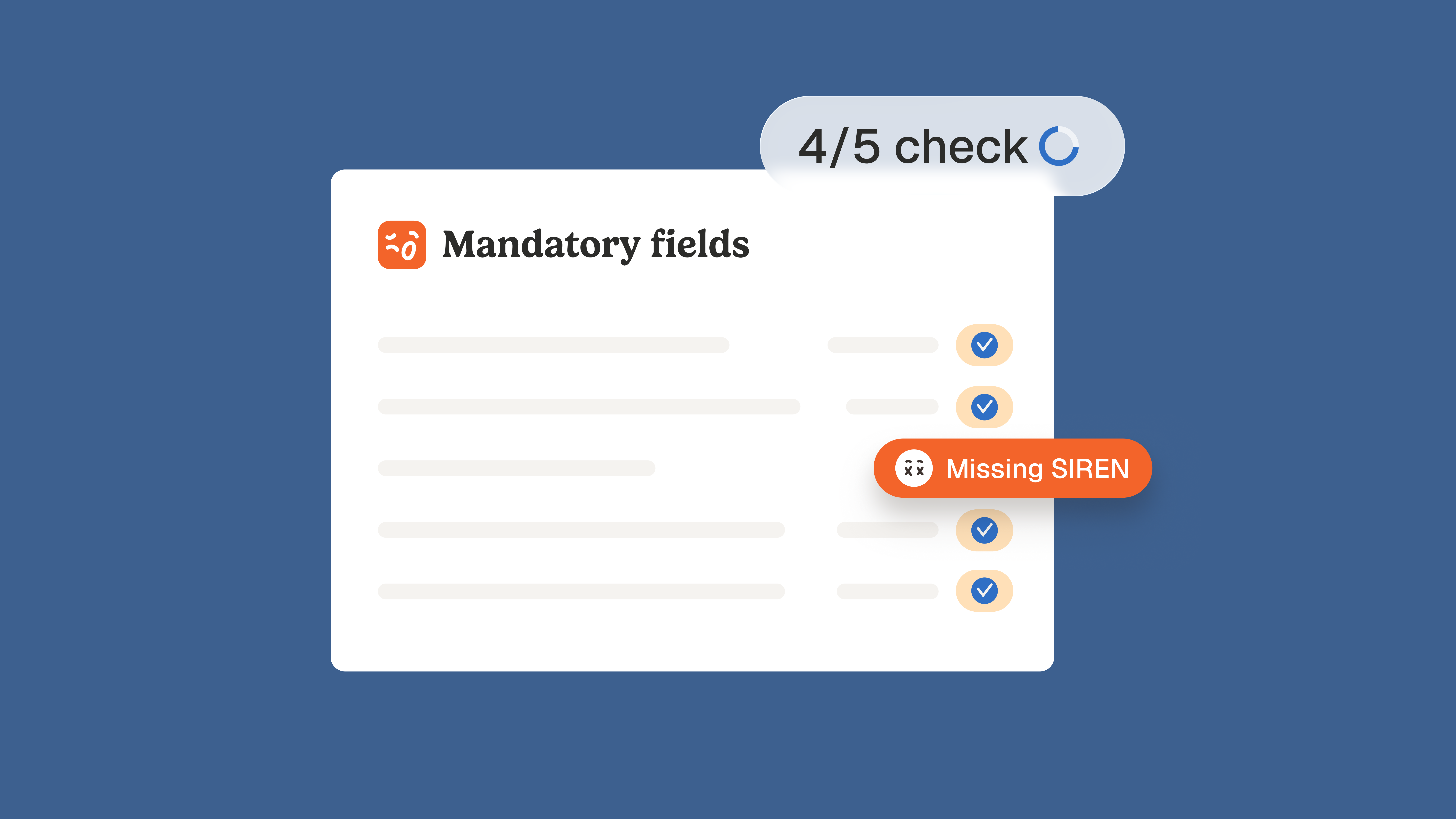
Five metrics, agreed in writing before the agent sees a single document: findings, precision, coverage, review time and traceability. Criteria written after the results turn a test into a sales argument, for either side.
These are also the criteria the public guides leave out. Across the five most visible English-language pages on AI pilots we read on 27 September 2026 (11,681 words in total), "false positive", "audit trail" and even "invoice" appear zero times, while "cost" appears 84 times. The guides discuss what a failed pilot costs. They never say how to tell whether a finance agent is right.
| Criterion | How it is measured in the proof of value | What to agree beforehand |
|---|---|---|
| Findings | Confirmed anomalies on the replayed month, each with its amount | The minimum total that would justify a deployment |
| Precision | Share of flags the owner confirms as real problems, the accuracy that matters to a reviewer | The share of false positives the team can tolerate before review time is wasted |
| Coverage | Share of documents processed, compared with the share checked by hand today | Whether 100% of the month is in scope, or which document types are excluded |
| Review time | Minutes the owner spends per flag, measured in week two | The weekly time budget the team can give to exceptions |
| Traceability | Every flag shows its source document, the rule applied and the reasoning | Whether an auditor could follow a flag without calling the vendor, the governance test any control must pass |
Add one stop condition. If precision is still below the agreed level after the third iteration, the pilot ends and the answer is no. A proof of value that cannot fail proves nothing.
What does a two-week proof of value look like, day by day?
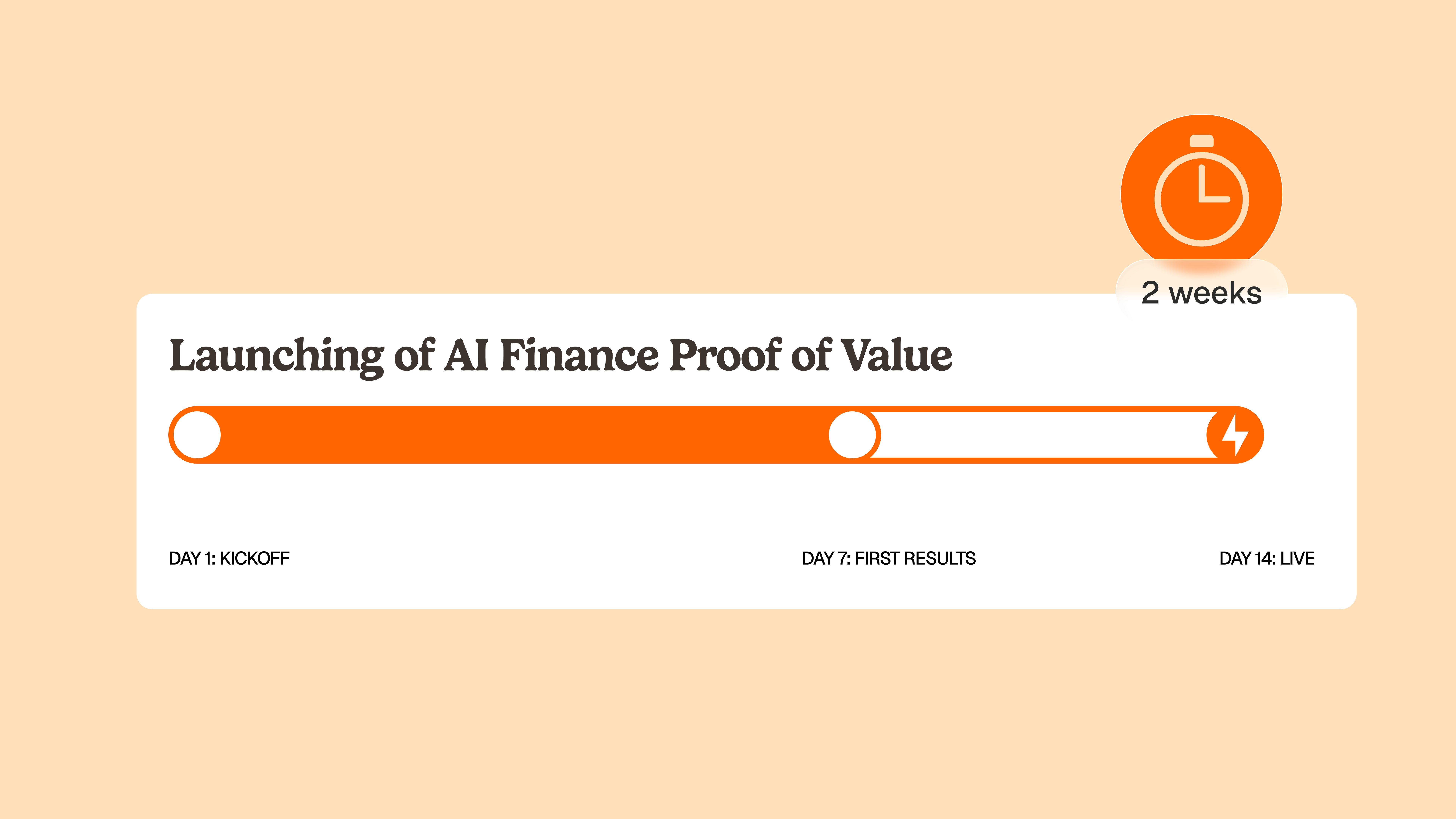
Ten working days, in two halves. The first week produces a first set of findings on history. The second week tunes the rules on real data until the flags are worth reviewing.
| Days | What happens | Who does what |
|---|---|---|
| Days 1 and 2 | Scope and access: export one closed month of documents and the reference data, write the rules in plain language | Finance owner: export and rules. Vendor: data intake |
| Days 3 to 5 | Configure the agent and replay the month | Vendor: configuration. Owner: answers questions on edge cases |
| Day 6 | First review: the owner confirms or rejects each flag | Owner: one working session |
| Days 7 to 9 | Second and third iterations: adjust tolerances, supplier-specific rules and known exceptions, then switch on the live flow if the rules hold | Vendor: iterations. Owner: short reviews |
| Day 10 | Readout against the five criteria, then a written go or no-go | CFO, owner and vendor |
The rhythm is not theoretical. Phacet's plans page states that simple agents reach production "in under a week" and standard agents in "1-2 weeks, 2-3 iterations on real data". Its glossary mentions one customer live within three days. Nicolas Marchais presented the method behind that schedule in a webinar on 10 June 2026, described as drawn from 342 deployments.
What the finance team gives is mostly attention: an export, a written set of rules and a few hours of review spread over two weeks. Replaying an export changes nothing in your systems, which is why the first findings can arrive before any integration work starts.
If you have a closed month of supplier invoices and the price list or orders they should match, you already have what a proof of value needs. Run a proof of value on your own invoices and judge the agent on your data rather than on a demo.
How should you read the results: findings, time or ROI?
In that order, because the three do not carry the same weight of proof. Findings are facts, review time is a measurement, and annual ROI is a projection built on the first two.
- Findings are facts. Every flag points to a document and an amount. The owner can check it, and the supplier can be asked for a credit note. At Astotel, a group of 18 Paris hotels, the purchasing director found, for the same reference of smoked salmon and the same quantity, "up to a €6 difference per kilo between two hotels". On a single supplier, errors reached up to €400 a month, nearly €5,000 a year.
- Time is a measurement, with a caveat. During the pilot the owner is also learning the tool, so total hours understate the long-run gain. Measure minutes per flag in week two instead. Astotel's purchasing director reports saving "at least two hours of work per day" during the test phase.
- ROI is a projection. Multiply the monthly findings by twelve, extend them to other suppliers or entities, then subtract the subscription and the review time. State each assumption, because the board will question every one of them.
Read what the pilot does not show as well. A proof of value on one process is not a deployment across the company. At Smartbox, 800 employees in 14 countries, "every use case addressed with Phacet was operational within six weeks", and payment-to-invoice matching became four times more productive. Two weeks buy a decision. Scaling the automation to other processes comes after it.
Which vendor claims should the pilot put to the test?
The claims a demo cannot prove: that the agent works on your documents, explains every flag and catches errors you already know about. Gartner warns about "agent washing", the rebranding of existing products as agents, and estimates that only about 130 of the thousands of agentic AI vendors are real. A pilot on your own data is the cheapest way to find out which kind you are dealing with.
- Your formats, not the vendor's samples. Include scanned invoices, multi-page PDFs, invoices received through EDI or a supplier portal, and the suppliers with the messiest layouts. A demo on clean samples tells you little about the month you actually close.
- Planted errors. Before the replay, list a few errors the team already found in that month: a duplicate, a price above contract, a missing delivery. If the agent misses them, you have learned more than any demo would show.
- The reasoning behind each flag. Open any flag and ask to see the document, the rule and the comparison. That is what matching with the reasoning exposed at each step means in practice.
- Where the data goes. Hosting, certification, GDPR compliance and whether your documents train the vendor's models. Phacet, for example, is EU-hosted, ISO 27001 certified and never uses customer data to train models, as its security page states.
What happens on day 15?
One of three decisions, taken against the criteria signed on day one: deploy, extend or stop. The worst outcome is none of them, a pilot that keeps running because nobody set an end date.
- Deploy when findings, precision and review time meet the thresholds. Keep the rules from week two and move the agent to the live flow.
- Extend when results are good but the scope was too narrow to judge: a second supplier family, a second entity, one more month of history.
- Stop when precision stayed below the agreed level after three iterations, or when the findings do not cover the cost. Write down why. It will save the next evaluation several weeks.
For the rollout itself, MIT's NANDA report offers a useful benchmark: its top performers reported "average timelines of 90 days from pilot to full implementation", while large enterprises took nine months or longer. A two-week proof of value is the first step on that path, not a shortcut around it.
The point of the exercise is not to show that AI works in finance. It is to show what one agent finds in your invoices, how much of your team's time the review takes, and whether the answer is worth paying for. The team keeps the rules and the decisions. The agent does the checking, on every document instead of a sample.
Frequently asked questions
What is an AI pilot?
An AI pilot is a limited, time-bound test of an AI solution on a real business process before a wider rollout. In finance it usually covers one task, such as checking supplier invoices against negotiated prices, on a defined set of documents. A good pilot ends with a written decision against criteria agreed before it started.
How long does an AI pilot typically take?
It depends on whether something has to be built. Build-route pilot templates often plan several months, and one widely read guide allocates six. A proof of value on an existing finance agent usually runs in about two weeks. MIT found that top performers took about 90 days from pilot to full implementation.
Is there a ChatGPT for finance?
General assistants such as ChatGPT or Claude can answer finance questions, but they do not know your suppliers, price lists or accounting rules. They do not connect to your ERP or invoice inbox, and they produce no audit trail. Specialized finance agents are built for recurring, traceable checks on a company's own documents.
Should a finance AI agent rely on an LLM or on deterministic rules?
On both, each for what it does best. Language models read unstructured documents such as invoices and emails, while deterministic rules apply tolerances and thresholds identically every time. In a pilot, check which part decides: blocking an invoice should rest on a rule you can read, not on a judgment you cannot trace.
Can a pilot show dollar-value savings without an IT project?
Yes, if it starts on history. Replaying an export of one closed month of invoices and reference data needs no connector and no change to your systems, and every finding comes with an amount. IT work, such as connecting the ERP or the invoice inbox, belongs to the deployment decided after the pilot.


Latest Resources

Unlock your AI potential
Go further with your financial workflows — with AI built around your needs.


