

For finance leads at French SMEs and mid-sized companies, and at international groups with a French subsidiary, who already receive e-invoices and are preparing to issue them. If you are a sole trader looking for a free invoicing app, the French administration's guides will answer faster.
France's e-invoicing mandate is the rule that requires every VAT-registered business established in France to receive structured electronic invoices through an approved platform since 1 September 2026. Large and mid-sized companies issue them from the same date, and SMEs and micro-businesses from 1 September 2027. AI does not replace the approved platform or your electronic invoicing software: it cleans the data that causes rejections before an invoice leaves, then checks what the platform never checks once it arrives, such as whether the invoiced price matches the negotiated one.
Key takeaways
- Every VAT-registered business in France must receive e-invoices since 1 September 2026, and SMEs must start issuing them on 1 September 2027.
- A French approved platform checks an invoice's form (mandatory data, identifiers, VAT arithmetic, duplicates), not whether the price matches the negotiated one.
- A French buyer can only refuse an e-invoice on the grounds the standard allows, so a price dispute is settled outside the platform.
- At one Phacet customer, a month of analysis found a discrepancy on 13.2% of supplier invoice lines (Nicolas Marchais, February 2026).
- The French government will apply no e-invoicing penalties in 2026; afterwards, each invoice not issued electronically costs 50 euros, capped at 15,000 euros a year.
Who must comply with France's e-invoicing mandate, and when?
Every business established in France and registered for VAT is in scope for its domestic business-to-business transactions, including micro-businesses under the VAT franchise scheme. What changes with company size is the timeline, and the mandate splits it into three obligations: receiving, issuing and reporting data to the tax administration.
| Obligation | Large companies and mid-sized companies (ETI) | SMEs and micro-businesses |
|---|---|---|
| Receive e-invoices | 1 September 2026 | 1 September 2026 |
| Issue e-invoices | 1 September 2026 | 1 September 2027 |
| Report transaction and payment data (e-reporting) | 1 September 2026 | 1 September 2027 |
| Add the 4 new mandatory invoice fields | 1 September 2026 | 1 September 2027 |
Sources: Service Public Entreprendre, A15683 and F23208, checked on 26 September 2026.
E-reporting means sending the tax administration the transaction data that does not travel as a domestic e-invoice, such as sales to consumers, together with payment data. It follows the same calendar as issuance.
One trap catches foreign readers in particular. In French, ETI stands for entreprise de taille intermédiaire, a mid-sized company category above SMEs. An SME, even a fairly large one, issues its e-invoices from September 2027, not 2026. It already receives e-invoices from any supplier that has started issuing them.
On enforcement, the French public accounts ministry stated in its launch announcement of 1 September 2026 that no penalties will be applied in 2026. The penalty scale itself is summarised in the FAQ at the end of this article.
What an approved platform checks, and what it does not
An approved platform (plateforme agréée, PA, previously called PDP) is an operator registered by the French State that issues, transmits and receives your e-invoices, and forwards the required data to the tax administration. It checks the form of each invoice, not whether what is invoiced is right.
In its FAQ published in August 2026, the French tax administration (DGFiP) lists the checks expected from platforms: presence of mandatory data, validity of identifiers, consistency between net amounts, rates and VAT, possible duplicates, format compliance and addressing. Everything about the economic content of the invoice stays with you.
| Check | Done by the approved platform | Still owned by your finance team |
|---|---|---|
| Mandatory data present | Yes | Keep source data current (SIREN, addresses, transaction category) |
| Valid identifiers (SIREN, SIRET) | Yes | Fix wrong customer and supplier records |
| Net amount, rate and VAT consistent | Yes | Confirm the rate is the right one for the transaction |
| Duplicate invoice | Yes, within the e-invoice flow | Catch the same invoice received as a PDF and as an e-invoice |
| Invoiced price matches negotiated price | No | Compare each line with the contract or price list |
| Invoiced quantity matches delivered quantity | No | Match invoice, delivery note and purchase order |
| Discounts, due dates and contract terms | No | Apply negotiated terms before approval to pay |
| Cost allocation and budget approval | No | Route to the right approver |
Platform column: DGFiP FAQ, August 2026. Table compiled by Phacet on 26 September 2026.
The public invoicing portal (PPF) is not a free channel for exchanging invoices. Article 289 bis of the French tax code requires issuing, sending and receiving e-invoices through an approved platform, and the administration provides a central business directory that routes each invoice to the recipient's platform. Google's AI Overview on the equivalent French query, viewed on 26 September 2026, still presents the portal as an option: it is not.
There is no shortage of platforms. On 22 September 2026, the lists published by impots.gouv.fr counted 163 platforms: 149 awaiting their audit report and 14 awaiting interoperability testing, since final registration is only granted after live interoperability tests. At launch, the French government said two thirds of the businesses at the core of the reform had already chosen theirs.
Which electronic invoicing software do you need in France?
You need an approved platform, and you may keep your current invoicing tool or ERP if it connects to one. Most searches for electronic invoicing software return generic invoicing apps built for other markets, which is why the question keeps coming up in finance forums. In France, the stack has three layers, and only the first is a legal requirement.
- An approved platform. Mandatory. It is the only route for sending and receiving domestic B2B e-invoices, and it reports data to the administration.
- Your invoicing tool or ERP, as a compatible solution. You do not have to create invoices inside the platform. The official wording allows a compatible solution connected to an approved platform.
- A control layer. Optional in law, essential in practice. It checks invoice content before payment and keeps reference data clean. This is where AI agents sit.
Phacet belongs to the third layer: it is not an approved platform and does not transmit invoices to the administration. When you compare electronic invoicing software for a French entity, check that the tool is on the official list or connected to a listed platform, that it supports the three accepted formats (UBL, CII and Factur-X), and that it exposes lifecycle statuses such as rejected, refused and paid.
Before you issue: your data decides your rejections
When an e-invoice fails to reach its recipient, the DGFiP starts the diagnosis with data, not technology. Its practical guide of July 2026 asks businesses to check the SIREN, the SIRET, the receiving establishment and the company name first, then to establish whether the issue comes from wrong data, outdated data or routing.
Two of those three causes are data quality problems. For readers outside France: the SIREN is the 9-digit identifier of a French company, and the SIRET is the 14-digit identifier of each of its establishments. The guide also separates a rejection, raised by a platform when transmission or a check fails, from a refusal, raised by the buyer. A rejection is an incident to fix, and the business should keep a record of it and of the correction.
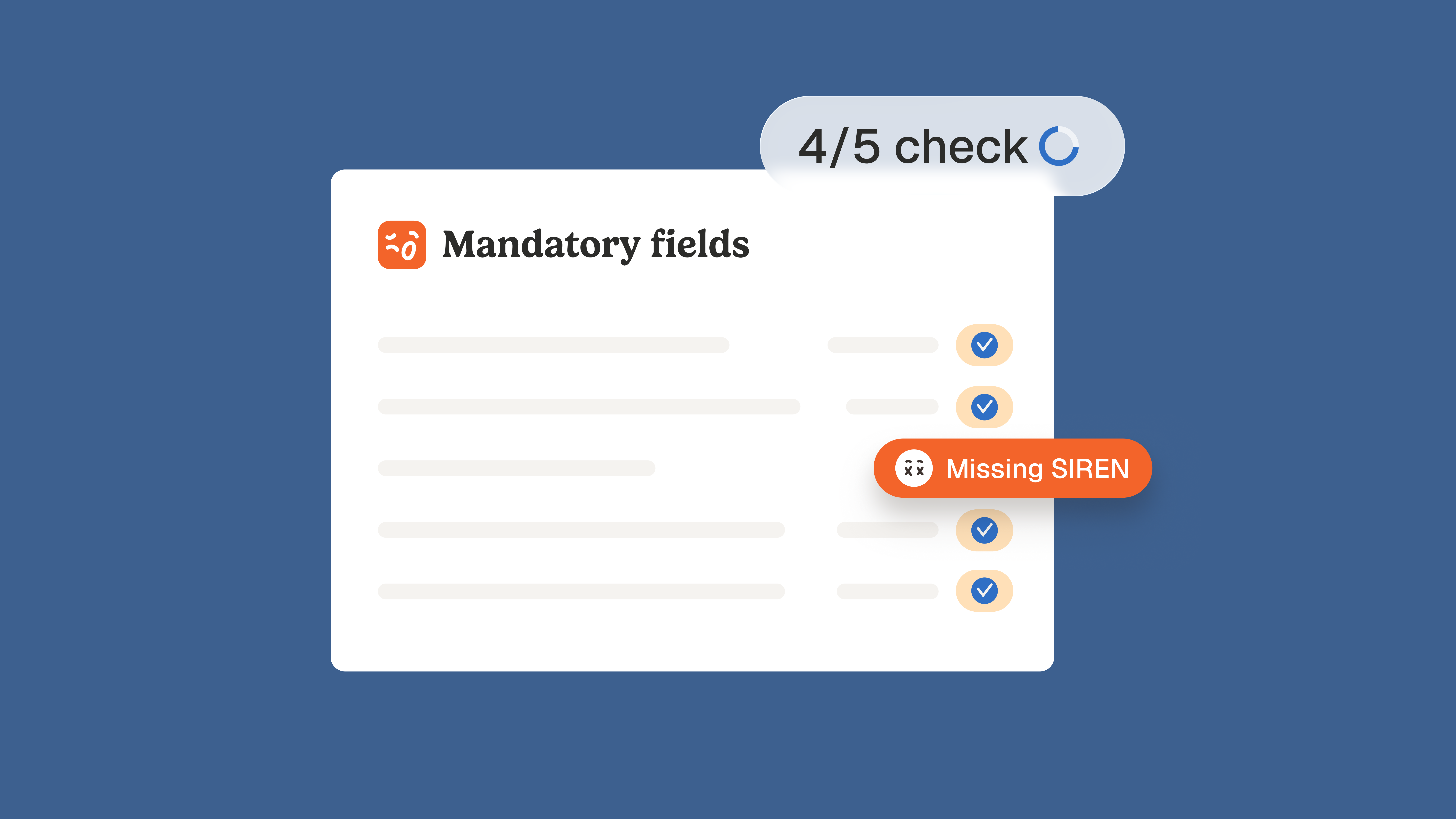
E-invoices carry 34 mandatory data fields in structured form. Four of them are new and drive routing:
- the customer's SIREN, when the customer is a business;
- the transaction category: supply of goods, supply of services, or both;
- the option to pay VAT on invoicing (TVA sur les débits), where the supplier has chosen it;
- the delivery address of the goods, when it differs from the customer's address.
Each of these depends on your customer master data and settings, not on the platform. Each mandatory field that is missing or wrong can also cost a 15 euro fine.
This is where an AI agent pays off first. An AI agent is a specialised program that runs one finance task end to end, following your rules, under your team's supervision. The Phacet agent that helps you clean and enrich your supplier database merges duplicate records, normalises names and addresses, checks IBAN consistency and queries external references: INSEE for SIRET numbers and VIES for EU VAT numbers. The same work is worth doing on your customer file before you start issuing in 2027.
Can a buyer refuse an e-invoice in France?
Yes, but only on the grounds the standard allows, and never for a simple commercial dispute. A refusal is a lifecycle status that must state its reason. According to the DGFiP practical guide, it can only be used in three cases:
- a regulatory non-compliance that the receiving platform did not detect;
- an invoice sent to the wrong recipient;
- a breach of contract terms that prevents the invoice from being processed, within the limits of the standard.
The guide adds that the refused status does not settle the disagreement between the parties. An overcharged price, a missing discount or an undelivered quantity is not resolved by clicking "refused". Those discrepancies have to be caught in your own control process, before approval to pay, and settled with the supplier through a credit note or a follow-up.
A compliant invoice is not a correct invoice
The mandate guarantees that an invoice reaches the right recipient, in the right format, with the right fields. It does not guarantee the amount is right. The DGFiP guide is explicit: the reform changes how invoices travel, and it leaves the substantive rules on the transaction, the debt and the payment untouched.
Substantive errors are common. Nicolas Marchais, CEO and co-founder of Phacet, put a number on it in February 2026: at one customer, a month of analysis showed that 13.2% of processed invoice lines carried a discrepancy. A perfectly compliant e-invoice can carry every one of them.
At Astotel, a group of 18 Paris hotels, prices used to be checked by sampling a few invoices at random. Valérie, the group's purchasing director, found up to 6 euros per kilo of difference for the same smoked salmon reference and the same quantity between two of the group's hotels. "AI has helped me become more efficient by quickly identifying price discrepancies, and even catching some errors I wouldn't have noticed on my own."
This content check is missing from the guides that rank for the French mandate: across the three France-focused guides we reviewed on 26 September 2026, the terms "AI", "purchase order" and "three-way match" do not appear once. They treat compliance as the finish line, while it says nothing about the right amount.
For an SME, the answer is not to hire someone to check every line by hand. It is to validate every invoice before payment with an agent that compares each line with your rules (negotiated prices, contract terms, approval thresholds), spots duplicates and flags every discrepancy with its exact reason.
How AI helps French SMEs comply: four practical uses
AI works where the approved platform stops: data quality, the hybrid flow of the transition years, line-by-line control and the use of structured data. In every case, the agent proposes and the team decides.
| Use | What the agent does | Example |
|---|---|---|
| Clean reference data | Merges duplicate records, checks SIRET, VAT number and IBAN | Prepare for issuing in 2027 without avoidable rejections |
| Absorb the hybrid flow | Sorts the accounting inbox, extracts PDFs still received, spots an invoice received twice | La Nouvelle Garde: the supplier inbox, which took two days a week, now arrives pre-processed |
| Check every line | Compares prices, quantities, delivery notes and purchase orders | Jinchan: every invoice price compared with the reference price list |
| Use structured data | Analyses price drift and its effect on margin | Astotel: price gaps between hotels made visible |
1. Clean the data before it leaves
The rejections of 2027 are prepared in 2026. A clean reference file, with verified SIREN numbers, identified establishments and checked bank details, reduces misrouted invoices and closes a door to fake IBAN fraud at the same time.
2. Absorb the hybrid flow of the transition
Until September 2027, you will receive e-invoices from large suppliers and PDFs from smaller ones. The DGFiP states that an invoice received by email, as a PDF or on paper should not be set aside for that reason alone, and warns about duplicates when a PDF copy travels alongside an e-invoice flow that already works.
At La Nouvelle Garde, teams spent nearly 70% of their time between Gmail and their accounting system, and the supplier inbox took two full days a week for one person. An agent that can automate your accounting inbox handles that mixed flow, whether the document is a PDF, a scan or a structured file.
3. Check every line, not a sample
La Nouvelle Garde also matched invoices against delivery notes by sampling. Théo Richard, its CFO, sums up the stakes: "A ten-cent difference on a delivery note, at our volumes, can mean half a margin point lost."
At Jinchan, the agent reads each supplier invoice, extracts it line by line, compares prices with the reference price list and surfaces the gaps. Alban Cacace, COO, stresses transparency: "We see exactly what is happening. Nothing is opaque."
4. Finally put structured data to work
The mandate has a useful side effect: incoming invoices become usable data instead of images to rekey. Once checked, that data feeds supplier price tracking, margin analysis and cash planning without any new data entry.
Where to start before September 2027
Start with what does not depend on the platform: your data and your supplier invoice controls. This is the sequence we recommend to an SME that starts issuing in 2027.
- Choose an approved platform from the official list if you have not done so, and confirm it connects to your ERP or accounting software.
- Clean supplier and customer records: SIREN, SIRET, establishment, VAT number, IBAN, delivery address.
- Map the flows still arriving as PDF or paper, and set one simple rule against duplicates.
- Put supplier invoices under control before payment: prices, quantities, duplicates, due dates.
- Document your path to compliance: the DGFiP guide expects businesses to show active compliance efforts, with a record of incidents, rejections and fixes.
Step 4 is also where most teams begin: according to Nicolas Marchais, accounts payable is the entry point for 47% of Phacet customers (June 2026). Phacet's accounts payable agents cover that step, with a first agent in production in under two weeks.
The mandate ends the PDF as an exchange channel. It does not end billing errors. The approved platform secures the pipe; your team, supported by AI agents that are reliable, controllable and auditable, stays accountable for what flows through it.
FAQ
What is the difference between e-invoicing and e-reporting in France?
E-invoicing covers invoices between VAT-registered businesses established in France, exchanged in structured form through approved platforms. E-reporting covers the data of transactions that do not travel as domestic e-invoices, such as sales to consumers, plus payment data, sent to the tax administration. Both follow the same calendar for issuers.
Which invoice formats are accepted in France?
Three formats are accepted: UBL and CII, which are fully structured, and Factur-X, a hybrid format that combines a readable PDF with an XML data file. A plain PDF sent by email is not an e-invoice under the French mandate, because its data cannot be processed automatically by the recipient's systems.
What are the penalties of non-compliance?
No penalties apply in 2026. From then on, each invoice not issued electronically costs 50 euros, capped at 15,000 euros a year, and each missing e-reporting transmission costs 500 euros, with the same cap. A business that does not receive invoices through an approved platform faces formal notice, then 500 euros, then 1,000 euros per quarter.
Can you still process a PDF invoice received after 1 September 2026?
Yes. According to the DGFiP practical guide of July 2026, an invoice received by email, as a PDF or on paper should not be rejected for that reason alone if the transaction is real and the invoice complete. The VAT deduction right is not lost automatically, but a supplier already required to issue e-invoices is in breach.
What is the best e-invoicing software?
There is no single best tool, because the right choice depends on your country and your systems. For a French entity, the software must be an approved platform or connect to one, support UBL, CII and Factur-X, and handle lifecycle statuses. A control layer such as Phacet then checks invoice content, which platforms do not.