

For finance leads of 50 to 500 person companies who have outgrown spreadsheets and just received a TMS quote. Group treasurers running an in-house bank and hedge accounting still need a TMS, and this page is not for them.
Cash management software is the right replacement for a treasury management system in an SME, but it only replaces half of one. A TMS does two jobs: it shows you the cash, and it controls the cash. Cash management software covers the first job, bank aggregation, cash position and forecasting, for a fraction of the price. The second job, reconciliation, payment approval, bank detail checks and an audit trail, has to be rebuilt on purpose, or it quietly disappears.
Key takeaways
- The median buyer pays $75,051 a year for Kyriba, according to Vendr purchase data updated in February 2026, and mid-market implementations add $50,000 to $150,000 on top.
- Treasury technology serves two purposes in the ACT and AFP guide to the field: efficiency, and control through segregation of duties, authorization limits, workflows and audit trails.
- Cash management software reads what the bank reports, so it shows a supplier payment to a changed bank account as a correct outflow unless a separate control checked the change first.
- Verification of Payee has been mandatory and free in the euro area since 9 October 2025, but businesses can opt out for batch payment files, the channel most SMEs use for supplier runs.
- An SME treasury stack without a TMS works when it has four layers: the banks, the ERP, cash management software for visibility, and a control layer for reconciliation and payments.
What is cash management software, and how is it different from a TMS?
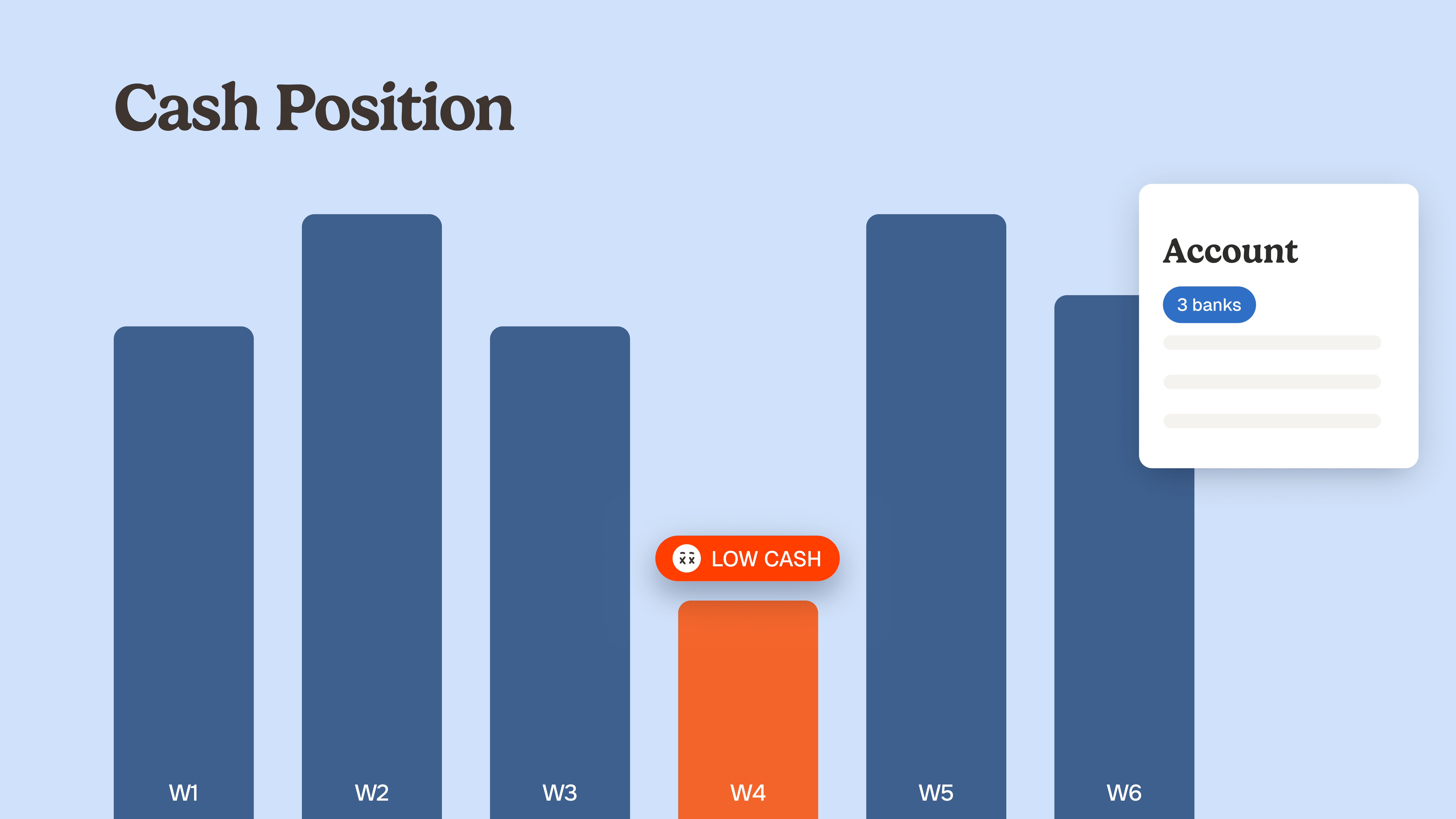
Cash management software is a tool that connects to a company's bank accounts, consolidates balances and transactions into a single cash position, and projects that position forward with a forecast. It is built to answer one question quickly: how much cash do we have, where, and how much will we have next month.
A treasury management system (TMS) answers that question too, then does a great deal more. The reference guide published by the Association of Corporate Treasurers and the Association for Financial Professionals, the ACT and AFP Guide to Treasury Technology (2016), describes two purposes for treasury technology. The first is efficiency. The second is control: "Most technology solutions support the segregation of duties and ensure individuals can only perform actions they are qualified and experienced to do. The solutions can embed limits and workflows in the systems so that authorities cannot be exceeded."
That second purpose is the one that gets lost when the label moves down market. Some vendors of SME cash tools now describe their own market as treasury management systems, and buyer guides rank both side by side. The distinction is not size. It is whether the tool only reports the cash, or also governs how it moves.
| Job | Bank portals and a spreadsheet | Cash management software | Treasury management system |
|---|---|---|---|
| Consolidated cash position | Rebuilt by hand, often weekly | Yes, from bank connections | Yes, including SWIFT and host-to-host |
| Cash forecast | Manual model | Yes, rolling forecast and scenarios | Yes |
| Payment initiation and approval workflow | In each bank portal | Sometimes, depends on the plan | Yes, with authorization limits |
| Bank reconciliation against the ledger | Manual, at month end | Often listed, check what it matches against | Yes |
| Bank account and payee checks | Manual | Rarely | Yes, bank account management modules |
| FX exposure, hedging, debt | Spreadsheet | Basic, if any | Yes |
| Audit trail of treasury actions | None | Partial | Yes |
Functional split based on the ACT and AFP guide and on the product pages ranking for this query, reviewed on 26 September 2026. Coverage varies by vendor and plan.
How much does a TMS cost a mid-sized company?
More than most SMEs expect, because the licence is only the first line. Vendr, a software purchasing platform, publishes figures drawn from anonymized Kyriba transactions on its platform. The median buyer pays $75,051 a year, with a range running from $9,053 to $151,502. The page was last updated in February 2026.
| Cost line, mid-market deployment | Range reported by Vendr |
|---|---|
| Annual subscription, core treasury, 10 to 50 entities | $75,000 to $200,000 a year |
| Implementation, configuration and integration | $50,000 to $150,000, one off |
| Payments module, added to core treasury | $50,000 to $100,000 a year |
| SWIFT setup and annual fees | $10,000 to $30,000 or more a year |
| Market data feeds for FX and interest rates | $5,000 to $20,000 or more a year |
Source: Vendr, Kyriba pricing, last updated February 2026. Figures are purchase data, not a published price list.
Time is the second cost. Reviewers on G2 note that the initial implementation can be time consuming and that compliance requirements can add unexpected time and cost. Agicap, a cash management vendor, puts an enterprise TMS project at six to eighteen months, against three to six months for its own deployment. Either way, a TMS is a project with consultants, not a subscription you switch on.
None of this makes a TMS overpriced. It is priced for what it does at the scale it was built for. The question for an SME is whether it needs that scope, and the honest answer is usually no.
Does owning a TMS remove the manual work?
Less than the brochure suggests, and that matters for how you judge the alternative. PwC's 2025 Global Treasury Survey, published on 25 June 2025 from 350 treasurers, found that 94% of respondents operate a dedicated TMS. In the same sample:
- 36% still manage FX exposure through a manual process.
- 52% of companies between $1 billion and $10 billion in revenue collect and consolidate forecasting data by hand.
- Offline or homegrown tools are still used for short-term forecasting (22%), treasury reporting (20%) and financial risk management (16%).
- Budget constraints are the first blocker to progress, cited by 70%.
These are organisations large enough to employ treasurers, and most of them own the system an SME is being told it needs. They still reconcile, consolidate and check by hand in places. Buying a TMS does not buy the discipline around it. Not buying one does not remove the need for that discipline either. It only moves the question: who does the control work, and with what tool.
What cash management software covers, and what it leaves out
What it covers is real and hard. On the Phacet podcast in March 2026, Sébastien Beyet, CEO and co-founder of Agicap, described the scale of the aggregation problem: "Our customers have on average around twenty bank accounts, sometimes multiple ERPs, and several forecasting sources. All of this data has to be aggregated, cleaned, and processed." (Phacet vs Agicap).
Turning twenty bank feeds into one readable position every morning is exactly the job a finance team should not rebuild in a spreadsheet. For most SMEs that alone justifies the subscription.
What it leaves out follows from how it works. A cash management tool reads what the bank reports. The bank reports what was paid, not what should have been paid. So the tool will faithfully display:
- a supplier invoice paid twice, as two correct outflows;
- a payment sent to a bank account changed by a fraudulent email, as a correct outflow;
- a bank line that never matched an entry in the ledger, as part of an accurate balance, unless the tool reconciles against your ERP;
- a payment batch approved by the person who prepared it, with no trace that anyone else looked.
None of these is a defect of the software. They sit outside its job. In a TMS environment they were caught by the other half of the system. Without one, they need an owner.
The four controls a TMS did for you
When an SME replaces a TMS quote with cash management software, four controls that a TMS enforces are no longer guaranteed by the system. Each can be rebuilt for far less than a TMS costs, but only if someone decides to.
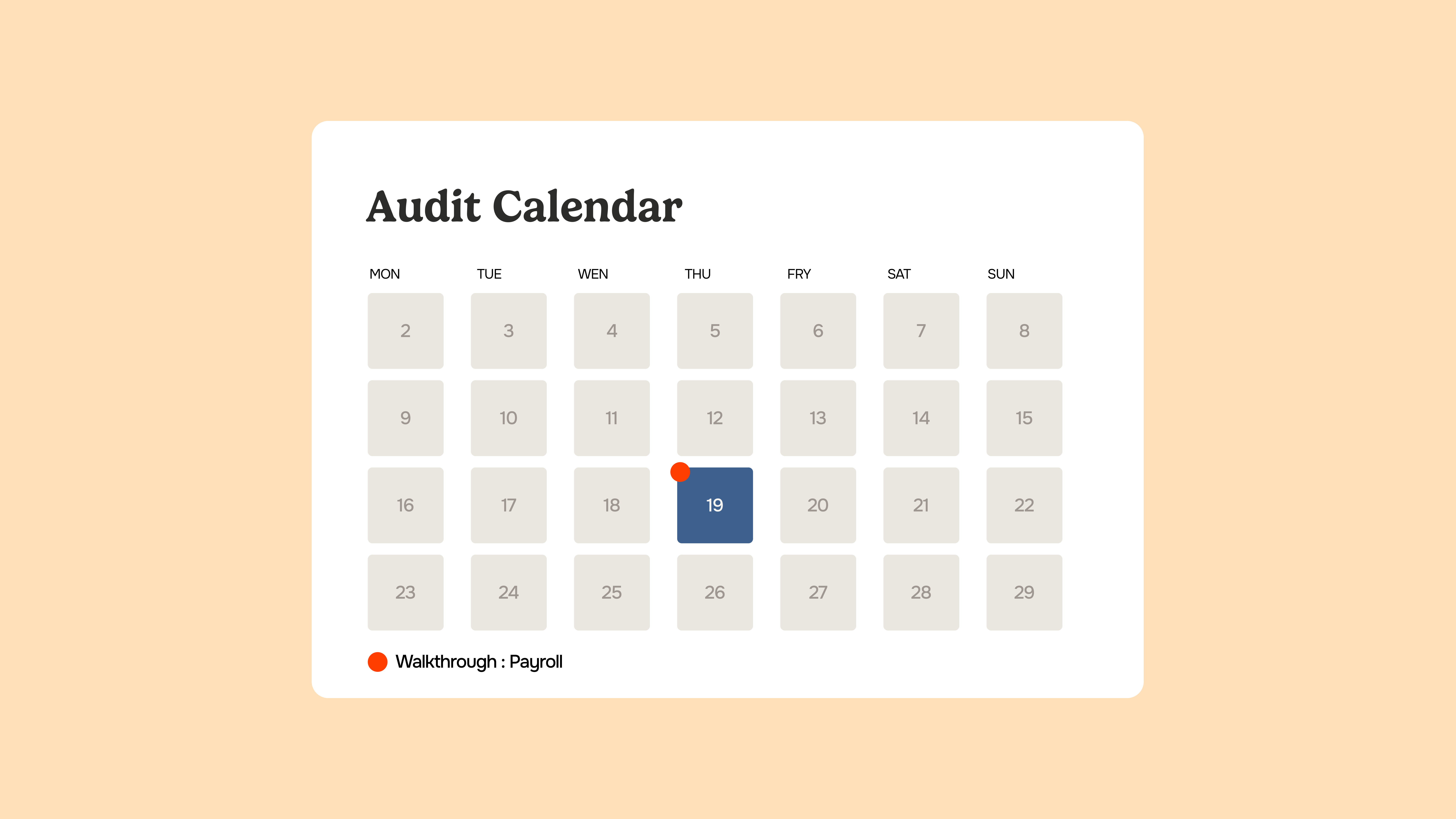
Bank reconciliation, daily rather than at month end
A TMS matches bank lines against expected flows as they arrive. Many cash tools list bank reconciliation as a feature too, so the useful question is what they reconcile against: their own categories and invoices, or the general ledger in your ERP, with every unmatched line assigned to someone. In most SMEs the ledger side still happens once a month, which means an unexplained debit can sit for four weeks before anyone asks about it. The ACT and AFP guide is explicit on the principle: "System audit trails should always be used to reconcile activities as regularly and as frequently as possible."
This is the easiest control to automate because both sides already exist as data. An agent that reconciles bank lines against the ledger every day turns the month-end exercise into a short list of exceptions. At Smartbox, the European leader in experience gift boxes with 800 employees, matching payments against invoices was "previously a very manual task. The result? A fourfold increase in productivity." Every use case there was operational within six weeks.
Supplier bank detail changes
A large share of payment fraud against companies does not break into anything. It asks politely for a change of bank details. The 2026 AFP Payments Fraud and Control Survey, published on 14 April 2026, found that 76% of US organisations experienced attempted or actual payments fraud in 2025, and that business email compromise affected 74% of them.
In the euro area, banks now run a free check. Regulation (EU) 2024/886 made Verification of Payee mandatory from 9 October 2025: before you authorize a credit transfer, your bank checks the payee name against the account identifier and tells you when they do not match. The same article adds a condition that matters to every SME finance team: banks must give business customers "the means to opt out from receiving the service ensuring verification when submitting multiple payment orders as a package". A weekly supplier run uploaded as one file is exactly that package. The opt-out can be reversed at any time, so the first thing to check is whether your company switched it on.
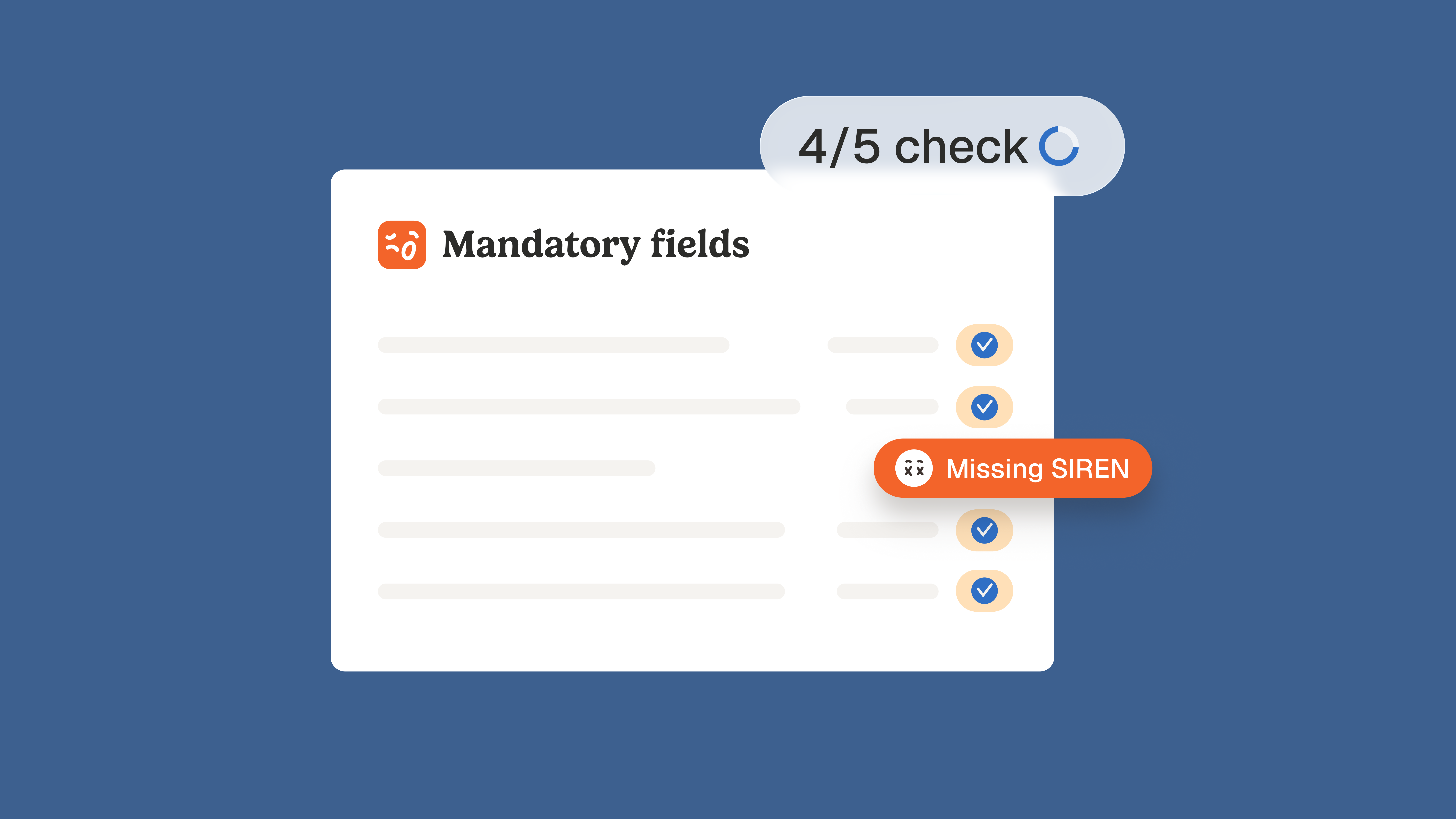
Structured e-invoices open a second checkpoint for European suppliers. In the EN 16931 standard, business term BT-84 carries the account to be credited, an IBAN for instance, and the Peppol BIS Billing 3.0 specification makes it mandatory whenever the invoice asks for a SEPA credit transfer (rule BR-61). Every incoming invoice can therefore be compared with the bank details held in your vendor master. Most cash management tools never ask that question, because they read the bank rather than the invoice.
So the bank's check may not run on the payments where the risk concentrates, and a TMS bank account management module is not there to catch it either. The control has to sit upstream, at the moment the vendor record changes. An agent that checks every supplier bank detail change against the supplier's history, country and bank, and routes suspicious ones for approval, closes that gap before the file is built.
Who approves the payment run
The AFP survey adds a detail that should worry any company without a treasurer: treasury is the department most likely to discover attempted fraud (83%) and actual fraud (55%). In an SME the treasury department is often one person who also prepares the payment file. The ACT and AFP guide anticipates this: "In some companies, smaller treasury may be supported by members of other departments to ensure appropriate segregation of duties."
A TMS enforces that separation with authorization limits. Without one, the minimum is a written rule: the person who builds the run is not the only person who releases it, and the batch is checked against approved invoices before release, not after. Where the second person does not exist, the check has to be systematic rather than human, so that every line is compared rather than a sample.
FX exposure and loan schedules
The last two controls are smaller in an SME but they do not vanish. If you buy or sell in a second currency, open positions still need to be listed and netted, and PwC's finding that 36% of TMS owners still do this by hand shows how often it slips. If you carry bank debt, amortization schedules and covenant dates still need to be tracked against what the bank actually debits. Both usually live in a spreadsheet that one person understands.
Taken together, these four controls are what a TMS quote was really pricing on top of visibility. They are also where Phacet works: treasury and cash agents that reconcile, check and raise exceptions alongside the cash tool you already use, with every step recorded in an audit trail and the decision left to your team.
What is the best cash management software for an SME?
The best cash management software for an SME is the one that connects to all your banks, fits your entity and currency structure, and is honest about what it does not control. Most buyer guides compare the first two points and skip the third. Across the five editorial pages ranking for this query on 26 September 2026, forecasting vocabulary appears 155 times, while segregation of duties, IBAN and payee verification do not appear once.
Use these checks, in this order:
- Count your bank accounts and banks first. Ask for the connector list and test the two smallest banks you use, not the largest. Missing feeds are the most common reason a cash position is wrong.
- Map your entities and currencies. Multi-entity consolidation and multi-currency positions are often priced as separate modules. Get them quoted explicitly.
- Check the forecast granularity you need. Weekly by category is enough for most SMEs. Daily by counterparty is a TMS level requirement.
- If the tool initiates payments, test the approval chain. Can the preparer also approve? Is every approval logged with a name and a timestamp?
- Ask what happens to a changed supplier IBAN. If the answer is that the bank handles it, check whether your bank runs Verification of Payee on batch files or whether you opted out.
- Confirm the export. Categorized flows should leave the tool as CSV or through an API, so a control layer or your auditor can use them.
If the vendor does not publish prices, ask for a quote broken down by module. Payments and consolidation are frequently priced apart from the base forecasting plan.
When does an SME actually need a TMS?
An SME needs a TMS when the control problem becomes a structural one rather than a discipline one. In an r/Accounting thread on the value a TMS adds, practitioners point to the moment more advanced automation is required: bank reconciliation at scale, netting, cash pooling, electronic bank account management and payee verification. PwC's survey shows where that sits: among companies with more than $10 billion in revenue, 67% run in-house banks and 60% run payment factories.
The signals that justify a TMS, even for a mid-sized company, are concrete:
- dozens of entities across several countries, with intercompany netting or cash pooling;
- direct SWIFT or host-to-host connectivity required by your banks;
- hedging programmes that need hedge accounting documentation;
- a payment factory paying on behalf of subsidiaries;
- a treasury team of several people who need system-enforced authorization limits.
If none of these applies, the TMS quote is buying scope you will not use. The better investment is the four controls above, attached to a cash tool you can switch on in weeks.
The SME treasury stack without a TMS
Without a TMS, the treasury stack of an SME has four layers, each with a clear job and a clear owner. The mistake is to buy the third layer and assume it covers the fourth.
| Layer | Job | Order of cost |
|---|---|---|
| Banks | Hold the cash, execute payments, run Verification of Payee on single transfers | Included in bank fees |
| ERP or accounting system | Book entries, hold supplier master data and approved invoices | Already paid |
| Cash management software | Aggregate accounts, show the position, forecast | Published plans from about $11 to a few hundred dollars a month; some base packages at $24,000 a year |
| Control layer | Reconcile daily, check bank detail changes, verify payment runs, track FX and debt schedules | From $299 a month on Phacet Studio |
| For comparison: a TMS | All of the above, plus in-house banking, SWIFT and hedge accounting | Median $75,051 a year before implementation (Vendr) |
Published plan prices taken from a February 2026 buyer's guide listing cash management tools; TMS figure from Vendr purchase data, February 2026.
The logic is simple. Visibility is a commodity now, and you should pay commodity prices for it. Control is specific to your suppliers, your banks and your approval rules, and it is the part that protects the cash you are looking at. The finance lead who can say where the cash is, and also prove that every payment that left was supposed to leave, has the substance of a TMS without the project.
FAQ
What are the tools used in cash management?
Cash management relies on four families of tools: bank portals for payments and statements, the ERP or accounting system for entries and supplier records, cash management software for a consolidated position and forecast, and a treasury management system for large groups. SMEs increasingly add a control layer that reconciles and checks payments between those tools.
What is the best way to monitor cash?
The best way to monitor cash is a consolidated position refreshed daily from bank feeds, reconciled against the ledger every day rather than at month end. Pair it with a short list of exceptions: unmatched bank lines, changed supplier bank details and payments released without a second approval. A position that is visible but not reconciled can still be wrong.
What is good cash management?
Good cash management means knowing where the cash is, what will move it in the coming weeks, and that every outflow was authorized. In practice that is a reliable daily position, a rolling forecast the team trusts, and controls on payments and bank details. Visibility without control reports losses accurately, after they happen.
Does a cash management platform integrate with my ERP?
Most cash management platforms integrate with common ERPs through native connectors or file imports, usually to pull invoices and push categorized flows. Check that the integration is two way and that exports are available as CSV or API. Control layers such as Phacet connect to both the ERP and bank data, so reconciliations run without rekeying.