

Retail supplier price control at volume: 500+ references, every invoice
Published on :
June 1, 2026

Nicolas Marchais is co-founder and CEO of Phacet. After seven years at Spendesk, he built Phacet as the agentic layer that orchestrates across ERP, banking and email systems. Reliable, auditable, cross-system, what he calls a Finance Workforce.

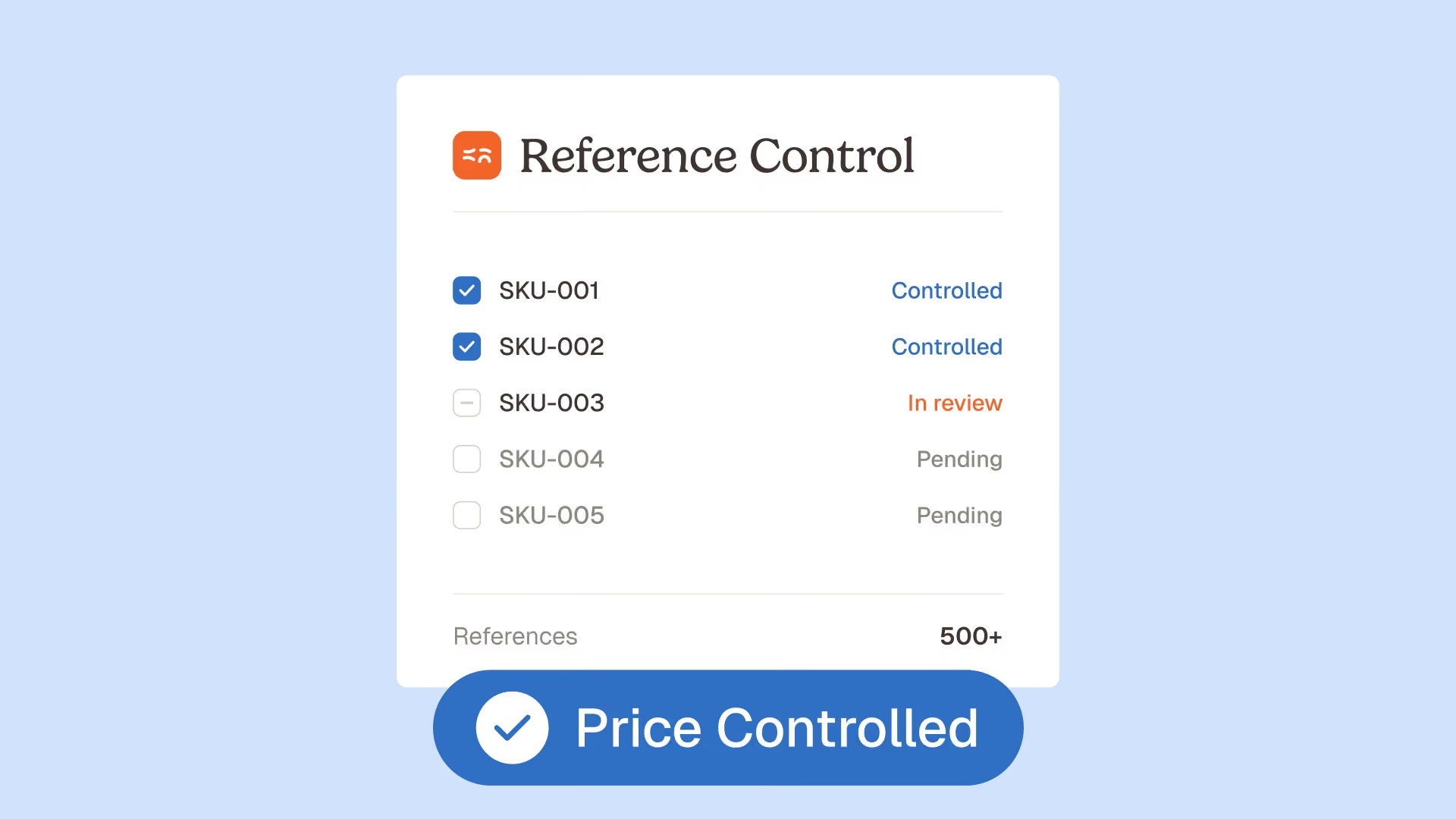
Most retailers control supplier prices by sampling. They spot-check a few lines, trust the rest, and the gap between negotiated and invoiced prices leaks margin quietly across hundreds of references. Supplier price control at volume means verifying every invoice line against the agreed price list, on every invoice, before payment.
An AI agent makes that practical. It extracts each line into an auditable table, matches the billed unit price against your negotiated catalog, and flags every discrepancy with its reasoning. Your buyers and controllers review exceptions instead of re-keying invoices. Nothing clears to payment until the price checks out.
This guide explains why price control breaks down past a few hundred references, why 3-way matching alone does not catch price errors, and how line-level control works in production.
What is supplier price control in retail?
Supplier price control is the process of verifying that the unit price a supplier bills matches the price you negotiated, line by line, before the invoice is paid. In retail it runs across the full supplier catalog: hundreds or thousands of SKUs, each with agreed pricing, volume tiers, and purchase conditions that shift over time.
It sits on the buy side. A retail invoice is the sales document a store issues to a consumer. Supplier price control is the opposite flow: the supplier invoices you receive, checked against what you agreed to pay. The two are easy to confuse, so it helps to name the difference up front.
The goal is simple to state and hard to do at scale: pay the negotiated price on every line, every time.
Why price control breaks down past a few hundred references
Retail accounts payable teams sit in one of the toughest invoice environments in finance. Invoices arrive from merchandise suppliers, logistics providers, store services, and marketing partners, in PDFs, EDI feeds, portal uploads, and scans, often in seasonal spikes across multiple locations.
Volume alone is manageable. The real problem is that nobody checks the price line by line. Three things make it fail:
- Sampling. Teams verify a handful of lines and approve the rest on trust. The unchecked lines are where the leakage hides.
- Stale spreadsheets. A lookup against last quarter's price list goes out of date the moment a supplier updates a tier or a promo ends.
- Scale. A single invoice can carry hundreds of SKUs. Manual review caps out long before the catalog does.
The cost is margin leakage: the slow erosion of gross margin when invoiced prices drift above negotiated terms and no one catches it. On a 500-reference catalog, a few cents of drift per line, repeated every month across every supplier, adds up to real money the business never sees.
Processing cost gets measured. Price leakage rarely does, which is exactly why it persists.
Why 3-way matching alone misses price errors
3-way matching compares three documents before payment: the supplier invoice, the purchase order, and the goods receipt. It confirms you were billed for the right item, in the right quantity, at the PO price. It is a strong control, and most AP automation tools center on it.
But matching the invoice to the PO is not the same as verifying the price was right in the first place. Here is what 3-way matching does not catch:
- A wrongly priced PO. If the purchase order was raised at the wrong price, the invoice matches it cleanly and the error sails through.
- Non-PO and recurring spend. Services, drop-ship, marketplace, and utility invoices often have no PO to match against at all.
- Mid-quarter price changes. When negotiated prices update, the PO can lag behind the new price list.
- Promotional allowances, rebates, tier breaks, and freight terms. These are priced outside the PO line and slip past the match.
The takeaway, in one line: 3-way matching tells you the invoice matches the order. It does not tell you the order was priced right.
That gap is where line-level supplier price control comes in. It does not replace 3-way matching, it completes it, by checking every billed price against your negotiated catalog rather than against a purchase order that may already be wrong.
The table below shows where each control stops.
What line-level supplier price control looks like
Line-level control follows three steps: structure the data, match it against your price list, then surface what does not align. An AI agent runs all three on every invoice.
1. Structure. Every invoice, whatever the format (PDF, EDI, email, portal, scan), is captured and broken into lines. The agent extracts SKU, description, quantity, and billed unit price into a table, with a confidence score on each field.
2. Match. Each billed unit price is matched against your negotiated price list, even when the supplier's SKU codes or descriptions do not align exactly with yours. Semantic matching handles the mismatch, and the agent exposes its reasoning at every step, so a buyer can see why two lines were treated as the same reference.
3. Analyze. Every gap surfaces as an exception before payment, ranked by dollar impact, with a clear explanation. Clean lines clear automatically. Disputed lines route to the right buyer or controller.
The agent proposes, your team decides. Every transformation is logged in a native audit trail, so a controller or an auditor can trace any line back to its source. That is what keeps the control trustworthy when it runs across thousands of lines a month.
In Phacet, this maps to the supplier billing control agent, backed by 3-way matching and a contract-terms check. The underlying mechanics (auditable Tables, semantic AI Match, native audit trail) are what make the control hold up in production, not just in a demo.
Three ways retailers control supplier prices, and where each breaks at volume
Most retail finance teams use one of three approaches. The first two were built for a few dozen references, not a few hundred. The table compares them on the criteria that actually matter at scale: coverage, freshness, exception handling, and team time.
The pattern is consistent. Manual sampling and spreadsheets protect a sliver of the catalog and degrade as references grow. An agent checks every line and keeps pace with price-list updates, so coverage holds whether you carry 50 references or 5,000.
How to roll line-level price control across 500+ references
You do not need to rebuild your stack or migrate your ERP. Line-level control sits on top of the systems you already run (SAP, Sage X3, NetSuite, Cegid, your supplier portals and EDI feeds) and reads from them.
A practical rollout:
- Set the reference. Load your negotiated price list and supplier catalog as the source of truth the agent checks against.
- Connect intake. Point the AP mailbox, EDI feeds, supplier portals, and scans at a single capture point.
- Define tolerances. Set the price gap that triggers an exception, and tune it by category (merchandise, freight, services).
- Keep humans on exceptions. The agent clears clean lines and routes gaps to the buyer who owns that supplier.
- Expand by supplier group. Start with your highest-spend suppliers, then widen coverage.
Time-to-value is short. Phacet brings a first agent into production in under two weeks. At Smartbox, each use case went live in six weeks.
Proof: what changes when every line is checked
Smartbox, the European leader in gift experiences (800 employees across 14 countries), put Phacet agents on its catalog and reconciliation work. Catalog management productivity rose 6 to 7 times, payment-to-invoice reconciliation 4 times, and each use case went live in six weeks.
"Phacet operates as an extension of our teams." Mourad Meraou, Operations Director.
The price-control mechanic shows up clearly in numbers elsewhere too. At Astotel, a group running 18 hotels, one agent surfaced 5,000€ a year of billing errors on a single supplier, the kind of drift that line-by-line checking catches and sampling never does.
"I catch errors I would never have seen on my own." Valérie, Head of Purchasing.
Same mechanic, applied to a retail catalog: check every line, expose the reasoning, flag the gap before payment.
FAQ
What is invoice control?
Invoice control is the set of checks that confirm an invoice is accurate, authorized, and compliant before it is paid. In retail, the highest-value check is price control: verifying that each billed unit price matches the negotiated price for that reference.
What is the difference between a retail invoice and supplier price control?
A retail invoice is the sales document a store issues to a customer. Supplier price control works the other way, on the invoices you receive from suppliers, checking that the prices billed match what you negotiated.
Does 3-way matching catch supplier price errors?
Partly. 3-way matching confirms the invoice matches the purchase order and the goods receipt, so it catches a billed price that differs from the PO price. It does not catch a PO that was priced wrong, non-PO spend, or price-list changes the PO has not picked up. Line-level price control covers those gaps.
What internal controls catch price discrepancies on supplier invoices?
The core controls are 3-way matching, contract-terms verification, duplicate detection, segregation of duties, and price-list verification. Price-list verification is the one most often missing, because it requires checking every line against a catalog, which is hard to do manually at volume.
What is margin leakage in retail?
Margin leakage is the slow erosion of gross margin when invoiced prices drift above negotiated terms and the difference goes uncaught. Across hundreds of references and recurring orders, small per-line gaps compound into a meaningful loss.
How many references can an AI agent check on a single invoice?
There is no practical cap. An agent extracts and checks every line on the invoice, whether that is 50 references or several hundred, in one pass.
Where this leaves your finance team
Sampling made sense when catalogs were small and invoices were short. At 500+ references, it leaves most of your spend unchecked and your margin exposed. Line-level supplier price control closes that gap by doing what no human can do at volume: verify every price, on every invoice, before payment, and show its work.
It does not replace your buyers or your controllers. It hands them a clean queue of real exceptions and the reasoning behind each one, so they spend their time negotiating and deciding, not re-keying invoices.
See how it works on your catalog. Explore the agents built for retail and distribution, or book a demo to test it on a live supplier price list.

Latest Resources
Unlock your AI potential
Go further with your financial workflows — with AI built around your needs.


