

How to verify invoice prices against negotiated contracts before cash moves
Published on :
March 3, 2026

Nicolas Marchais is co-founder and CEO of Phacet. After seven years at Spendesk, he built Phacet as the agentic layer that orchestrates across ERP, banking and email systems. Reliable, auditable, cross-system, what he calls a Finance Workforce.

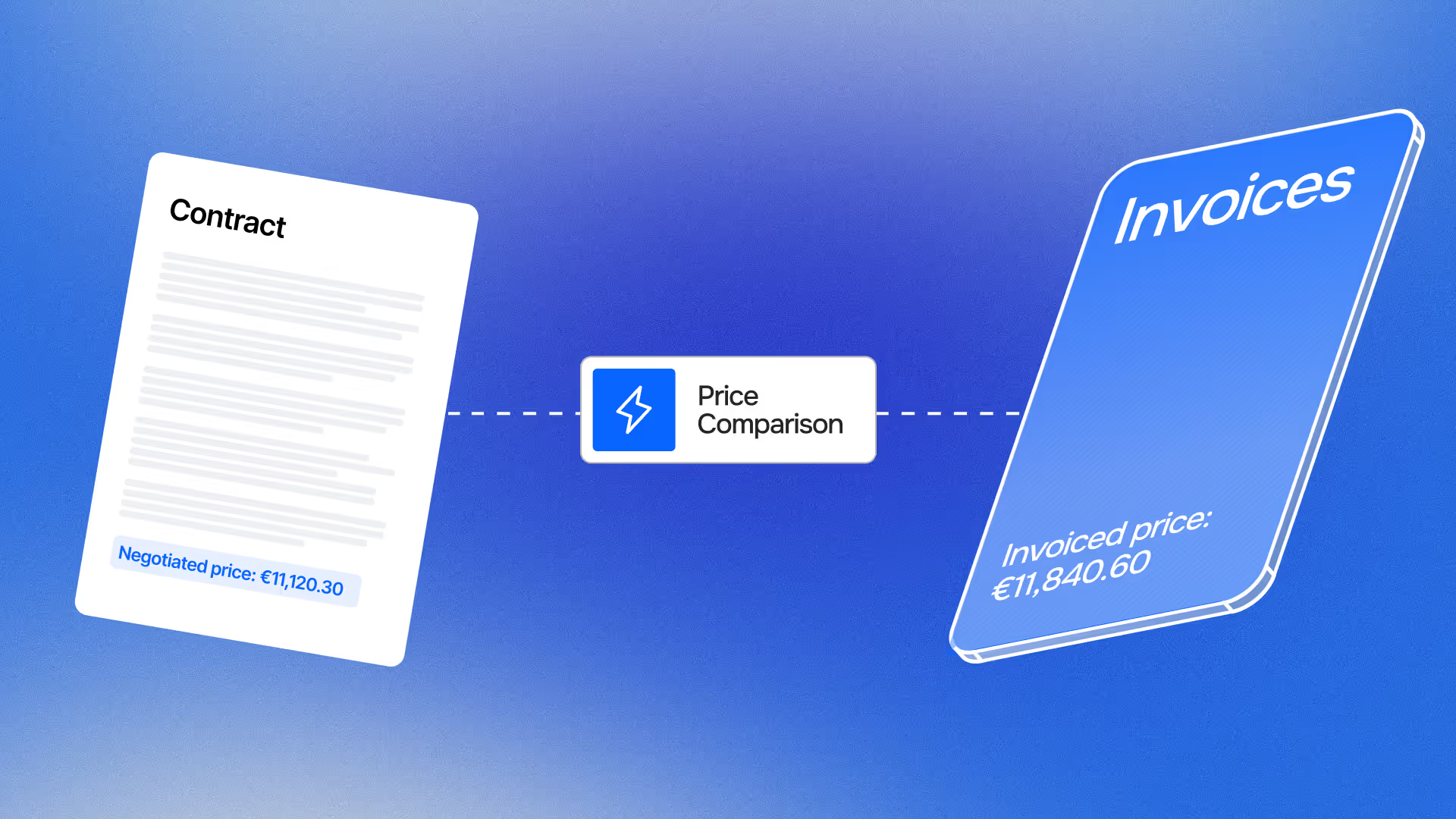
Procurement teams spend weeks negotiating supplier contracts. Unit prices, volume discounts, promotional rates, delivery surcharges, every term is documented, agreed, and signed. Then invoices arrive, and nobody checks whether what's being billed matches what was negotiated.
Not because finance teams don't care. Because comparing every invoice line against the applicable contract version, at the scale of hundreds of monthly invoices across dozens of suppliers, is genuinely difficult to do manually, and genuinely expensive to get wrong. Vivason, a distribution group, was absorbing €180,000 in annual billing overcharges before deploying systematic invoice price validation. The invoices weren't obviously fraudulent. They were subtly off, line by line, supplier by supplier, month after month, invisible to any review process short of systematic comparison.
Invoice price validation is the control that closes this gap. This article explains why it's harder than it looks, what reference data it requires, which price discrepancy patterns cost the most, and how to make it run automatically before any payment is approved.
Why invoice price validation is harder than it sounds
The concept is simple: compare what the supplier invoiced against what was contractually agreed, flag anything that doesn't match. In practice, several factors make this comparison genuinely complex at scale.
Contract fragmentation. Most businesses manage supplier pricing across multiple formats simultaneously: framework contracts, catalog price lists, spot agreements, promotional rate sheets, volume-tier schedules. The applicable reference for a given invoice line may not be the most recent contract, it may be the rate negotiated in a specific campaign, valid for a specific period, for a specific SKU category. Knowing which document applies to which line requires more than a file search; it requires structured reference data that can be queried at line-item level.
Version drift. Supplier contracts get renegotiated. Prices change. The reference data that was correct six months ago may not reflect current agreed terms. A price validation system that compares invoices against an outdated contract version generates false positives on legitimate price changes, and misses discrepancies where new rates were negotiated but not updated in the reference file.
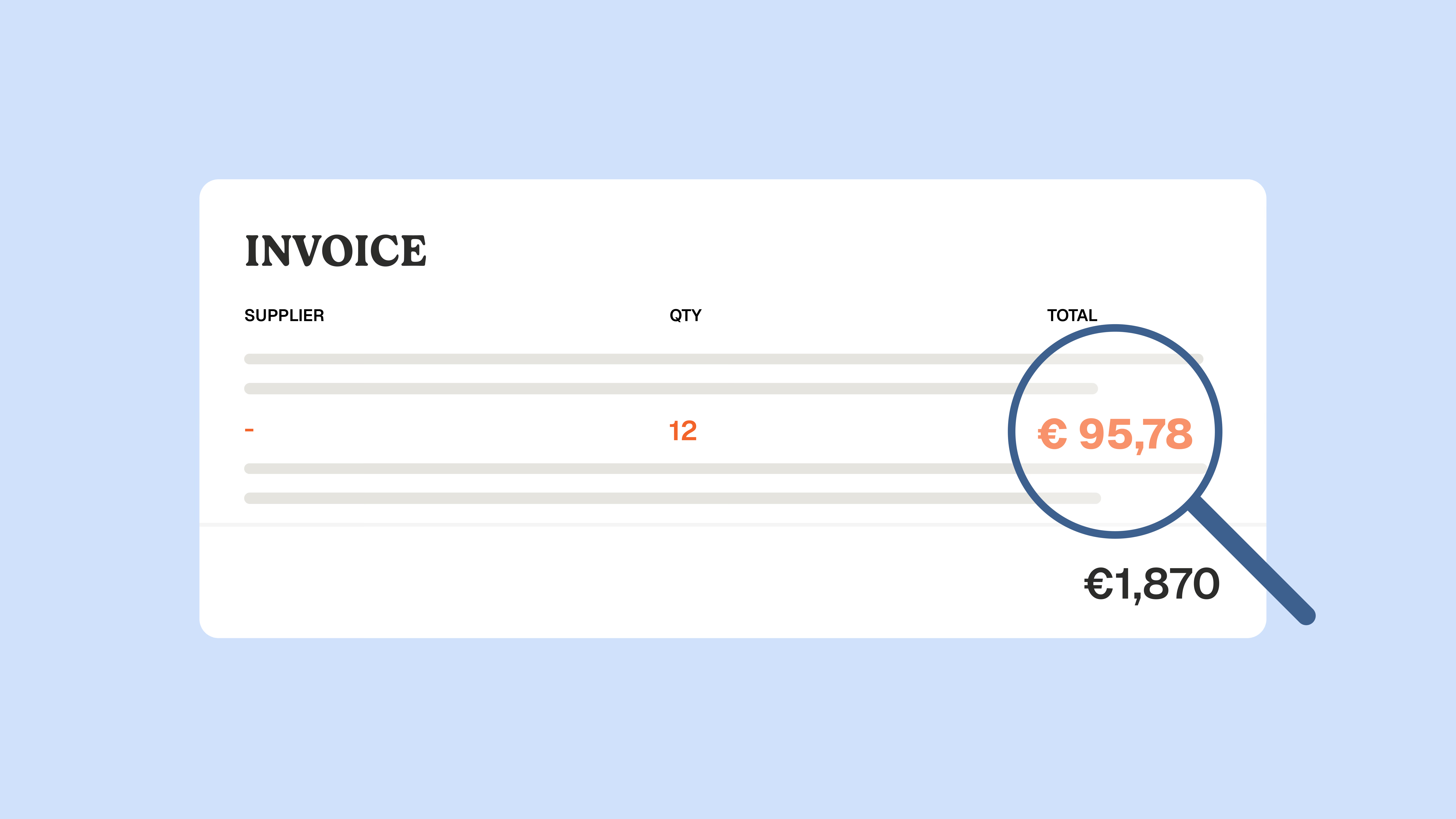
Line-item granularity. Header-level invoice review, checking total amounts, misses the discrepancies that accumulate inside the detail. A supplier can invoice the correct total while overcharging on some lines and undercharging on others, or billing for service categories that weren't part of the delivery. Effective price validation requires comparison at line-item level: each product code, each unit price, each quantity, each applicable surcharge or discount.
Multi-supplier complexity. Each supplier has its own pricing structure, its own SKU nomenclature, its own invoice format. Cross-referencing a food distributor's invoice against a weekly mercuriale requires different logic than cross-referencing a technology vendor's invoice against an annual SaaS contract. A validation system that applies the same rigid template to all suppliers generates noise; one that can be configured per supplier and per contract type generates signal.
This is why contract analysis and structured price reference data are prerequisites for invoice price validation, not optional enhancements.
The reference data problem: what you need before you can validate
Invoice price validation is only as good as the reference data it validates against. Before any automated comparison can run, the applicable pricing reference must be structured, current, and queryable at line-item level.
The reference set typically includes four elements.
Negotiated unit prices. The price per unit, per SKU, per service category, as agreed in the current contract. This must be maintained at the granularity at which suppliers invoice, not at category level, but at the specific product code or service reference that appears on each invoice line.
Applicable date ranges. Contracts have start and end dates. Promotional rates have validity windows. Volume discounts apply within defined billing periods. Price validation logic must match each invoice line to the rate that was valid on the invoice date, not to the current rate if the two differ.
Volume tiers and conditions. Many supplier agreements include volume-dependent pricing: the unit price drops once a monthly or quarterly threshold is crossed. Validating these requires knowing the accumulated volume at the point of invoicing, not just the unit price in isolation.
Applicable surcharges and exclusions. Delivery surcharges, minimum order fees, fuel supplements, currency adjustments, each contract has its own structure of additions and deductions. Validation logic must account for these correctly, or legitimate charges generate false flags and real overcharges pass undetected.
Assembling and maintaining this reference data is where many manual price validation efforts break down. The data exists, in contracts, in procurement systems, in price list PDFs, but it isn't structured in a way that enables automated line-item comparison at invoice processing speed. Phacet's contract intelligence capability extracts and structures this reference data from source documents, making it available as a queryable validation layer rather than a file to look up manually.
The four price discrepancy patterns that cost the most
Not all invoice price discrepancies follow the same pattern. Understanding which patterns occur most frequently, and which are most financially significant, directs validation effort toward the highest-value controls.
Pattern 1: chronic unit price overcharging
This is the most common and most financially significant pattern. A supplier invoices a unit price that is consistently above the contracted rate, sometimes by fractions of a percent, sometimes by several percentage points. The discrepancy is not random; it appears on every invoice for the same product, from the same supplier, over months or years.
The mechanism varies. Sometimes a price was updated in the supplier's billing system but the negotiated rate was never applied. Sometimes a promotional discount expired and the pre-promotion rate reactivated automatically. Sometimes a clerical error in the supplier's system persisted across billing cycles without anyone noticing on either side.
Chronic overcharging is invisible to any review process that checks individual invoices in isolation. It only becomes visible when invoice data is aggregated across time and compared systematically to the contract baseline. Jinchan Group saw its anomaly detection rate multiply by 5x after moving from manual spot-checking to systematic comparison, the chronic patterns that had been accumulating for months surfaced immediately.
Pattern 2: unapplied volume discounts
Volume-based pricing agreements give buyers lower unit prices once they exceed defined purchase thresholds. The discount is triggered by accumulated volume, and that accumulation must be tracked and applied correctly at invoice time.
When suppliers fail to apply earned discounts, the buyer pays the non-discounted rate on units for which they've already earned preferential pricing. This is technically an overcharge, but it is often invisible because no individual invoice is "wrong", the rate billed was the standard rate, just not the discounted rate the volume commitment entitled the buyer to.
Validating against volume tiers requires a price validation system that tracks cumulative purchase volumes and applies the correct tier at each billing cycle. Phacet's supplier billing control agent handles this logic automatically, flagging invoices where the non-tiered rate was applied when the volume threshold had already been crossed.
Pattern 3: expired promotional rates applied in reverse
Promotional agreements cut both ways. When a supplier offers a promotional discount for a defined period, the buyer expects the discount to apply during the promotion window and the standard rate to resume after. The overcharge risk arises when the standard rate resumes before the promotion window closes, or when the promotional rate that was charged to the buyer continues to be applied by the buyer in post-promotion reconciliations, resulting in the supplier being underpaid and generating a subsequent correction invoice.
More commonly, the reverse occurs: a promotional price that was lower than the standard rate expires, the standard rate resumes on the supplier's system, but the contract documentation held by the finance team still references the promotional rate. The invoice then flags as an overcharge when it is actually correct. This false positive is only resolvable by having the current, correctly versioned contract data as the validation baseline, not an outdated extract.
Pattern 4: non-contracted line items
Some billing discrepancies are not about the price of contracted items, they are about the invoicing of items or services that were not part of the original order at all. Handling fees not mentioned in the contract, delivery surcharges added beyond the agreed structure, service categories billed that were excluded from the scope.
These discrepancies pass unit price checks cleanly, because the price billed for the line item may match a standard catalog rate. The discrepancy is at scope level: the item should not be on the invoice at all. Catching this requires validation logic that checks not just whether the price is correct, but whether each invoiced line corresponds to something that was ordered, which is where invoice price validation intersects with three-way matching against purchase orders and delivery records.
For a deeper look at how these two controls work together, see our article on AI-powered 3-way matching and payment traceability.
How automated invoice price validation works at scale
The practical question for finance teams is not whether invoice price validation matters, it clearly does, but how to make it run systematically on every invoice, without consuming the team's entire review capacity in the process.
The automated approach follows four steps that operate between document receipt and payment approval.
Step 1 — Structured extraction.
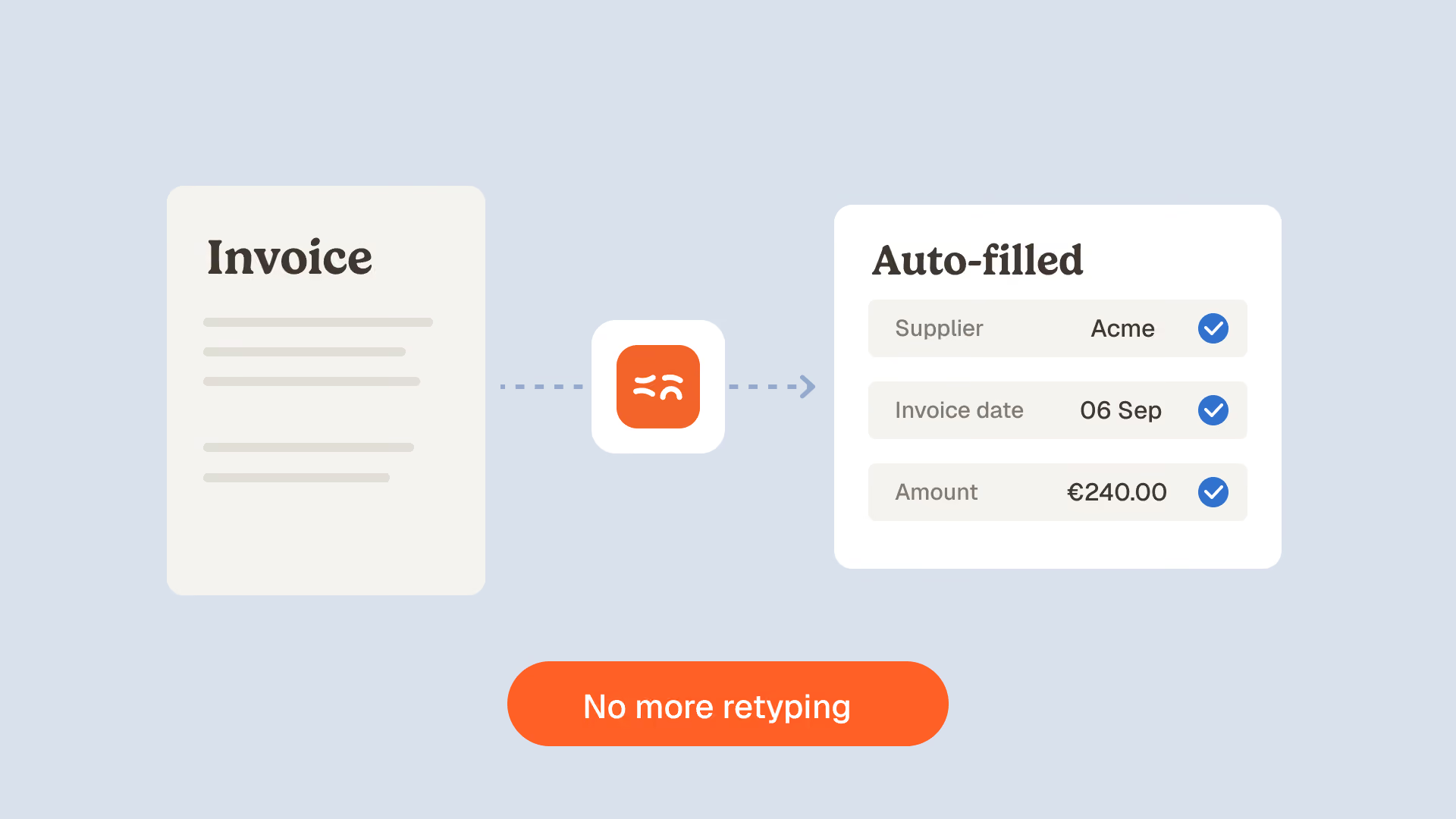
Each incoming invoice is processed by OCR to extract machine-readable line-item data: supplier reference, product code or description, quantity, unit price, applicable surcharges, invoice date, total per line. The extracted data is normalized to a common structure, regardless of the original invoice format.
Step 2 — Contract matching.
The extracted invoice data is matched against the applicable contract reference for each supplier. This matching operates at line-item level: each product code on the invoice is compared to the rate schedule applicable on the invoice date, for the correct pricing tier, with the correct surcharge structure. The system applies the right contract version automatically, not the most recent one by default, but the one valid on the date of the transaction.
Step 3 — Discrepancy flagging.
Lines where the invoiced price exceeds the contracted rate by more than the configured tolerance threshold generate a flag. The flag includes the specific line, the invoiced price, the applicable contracted price, the variance amount, and the contract clause the validation applied. Lines within tolerance proceed automatically; flagged lines enter a structured review queue.
Step 4 — Exception resolution and audit trail.
Flagged lines are reviewed by the finance or procurement team with full context. The reviewer can approve the exception (with documented justification), reject the invoice line, or initiate a credit note request. Every decision, automatic validation or manual exception, is logged in a complete audit trail, providing full traceability for CAC audits and internal governance.
This is the architecture that stopped Vivason's €180,000 annual billing drift. The comparison had always been possible, the data existed on both sides. What was missing was the structured, automated matching that ran on 100% of invoice lines, at processing speed, before any payment was approved.
Tolerance thresholds: configuring validation for your business
One of the operational decisions in deploying invoice price validation is setting the right tolerance threshold, the variance level at which a discrepancy triggers a review rather than auto-approving.
Setting the threshold too low generates excessive false positives: rounding differences, currency conversion variances, and minor unit-of-measure conversions all generate flags that consume reviewer time without representing real billing errors. Setting it too high misses the systematic small-scale overcharging that accumulates into significant annual figures.
Most finance teams configure thresholds on two dimensions simultaneously:
- Percentage tolerance: a fixed percentage variance, typically 1–3%, below which a line is auto-approved even if the invoiced price differs slightly from the reference rate
- Absolute amount threshold: a minimum absolute variance, typically €20–€100 per line, below which the difference is too small to justify review overhead regardless of percentage
The combination means that a €0.03 variance on a low-value item doesn't generate a flag, while a €500 variance on a single high-value line does, regardless of whether the percentage is small. This calibrated approach ensures that automated validation focuses human attention on discrepancies that are financially material, not on noise.
Phacet's validation rules are configurable per supplier, per product category, and per contract type, so the threshold logic reflects the actual risk profile of each supplier relationship rather than applying a universal standard that fits no one well. See how this configurable approach works across the full accounts payable automation platform.
From price validation to margin intelligence
Invoice price validation doesn't just prevent overpayments on individual transactions. Over time, validated invoice data builds a supplier-level performance record that transforms purchasing decisions.
When every invoice line has been compared against the contracted rate and the variance logged, finance and procurement teams gain access to data they previously had no systematic way to see:
- Which suppliers consistently invoice within tolerance versus which ones regularly require corrections
- Which product categories carry the highest billing variance risk
- Whether volume discount thresholds are being hit efficiently or whether purchasing patterns should be adjusted to access lower price tiers
- Whether contract terms negotiated by procurement are actually being honored at invoice time, and by how much the reality deviates from the agreement
This is the transition from reactive invoice processing to active supplier performance management. The data was always there, embedded in invoice PDFs and contract PDFs that no one had the time to systematically cross-reference. Automated validation makes it accessible and actionable.
Astotel, a multi-property hotel group, reduced its invoice error rate from 7% to 2% through systematic validation, and in doing so generated a supplier accuracy dataset that procurement uses to benchmark vendor reliability in contract renewals. Read the full Astotel case study for the implementation detail.
For teams processing invoices across multiple brands or supplier categories, Phacet's automatically label supplier transactions for margin tracking agent extends this logic further, connecting validated invoice data to product-level margin analysis in real time.
Frequently Asked Questions
What is invoice price validation?
Invoice price validation is the process of comparing each line on a supplier invoice against the applicable negotiated price, from a contract, catalog, or rate schedule, before approving payment. It verifies that what the supplier is billing matches what was contractually agreed, at the correct price tier, for the correct period, with the correct surcharge structure applied.
Why is invoice price validation important before payment?
Once a payment is made, recovering an overcharge requires supplier contact, credit note negotiation, and a reconciliation process that can take weeks. Catching a price discrepancy before payment, when the invoice can be held and a correction requested, costs almost nothing beyond the validation system itself. The earlier in the process the check runs, the lower the cost of error correction.
What data do you need to validate invoice prices against contracts?
Effective invoice price validation requires four elements: the negotiated unit prices at line-item granularity, the applicable date ranges for each rate, the volume tier structure if discounts are volume-dependent, and the surcharge and exclusion terms specific to each supplier agreement. This data must be structured and queryable at processing speed, not stored in PDFs that require manual lookup.
How do you handle contract versioning in price validation?
Contract versioning is one of the most common sources of false positives in price validation. A supplier may legitimately update prices following a renegotiation; if the validation system compares against an outdated contract version, it flags the new rate as an overcharge even when it is correct. Phacet maintains versioned contract references and applies the rate applicable on the invoice date automatically, not the most recent rate by default.
What tolerance thresholds should be set for invoice price validation?
Most finance teams configure a combination of a percentage tolerance (typically 1–3%) and an absolute amount threshold (typically €20–€100 per line). The percentage tolerance handles rounding differences and minor unit conversions without generating noise; the absolute threshold ensures that even small-percentage variances on high-value lines are flagged. Thresholds should be calibrated per supplier category, a 2% variance on a high-frequency commodity purchase has different financial significance than a 2% variance on a low-volume specialist service.
Can invoice price validation work across multiple contract types and formats?
Yes, provided the validation system supports per-supplier and per-contract-type configuration. A food distributor operating with weekly mercuriales, a software vendor invoicing against an annual SaaS contract, and a logistics provider billing against a framework rate card each require different validation logic. Phacet's validation rules are configurable at supplier level, so each relationship applies its own price reference and tolerance structure rather than a universal template.
How does invoice price validation connect to three-way matching?
Invoice price validation checks whether prices are correct. Three-way matching checks whether what is being invoiced corresponds to what was ordered and delivered. The two controls are complementary: price validation catches overcharging on correctly ordered and delivered items; three-way matching catches non-contracted items, quantity discrepancies, and delivery variances. Together they form a complete pre-payment control layer. See how both work in Phacet's 3-way matching use case.
What is the ROI of automated invoice price validation?
ROI depends on supplier spend volume, contract complexity, and current error detection rates. The baseline calculation is direct: the percentage of annual supplier spend that systematic validation recovers through prevented overcharges, typically 0.5–1.5% for companies without systematic pre-payment price checking. For a company with €10M in annual supplier purchases, that range represents €50,000–€150,000 in annual recovery. Phacet deployments typically reach payback within four months on prevention alone, before factoring in the reduction in correction overhead.
The gap between what was negotiated and what gets paid
Procurement negotiates prices with discipline and documentation. Finance pays invoices under time pressure, at volume, without the visibility to check that every line honors what procurement agreed. The gap between those two realities is where billing drift lives, accumulating quietly, line by line, invoice by invoice, until it adds up to something worth paying attention to.
Automated invoice price validation closes that gap by making the check systematic rather than aspirational. Not a spot-check on invoices that happen to attract attention. Not a month-end reconciliation that turns up discrepancies after cash has moved. A consistent, line-level comparison that runs on every invoice before payment approval, the same check, the same rigor, regardless of invoice volume, supplier familiarity, or month-end time pressure.
Vivason's €180,000 didn't disappear because someone found time to audit supplier invoices more carefully. It stopped because systematic comparison made the invisible visible, before payment, at every billing cycle. Book a demo to see how Phacet's invoice price validation works against your supplier contracts and invoice volumes.


Latest Resources
Unlock your AI potential
Go further with your financial workflows — with AI built around your needs.


