


At month end, the two figures agree. The bank says one number, the ledger says another, the adjustments in between close the gap, the statement is signed and filed. Then someone asks why a $9,300 deposit has been sitting in transit since March.
That question is the real subject of a bank reconciliation statement. Making two balances meet is arithmetic, and arithmetic is the part software solved a long time ago. The list of reconciling items sitting above the agreed total is the part that still decides whether your cash is proven or simply balanced.
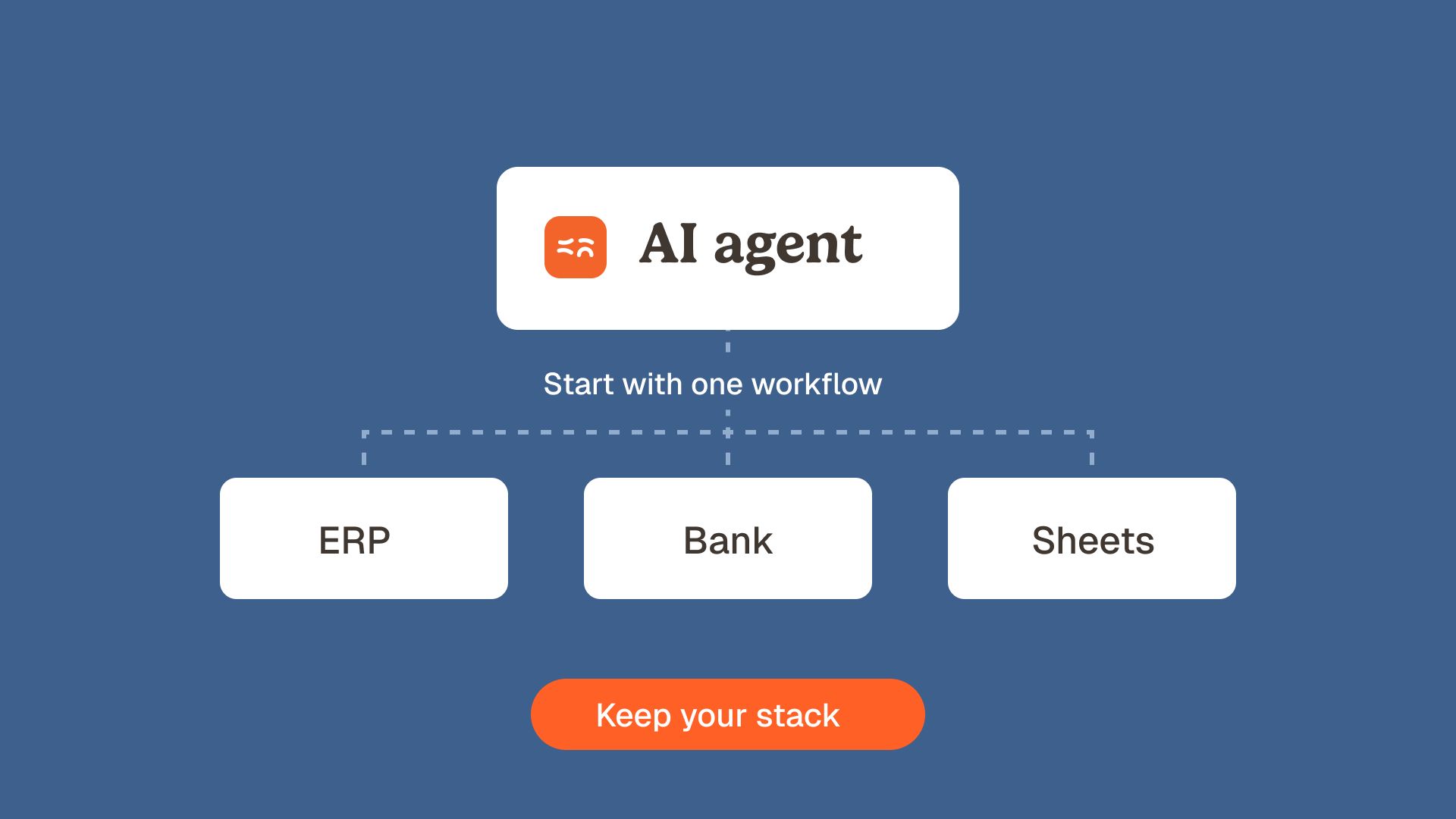
The Phacet agent Reconcile bank transactions and detect unmatched flows works on that list. It structures the bank file and the ledger extract into one auditable table, matches every line while exposing its reasoning, then surfaces what did not match instead of the thousands of lines that did. This article covers the format, a worked example, the journal entries, and the discipline that stops a reconciling item from quietly rolling into its fifth month.
Key takeaways
- A bank reconciliation statement is the document that explains the difference between a bank closing balance and a book closing balance on a given date.
- The standard format holds two adjustment blocks: the bank side (deposits in transit, outstanding checks) and the book side (fees, interest, NSF checks, recording errors).
- Only book side adjustments generate a journal entry. Bank side timing differences clear on their own and never touch the ledger.
- A reconciling item that survives more than one full cycle is no longer a timing difference. It is a control point that needs an owner and a resolution date.
- The Washington State Auditor calls the fuller version a proof of cash: it reconciles the period activity, not just the closing balances.
What a bank reconciliation statement proves, and what it does not
A bank reconciliation statement is an accounting document that explains the difference between the closing balance on a bank statement and the closing balance of the matching cash account in the general ledger, and that shows both figures agree once known adjustments are applied.
It is prepared at a fixed cut-off date, usually month end, and it is kept as evidence. Its value comes from the items it lists, not from the total at the bottom.
The statement, the process, and the bank statement are three different things
The bank statement is issued by the bank and records what actually cleared. Bank reconciliation is the process of comparing that record to your own. The bank reconciliation statement is the document that comes out of the process.
Vocabulary shifts by country and creates real confusion. British and Indian accounting courses call the internal record the cash book and the bank statement the pass book. US practice calls the same two things the book balance and the bank balance. The objects are identical, only the labels change.
Why the agreed figure is the easy part
Two balances can always be forced to agree. A suspense entry or a rounding plug closes any gap, and the statement still shows a clean match while proving nothing.
What proves cash is the composition of the middle section: every reconciling item named, dated, categorized and resolvable. That is also what separates a reconciliation you can hand to an auditor from one you can only hand to yourself. If you are looking at the underlying concept rather than the document, see bank reconciliation automation.
Bank reconciliation statement format
The standard bank reconciliation statement format has four blocks: the bank closing balance with its adjustments, the book closing balance with its adjustments, and one adjusted figure that both sides have to reach.
The fields a statement has to carry
- Legal entity and bank account identifier, so the statement can be matched to a specific general ledger account
- Period covered and cut-off date
- Closing balance per bank statement
- Closing balance per general ledger
- Bank side adjustments, itemized, never grouped into a single line
- Book side adjustments, itemized, with the journal entry reference for each
- The adjusted balance, identical on both sides
- Preparer name, reviewer name, and date of review
The last field is the one most templates leave out, and it is the first thing a reviewer looks for. A reconciliation prepared and approved by the same person is not an internal control, whatever the arithmetic says. Separating preparation from review is the cheapest segregation of duties any accounting team can put in place.
The two-column layout
The two sides are laid out in parallel so a reader can follow each adjustment back to its source. The structure below is the one to reuse whatever the accounting system.
| Block | Bank side | Book side |
|---|---|---|
| Starting point | Closing balance per bank statement | Closing balance per cash account in the general ledger |
| Add | Deposits in transit | Interest earned, direct collections credited by the bank |
| Subtract | Outstanding checks and unpresented payments | Bank service charges, NSF checks returned, transfer fees |
| Correct | Bank errors, in either direction | Recording errors in the books, in either direction |
| Result | Adjusted bank balance | Adjusted book balance |
| Requirement | Both adjusted balances must be identical. Any residual difference is an unexplained item, not a rounding issue. | |
| Journal entry | None. These items clear on their own. | One entry per line, with its reference on the statement. |
| Sign-off | Preparer name, reviewer name, date of review. The preparer and the reviewer are two different people. | |
A worked bank reconciliation statement example
Example: a company closes March with a bank statement balance of $128,450 and a general ledger cash balance of $124,180. The $4,270 gap is explained by six items, three on each side.
| Line, period ending March 31 | Bank side (USD) | Book side (USD) |
|---|---|---|
| Closing balance as reported | 128,450 | 124,180 |
| Add: deposit in transit, banked March 30 | +9,300 | |
| Subtract: outstanding checks, 4 items | -14,120 | |
| Subtract: bank service charges | -180 | |
| Add: interest earned | +95 | |
| Subtract: customer check returned NSF | -1,250 | |
| Add: correction, check of 785 entered twice | +785 | |
| Adjusted balance | 123,630 | 123,630 |
| Journal entries required | 0 | 4, net -550 |
Both adjusted balances land on $123,630. Note that neither starting figure was correct: the bank had not yet processed everything, and the ledger had not yet recorded everything the bank knew.
Which items need a journal entry, and which never will
This is where most reconciliations go wrong, and where published guides are least clear. The rule is short and has no exceptions.
Bank side adjustments never generate a journal entry. The deposit in transit and the outstanding checks are already recorded in the books. The bank has simply not caught up. Posting an entry for them would double count the transaction.
Book side adjustments always generate a journal entry. Each one exists because the bank knows something the ledger does not: the $180 service charge, the $95 of interest, the $1,250 NSF check reversal, and the $785 duplicate that has to be backed out. Four entries, net effect of $550 credited out of cash, and the ledger now shows $123,630.
A quick test before you post: if the transaction originates with the bank, it needs an entry. If it originates with you, it does not.
How to prepare a bank reconciliation statement, step by step
Published guides describe this work in four, five, six or seven steps, which makes the process look unsettled. It is not. The difference is only where each guide stops. Four-step versions stop when the two adjusted balances agree. Seven-step versions carry on through the journal entries, the investigation of what did not match, and the review. The four extra steps are optional in a textbook and mandatory in a real close.
- Fix the period and gather the sources. Bank statement or bank file, general ledger extract for the matching cash account, and the list of items carried forward from last month.
- Confirm the opening balances agree. If last month closed clean, this month opens clean. When the opening figures do not match, stop here: the problem is behind you, and reconciling forward will only bury it.
- Match transactions and isolate what did not match. Amount, date and reference. Everything that pairs off is finished work.
- Adjust the bank side. Add deposits in transit, subtract outstanding checks, correct any bank error in either direction.
- Adjust the book side and post the entries. Fees, interest, returned checks, direct debits and recording errors.
- Confirm both adjusted balances are identical. If they are not, the discrepancy is a real unexplained item, not a rounding issue. Research it rather than plug it.
- Age the open items, assign each one, and have the statement reviewed. By someone who did not prepare it.
The reconciling items that keep coming back
A reconciling item is any transaction that appears on one side and not the other at the cut-off date. Most of them clear within days without anyone doing anything. A small number never clear, and those are the ones worth your attention.
Timing difference or actual problem
The two categories look identical on a statement and behave nothing alike. A timing difference resolves itself. A problem waits for someone to act, and grows quieter every month it survives.
| Reconciling item | Usual cause | Nature | Journal entry | If still open after one cycle |
|---|---|---|---|---|
| Deposit in transit | Receipt banked close to the cut-off date | Timing | No | Treat as an unbanked receipt and confirm the funds physically reached the account |
| Outstanding check | Payment issued but not yet presented | Timing | No | Confirm the payee received it, then consider voiding and reissuing |
| Bank service charge | Fee debited by the bank, not yet booked | Recording gap | Yes | Check the fee against the contracted schedule before posting it again |
| Interest earned | Credit applied by the bank, not yet booked | Recording gap | Yes | Confirm the rate applied matches the agreement |
| NSF check returned | Customer payment reversed for insufficient funds | Problem | Yes | Reopen the receivable and escalate to collections |
| Duplicate entry | Same payment recorded twice in the ledger | Problem | Yes | Correct the entry, then find out how the duplication happened upstream |
| Keying or transposition error | Amount entered incorrectly at input | Problem | Yes | Correct the entry, then test whether the error is isolated or systematic |
| Unidentified debit or deposit | No supporting document found on either side | Problem, possible fraud | Yes, once identified | Park it in suspense, escalate immediately, never write it off to close the statement |
Aging: when a timing difference stops being one
A deposit in transit on day three is normal. The same deposit on day forty is not a timing difference any more. It is an unbanked receipt, a misposted entry or a duplicate, and it has been sitting on the statement long enough to look legitimate.
The working rule is simple: any item that survives a full cycle changes category. It stops being a timing difference and becomes an exception with a name, an age and a resolution date. Controllers who track the age of open items catch problems in month two instead of month nine.
Thresholds and named ownership
Two decisions sit on top of the aging discipline. The first is a materiality threshold below which an item is written off rather than investigated. Without one, a close is spent chasing three dollar differences while a five figure item ages in the same list.
The second is a name against every item above that threshold. An unassigned reconciling item survives indefinitely, because reviewing it is nobody's job. Both decisions push the close toward exception-based review, where the team works the short list rather than the long one.
One caveat for multi-site groups in retail, hospitality and food service: bank against ledger is only one of the reconciliations that has to tie. Card settlements arrive net of fees, payment provider payouts batch several days together, and point of sale takings follow their own schedule. Those flows do not change the format of the statement, they change how many statements you have to produce.
That is a tooling question rather than a format question, and it is covered separately in our guide to bank reconciliation software and by the agent that reconciles payment gateway, bank and ERP flows.
What makes a bank reconciliation statement audit ready
An audit ready bank reconciliation statement is one where every reconciling item is supported by a document a reviewer can open, and where the path from a ledger line back to a bank line can be reconstructed without asking the preparer.
Evidence, not assertion
A reviewer does not check your arithmetic. Spreadsheets do arithmetic correctly. What a reviewer checks is whether each item in the middle of the statement is real: the deposit in transit backed by a deposit slip, the NSF check backed by the bank advice, the correcting entry backed by the original document that was misread.
Public sector accounting manuals set a higher bar than most private companies apply, which makes them a useful benchmark for what an auditor has in mind. The Washington State Auditor's BARS GAAP Manual (section 3.1.9) describes the purpose of a bank reconciliation as comparing balances and activity, a fuller exercise it names a proof of cash, and it requires the governments it oversees to document a reconciliation of both the ending cash balance and the cash activity at least monthly. The same manual instructs that unidentified deposits be investigated and parked in a suspense account until they are resolved, rather than absorbed into the balance.
Nothing in that is specific to public bodies. It is simply the standard written down.
Tracing a ledger line back to the bank line
The practical form of that standard is a native audit trail: every match, every adjustment and every write-off timestamped, attributed and reversible, so a question asked in November about a March reconciliation has an answer that does not depend on who was in the office. Reconciliation sits at the center of the closing and audit workload for exactly that reason.
Automating the statement without losing the review
Automation belongs on the matching, not on the judgment. The split matters, because a tool that decides on your behalf produces a statement nobody can defend.
The Phacet agent works in three moves. It structures the bank file and the ledger extract into one table with configurable AI columns. It matches line by line through AI Match, a semantic matching engine that shows its reasoning for each pairing rather than returning a score. It then surfaces the unmatched flows, aged and categorized, in a detail view where each item can be opened down to its source document.
What stays human is the decision. The agent proposes a match, an owner reviews it, and the sign-off carries a person's name. That is the difference between a reconciliation that is fast and a reconciliation that is fast and defensible. See how the pieces fit together on our automated bank reconciliation page.
Smartbox, the European gift box leader with 800 employees across 14 countries, applied this approach to reconciling payments against invoices, a different reconciliation from bank against ledger but the same mechanics of matching and exception review. The result was a fourfold gain in reconciliation productivity, with each use case operational in six weeks.
"Phacet operates like an extension of our teams." Mourad Meraou, Operations Director, Smartbox
Phacet runs more than 40 finance agents built on over 100 real deployments, and a first agent typically reaches production in under two weeks. The full range for cash and banking work sits in the treasury and cash catalog.
The bottom line
A bank reconciliation statement that balances tells you the arithmetic held. A bank reconciliation statement you can defend tells you the cash is real. The gap between the two is the list of reconciling items in the middle, how old they are, and whose name is next to each one.
Start by aging what is already open. Sort every reconciling item on your last statement by the date it first appeared, and look at anything older than one cycle. That single view usually says more about the state of your cash than the reconciliation itself, and it costs one afternoon.
Frequently asked questions
What are the 4 steps of bank reconciliation?
The four core steps are: compare the bank statement against the cash ledger, adjust the bank balance for deposits in transit and outstanding checks, adjust the book balance for fees, interest, returned checks and errors, then confirm both adjusted balances are identical. Longer versions add journal entries, investigation and review.
What is the simplest format for a bank reconciliation?
The simplest format is two columns side by side: the bank closing balance with its adjustments on the left, the book closing balance with its adjustments on the right, and one identical adjusted figure at the bottom of both. Add the period, the account and the preparer name.
How often should bank reconciliation be done?
Monthly is the baseline. The Washington State Auditor's BARS GAAP Manual requires the governments it oversees to reconcile both the ending cash balance and the cash activity at least monthly, and recommends daily reconciliation for accounts with heavy activity or higher fraud risk. Frequency should follow risk, not habit.
What is an easy way to prepare a bank reconciliation?
Import the bank file and the ledger extract into a single table, match on amount, date and reference, then work only the lines that did not pair off. Phacet runs that match automatically and surfaces the exceptions, so a review starts with twelve open items rather than three thousand cleared ones.