AI finance agent pricing: real cost per document explained
Published on :
September 21, 2026

Nicolas Marchais is co-founder and CEO of Phacet. After seven years at Spendesk, he built Phacet as the agentic layer that orchestrates across ERP, banking and email systems. Reliable, auditable, cross-system, what he calls a Finance Workforce.

This page is for the finance leader who has been asked to put a number on an AI agent before the next budget round, and who keeps finding quotes that range from a few hundred euros to several hundred thousand for what looks like the same thing.
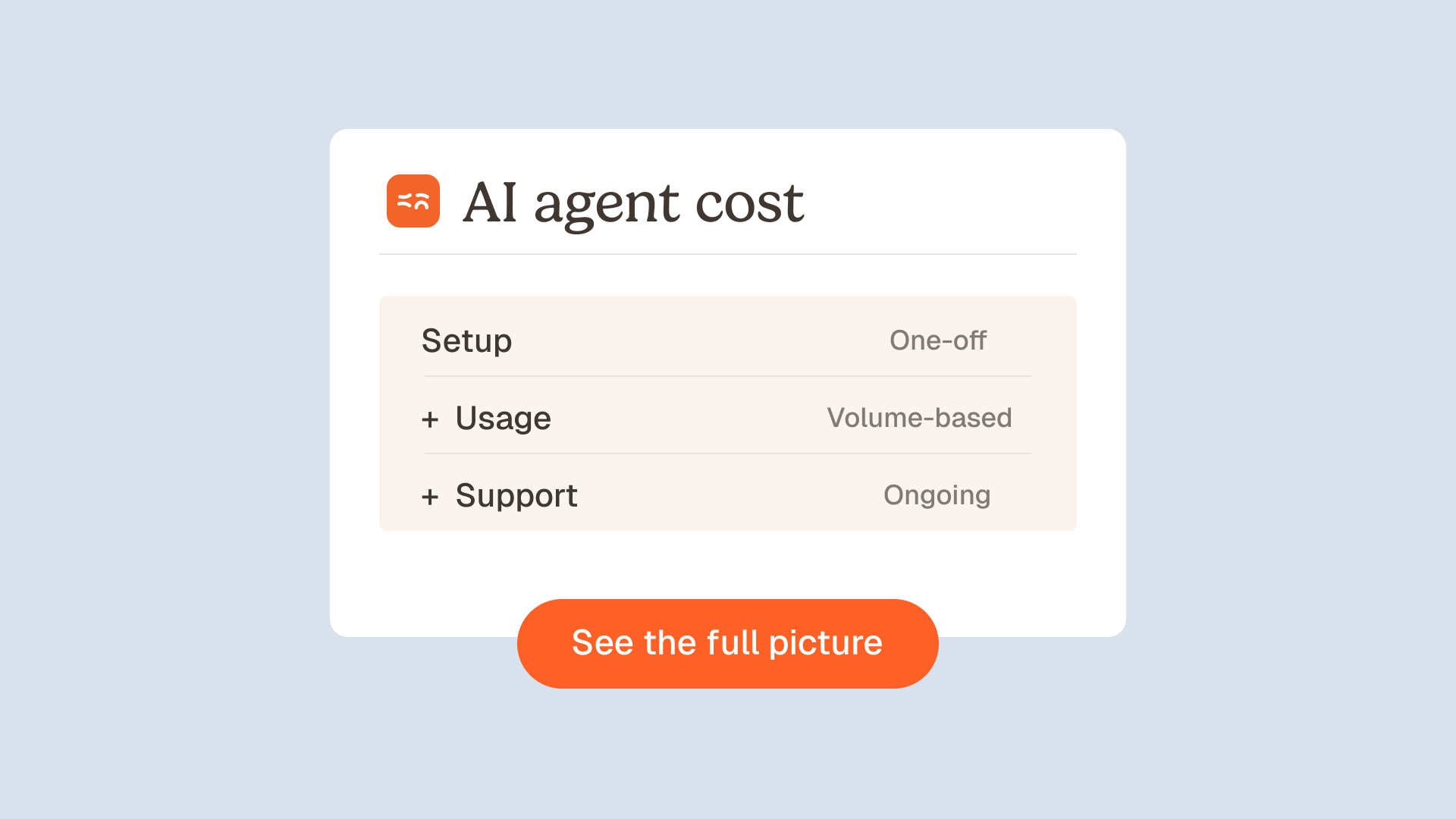
AI finance agent pricing splits into two purchases that are constantly confused. Commissioning a custom build is quoted between roughly 3 000 and 100 000 euros as a one-off project. Subscribing to an agent that already exists is quoted per unit of work, and the published grids land between 0,005 and 0,008 euro per credit, which puts a supplier invoice extracted and checked at around 0,13 euro. The number your budget needs is the second one, multiplied by the documents you actually process each month. Everything else is a project cost, not a price.
Key takeaways
- An AI finance agent bought as a subscription is priced per action, not per seat: about 0,13 euro to extract and control a supplier invoice, 0,20 euro for a three way match, 0,40 euro for a bank reconciliation.
- Three published credit grids (Phacet, Salesforce Agentforce, Microsoft Copilot Studio) converge on 0,005 to 0,008 euro per credit, so the unit price of agent work is now a market rate rather than a negotiation.
- Entry subscriptions for a finance agent start at 299 euros per month, which covers roughly 2 250 supplier invoices extracted and controlled before any extra credit pack is needed.
- A quoted build at 25 000 euros equals about seven years of that subscription, so the build only pays off when a needed control genuinely does not exist as a ready made agent.
- Four cost lines sit outside the sticker price and decide the real total: setup, connections to each source system, human review of exceptions, and what happens when you pass your monthly limit.
Why published prices disagree by a factor of 600
Search the cost of an AI finance agent and you get a spread that no reader can act on. The figures below were all published on the first page of Google for that question, or cited by its AI Overview, and were read on 20 September 2026.
| Source | Published | What it quotes | What it is actually pricing |
|---|---|---|---|
| Google AI Overview (US) | Read 20 Sep 2026 | 500 to 300 000 dollars and above | Both purchases merged into one range |
| Azilen Technologies | 2 Jan 2026 | 50 000 to 300 000 dollars and above | A custom build for a bank or a fintech |
| Smartpoint | 28 Jan 2026 | 50 000 to 100 000 euros, then 5 000 to 15 000 per month | A build plus its run, sized for an IT department |
| Digital Unicorn | 12 Feb 2026 | 30 000 to 100 000 euros | A custom build |
| Genee | 26 Apr 2026 | From 12 000 euros for a proof of concept | A scoped pilot, one use case |
| Annei | 6 May 2026 | 1 500 to 15 000 euros, then 100 to 400 per month | A small custom build |
| r/AI_Agents thread | Read 20 Sep 2026 | 3 000 to 8 000 dollars for a typical setup | What agencies charge to build one |
Read the right hand column and the spread collapses. Every one of these numbers prices an agent being built. None of them prices an agent being used. That is not a detail: the two purchases have different buyers, different contracts and different failure modes, and a finance team evaluating a ready made agent is reading a price list written for someone commissioning software.
The bias has a simple cause. The pages answering this question are published almost entirely by the firms that sell the build. A guide written by a development agency naturally quotes development. It is accurate, and it answers a question a finance leader evaluating an agent is not asking.
What one unit of finance work costs
Agents sold as subscriptions are billed per action. The vendor publishes how many credits each action consumes and how many credits the plan includes, which makes the unit price a division anyone can do.
Phacet publishes the credit cost of each finance action on its plans page. On the entry plan at 299 euros for 45 000 credits, one credit is worth 0,0066 euro. Applied to the published actions, that gives the following unit prices, computed on 20 September 2026.
| Finance action | Credits | Cost per action | Volume covered by the entry plan |
|---|---|---|---|
| Categorise an accounting entry | 2 | 0,013 euro | 22 500 per month |
| Automated account matching (lettrage) | 4 | 0,027 euro | 11 250 per month |
| Extract and control a supplier invoice | 20 | 0,133 euro | 2 250 per month |
| Control an expense report | 22 | 0,146 euro | 2 045 per month |
| Match order, delivery and invoice | 30 | 0,199 euro | 1 500 per month |
| Check invoiced price against the negotiated catalogue | 30 | 0,199 euro | 1 500 per month |
| Reconcile bank flows and flag discrepancies | 60 | 0,399 euro | 750 per month |
Two other vendors publish the same shape of grid. Salesforce sells Agentforce Flex Credits at 500 euros per 100 000 credits, with a standard agent action costing 20 credits, so 0,10 euro per action. Microsoft sells Copilot Studio credits at 200 dollars per pack of 25 000, so 0,008 dollar per credit, with a variable number of credits per action.
Three independent grids, three companies with nothing in common commercially, and the same unit within a narrow band. The price of one piece of agent work is no longer a negotiation, it is close to a market rate. That is the single most useful fact for a budget, and it is the one the cost guides never state, because they are not pricing usage.
Note what the unit tracks. A three way match costs more than a categorisation because it reads three documents and compares them line by line, not because it is sold as a premium feature. Price follows the amount of checking, which is exactly the variable a controller already reasons about.
How to size your own monthly budget in four steps
You do not need a quote to get within a few euros of your own number. You need your volumes.
- Count the documents, not the users. Supplier invoices received per month, bank lines to reconcile, expense reports, delivery notes. Your accounting system exports this in a few minutes.
- Name the control you want on each one. Extraction alone is cheap. Extraction plus price comparison plus a three way match costs roughly four times more per document, and catches things extraction never will.
- Multiply. Volume times the unit price of the control. Two thousand supplier invoices fully extracted and controlled is about 266 euros of work per month, which sits inside an entry plan.
- Add the exceptions. Budget for a human reviewing the flagged minority. The agent does not remove that line, it shrinks it and tells you where to look.
Once you have that figure you can read a vendor grid properly, because you know which plan your volume actually lands in. The Phacet plans page publishes the credit cost of each action next to the plan envelopes, so the comparison takes minutes rather than a discovery call.
The four cost lines that are not on the pricing page
Finance buyers discussing this in public are consistent about what goes wrong, and none of it is the headline price. The recurring complaints on r/CFO are that pricing is not clear upfront, that the return does not land when the team has to build every agent itself, and that usage based billing will be repriced once the workflow is locked in. Those are the right worries. Here is where they actually live.
Setup. Someone has to configure the agent on your data, your suppliers, your chart of accounts. Ask whether it is included, and ask for the time to production in weeks rather than in a phase name.
Connections. Each source system you plug in is work. One published US estimate puts custom integration at 5 000 to 15 000 dollars per system, which is realistic when the connector does not exist and irrelevant when it does. The question to ask is not what an integration costs, it is whether your ERP, your bank and your inbox are already in the catalogue.
Human review. No serious agent removes the reviewer. It changes what the reviewer looks at, from every document to the flagged ones. If a vendor implies otherwise, the savings case is built on something that will not happen.
Going over the limit. This is where credit models get a bad reputation, and it is worth reading the contract text. Phacet states that AI costs are passed through at cost with zero markup, that consumption is visible in real time, and that customers are notified before hitting the limit rather than after. Whatever vendor you look at, those three sentences are the ones to find in writing.
Build or subscribe: the arithmetic
Put the two purchases on the same scale and the decision stops being philosophical.
The cheapest build quoted on the first page of results for this question is 2 999 euros, and the typical range sits between 12 000 and 30 000 euros. An entry subscription at 299 euros per month costs 3 588 euros a year. So the cheapest build equals ten months of subscription, and a 25 000 euro build equals about seven years of it, before counting the run costs that the same guides put at 100 to 500 euros per month for hosting and maintenance.
That maths is not an argument against building. It sets the condition under which building makes sense: the control you need has to be genuinely absent from every catalogue, and specific enough that it will still be yours alone in three years. For invoice extraction, price compliance, three way matching, bank reconciliation or account matching, that condition is not met. These agents exist, they are priced per document, and rebuilding them is paying a seven year premium for a control you could have run next week.
What moves the price more than the vendor does
Across the published grids, four variables move the bill far more than the choice of supplier.
- Volume. The only genuinely linear driver, and the easiest to forecast.
- Depth of control. Reading a document is cheap. Comparing it against a contract, a purchase order and a delivery note is where both the cost and the recovered money sit.
- Number of connected systems. Not the cost of each connector, but whether they exist already.
- Evidence requirements. If an auditor has to be able to replay a decision, the agent needs a native audit trail. Retrofitting that is expensive. Having it is not.
Worth noting what none of the cost guides weigh on the other side. Across the five most visible guides on this question, read in full on 20 September 2026, the words invoice, reconciliation, audit trail and CFO appear one, two, zero and zero times respectively. The literature on what an AI finance agent costs almost never names the finance work it is supposed to do, which is why it can only price the build.
What the saved money looks like
The cost side is only half a budget line. At Astotel, a group of 18 Paris hotels, supplier price checks were done by sampling because checking every line by hand was not realistic. An agent comparing each invoice line against negotiated prices surfaced around 400 euros of billing errors a month on a single supplier, close to 5 000 euros a year, and freed up about two hours a day.
"I save up to two days a month, and I spot errors I would never have caught on my own." Valerie, Purchasing Director, Astotel.
At Smartbox, a European gift box leader operating in 14 countries, reconciling payments against invoices moved to four times the previous productivity, with each use case live in six weeks. Those figures are worth holding next to the per document price: at 0,199 euro a line check, recovering 400 euros of errors on one supplier pays for several thousand checks.
The honest summary
If you are budgeting for an AI agent on finance work, the useful number is not a range someone published. It is your monthly document volume multiplied by the unit price of the control you want, which for a supplier invoice extracted and checked is around 0,13 euro today, plus a line for the human who reviews the exceptions. Entry plans start at 299 euros per month, and a build only earns its seven year premium when the control you need does not exist anywhere.
Work out your volumes first. Then a demo is a conversation about your documents rather than about pricing models.
Frequently asked questions
How much do AI agents cost?
Ready to use business agents are sold per action, at published rates of 0,005 to 0,008 euro per credit, where one action consumes between 2 and 60 credits. That puts most finance actions between 0,01 and 0,40 euro each. Custom built agents are quoted as projects, typically 3 000 to 100 000 euros, plus monthly hosting and maintenance.
Which AI agent is best for finance?
There is no single best one, but three filters eliminate most candidates quickly. Does it already connect to your ERP and your bank without custom work. Does it show its reasoning and keep an audit trail an auditor can replay. Is its price set per document rather than per seat.
Do you have to pay for an AI agent?
For anything touching accounting data, yes. Free tools exist but they do not connect to your systems, do not keep an audit trail and do not guarantee where your data is processed. Most vendors offer a trial instead, commonly 14 days with credits included, which is enough to run the agent on real documents before committing.
Is there a completely free AI agent?
Open source frameworks are free to download, but they are toolkits, not running agents. You still pay for the model calls, the hosting, the integrations and the engineer who maintains it. For a finance team without an in house developer, a free framework is usually the most expensive option once those lines are counted.
Is ChatGPT an AI agent?
ChatGPT can act as an agent within a session, but it is a generalist assistant, not a finance agent. It does not know your suppliers, your price book or your accounting rules, it does not connect to your ERP or your inbox on a schedule, and it produces no audit trail.
Sources and method. Credit costs and plan envelopes read on the Phacet, Salesforce Agentforce and Microsoft Copilot Studio published price pages on 20 September 2026. Unit prices computed from those published figures. Quoted build ranges read on the first page of Google results for this question and in its AI Overview on the same date. Term counts measured on the full main content of the five most visible guides on the question, read the same day.
Latest Resources
Unlock your AI potential
Go further with your financial workflows — with AI built around your needs.