

For finance leads at 50 to 500-person companies that buy and sell goods, and who have watched cash tighten while sales grow. Students after the formula: our working capital requirement definition is enough.
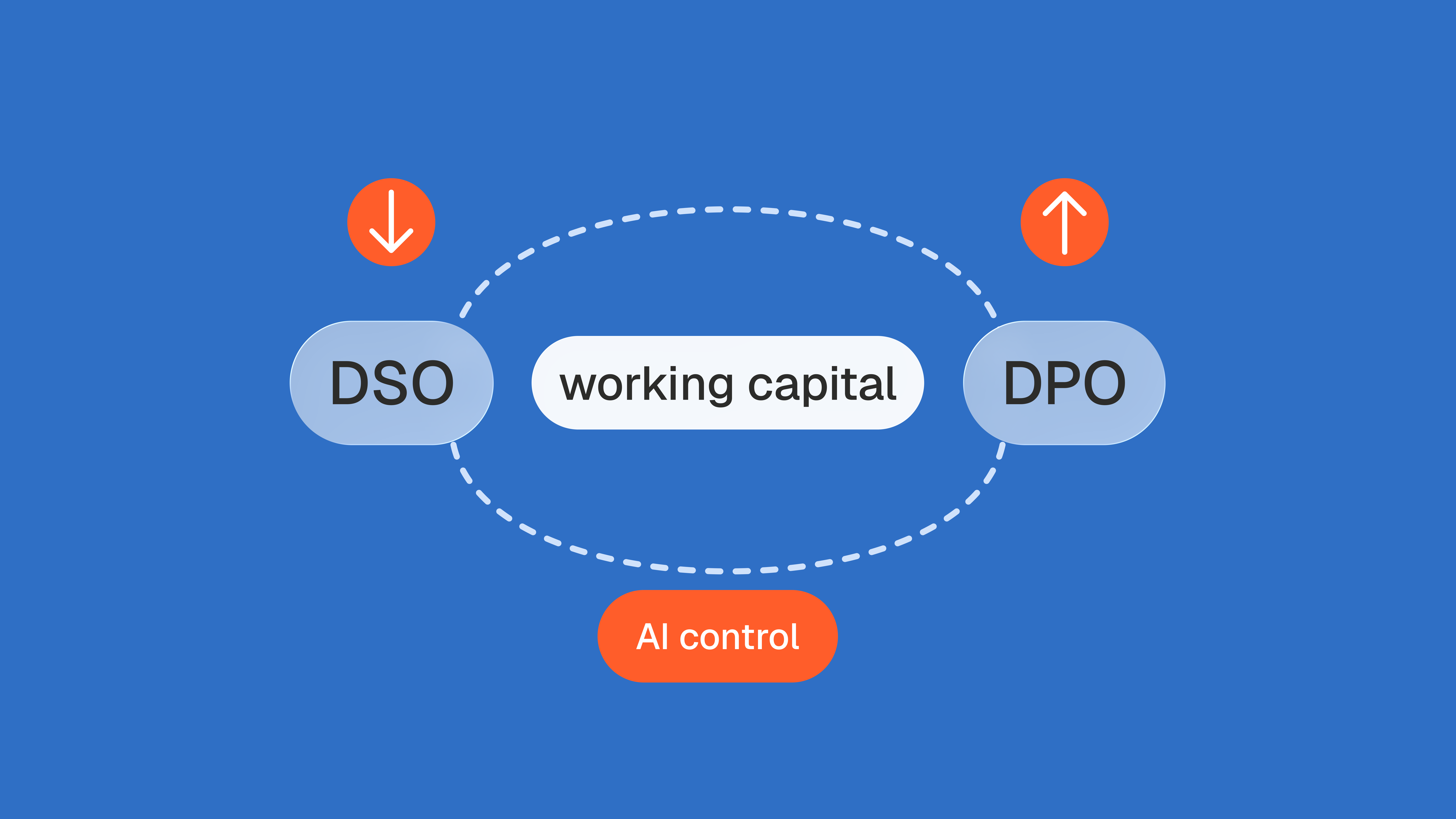
Working capital management is the day-to-day control of receivables, payables and inventory, so that the operating cycle ties up as little cash as possible. Finance steers two of its levers directly: days sales outstanding (DSO), which should go down, and days payable outstanding (DPO), which should be protected rather than cut, because every day a supplier is paid early is a day of purchases financed from your own cash. AI control works on the data behind both numbers. It matches payments to open invoices, surfaces disputed lines before they age, and stops supplier invoices from being paid early, at the wrong amount or twice.
Key takeaways
- Cutting DPO increases the cash a business needs: on $18 million of annual purchases, each day of DPO lost moves about $49,000 from your account to your suppliers'.
- DSO counts every open receivable, so payments received but never matched, disputed invoice lines and unreconciled card or platform payouts push DSO up even when customers have already paid.
- Skipping a 2/10 net 30 supplier discount costs about 37% a year, so paying early makes sense only when the discount beats your cost of capital, and paying early without a discount is a pure DPO loss.
- Atradius attributes overdue B2B payments in North America to customer liquidity issues and to inefficiencies in payment processes, and only the second cause is in the hands of your finance team.
- Working capital controls pay off when they run as an invoice arrives or as cash lands, because a check made at payment time either delays a payment that is due or lets the error through.
What inflates DSO besides slow-paying customers?
Four things inflate DSO without any customer paying late: invoice lines the customer disputes, payments received but never matched to their invoice, payouts from card acquirers and platforms that nobody reconciles, and invoices sent late. DSO is open receivables divided by revenue, multiplied by the days in the period. Anything that keeps a receivable open counts, whether or not the cash is already in your bank.
The distinction matters because the usual fix, chasing customers harder, only works on a customer who can pay and has not. An accountant on r/Accounting described the other case: "There wasn't a true aging or tracking of deductions/short pay causes and customers started refusing to pay until their accounts were fixed." Sending reminders to a customer whose account is wrong makes DSO worse, not better.
| DSO inflator | What you see | The control that removes it |
|---|---|---|
| Disputed invoice lines | A short payment, a deduction, or a customer waiting for a credit note before paying anything. | Each invoice checked against the contract and the deal before it is sent, with billing checked against the CRM and the ERP so a missing credit note or an unbilled deal never reaches the customer. |
| Unapplied cash | Money in the bank, the invoice still open, reminders sent to a customer who paid. | Every incoming payment matched to open invoices each day, including partial and grouped payments. |
| Unreconciled payouts | Card sales settled days later, net payouts after fees and chargebacks, platform remittances with no invoice number. | Each payout reconciled to gross sales, fees and the bank line, with missing settlement days flagged. |
| Late or incomplete invoices | The payment clock starts days after delivery, or stops while the customer asks for a purchase order number. | Invoices issued at delivery, carrying the order reference the customer's payables team needs to approve them. |
The third row is the one goods businesses underestimate. Phacet's description of card settlement is blunt: card amounts "land in your account one to three days later", and "when settlement fails or a terminal is misconfigured, entire days can go unreceipted without anyone noticing." Payment gateways such as Stripe, Adyen or SumUp add a layer, because they aggregate dozens of transactions into one net payout after fees. A dispute or a refund that nobody provisioned stays hidden inside a receivable that looks collected, which is why reconciling gateway payouts to the bank and the ERP belongs in working capital management, not only in month-end accounting.
Late payment is real, of course. The 2025 Atradius Payment Practices Barometer for North America found 43% of US B2B sales on credit overdue, "primarily due to customer cash flow pressures", and it names a second cause across the region: inefficiencies in payment processes. You cannot fix a customer's liquidity. You can fix the second cause, and it starts on your side of the invoice.
The published guides rarely go there. Across the five most visible working capital guides we reviewed on 27 September 2026, 8,440 words in total, the words dispute, unapplied, remittance and duplicate do not appear once, while inventory appears 86 times. DSO is explained as a collections problem. For a company that sells on credit, it is just as often a data problem.
The first control to put in place is the second row of the table, because it is the cheapest cash you will ever collect: it is already in your bank. An agent that reconciles bank transactions and detects unmatched flows matches each receipt to its open invoice and leaves your team only the exceptions to review, so the DSO you report is the DSO your customers actually owe.
Why cutting DPO works against your working capital
Cutting DPO increases the cash your business needs, because DPO measures the part of the operating cycle your suppliers finance. The cash conversion cycle makes it explicit: days inventory outstanding (DIO), plus DSO, minus DPO. Every day removed from DPO adds a day to the cycle, exactly like a day added to DSO. DSO and DPO move working capital in opposite directions, and treating them as two numbers to shrink is the most common mistake in working capital management.
Take a distributor with $30 million of annual revenue and $18 million of annual purchases. One day of DSO is worth about $82,000 of cash and one day of DPO about $49,000. Paying suppliers five days before their due date, on average, parks roughly $247,000 in suppliers' accounts instead of yours, and nobody negotiated that loss.
The goal on the payables side is therefore not a lower DPO, and not an ever longer one either. Phacet's own glossary speaks of "paying suppliers on optimal terms", and its page on validating invoices before payment gives the operating rule: invoices "paid at the right date", "not too early (cash tied up) or too late (penalties, supplier relations)". In practice, DPO leaks in three ways that no negotiation fixes.
- Early by default. A weekly payment run pays everything due before the next run, so an invoice due on a Friday is paid on the Monday before. Four days of DPO, on every invoice, every week.
- At the wrong amount. A price above the negotiated rate or a missing credit note is paid in full, and the refund comes back weeks later, if at all. Astotel, a group of 18 Paris hotels, recovers about €5,000 a year of billing errors on a single supplier since every invoice line is checked.
- Twice. The same invoice arrives by email and through a supplier portal, or as a PDF and then as a reminder, and both copies are paid. The cash comes back only when someone notices.
Late is not free either. Paying past the due date buys days of DPO at the cost of late fees and of the supplier's goodwill, which you will pay back in pricing or in priority. The only DPO worth having is the one written in the contract.
In Europe, that frame is legal as well as commercial. The EU Late Payment Directive 2011/7/EU entitles a supplier to late payment interest, without any reminder, from the day after the agreed due date, and to a fixed sum of at least €40 for recovery costs. It caps contractual payment terms between businesses at 60 calendar days, unless expressly agreed otherwise and not grossly unfair to the creditor, and limits an acceptance or verification procedure to 30 days from receipt of the goods. Blocking an invoice for checks does not stop that clock, which is why the checks have to fit inside the payment term.
Should you pay early to take a supplier discount?
Pay early only when the discount's annualized return beats your cost of capital. The most visible guides disagree on this point. J.P. Morgan tells businesses to "capitalize on suppliers' early payment discounts" with no condition attached. HighRadius lists early payments among the key challenges of working capital management, because they deplete "cash that could be used elsewhere", then recommends "taking advantage of early payment discounts" on the same page. Stripe gives the rule that settles it: "If early payment discounts save more than your cost of capital, take them."
| Supplier terms | What paying early earns | Annualized return |
|---|---|---|
| 2/10 net 30 | 2% for paying 20 days early | About 37% |
| 1/10 net 30 | 1% for paying 20 days early | About 18% |
| Net 30, no discount | Nothing | 0%, and 20 days of DPO lost |
The calculation is the discount divided by the amount left to pay, multiplied by 365 divided by the days gained. At 2/10 net 30 that is 2/98 × 365/20, or 37.2%, far above the cost of a credit line, so take it. Without a discount the return is zero and the only effect is lost DPO. The control that matters is therefore a check on every invoice rather than a policy: does it carry discount terms, and does the payment date capture them or simply arrive early?
Where should working capital controls sit in the cycle?
Working capital controls belong at the moment the data is created, not at the moment cash moves. A check made at payment time has two possible outcomes: it blocks a payment that is already due, which costs late fees or goodwill, or it lets the error through. The table maps each control to the metric it protects.
| Moment | Control | Protects |
|---|---|---|
| Customer invoice issued | Invoice consistent with the contract, the CRM deal and the delivery; credit notes issued when they are owed. | DSO |
| Cash received | Each receipt, and each card, gateway or platform payout, matched to open invoices or gross sales. | DSO |
| Supplier invoice received | Price, quantity and discount checked against the order, the delivery note and the contract; payment terms on the invoice compared with the terms in the contract. | DPO |
| Before the payment run | Duplicates blocked, invoices not yet due held back, changes of bank details verified. | DPO |
| Month-end | Receivables split by cause; DPO lost to early or wrong payments measured. | Both |
The supplier invoice row carries a detail most teams skip. The payment terms printed on an invoice are not always the terms in the contract. An invoice that says 30 days when the framework agreement says 60 shortens your DPO silently, and if your due date comes from the invoice, that is the date it gets paid. Reading the terms at reception, not at payment, catches it while there is still time to ask for a corrected invoice.
The same logic applies to three-way matching of the order, the delivery note and the invoice. Done at reception, a price or quantity gap becomes a question to the supplier inside the payment term. Done at the payment run, it becomes a blocked payment and a supplier on the phone.
How Phacet applies AI control to DSO and DPO
Phacet runs AI agents that check the data behind DSO and DPO, on every invoice and every payment. An AI agent, in this context, is software that reads documents and transactions, applies a defined control and flags what disagrees, with its reasoning visible.
Structure. Customer invoices, remittances, payouts, supplier invoices and contracts become auditable tables, with amounts, due dates, payment terms, bank details and references extracted from each document.
Match. Receipts are matched to open invoices, card and gateway payouts to gross sales and fees, supplier invoices to orders, deliveries and contract terms. Every unmatched line becomes an exception with its reason: missing credit note, unbilled deal, price above contract, duplicate.
Analyze. Receivables split by cause and payables paid early or twice become filters in a single table, instead of a spreadsheet rebuilt before every close.
Smartbox, the European gift box company with 800 employees across 14 countries, started on the receivables side. Its team explained to Phacet in December 2024: "We implemented an application to match payments and invoices in our finance department", a task that had been very manual until then. "The result? A fourfold increase in productivity."
You do not need to rebuild the whole cycle to start. Pick the lever with the most cash behind it: card and platform payouts for a business paid at the till or online, unapplied receipts for a business that invoices on credit, the payment run for a heavy buyer. Run the agent on three months of history and compare the result with your aged balance. The differences are your first list of exceptions, and your first measure of cash recovered.
What Phacet does not do matters as much. It does not send dunning emails and it does not forecast cash. It sits between your ERP, your bank, your payment providers and your collections tool, and makes sure the numbers they exchange are right. Every value keeps its source document and every decision is recorded in a native audit trail: the agents flag, and your team decides. Phacet runs in production at more than 100 companies, and a first agent is typically live in under two weeks.
What to track each month instead of one DSO number
Track DSO split by cause and DPO lost to early or wrong payments, rather than two headline numbers. A finance professional on r/FPandA put the problem plainly: "I think companies fool themselves when they dump all overdue AR into one bucket. Some customers are genuinely slow to pay." Four measures are enough to separate them.
- DSO by cause. Collectible, disputed, unapplied, and in transit from card acquirers or platforms. Only the first bucket belongs to collections.
- Dispute age. Days since the customer first contested a line. A dispute older than your payment terms is DSO you created.
- DPO slippage. Average days between payment date and due date, for invoices paid early without a discount.
- Errors stopped before payment. Duplicates, prices above contract and missing credit notes caught before the run, in value.
Working capital management is often presented as a negotiation: shorter terms for customers, longer terms from suppliers. Terms matter. But part of the cash tied up in the cycle comes from invoices nobody checked and payments nobody matched, and fixing those requires nobody's agreement but your own.
FAQ
What are the 5 elements of working capital management?
The five elements usually listed are cash, accounts receivable, accounts payable, inventory and short-term financing. Cash and short-term financing set how much liquidity you hold, while receivables, payables and inventory set how much the operating cycle consumes. Finance controls receivables and payables most directly, through DSO and DPO, and inventory through purchasing and stock policy.
What is a good working capital ratio?
A current ratio, meaning current assets divided by current liabilities, between 1.5 and 2.0 is usually considered healthy. Below 1.0, short-term obligations exceed short-term assets. Far above 2.0, cash may be sitting idle in receivables or stock. Retailers and restaurants that collect at the till can safely run lower ratios than distributors.
How much working capital should a company have on hand?
Enough to cover the gap between paying suppliers and staff and collecting from customers, plus a buffer for a slow month. A practical way to size it is to multiply your cash conversion cycle in days by your daily operating costs. A 40-day cycle on $50,000 of daily costs means about $2 million tied up in operations.
What is an ideal cash conversion cycle?
There is no universal target: the cash conversion cycle, DIO plus DSO minus DPO, depends on the business model. Restaurants and retailers that collect at the till and pay suppliers on credit can run near zero or even negative. Distributors and manufacturers that sell on credit and hold stock run much longer cycles. The useful benchmark is your own trend.
Are AI dunning agents worth it for a small AR team?
They are worth it for customers who can pay and simply have not. They do not help when a payment was received but never matched, or when the customer awaits a credit note: reminders then irritate a customer who is right. Phacet's agents work on that second group, matching receipts to invoices and checking invoices before they are sent.