

For finance and credit leads at B2B companies of 50 to 500 people who sell on terms and chase from an aging report. Need only the formula? See our DSO definition.
Days sales outstanding (DSO) is the average number of days a company takes to turn its credit sales into cash. You reduce it without chasing every invoice by separating the part of DSO that your payment terms and sales timing set from the part that late payment adds, then removing from the reminder list every invoice a reminder cannot fix: invoices the customer has not approved, disputed lines, and payments already received but not matched. Automated reminders go to approved, undisputed, past-due invoices only, and your team calls the few largest balances.
Key takeaways
- Only average days delinquent, which the Credit Research Foundation defines as DSO minus best possible DSO, falls when you chase customers; payment terms and sales timing set the rest.
- A net-30 business whose customers all pay on day 30 reports a DSO of 36 days when monthly sales rise from $0.8 million to $1.2 million over a quarter, with no invoice late.
- An open invoice waiting for approval, a dispute answer or a cash match needs a correction, not a reminder, so it comes off the chase list before any sequence starts.
- Automated reminders are reliable only once every incoming payment is matched to its invoice; otherwise they reach customers who have already paid.
- The collection effectiveness index measures what share of collectible receivables your team actually collected in the period, which DSO alone cannot show.
Last updated: September 27, 2026
Which part of DSO can chasing actually reduce?
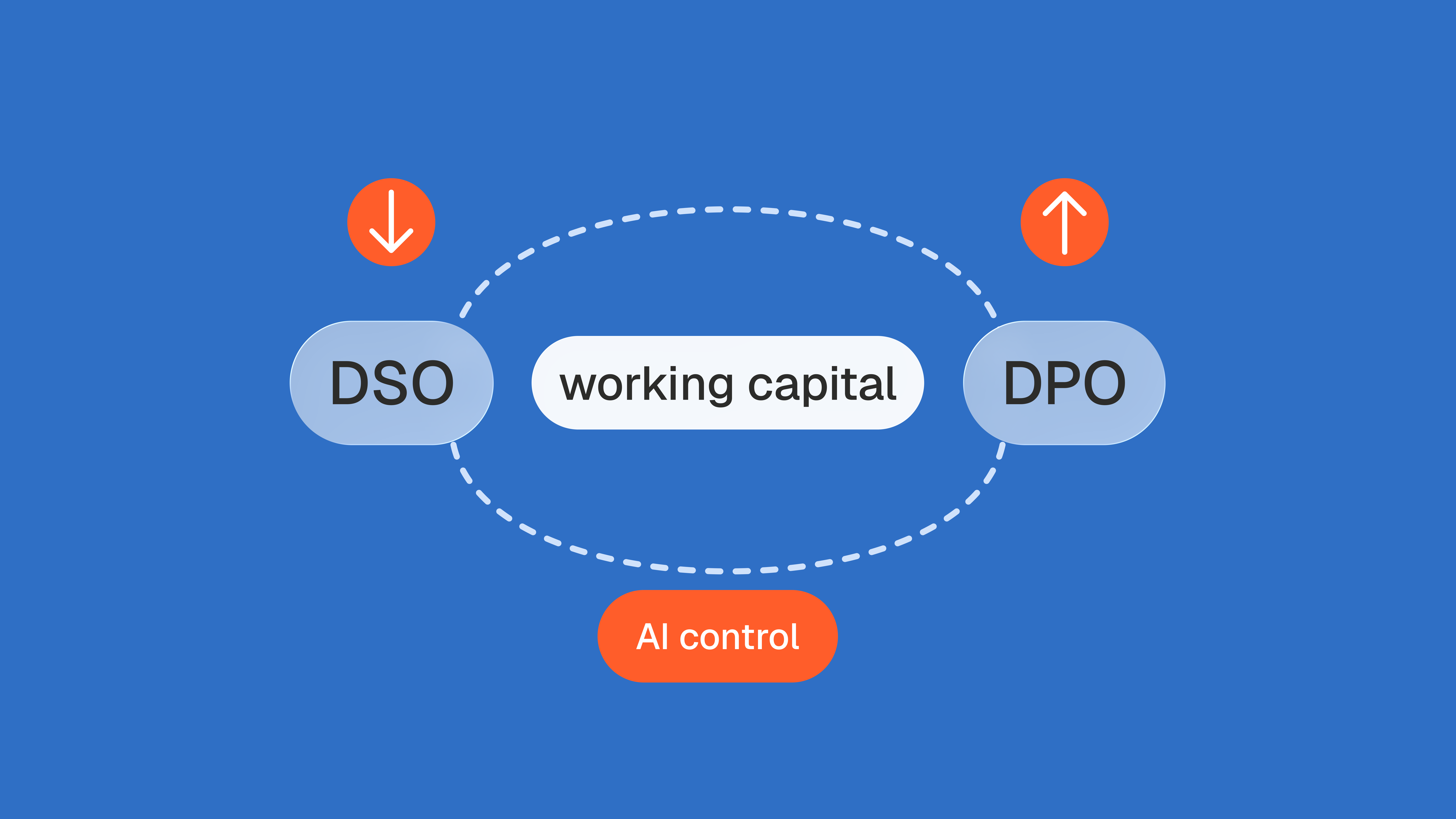
Chasing reduces only the days customers add by paying late. The Credit Research Foundation (CRF), the research body of the US credit profession, splits DSO in two: best possible DSO, the level receivables would reach if no invoice were past due, and average days delinquent (ADD), the difference between DSO and best possible DSO. Reminders, calls and escalation act on ADD. Your payment terms and the timing of your sales set best possible DSO. Both halves tie up working capital, but only one of them answers to a reminder.
The CRF is blunt about the headline figure. In its guide to credit performance measures, it calls DSO "one of the most often misused and misunderstood performance measures". Its three formulas share one denominator, credit sales for the period:
- DSO = ending total receivables × days in the period ÷ credit sales for the period.
- Best possible DSO = current receivables, meaning invoices not yet due, × days in the period ÷ credit sales for the period.
- Average days delinquent = DSO minus best possible DSO.
Example: a distributor selling on net 30 terms closes a 90-day quarter. The figures are illustrative.
| Scenario | Credit sales, months 1 / 2 / 3 | Receivables at quarter end | DSO | Best possible DSO | Average days delinquent |
|---|---|---|---|---|---|
| A. Flat sales, every customer pays on day 30 | $1.0M / $1.0M / $1.0M | $1.0M, all current | 30 | 30 | 0 |
| B. Rising sales, every customer pays on day 30 | $0.8M / $1.0M / $1.2M | $1.2M, all current | 36 | 36 | 0 |
| C. Rising sales, $300,000 past due | $0.8M / $1.0M / $1.2M | $1.2M current and $0.3M past due | 45 | 36 | 9 |
Scenario B is the one that trips teams up. DSO sits six days above terms although not a single invoice is late: the last month of the quarter simply weighs more. A common rule of thumb reads that gap as lateness. Commerce Bank, one of the sources Google's AI Overview cites for this query, writes that with net 30 terms a DSO of 70 "means that customers are paying, on average, 40 days late". That reading only holds when sales are flat.
In scenario C the same rule finds 15 days of lateness, while the CRF split finds 9. Chasing every customer harder could remove, at best, those 9 days. The other 36 come from your terms and from when you sell, and no reminder will touch them. That is also the first test of any DSO target: if most of the gap to your terms is best possible DSO, the fix is in terms, invoicing dates or sales mix, not in collections.
You already hold the inputs. The "current" column of your aging report is the numerator of best possible DSO, and total receivables is the numerator of DSO. Both use the credit sales figure you already report, so the split takes one extra line in the monthly pack, not a new system.
Why does DSO move when collections haven't changed?
Because DSO divides receivables by sales, anything that changes sales or the formula moves it, whatever the collectors do. The most visible guides do not even agree on the formula. Investopedia describes "dividing average accounts receivable by total credit sales", while its own formula uses receivables without averaging. Wall Street Prep divides average receivables by net revenue. J.P. Morgan and Salesforce divide receivables by credit sales, as the CRF does.
Each choice shifts the result. Dividing by total revenue that includes cash or card sales lowers DSO without any customer paying sooner. Averaging opening and closing receivables smooths a month-end spike, which suits a financial model and hides a collection problem. Salesforce also describes the countback method, which starts from ending receivables and counts back through recent daily credit sales until the balance is covered, so it follows the latest sales rather than the period average.
Pick one definition, preferably the CRF one because best possible DSO and ADD are built on it, write it down, and calculate it the same way every month. A trend on a stable formula tells you more than a benchmark computed some other way.
Which invoices should never get a reminder?
Any invoice that is waiting for something other than the customer's decision to pay. The CRF lists what DSO is made of: "terms (the future & current receivables), delinquent invoices and operational errors, service and quality problems, disputes and customer dissatisfaction (deductions)". Only delinquent invoices respond to a reminder. Operational errors, quality problems and disputes need someone on your side to act, and a reminder sent in the meantime tells the customer that nobody read their last email.
Sort the open balance before any sequence runs:
| What the open invoice is waiting for | How you see it | What moves it | Reminder? |
|---|---|---|---|
| Customer approval | Missing purchase order number, wrong billing entity, invoice not uploaded to the customer's portal | Correct and resubmit the invoice, then confirm receipt | No |
| An answer on a disputed line | Short payment, deduction, customer email about price, quantity or a missing credit note | A named owner resolves it, then issues the credit note or sends the proof of delivery | No |
| Nothing: the cash is already in | A bank receipt with no matched invoice, one transfer for several invoices, a card or platform payout net of fees | Match the receipt to the invoices | No, and a reminder here costs goodwill |
| The due date | Invoice still current in the aging report | Nothing, except a receipt check on large invoices | No |
| The customer | Approved, undisputed, unmatched to any receipt, past due | Automated reminder sequence, then a call for the largest balances | Yes |
Customers notice when the sorting is skipped. An accounts payable accountant posted on r/Accounting under the title "The invoices are <30 days old, chill down with the reminder", complaining that the invoices being chased were "barely 2 weeks old". Those reminders cost goodwill and collected nothing, because the invoices were not yet due.
The second row needs an owner more than a collector. Price and quantity disputes belong to sales or operations, quality claims to whoever delivered, and the CRF files both under "service and quality problems" and "disputes", not under delinquency. Give each disputed line a named owner and a date, and keep it off the sequence until it is resolved. A dispute left in the reminder flow ages twice: once in the ledger, and once in the customer's patience.
The third row is the one a reminder tool cannot see on its own. When a customer pays three invoices in one transfer, or a card acquirer pays out net of fees a few days later, the invoices stay open in the ledger and the sequence keeps running. In the US the gap is often wider still: an ACH payment lands with a short reference while the remittance detail arrives separately, by email or in the customer's portal, so the bank line alone rarely says which invoices it settles. Phacet's page on third-party account matching states the dependency in one line: once every payment is matched, "The aged balance reflects reality; dunning is reliable." In practice that means matching every bank receipt to its open invoices every day, before the reminder run, not at month end.
What should happen before the due date?
Three checks, all made before the invoice is late: the invoice is right when it leaves, the customer has received and approved it, and it carries the references both accounts payable and your own team need. Each check takes an invoice off next month's chase list, and none of them requires a reminder.
Right the first time. Among the CRF's diagnostic questions for a high DSO are "Are invoices issued promptly and correctly?" and "Are invoices easily understood to avoid disputes and encourage prompt payment?". An invoice that disagrees with the contract, the order or the CRM comes back weeks later as a short payment or a dispute. Checking ERP, CRM and billing consistency before invoices go out finds the root causes Phacet sees most often in these gaps: a missing credit note, an unbilled deal, a misposted entry.
Received and approved. For your largest invoices, confirm about ten days before the due date that the customer has the invoice and has approved it. A customer portal, an EDI acknowledgment or an e-invoicing status often answers the question without an email. Large buyers frequently route supplier invoices through a procurement portal, and an invoice sitting "pending approval" there belongs in the first row of the table, whatever the aging report says. In France, where receiving e-invoices became mandatory for every company in September 2026, the tax authority's FAQ states that a buyer who refuses an invoice must give a reason, and the supplier is informed.
Payable and matchable. Put the customer's purchase order number, your invoice number and a payment reference on every invoice, and ask customers to quote the invoice number on transfers. The same references let the customer's team approve faster and let yours match the payment on the day it lands, which keeps the invoice out of row three.
How do you reduce DSO without annoying good customers?
Send reminders only to invoices that are approved, undisputed and past due, time them to your terms, and keep personal calls for the few balances that move the number. The question comes up in almost those words. A finance lead on r/CFO wrote that they were "under pressure to bring dso down but we're also very aware that pushing too hard on collections can annoy customers who are otherwise good".
- No reminder before the due date. A receipt check or a statement sent before the due date is a service. A reminder on an invoice that is not due is the email the r/Accounting post was about.
- An automated sequence after the due date, for the last row of the table only. A first notice a few days after the due date, a second with the invoice attached, then a handover to a person with the full history. The sequence stops on its own the moment a payment is matched or a dispute is logged, so no email goes out by mistake.
- Calls ranked by amount multiplied by days past due. Two $80,000 invoices ten days late weigh more than forty $500 invoices at sixty days: 1.6 million dollar-days against 1.2 million.
- Collectors measured on what they control. The CRF's collection effectiveness index (CEI) compares what was collected with what was collectible: beginning receivables plus credit sales for the period divided by the number of months, minus ending total receivables, divided by the same sum minus ending current receivables, times 100. In the CRF's words, "The closer to 100 percent, the more effective the collection effort is." Read it next to ADD, not next to DSO.
One lever is often suggested instead of chasing: an early payment discount. It does buy cash flow, at a price, and it has a side effect on the metrics. The CRF lists "Would early payment discounts be cost effective?" among its diagnostic questions, and warns that average days delinquent "can be deceiving by masking the performance of delinquent accounts if other accounts are discounting their bills". Customers who take the discount pull the average down while the same late payers stay late. If you offer one, track ADD on the customers who do not use it.
This split also changes the conversation with sales. When most of the gap to terms sits in best possible DSO, the lever is the terms that sales negotiates or the date invoices go out. When it sits in ADD, the lever is collection. And when it sits in the first three rows of the table, the lever is your own process.
Where do AI agents fit, and where don't they?
AI agents fit where the chase list goes wrong: matching payments to invoices, checking invoices before they leave, and flagging what does not reconcile. They do not replace the reminder itself or the conversation with a customer who is late. Phacet works on the first part.
Phacet's glossary entry on DSO puts it directly: "DSO is only as honest as the data feeding it." Its accounts receivable agents match incoming bank payments and payment processor payouts to open invoices, reconcile ERP, CRM and billing records, and, for companies with French entities, match third-party accounts line by line. High-confidence matches pass automatically. Ambiguous ones go to a person with the source document and a confidence score, and every decision is logged in a native audit trail: the agent flags, your team decides.
Phacet does not send reminders and does not call customers. It hands your team, or your dunning tool, a list in which every open invoice is really open. At Smartbox, the European leader in experience gift boxes with 800 employees, the finance team says it "implemented an application to match payments and invoices", work that was "previously a very manual task", with "a fourfold increase in productivity". Phacet runs in production at more than 100 companies, and a first agent is typically live in under two weeks.
The cheapest days of DSO to remove are the ones no customer caused. Split the figure, empty the chase list of everything a reminder cannot fix, and your collectors spend their calls on the customers who are actually late.
FAQ
What does DSO tell you?
DSO tells you how many days of credit sales are still sitting in receivables at the end of a period. It blends three things: your payment terms, the timing of your sales and customer lateness. Comparing it with best possible DSO isolates the third: the gap, average days delinquent, is the part late payment adds.
Is it better to have a higher or lower days sales outstanding?
Lower is better, within limits. A lower DSO means credit sales turn into cash sooner and less cash is tied up in receivables. A DSO far below your payment terms can signal terms too strict for your market, or a calculation on total sales, including cash sales, that flatters the figure.
How is DSO calculated in 3 months?
Divide receivables at the end of the quarter by credit sales for the quarter, then multiply by the number of days in the quarter, usually 90 or 91. For example, $1.5 million of receivables on $3 million of quarterly credit sales gives 45 days. Keep the same day count every quarter so the trend stays comparable.
What is a good Days Sales Outstanding (DSO) ratio?
A good DSO sits close to your best possible DSO, which your payment terms and sales timing determine. As a rough check, Commerce Bank suggests staying within five to 10 days of your standard terms, but that rule breaks when sales rise sharply at period end. Compare against your own twelve-month trend first, then your industry.
Is days sales outstanding the same as collections?
No. DSO measures how long receivables stay open, whatever the reason, while collections is the work of getting past-due invoices paid. An invoice blocked by a missing purchase order or a payment nobody matched raises DSO, yet no collector can fix it. Average days delinquent and the collection effectiveness index measure collections more directly.