

How restaurant groups lose margin to supplier price drift
Published on :
June 1, 2026

Nicolas Marchais is co-founder and CEO of Phacet. After seven years at Spendesk, he built Phacet as the agentic layer that orchestrates across ERP, banking and email systems. Reliable, auditable, cross-system, what he calls a Finance Workforce.

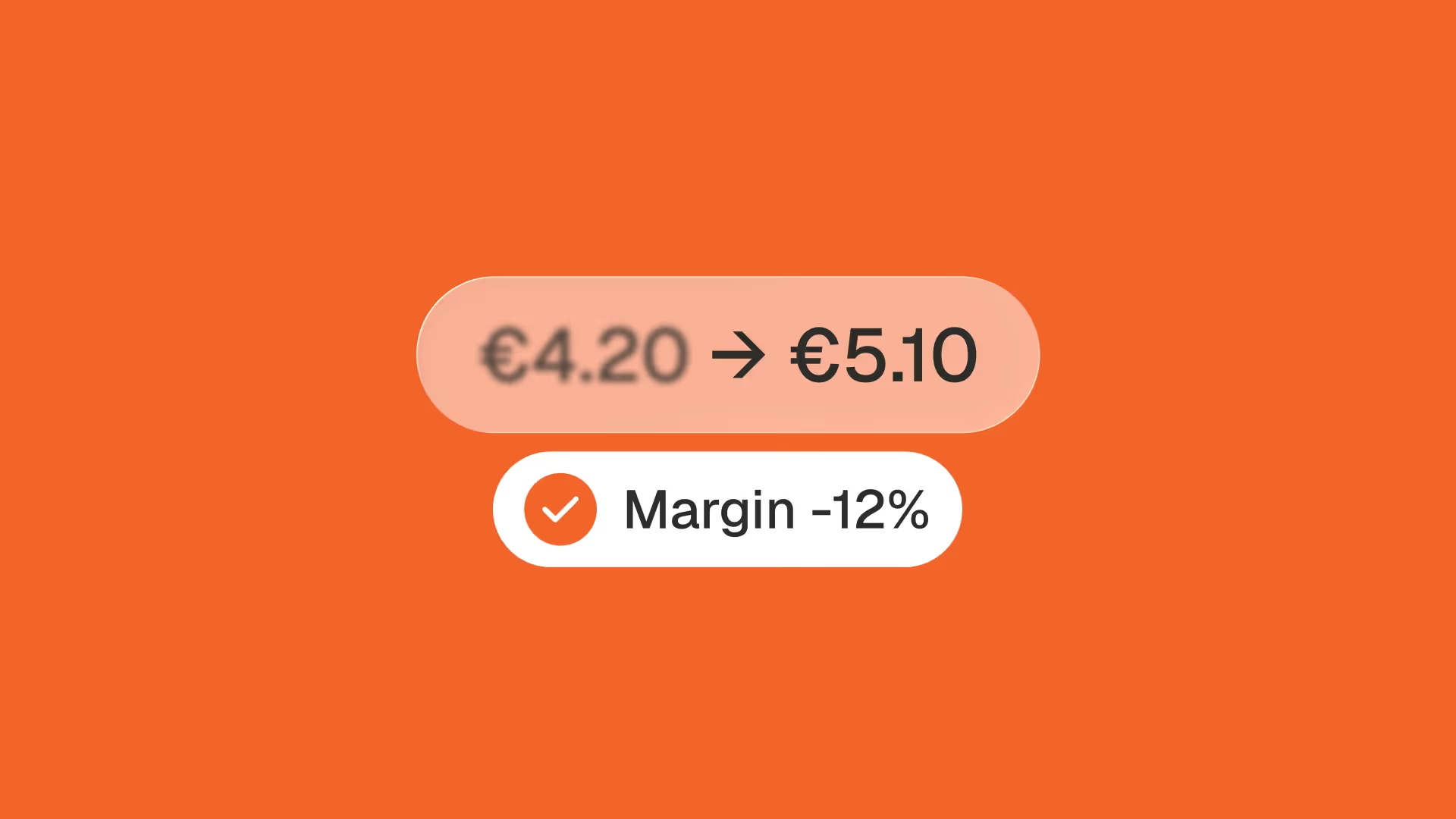
For a restaurant group running ten outlets at $50,000 monthly food spend each, a 1.5 percent gap between negotiated prices and billed prices represents $90,000 of margin evaporating per year, with no single invoice large enough to trigger a review. The leak does not look like fraud. It does not look like a billing error. It looks like the price column of a Sysco or US Foods invoice creeping up over six months, one penny per pound at a time, on items the buyer agreed to last quarter at a lower number.
Supplier price drift is the cumulative gap between the price a restaurant group negotiated with a supplier and the price it actually pays, line by line, week after week, across every invoice that passes through accounts payable. It does not announce itself. It compounds. And on a 4 to 6 percent net margin, it surfaces in the quarterly P&L as a food cost percentage that climbed without anyone deciding it should.
This article unpacks the four mechanisms behind supplier price drift, the math of how it compounds across units, the reason standard AP workflows miss it, and the practical sequence a finance leader can deploy to bring it back under control.
What supplier price drift is, and why it is not a billing error
A billing error is a discrete event: a duplicate invoice, a wrong quantity, a tax line that should not be there. The AP team catches it, the supplier issues a credit memo, the matter is closed.
Supplier price drift is different in three ways.
It is silent: each individual invoice looks normal, and the variance per line is small enough that no exception rule flags it. It is cumulative: what costs $40 extra on one delivery becomes $2,000 over a year on that single line, and $20,000 across a group of ten outlets all buying the same item. And it is structural: it originates in contract terms, market dynamics, packaging changes or seasonal calendars, not in supplier malice or operator error.
The practical test: a billing error is something the AP clerk would notice on close inspection. Price drift is something the AP clerk would never notice unless they were comparing every line of every invoice against the contracted reference, every week, across every supplier, across every outlet. No human team does this at scale.
The four mechanisms of supplier price drift
The full breakdown of each mechanism, how it surfaces on a restaurant supplier invoice, and what a sample-based AP review typically misses, is consolidated in the table below.
Contract drift
The most common form. The procurement director negotiates a quarterly price list with a primary distributor. By week three, two or three SKUs are already invoiced at a different unit price than the agreed reference. By week eight, several more have shifted. The supplier may have legitimate reasons (market index pass-through, packaging change, substitution) but the gap goes uncommunicated.
What it looks like on an invoice: line 12 of a Sysco delivery sheet showing "Beef tenderloin, choice, 4-pack 8oz, $8.42/lb" when the contracted price was $7.95/lb. Difference of $0.47/lb. On 35 lb per delivery, twice a week, across 10 restaurants, that is roughly $17,000 per year on a single SKU.
Market drift
Commodity prices rise. The supplier passes them through (legitimate) or expands the markup on pass-through (less so). Either way, the menu price was set against an older cost basis. The food cost percentage climbs week by week with no visible cause. Beef in 2026 is a textbook case: the USDA Economic Research Service projects food-away-from-home prices rising 4.6 percent in 2026, faster than the 20-year historical average of 3.5 percent, with specific categories like beef running materially higher.
Pack-size drift (shrinkflation)
The price holds. The pack size changes. A case of bottled sauce that was 12 by 32oz becomes 12 by 28oz at the same dollar figure. The per-unit cost is now 14 percent higher and the recipe yield assumption is wrong by the same amount. Every plate costed against the old yield is under-margined silently.
Seasonal drift
Produce prices follow seasonal patterns. The supplier's quoted price often lags the market on the way down. Tomatoes that were $3.20/lb in winter peak should drop to $1.80 in summer, but the invoice keeps listing $2.60. The buyer is not actively over-paying. The buyer is missing a seasonal recompetition the supplier did not offer.
The margin math: what 1.5 percent drift costs a 10-restaurant group
Most operators reading the section above will instinctively think their drift is closer to 0.5 percent. The math below uses 1.5 percent as a working baseline, which tracks with what Phacet observes in deployment across F&B clients before controls go in. The full calculation is laid out in the dedicated table.
A mid-market US restaurant group with 10 outlets, each spending $50,000 a month on food and beverage suppliers, represents $6 million in annual purchasing. A drift of 1.5 percent across that base is $90,000 a year. On a 4 percent net margin, that group would need to add $2.25 million in revenue to absorb the same erosion through the top line. Few operators have a $2.25 million growth lever sitting unused.
The compounding effect across categories is worth naming. Food costs typically run 28 to 35 percent of revenue in restaurant P&Ls, with full-service formats running higher and limited-service running lower. A drift that adds even half a percentage point to the food cost percentage trims roughly the same amount from the gross margin and twice that share from the net margin, depending on the operating leverage of the format.
Why standard restaurant AP workflows miss it
Three-way matching, as typically implemented in a restaurant group, compares the invoice to the purchase order and the delivery receipt. It catches quantity mismatches and obvious overcharges per invoice. It does not compare today's invoice to last week's invoice against the same SKU at the same supplier, and it does not compare any invoice against the contracted reference price beyond a manual spot-check.
The handoff between procurement and finance is where drift hides. Procurement holds the negotiated price list. Finance pays the invoice. Neither has the time or the system to reconcile line by line, every week, across thousands of lines. The check that should happen is treated as a sampling exercise, often once a quarter, sometimes once a year.
Astotel, a Paris-based group of 18 hotels, ran exactly that sampling control. A Phacet agent surfaced roughly €400 of monthly supplier billing variance on a single vendor that had been invisible to the sample-based review, working out to nearly €5,000 per year on one supplier alone. Across 18 hotels and dozens of vendors, that pattern compounds in the same direction.
The structure is the same in the US market. The vendor names change (Sysco, US Foods, Performance Food Group, Gordon Food Service, Reinhart Foodservice) but the dynamic is identical: high-volume, repeat-cadence purchasing on a long SKU tail where no human controller can hold the contract reference in their head while scanning a 200-line invoice.
The detection cycle: structure, match, analyze
The cycle that catches supplier price drift before payment has three steps.
1. Structure the invoice. Every supplier invoice that lands in the accounts payable inbox is converted into an auditable line-item table. Header fields (supplier legal name, invoice number, date, outlet) and line-item fields (item code, description, pack size, unit of measure, quantity, unit price) are extracted and tied back to the underlying PDF or image. The line-item view is non-negotiable: header-only extraction is sufficient for AP posting but useless for drift detection.
2. Match against the contracted reference. Each line is compared against the negotiated price list and against the same SKU from the same supplier in prior weeks. Variances are flagged at the line level with a reasoning trace: which SKU, which price difference, which contract clause it violates, which preceding invoices it diverges from. The match is sourced, not assumed: every flag points back to the contract clause or invoice that justifies it.
3. Analyze the pattern over time. Once line-level data is in a clean table, the trend per SKU, per supplier, per outlet, per category becomes visible. A drift of 0.4 percent on one SKU is noise. A pattern of 0.4 percent drift across 30 SKUs from the same supplier over six weeks is a procurement conversation.
The Phacet platform names these three steps Structure, Match and Analyze. Each step produces an audit trail that the finance director can hand to a controller, an auditor or an external accountant without reconstructing the reasoning from memory.
A practical sequence for restaurant groups
For a restaurant group looking to deploy this in production, the sequence below has been validated across F&B clients on Phacet over more than 100 deployments. The first operational agent typically goes live in under two weeks.
Step 1. Capture every supplier invoice automatically. The automate your accounting inbox agent ingests invoices from the dedicated AP mailbox, the supplier portals and the scanner. PDF, image, EDI and forwarded email are all handled the same way. Manual triage stops.
Step 2. Anchor every line against the contracted price list. The control your food supplier price list agent compares each line item against the negotiated reference, against the previous week's invoice for the same SKU, and against the supplier's own prior pricing history. Drift is flagged with a variance amount and a reason code. The buyer sees a price-drift queue, not a stream of invoices.
Step 3. Run three-way matching on what remains. The 3-way matching agent verifies the invoice against the purchase order and the delivery receipt. The point at this stage is no longer to catch errors (the previous step did that): it is to confirm that what was ordered, received and billed is the same item at the same quantity, before payment release.
Step 4. Alert before payment. Drift items that exceed a configurable threshold (per-line dollar amount, per-line percentage, or cumulative weekly variance) are held in a pre-payment alert queue. The AP team sees them. The procurement lead sees them. Both can act before the bank transfer goes out, not after.
Step 5. Report drift to the finance leadership monthly. A drift report per supplier, per category, per outlet runs on its own cadence. The CFO or finance director receives a single view of where the group's food cost percentage is gaining or losing ground, against which suppliers, in which units.
Astotel illustrates what step 2 looks like in production. Valérie, Directrice Achats, summarized the experience after the agent had been running for several weeks: "I spot errors that I would never have caught on my own." The €400 monthly variance against a single supplier had been hiding inside invoice lines that all looked routine in isolation.
What good looks like at scale
A restaurant group that has the cycle running well sees three changes in its operating cadence.
The food cost percentage stops drifting upward unexplained. When it moves, the finance team can point to which suppliers, which SKUs and which weeks. The number is no longer a mystery.
The procurement conversation with suppliers changes tone. Negotiations are anchored in data the buyer can put on the table. Suppliers know the buyer is checking every line. Behavioral drift declines on its own.
The AP team's time shifts from re-keying line items to reviewing flagged exceptions. The same headcount handles materially more volume. New outlets do not require new AP staff.
This is the transition from a reactive finance function (a back-office cost center catching errors after the fact) to a finance function that is operationally embedded in the group's margin. The platform sits between procurement and finance, runs the controls neither team has time to run manually, and produces an audit trail an external accountant can read in minutes.
Frequently asked questions
What is supplier price drift in a restaurant context?
Supplier price drift is the cumulative gap between the price a restaurant negotiated with a supplier and the price actually billed on its invoices, accumulated line by line and week by week. It is structurally different from a billing error: it is silent, cumulative, and originates in contract terms or market dynamics rather than supplier malice.
How much margin does supplier price drift cost a restaurant group?
In Phacet deployments across F&B clients, the typical drift observed before controls range between 0.8 and 2 percent of annual food and beverage purchases. For a 10-restaurant group spending $6 million annually on suppliers, a 1.5 percent drift represents $90,000 of annual margin erosion, which on a 4 percent net margin equates to $2.25 million in additional revenue that would be needed to offset it.
What is the difference between price drift and a billing error?
A billing error is a discrete, one-time anomaly visible on a single invoice: duplicate, wrong quantity, incorrect tax. Price drift is a slow shift in the price column across many invoices over time, where each individual line appears normal but the cumulative variance is material.
Can three-way matching alone catch supplier price drift?
Three-way matching catches quantity errors and obvious overcharges by comparing the invoice to the purchase order and delivery receipt. In standard implementation, it does not compare today's price against last week's price for the same SKU, or against the contract reference. Three-way matching is necessary but not sufficient to surface price drift. A contract-anchored line-by-line comparison is required in parallel.
How do you detect supplier price drift in a multi-unit restaurant group?
The detection cycle has three steps: extract every line of every supplier invoice into an auditable table, compare each line against the contracted price list and against the same SKU's prior invoices, and report the pattern over time per supplier, per category and per outlet. Variances are flagged before payment, not after the quarterly P&L.
Does Phacet replace my ERP or restaurant accounting software?
No. Phacet sits between your suppliers, your AP inbox and your existing accounting or ERP system. The platform structures invoices, runs the controls, and posts the validated entries to whichever accounting system the group already uses, alongside the existing AP workflow. The first Phacet agent typically goes live in production in under two weeks, starting from €299 per month.
Move from sampling to systematic
A restaurant group that controls supplier pricing by sampling is, in effect, accepting a level of margin erosion as the cost of doing business. The 0.8 to 2 percent drift becomes part of the operating baseline. The food cost percentage drifts upward over the year. The quarter-end negotiation reset recovers some of it and the cycle restarts.
A restaurant group that controls supplier pricing systematically, every line, every invoice, against the contracted reference, with a pre-payment alert, sees that drift narrow toward zero. The agent runs in the background. The finance leadership inherits a clean number to act on. The conversation with suppliers becomes one of evidence, not impression.
The Phacet agent dedicated to this control is Control your food supplier price list. It is among the most-deployed agents in F&B groups on the platform, and the time from first invoice in to first variance surfaced is typically days, not weeks.
Operators looking for the full set of controls relevant to a multi-unit F&B group can review the Food & Beverage industry pagefor use cases and customer references, or the Accounts Payable categoryfor the broader agent catalog. Finance leaders evaluating the platform from a control architecture standpoint will find the Finance Leadership persona pare directly aligned. Procurement directors will recognize the workflow on the Procurement persona page.

Latest Resources
Unlock your AI potential
Go further with your financial workflows — with AI built around your needs.


