

Restaurant accounting software: what it does not control
Published on :
August 26, 2026

Nicolas Marchais is co-founder and CEO of Phacet. After seven years at Spendesk, he built Phacet as the agentic layer that orchestrates across ERP, banking and email systems. Reliable, auditable, cross-system, what he calls a Finance Workforce.

Restaurant accounting software is a financial system that records the money a restaurant takes in and pays out, built around the operational realities of food service: daily point-of-sale settlements, several tax rates on the same ticket, tipped payroll, and food costs that move every week. It posts the daily sales journal, holds the general ledger, runs payables and payroll, and produces the statements your accountant signs off.
What it does not do is verify that the price on a supplier invoice matches the price you negotiated. That distinction decides which tool you need. A single-site operator who wants clean books and a fast month-end close is served by a general ledger platform with a point-of-sale connector. A group running eight sites, forty suppliers and eleven hundred invoices a month has a second problem the ledger was never designed to solve: an invoice that is coded correctly, posted correctly and paid correctly can still be wrong on the line.
Key takeaways
- Restaurant accounting software falls into four distinct categories, and picking the wrong category is more expensive than picking the wrong vendor inside the right one.
- Across five editorial guides ranking on Google for "restaurant accounting software" in August 2026, the words "purchase order", "delivery note", "3-way matching", "negotiated price" and "audit trail" appear zero times, while the word "invoice" appears 42 times.
- Accounting software records what a supplier charged you. It does not check that figure against what the supplier agreed to charge you, because the negotiated price list does not live in the ledger.
- At Astotel, an 18-hotel group, line-level price checking recovered roughly 5,000 euros a year of billing errors on a single supplier.
- Phacet measures a 91% reduction in supplier control time on its food supplier price list agent, moving that work from three hours a week to twenty minutes.
What restaurant accounting software actually does
Every restaurant accounting platform performs the same core jobs. It ingests the daily sales summary from the point-of-sale system and turns it into a journal entry, splitting revenue by category, tender type and tax rate. It holds the chart of accounts. It processes payables, tracks payroll including tipped wages, and produces the profit and loss statement, the balance sheet and the tax filings.
The restaurant-specific part sits in the details. Sales arrive as thousands of small transactions rather than a handful of invoices. Payroll involves shift workers, overtime and pooled tips. Inventory turns over constantly and the cost of that inventory changes week to week, which is why food cost tracking and recipe costing appear in nearly every product comparison. Prime cost, the combined weight of food, beverage and labour, is the operating number most managers watch.
All of that is real, and all of it is reporting. The software tells you what happened after it happened. That framing matters for the rest of this page.
The four categories, and why the category matters more than the vendor
Most comparison guides list eight or nine products side by side as if they competed with each other. They do not. They occupy four different layers of the stack, and two of those layers are usually bought together rather than instead of one another.
| Category | Examples | What it is for | Where it stops |
|---|---|---|---|
| General ledger platform | QuickBooks Online, Xero, Sage Intacct | The books themselves: chart of accounts, payables, statements, tax | No native food costing, no supplier price reference |
| Restaurant back office | Restaurant365, MarginEdge | Inventory, recipe costing, purchasing, in some cases the ledger too | Costing is retrospective, priced per location, heavy to implement |
| AP automation add-on | xtraCHEF by Toast, Ottimate | Capturing supplier invoices and coding them into the ledger | It is not a ledger; you still need one behind it |
| POS accounting bridge | Toast, Lightspeed, Square connectors | Pushing the daily sales journal into the ledger automatically | Revenue side only; nothing on the purchasing side |
General ledger platforms
QuickBooks Online remains the default for independent restaurants for one unglamorous reason: every accountant already knows it. Xero offers a cleaner interface and a large app marketplace but thinner restaurant reporting. Sage Intacct is the multi-entity consolidation choice, and it is genuinely heavier than most groups under ten sites need. All three depend on connectors for anything restaurant-specific.
Restaurant back office platforms
Restaurant365 is the all-in-one for multi-unit groups, combining the general ledger with inventory, scheduling and purchasing. It carries a real implementation cost in time and internal effort. MarginEdge is not a ledger at all: it captures invoices, costs recipes and feeds a general ledger that sits behind it. Confusing the two is the single most common mistake in this category.
AP automation add-ons
These tools digitise supplier invoices and turn them into coded line-item data. They pay off when invoice volume is high and the finance team is small. They do not hold the books, and the strongest of them are tied to a specific point-of-sale ecosystem, which narrows the choice more than the marketing suggests.
POS accounting bridges
A bridge maps sales categories to general ledger codes and posts the daily journal automatically. It removes a genuinely tedious task. It touches only the revenue side of the business, which is roughly a third of where money leaks in a restaurant group.
What software do most restaurants use?
Most independent restaurants in the United States run QuickBooks Online, connected to their point-of-sale system through a bridge, with an accountant or bookkeeper reviewing the file monthly. Multi-unit groups above roughly ten sites move to Restaurant365 or to Sage Intacct for multi-entity consolidation, often keeping an AP capture tool alongside. Free platforms such as Wave and ZipBooks serve very small operations and single food trucks, and stop being viable as soon as multiple entities or serious purchasing volume appear.
The stack operators actually describe on public forums is messier than any vendor page suggests. A recurring pattern on r/Bookkeeping is the advice to keep QuickBooks for the books and explicitly not to use it for restaurant inventory, because it was never built for that. A thread on r/msp is opened by an operator running six restaurants on six separate QuickBooks Desktop files, chosen precisely because the licence was a one-off purchase. On r/Restaurant_Managers, a single-site operator handling between two and three hundred invoices a month describes processing them manually in a spreadsheet before sending them on.
Read those three together and the same shape appears each time. The ledger is settled early and rarely revisited. Everything the ledger does not cover, which is inventory, purchasing and invoice handling, gets absorbed by a spreadsheet and a person. That works, in the sense that the books close. It stops working quietly, without anyone declaring a failure, because the failure mode is not an error in the accounts.
That is the honest picture of the market, and it is the picture almost every comparison guide produces. It is also incomplete, for a reason that becomes visible once you stop looking at what these tools include and start looking at what they check.
The control gap: what none of these categories verifies before you pay
In August 2026 we measured the vocabulary of the five editorial guides ranking in the top 20 on Google for "restaurant accounting software". The word "invoice" appears 42 times across them. The words "purchase order", "delivery note", "3-way matching", "negotiated price", "price list", "duplicate invoice", "credit note", "approval workflow" and "audit trail" appear zero times. Not rarely. Zero.
More telling still: on those same five pages, no verb of verification, whether control, verify, check, validate or audit, ever appears next to the word invoice. Forty-two mentions of invoices, and not one of them in a context where someone checks whether the invoice is correct.
That is not an oversight by five writers. It reflects the tools themselves. A general ledger records the amount a supplier billed. An AP automation tool extracts that amount accurately and codes it to the right account. A back office platform costs the recipe using that amount. Every layer treats the invoiced price as the input. None of them holds the price you actually negotiated, so none of them can tell you the two disagree.
| Check | General ledger | Back office | AP capture | Control layer |
|---|---|---|---|---|
| Invoice total is coded correctly | ✓ Yes | ✓ Yes | ✓ Yes | ✓ Yes |
| Unit price matches the agreed price list | ✗ No | Retrospective only | ✗ No | ✓ Line by line, before payment |
| Quantity billed matches the delivery note | ✗ No | Partial, if counts are kept | ✗ No | ✓ Automated 3-way matching |
| Same overcharge spotted across all sites | ✗ No | Per location | ✗ No | ✓ Group level |
| Every decision traceable for the auditor | Postings only | Postings only | Extraction log | ✓ Native audit trail |
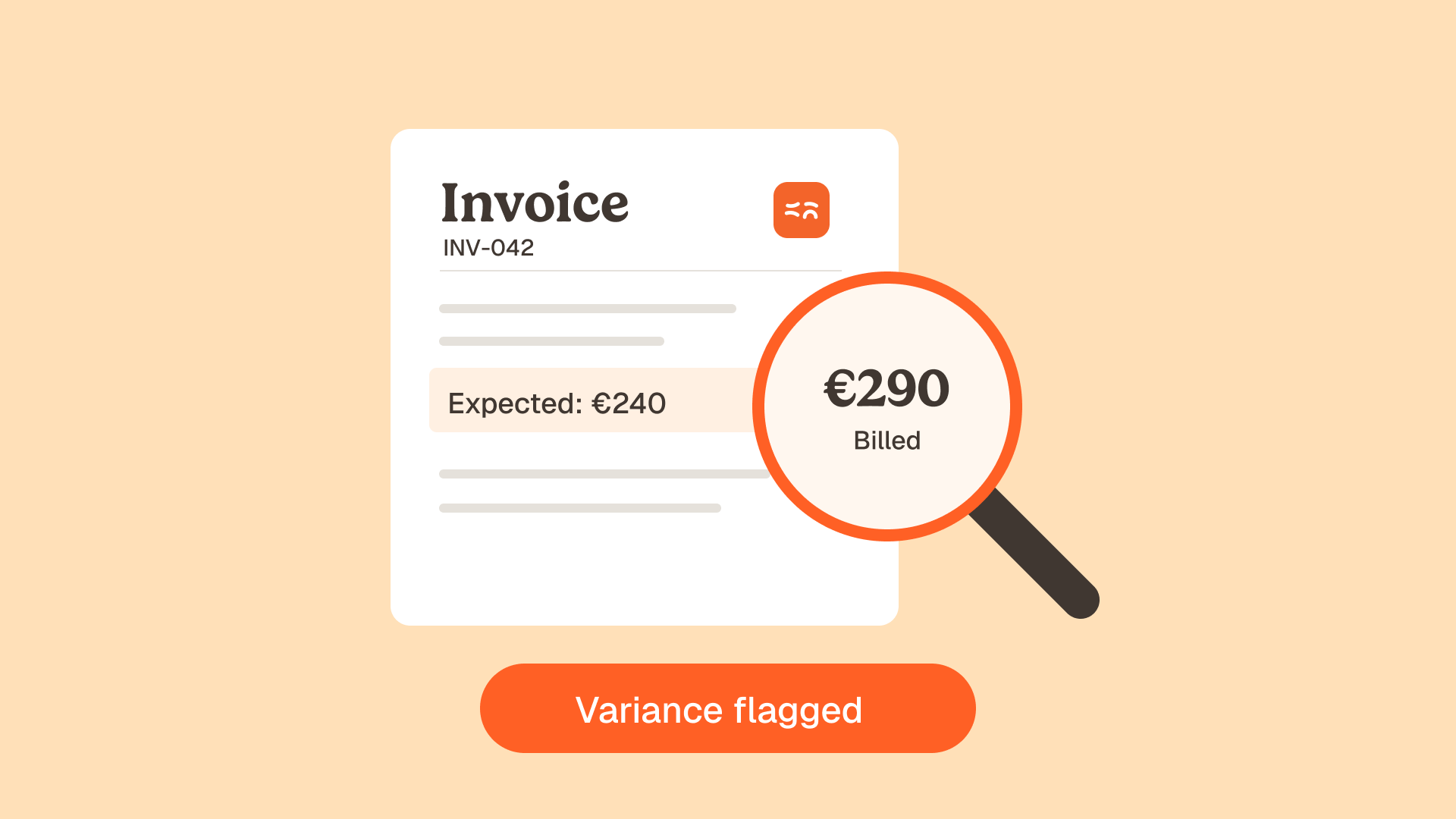
The practical consequence is a category of loss that never shows up as an error, because nothing was ever wrong on the books. A supplier applies last month's rate to this month's delivery. The invoice is arithmetically correct, it posts cleanly, it gets paid on time, and it surfaces six weeks later as a food cost variance nobody can explain. Multiply that by forty suppliers and eight sites, and you have the gap that group-level supplier invoice validation exists to close.
Why AP automation is not invoice control
This is the distinction that gets collapsed most often, including by the vendors themselves, and it is worth separating carefully because the two things sound identical in a demo.
Accounts payable automation solves a speed problem. An invoice arrives as a PDF or a photograph, and a human would otherwise retype the supplier, the date, the total and the account code. The tool reads the document, extracts those fields, applies coding rules and pushes a draft into the ledger. Measured against manual entry, it is a large improvement, and for a finance team of one it can be the difference between closing on the fifth working day and closing on the fifteenth.
Invoice control solves an accuracy problem, and it needs something AP automation does not have: a reference to compare against. Extracting "chicken breast, 12 kg, 8.40 euros per kg, 100.80 euros" perfectly tells you nothing about whether 8.40 was the agreed rate. Answering that requires the negotiated price list to exist in a system, to be current, and to be checked line by line against every incoming invoice before the payment run, not after.
An easy test when you are evaluating a vendor: ask what the tool does when a supplier bills a price that is higher than the one on the contract. If the answer is that the invoice is captured accurately and coded correctly, you are looking at AP automation. If the answer involves a threshold, an alert and a hold before payment, you are looking at control. Both are useful. They are not substitutes.
What the control gap costs, in numbers
The reason this gap survives is that it is invisible in the aggregate. A 3% drift on one line of one invoice is not worth a meeting. The arithmetic only becomes uncomfortable when you run it across a group.
Take the measured case first. At Astotel, an 18-hotel group in Paris, line-level checking surfaced roughly 400 euros of billing errors a month on a single supplier, close to 5,000 euros a year. That number is not a projection; it is what the checks found on one supplier relationship that had previously been verified by sampling.
Now consider the shape of the problem rather than the number. A mid-sized group buying from forty suppliers has forty price lists, each renegotiated on its own rhythm, with seasonal produce moving weekly. Site managers approve deliveries because they are the ones physically present, which means the approval is a check that goods arrived, not that prices held. Nobody compares the rate one site pays against the rate another site pays for the same product on the same week, because no report exists that would show it.
The second cost is time, and it is easier to measure. At La Nouvelle Garde, the supplier inbox alone consumed two full days a week for one person before automation, with teams spending close to 70% of their time between Gmail and the accounting system. Maslow Restaurants recovered one to two hours a day on invoice handling. On the food supplier price list agent specifically, Phacet measures a 91% reduction in supplier control time, from three hours a week to twenty minutes.
The third cost has no invoice attached to it and is usually the one that decides the project. It is the position a finance director is in when the CEO asks whether supplier prices are under control, and the honest answer is that nobody knows, because the checks are done on a sample and the sample is chosen by whoever has time that week.
Single location or multi-unit? The question that changes the answer
Google's own AI Overview on this query ends by asking the reader two things: whether the restaurant is a single independent location or a multi-unit operation, and which point-of-sale system it runs. The first question is the one that matters, and almost nobody answers it properly.
For a single site, the control gap described above is largely theoretical. The owner sees the invoices, knows the suppliers by name, and notices when the price of a case of chicken moves. Human attention scales to one location. A general ledger platform and a point-of-sale bridge are a complete answer.
Above roughly four sites, three things break at once. Invoices arrive at site level and are approved by managers whose real job is running a service, not verifying prices. The same supplier bills different locations at different rates, and nobody sees the pattern because nobody looks across sites. And the volume, commonly several hundred to a couple of thousand invoices a month for a mid-sized group, passes the point where sampling gives any real assurance.
There is a structural trap in the same transition, and it is worth naming because it is expensive to fix later. Restaurant groups usually grow one legal entity at a time, opening each site as its own company for liability and financing reasons. The accounting stack grows the same way: one subscription per entity, one file per entity, one chart of accounts per entity, each drifting slightly from the others as different bookkeepers make different coding choices. By the fifth site, consolidation is a monthly spreadsheet exercise and cross-site comparison is impossible, because the same product sits under a different account code in three of the files.
Sage Intacct and Restaurant365 are built for this and handle multi-entity consolidation natively. QuickBooks Online does not: it needs a subscription per entity and third-party tooling to consolidate, which is exactly the configuration operators describe running by hand. Whichever route you take, standardising the chart of accounts across entities before you have ten of them is the cheapest hour you will ever spend.
This is where the decision stops being about accounting software and starts being about a second layer. The right question is no longer which ledger to buy, but what sits between the invoice arriving and the payment leaving.
How to evaluate restaurant accounting software: eight checks
- Entity structure first. If you operate several legal entities, consolidation is the constraint that eliminates most candidates before any other feature matters.
- Point-of-sale compatibility. Confirm the daily sales journal, tender types and tax splits post automatically, not through a monthly export.
- Where the supplier price list lives. Ask the vendor directly where a negotiated rate is stored and what happens when an invoice disagrees with it. The answer is usually that neither exists.
- Invoice volume per month, per site. Below roughly 150, manual handling survives. Above 500, it does not, whatever the team says.
- Approval path. Who approves what, at which site, and is the trail reconstructable a year later without a spreadsheet.
- Payroll and tips. Either native or through an integration you have seen working in another restaurant, not on a slide.
- Real cost at your size. Restaurant back office platforms and AP add-ons are frequently priced per location, so the quoted figure and the fifth-site figure are different conversations.
- What your accountant already uses. Fighting your accountant's software is a recurring cost that no feature list captures.
Adding a control layer on top of the software you already run
None of this argues for replacing your accounting system. The books belong in the ledger, your accountant works there, and migrating a general ledger is a project measured in quarters. The gap sits earlier in the chain, between the invoice arriving and the payment going out, and it is filled by adding a layer rather than swapping the foundation.
That is the position Phacet occupies. It is not accounting software and it does not try to be. Its agents read incoming supplier invoices wherever they arrive, extract them line by line, check each line against the negotiated price list, flag the variances, and pass the clean result to QuickBooks, Xero, Sage or Pennylane as a draft ready for approval. The reasoning is exposed at every step and every transformation is timestamped in a native audit trail, which is what makes the output defensible to an auditor rather than merely fast.
The results are specific rather than general. At Astotel, a group of 18 Paris hotels, price checks were done by sampling until line-level verification surfaced roughly 400 euros of billing errors a month on a single supplier, close to 5,000 euros a year.
"I save up to two days a month, and I catch errors I would never have seen on my own." Valerie, Head of Procurement, Astotel
At La Nouvelle Garde, a group of ten Paris brasseries, teams were spending close to 70% of their time between Gmail and their accounting system, with the supplier inbox alone consuming two full days a week for one person. Maslow Restaurants recovered one to two hours a day on invoice handling. On its food supplier price list agent, Phacet measures a 91% reduction in supplier control time, from three hours a week to twenty minutes.
The mechanism underneath is 3-way matching, the automated reconciliation of the purchase order, the delivery note and the invoice, applied across every site rather than sampled at one. The wider set of checks for the sector sits on the financial controls built for food and beverage groups.
Choose your accounting software on the criteria above. Then ask the separate question that this page exists to raise: once the invoice is posted correctly, who checked that it was right.
Frequently asked questions
What is the 30/30/30 rule for restaurants?
It is a budgeting rule of thumb that allocates roughly 30% of revenue to food and beverage costs, 30% to labour and 30% to overhead, leaving around 10% as profit. It is a starting benchmark, not an accounting standard, and it varies widely by format. Full-service restaurants typically run food cost between 28% and 35%.
What type of accounting is used in restaurants?
Most restaurants use accrual accounting, which records revenue and expenses when they are incurred rather than when cash moves. It is the only method that gives an accurate food cost, because it matches deliveries received against sales made in the same period. Very small operations sometimes use cash accounting for simplicity.
How much does restaurant accounting software cost?
General ledger platforms typically run from around 30 to 200 dollars a month per entity. Restaurant back office platforms and AP automation add-ons are usually priced per location, which changes the total sharply for multi-unit groups. Always price the quote at your target number of sites, not your current one.
Do you still need a bookkeeper if you buy the software?
Usually yes. Software automates data entry and reconciliation, but someone still has to review the coding, handle period close, manage tax filings and interpret the numbers. What changes is the ratio: the bookkeeper spends less time keying invoices and more time on review and analysis.
Can accounting software handle multiple restaurant locations?
Some can. Sage Intacct and Restaurant365 are built for multi-entity consolidation. QuickBooks Online requires a separate subscription per entity and third-party tooling to consolidate. Verify how the system handles intercompany transactions and per-site reporting before committing, because retrofitting multi-entity structure later is painful.

Latest Resources
Unlock your AI potential
Go further with your financial workflows — with AI built around your needs.


