
Reconcile deposits, credit notes and suspense accounts
What remains open at period-end matched and reconciled: deposits, credit notes, suspense accounts.

Period-end reconciliation
At period-end, some amounts stay open: unapplied deposits, credit notes not matched to their invoice, entries sitting in suspense accounts. Reconciling them means finding what belongs together so every account is right.
Three situations keep coming back: a deposit invoice that never finds its final invoice, a credit note floating without the invoice it cancels, and a suspense account that grows month after month. By hand, teams tick line by line, in the rush of the close.
Phacet automates this reconciliation with its AI skills in data matching and variance detection. The agent finds the counterpart of each open amount, proposes the match and explains what remains.
When to use this agent?
Ideal for accounting teams and accounting firms who want to:
- Clear deposits and credit notes at every close.
- Empty suspense accounts before they grow.
- Reach the audit with justified accounts.
AI skills involved

Automatically match your data across files, tools and systems
Phacet cross-references your data across sources - invoices vs. payments, POs vs. receipts, bank lines vs. GL entries, CRM deals vs. billing records. It tells you exactly what matches, what's missing, and what's off. No VLOOKUP, no manual comparison.

Spot duplicates, outliers and suspicious patterns in your data
Phacet scans your full dataset to surface what shouldn't be there - duplicate payments, abnormal amounts, unknown suppliers, unusual timing patterns, RIB changes. It catches what rules alone can't predict, without requiring you to define every possible scenario upfront.

Route exceptions to the right person and track every decision
Phacet doesn't decide edge cases alone. It routes ambiguous results to the right person with full context - original document, matched data, confidence score. Your team validates, corrects or rejects. Every decision is logged. The AI learns from each correction and gets more accurate over time.

Every AI result linked to its source — audit-ready by default
Every output Phacet produces is traceable back to the exact source line - the PDF page, the ERP row, the bank entry. You can always answer "why did Phacet flag this?" with a precise reference. Confidence scores, decision logs and source citations are built in, not bolted on.
Business impact

81% time savings on matching
From 1-3 days per month to 2-3 hours. High-confidence matches pass automatically; ambiguous cases are reviewed.
Third-party accounts finally cleared
Accounts 401 and 411 are matched systematically. The aged balance reflects reality; dunning is reliable.
NetSuite/SAP problem solved
French-style lettrage finally works, even if your ERP doesn't natively support it. The matched FEC export is ready.
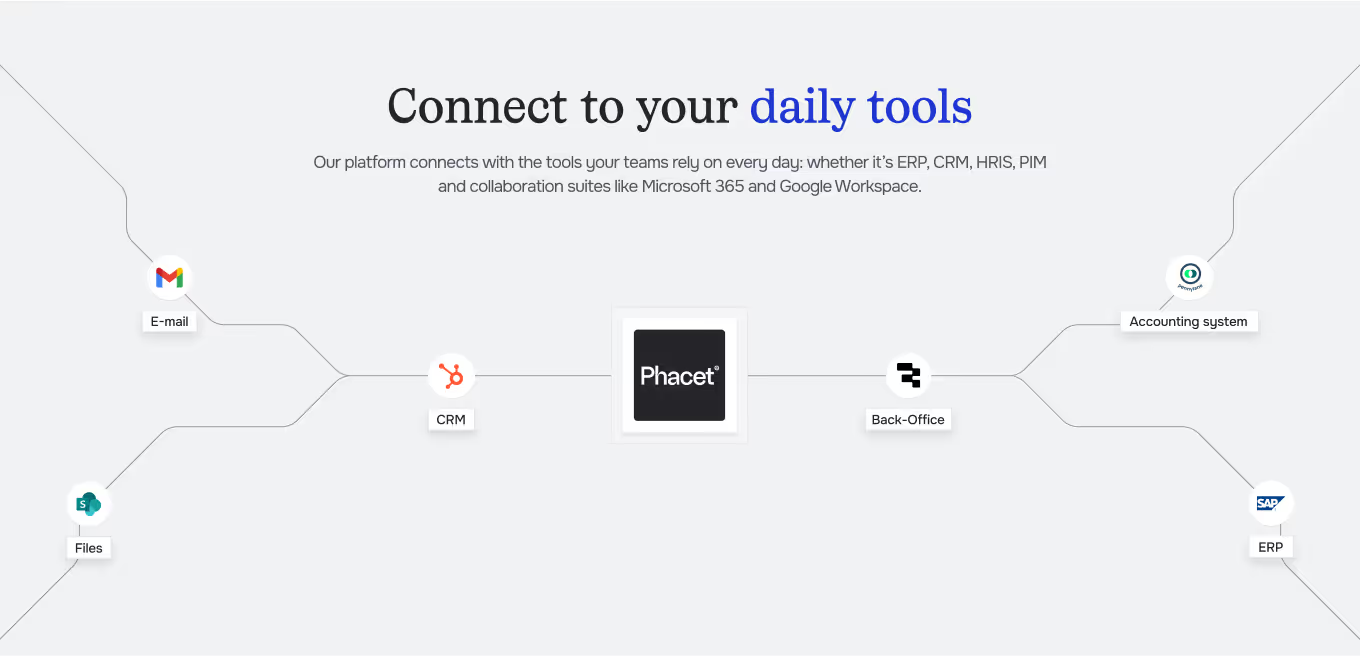
Integrated with everything


Steps to get Started
Connect your systems
Connect your accounting tool (Pennylane, Sage, Netsuite…).
Choose your accounts
Set the accounts to reconcile, customers, suppliers, deposits, suspense accounts.
Match & propose
Phacet finds the counterpart of each open amount and proposes the match.
Approve & reconcile
You approve the proposals, the reconciliation is posted, and what remains is explained.
Unlock your AI potential
Do more with your existing resources using tailored AI solutions.
Frequently Asked Questions
Yes. Phacet handles cases where a payment partially covers an invoice, or one payment covers multiple invoices.
Yes. This is one of the main use cases. NetSuite doesn't handle French-style lettrage natively — Phacet fills this gap.
Generally 60-80% from the first cycle on a FEC with auxiliary accounts. The rate improves over time.
Yes. A FEC export with matching codes (EcritureLet column) is generated automatically.
Yes. Each validation or correction improves the model. The automatic matching rate increases month after month.


GUIDE
The AI CFO guide
For accounting teams, accounting firms and CFOs of SMEs and mid-sized companies who want to know where to start.