

Esker alternative: Phacet vs Esker, control vs automation
Published on :
November 23, 2026

Nicolas Marchais is co-founder and CEO of Phacet. After seven years at Spendesk, he built Phacet as the agentic layer that orchestrates across ERP, banking and email systems. Reliable, auditable, cross-system, what he calls a Finance Workforce.

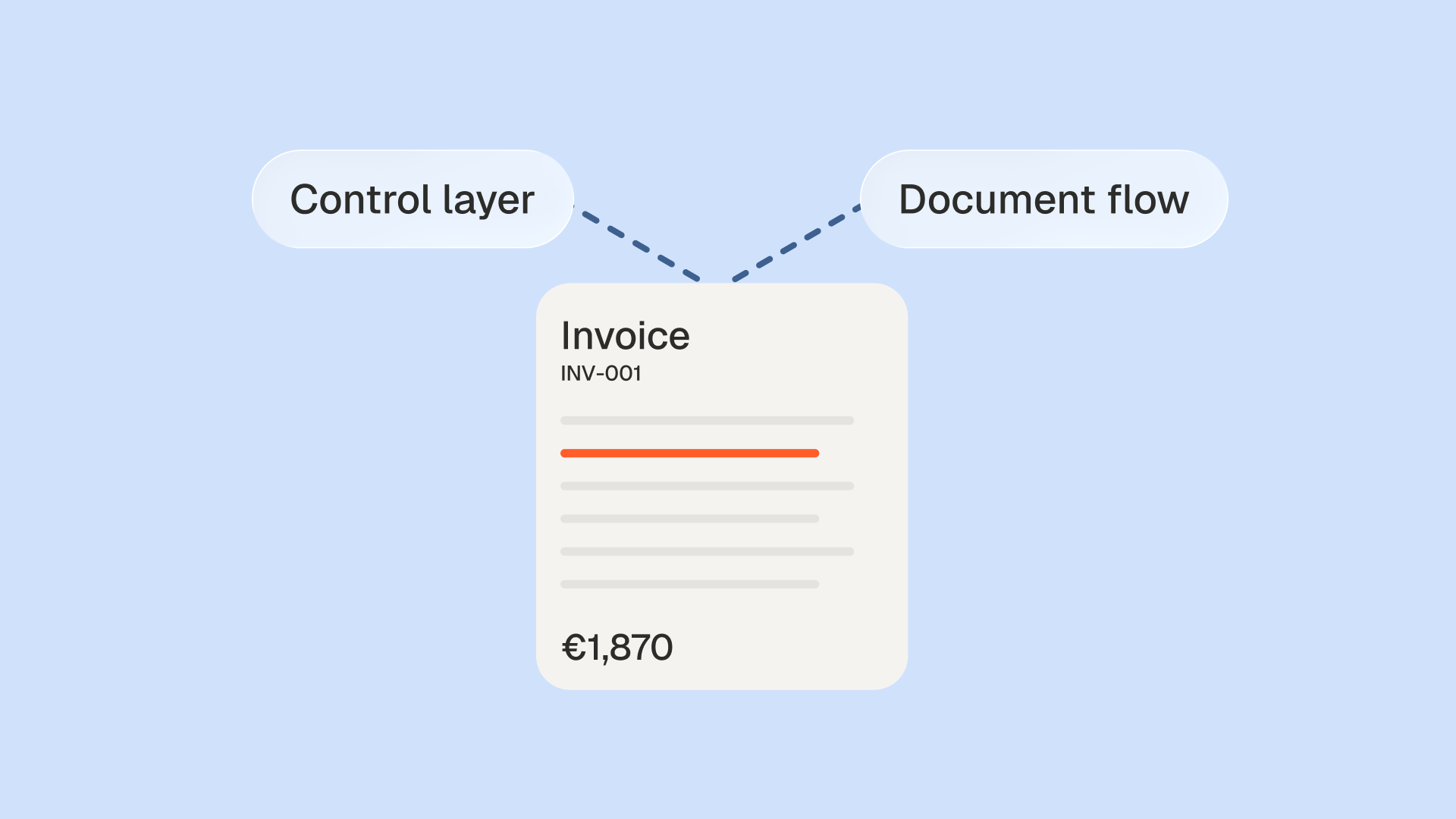
This page is for finance leads at companies of 50 to 500 people who are evaluating Esker for supplier invoices, or who already run it and still find pricing errors after payment. Short answer: replace Esker only if the process itself is the problem; if the process works and wrong invoices still get paid, add a control layer. If you need a replacement for Esker's receivables, collections or order management tools, or an opinion on Esker as an investment, this page is not for you.
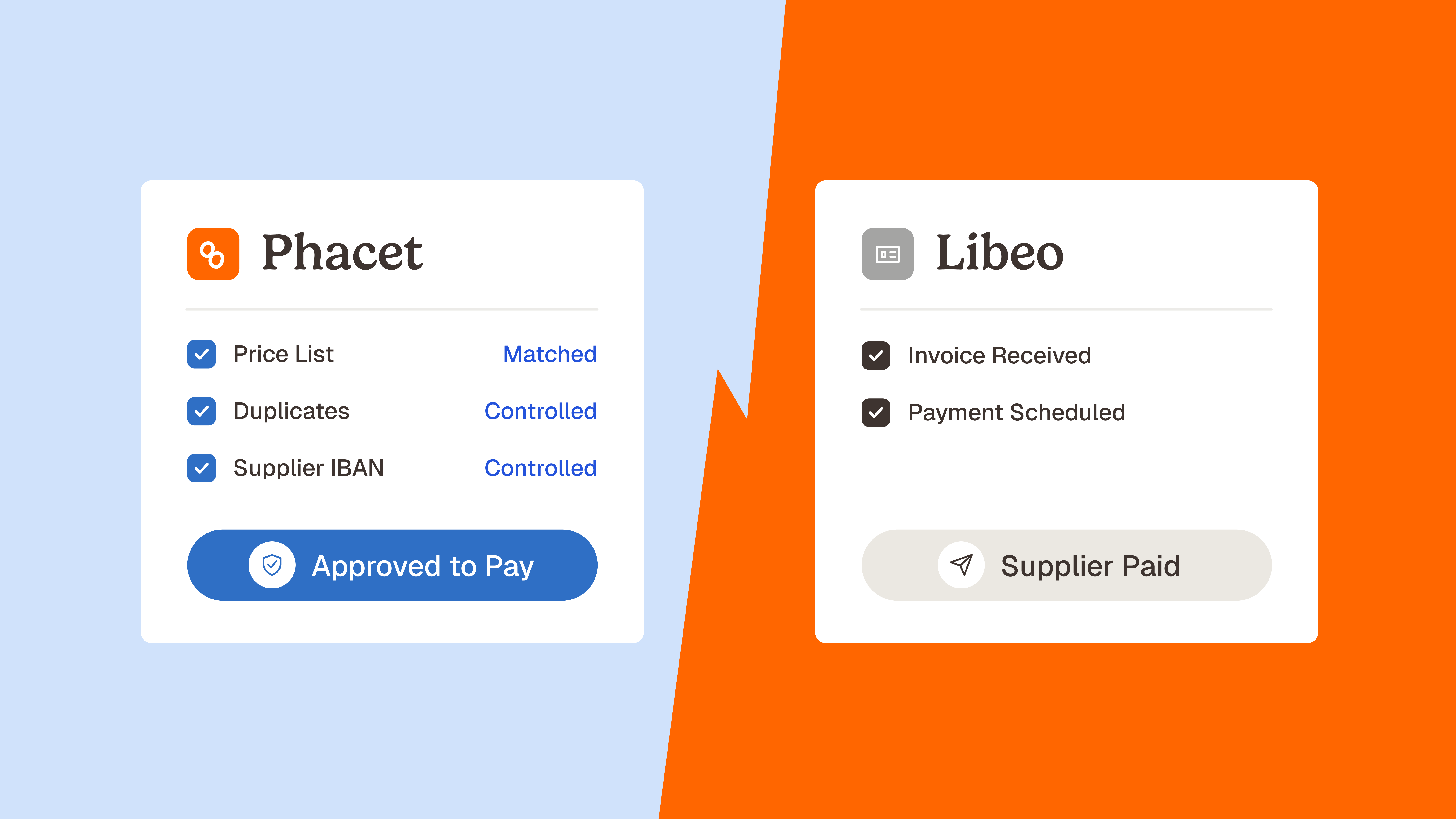
Esker is a French software publisher that automates document-heavy finance processes: it captures supplier invoices, routes them for approval, matches them against purchase orders and goods receipts, and posts them to the ERP, across Source-to-Pay and Order-to-Cash. Phacet is not a like-for-like alternative, because it does not run approval workflows or pay suppliers. Phacet is a catalogue of AI agents that checks each invoice line against the order, the delivery note and the negotiated price before payment, on top of whichever tool processes the invoice, Esker included.
Key takeaways
- Esker describes itself as a document process automation provider: its accounts payable module captures invoices, applies business rules, matches them against purchase orders and goods receipts, then posts them to the ERP.
- Esker enables touchless processing when its rules detect no exception, and it validates invoices against purchase orders, goods receipts and contract terms coming from its own sourcing activities.
- Esker has been privately held since 3 March 2025, when a holding company controlled indirectly by a Bridgepoint fund bought out the remaining shares at 262 euros each.
- At Astotel, a group of 18 Paris hotels, checking every invoice line against the negotiated price list surfaced up to 400 euros of errors a month on one supplier, nearly 5,000 euros a year.
- Phacet adds line-level checks on top of an existing invoice process, from 299 euros a month, with a first agent in production in under two weeks.
What Esker does, in its own words
Esker was founded in Lyon in 1985 by Jean-Michel Bérard, who still runs it. The company calls itself one of the leading document processing automation providers: its first document process automation product shipped in 2001, and since 2007 its solutions have run in the cloud on the Esker on Demand platform. On its about page, read on 28 October 2026, Esker states more than 1,200 employees, about 250 million euros of revenue in 2025 and more than 3,000 customers.
The suite covers both sides of the ledger. On the purchasing side (Source-to-Pay), it handles procurement, supplier management, contracts and accounts payable. On the sales side (Order-to-Cash), it handles orders, customer invoicing, credit and collections. That is why a search for an Esker alternative returns such different tools: some replace the receivables module, others the payables module. This page deals only with supplier invoices.
Three facts are worth checking before you shortlist anything:
- Ownership. Esker left the stock market in 2025. The French market authority's notice of 17 February 2025 (in French) sets the squeeze-out of the remaining shares on 3 March 2025, at 262 euros a share, by a holding controlled indirectly by a Bridgepoint fund. Esker's own history names Bridgepoint and General Atlantic as the sponsors of the tender offer. The figures it publishes since then are company statements, not listed-company disclosures.
- AI. Esker presents its Synergy AI agents as the intelligence layer embedded across its Office of the CFO suite. Our reading: they work on the documents and data that flow through Esker.
- France's e-invoicing reform. Esker appears on the French tax administration's list of approved e-invoicing platforms, with its registration number issued on 11 December 2025. The administration defines that role as issuing, transmitting and receiving e-invoices and passing invoice, transaction and payment data to the tax authority. Checking what an invoice says against your orders is not part of the definition.
Do you need an Esker alternative, or a control layer?
You need a different suite if Esker's process does not fit your company. You need a control layer if the process runs and wrong invoices still get through. From a distance both problems sound like "our AP automation is not working", but they call for different purchases, and buying the wrong one costs a year.
| Your situation | What it points to | Where to look |
|---|---|---|
| Enterprise or large mid-market group with many entities, one platform wanted for purchasing, payables and receivables | A suite | Esker, or the other Source-to-Pay suites that software directories list next to it |
| Only receivables, collections or order intake need fixing | Not an accounts payable question | Receivables and order management tools, outside the scope of this page |
| Your ERP or accounting tool already captures and routes invoices | No new suite | Keep the tool, receive e-invoices through an approved platform where required, and add checks |
| Esker is live, invoices flow, and price or quantity errors still surface after payment | A control layer | Agents that check each line against price lists, contracts and delivery notes before payment |
| 50 to 500 people, no IT team for a platform project | Start with control, not with a suite | One agent on one supplier family, then extend |
The same split applies to capture tools. Our Phacet vs Yooz comparison walks through it for a tool that digitises and routes invoices without being a full Source-to-Pay suite.
What does "touchless" measure in Esker's AP automation?
In Esker's own description, an invoice goes touchless when no exception is detected. Its accounts payable page says the solution applies business rules and matches invoice data against purchase orders and goods receipts, supports three-way matching, and uses contract terms and supplier data from its sourcing activities to validate invoices. The same page announces 80%+ touchless invoices and 70%+ fewer exceptions, without saying how either figure is measured.
Our reading: a touchless rate counts the invoices the rules did not flag. It does not count the invoices that were right. The two are the same only when the rules have something to compare each line against. Three cases often fall outside that comparison in goods-heavy businesses:
- Invoices without a purchase order. Food supplies, maintenance and many services are bought on a phone call or a standing agreement. A non-PO invoice can be routed for approval, but there is no order line to match it to.
- Prices negotiated outside the suite. Esker validates against contract terms from its own sourcing activities. When your negotiated rates live in a supplier price list, a spreadsheet or a PDF framework agreement, the rule has no rate to compare with.
- Deliveries that are never recorded. Three-way matching needs a goods receipt. When the delivery note stays at the site and never reaches the system, the quantity check has nothing to read.
Phacet's co-founder put the gap in two sentences.
"Tomorrow, no invoice will be paid without AI. Because suppliers deliver 80 units and invoice 100. And nobody sees it." Nicolas Marchais, CEO and co-founder, Phacet, on LinkedIn, 25 February 2026 (our translation).
In the same post, he reports that one month of analysis at one Phacet customer found a variance on 13.2% of the invoice lines processed. Lines, not invoices: one wrong line is enough to pay the wrong amount on an invoice that otherwise looks fine.
The comparison pages that compete for this search never get to that question. On the four English pages we reviewed (two Esker comparisons by ERP Research, an accounts receivable vendor's guide to Esker alternatives and OrderSync's comparison, 6,270 words in total, read on 28 October 2026), the terms "negotiated price", "price list", "credit note", "delivery note", "before payment" and "overcharge" appear zero times. They compare integrations and modules. None asks what happens to an invoice the rules had nothing to compare against.
That question is the job of Phacet's invoice validation agent. It checks every invoice before payment for duplicates, due dates and budget, routes it to the right approver and logs each decision in an audit trail. It works on the invoices you already receive, by email, file or API, so the tool that captured them can stay where it is.
Phacet vs Esker, side by side
The table compares the two job by job. Esker cells come from Esker's accounts payable, Synergy AI and company pages and its press release of 5 January 2026. Phacet cells come from Phacet's agent and pricing pages. All were read on 28 October 2026.
| Job | Esker | Phacet |
|---|---|---|
| Category | Document process automation suite, Source-to-Pay and Order-to-Cash | Catalogue of AI agents for finance work, on top of existing tools |
| Invoice capture and extraction | Core feature: AI extraction, validation forms generated automatically | Extracts each invoice line to check it; keeps no books |
| Approval routing | Core feature: automated routing, workflow history archived for traceability and compliance | Routes each invoice to the right approver with the check results attached |
| Purchase order and receipt matching | Business rules and three-way matching, across several ERP environments from one cloud platform | Line-by-line matching of invoice, order and delivery note |
| Negotiated prices and contracts | Contract terms and supplier data from Esker's sourcing activities | Price lists, framework agreements and PDF contracts, wherever they are kept |
| Invoices without a purchase order | Not described on the pages reviewed | Checked against the price list or contract that applies |
| Duplicates and bank-detail changes | Fraud prevention named among the module's goals | Each invoice compared with payment history; bank-detail changes flagged |
| Payment execution | Esker Pay payment capabilities | None: Phacet does not pay suppliers |
| AI agents | Synergy AI agents embedded across the Esker suite | 40+ agents working across your ERP, inbox and files |
| Approved e-invoicing platform in France | Yes, registration number issued on 11 December 2025 | No: works on top of your platform |
| Public price | Not published on the pages reviewed | Studio plan from 299 euros a month, 14-day trial |
Method: each Esker cell restates a sentence from Esker's own pages; "not described" means the pages listed above say nothing on the point, not that the feature cannot exist in a project. Read on 28 October 2026.
Read the table as two layers rather than two rivals. The upper rows are the process, which Esker runs at scale. The lower rows are the check of what the process carries. AI Match, Phacet's matching engine, compares each line with the order, the delivery and the price, and shows the data and reasoning behind every match, so the approver sees why a line was flagged. Plans and credits are detailed on the Phacet pricing page.
How a control layer works next to Esker
Esker keeps the process; the control layer checks the content before the payment run. In practice it takes four steps.
- Collect the references once. Load the negotiated price lists and framework agreements, wherever they live today. The contract terms agent identifies the contract behind each invoice and can extract terms directly from PDF contracts, so you do not need a structured contract base to start.
- Feed the invoices. Invoices and delivery notes come in by email, ERP export or upload. Nothing changes in the way suppliers send them or in the way Esker routes them.
- Check every line. Price, discount, volume, quantity delivered, duplicates, bank details. Each variance is quantified in euros with its reason: missing discount, modified price, short delivery.
- Decide before paying. The approver sees the flagged lines with the source document next to them and keeps the final word. Every decision stays in the audit trail for the auditor or the accountant.
Where Esker's rules already cover a supplier family, start elsewhere. The first agent goes where invoices have no order, or where prices are negotiated outside the suite: that is where a touchless invoice is most likely to be an unchecked one.
What control catches in production
At Astotel, a group of 18 Paris hotels, the purchasing director used to check prices by picking invoices at random. Once an agent compared every line with the negotiated price list, she found up to 400 euros of errors a month on a single supplier, nearly 5,000 euros a year, and structural anomalies in billing where she had previously seen only differences between hotels.
"I save up to two days per month and catch mistakes I would never have spotted on my own." Valérie, Purchasing Director, Astotel.
The Astotel case says nothing about Esker. What it shows is where the errors sat: between an invoiced price and a negotiated one, on purchases that a sampling check misses and that a rule can only catch if it has the negotiated price to read.
When Esker is the right call
Esker is a sound choice for enterprise finance teams when the process is the problem and the company can run a platform project. Three signs point that way:
- many entities or countries to bring onto one invoice process, where Esker says it offers compliant e-invoicing solutions in more than 60 countries;
- purchasing, payables and receivables to consolidate with a single vendor;
- most spend running on purchase orders and recorded receipts, so that three-way matching has data to work on.
It is a heavier answer than needed when invoices already arrive through an approved platform and an accounting tool, and the gap is the check rather than the flow. A control layer can then go live on one supplier family in under two weeks, next to Esker or to whatever tool you keep.
Frequently asked questions
What is Esker software used for?
Esker software automates document-heavy finance processes. On the purchasing side it captures supplier invoices, applies business rules, matches them against purchase orders and goods receipts, routes them for approval and posts them to the ERP. On the sales side it covers orders, customer invoicing, credit and collections. It runs in the cloud on Esker on Demand.
Is Esker a SaaS?
Yes. Esker moved all its document process automation solutions to the cloud in 2007 with the Esker on Demand platform, which users reach through a web browser. In France, Esker is also an approved e-invoicing platform, with its registration number issued by the tax administration on 11 December 2025.
How large is Esker?
Esker states more than 1,200 employees, about 250 million euros of revenue in 2025, more than 3,000 customers and 1.12 million users. Its last annual revenue published as a listed company was 205.3 million euros for 2024. Founded in Lyon in 1985, Esker has been privately held since March 2025.
Is Esker still a public company?
No. Esker was listed on Euronext Growth Paris until the squeeze-out of its minority shares on 3 March 2025, at 262 euros a share, according to the French market authority. The buyer is a holding company controlled indirectly by a Bridgepoint fund, and Esker names Bridgepoint and General Atlantic as the sponsors of the offer.
Can Phacet replace Esker?
Not as a suite. Phacet does not run approval workflows, act as an approved e-invoicing platform or pay suppliers. It adds the check that rules can only make when a reference exists: each invoice line against the order, the delivery note and the negotiated price, before payment. Plans start at 299 euros a month, with a 14-day trial.
The takeaway
"Esker alternative" hides two different purchases. Make the decision twice. Once for the process: Esker, another suite, or the tools you already have plus an approved platform where required. Once for the control, which a touchless rate does not measure and which shows up in your margins rather than in your workflow reports. To see what a control layer finds on your own invoices, book a demo with one supplier family whose prices are negotiated outside your ERP.
Sources used in this article, all checked on 28 October 2026: Esker's about, accounts payable and Synergy AI pages; Esker's press release of 5 January 2026 on its approved-platform registration and its fourth-quarter 2024 revenue release; the AMF notice 225C0333 of 17 February 2025; the list of approved platforms on impots.gouv.fr (page updated on 13 October 2026); Phacet's agent, pricing and customer pages; Nicolas Marchais's LinkedIn post of 25 February 2026. The corpus measure covers four English comparison and alternatives pages (ERP Research's Esker vs Medius and Basware vs Esker, AccountsReceivable.ai's Esker alternatives guide, OrderSync's Esker comparison), 6,270 words. Quotations from French sources are our translations.

Latest Resources

Unlock your AI potential
Go further with your financial workflows — with AI built around your needs.


