

Libeo alternative: Phacet vs Libeo, control before payment
Published on :
November 23, 2026

Nicolas Marchais is co-founder and CEO of Phacet. After seven years at Spendesk, he built Phacet as the agentic layer that orchestrates across ERP, banking and email systems. Reliable, auditable, cross-system, what he calls a Finance Workforce.

This page is for finance and purchasing leads at multi-site SMEs who use or compare Libeo, the supplier payment platform, and want to know what the Shine deal changes. It is not about the veterinary medicine Libeo or the Libéo buses in Brive.
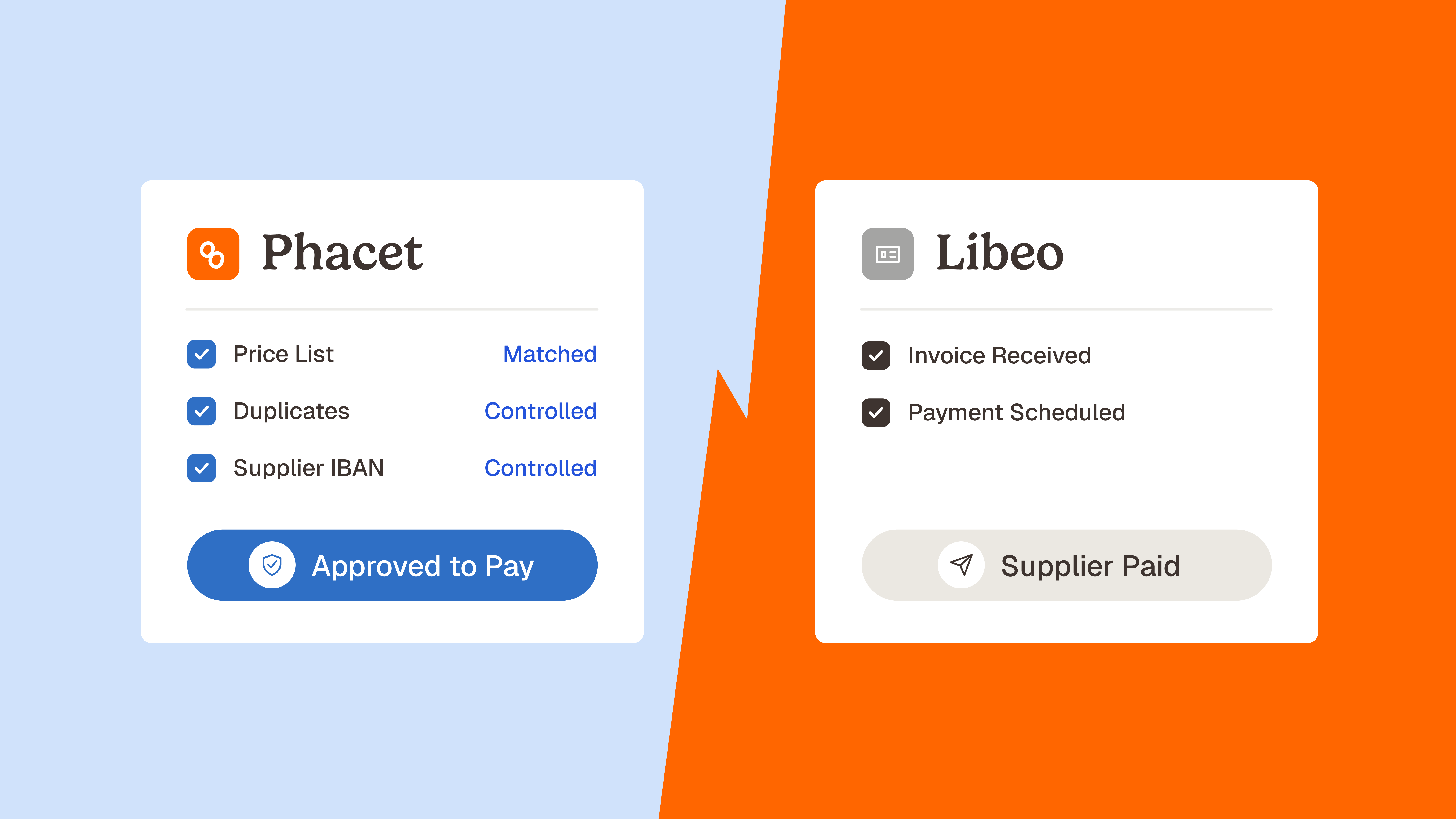
Libeo is a French platform that collects supplier invoices, routes them for approval and pays suppliers by transfer. Shine, a Cegid group company, has announced the acquisition of Libeo (reported on 28 September 2026), and according to the announcement Libeo's product, pricing and teams stay unchanged. Phacet pays no supplier: its AI agents check each invoice line against the order, the delivery note and the negotiated price before payment, whichever tool then pays. Libeo sells comparable line checks as an additional service, so the real choice is where control should live.
Key takeaways
- Shine, part of the Cegid group, has announced the acquisition of Libeo, reported on 28 September 2026; Libeo's product, pricing and teams stay unchanged, and the integration timeline has yet to be specified.
- When a payment is prepared in Libeo, an alerts column flags duplicates, credit notes, new IBANs and missing IBANs, and only a member with execution rights can send the payment.
- Libeo checks invoices against delivery notes and purchase contracts through Libeo AI, which Libeo describes as an additional service that its technical teams set up for each customer.
- Libeo is not an approved e-invoicing platform in France: it relies on its partner SERES, registered on the official list on 11 December 2025.
- At Astotel, a group of 18 Paris hotels, checking every invoice line against negotiated prices surfaced up to 400 euros of errors a month on a single supplier, nearly 5,000 euros a year.
What is Libeo, and what does the Shine acquisition change?
Libeo is a supplier invoice and payment platform founded in Paris and aimed at SMEs, groups and accounting firms, with dedicated pages for restaurants, hotels, retail, medical practices and construction. It collects invoices, reads them, sends them through approval circuits and pays suppliers by transfer, and its integrations page lists accounting tools such as Pennylane, Sage 100, Cegid Loop, ACD, MyUnisoft and Odoo. On the regulatory side, Libeo's legal notice states that it is registered with ORIAS as a broker and as a non-exclusive agent in banking and payment services for the company Swan.
Ownership changed this autumn. On 8 June 2026, Cegid announced that it had completed its acquisition of Shine, the business account provider. Shine has since announced the acquisition of Libeo, for an undisclosed price, as FrenchWeb and Presse-citron reported on 28 September 2026. According to the announcement, Libeo's product, pricing and teams stay unchanged, and two of Libeo's three co-founders, Pierre-Antoine Glandier (CEO) and Jérémy Attuil, join Shine with the whole team. FrenchWeb adds that the timeline and terms for integrating Libeo's features into Shine's offer have yet to be specified.
The size figures you will find online differ by a factor of fifty. Tipalti's page on Libeo alternatives, updated on 28 June 2026, credits Libeo with a customer base of 150,000 companies. In the deal coverage, Libeo says it serves about 3,000 SMEs and accounting firms, and its own about page speaks of 20,000 daily users. Users and customer companies are different units, and the 3,000 figure is the one attached to the transaction. Use that one.
The pages that currently review or compare Libeo have not caught up with the deal. On the five pages that review or compare Libeo and that Google currently shows or cites for these searches (two approved-platform directories, a French review article, Blog du Modérateur's product sheet and Tipalti's alternatives page, 6,284 words in total), Shine, Cegid and Libeo AI appear zero times.
Method: the five pages were read on 28 October 2026 and searched by script for each term, plural forms included.
What does Libeo check before it pays?
More than a quick review suggests. Libeo's own documentation, read on 28 October 2026, describes checks at three points.
- When a payment is prepared. Libeo's help centre article on preparing a payment (dated 6 August 2026) describes an alerts column that flags duplicates, credit notes, new IBANs and missing IBANs. A payment is only triggered when a member with the right to execute payments sends it, and an admin can give a member the specific right to validate the IBANs entered during preparation.
- On bank details. Libeo's payment security page advertises an automatic check that a supplier's IBAN matches its SIREN, the French company identification number.
- On incoming e-invoices. Libeo's e-invoicing page mentions native extraction of Factur-X data, AI reading of PDFs, and detection of duplicates and VAT anomalies.
Line-level checks are a separate product. Libeo AI, as presented on its own page, identifies price and quantity gaps between delivery notes and supplier invoices, and between purchase contracts or price lists and purchase documents. The same page calls Libeo AI "un service additionnel", an additional service built around each customer's needs, which Libeo's technical teams then set up. According to FrenchWeb, Libeo launched Libeo AI in 2025 and said at the time that twenty customers were testing it.
So the honest summary is this: Libeo's core subscription is designed around the payment (has this been paid already, is this account new, who may send the money), and its line checks against orders and contracts come as an add-on configured by Libeo.
Should invoice control live inside the tool that pays?
Our reading is that it should not, for two reasons that go beyond Libeo.
First, the checks on the payment itself are becoming a baseline. Since 9 October 2025, under Regulation (EU) 2024/886, payment service providers located in the euro area must offer payers a verification of payee for every credit transfer in euro, instant or not: before the payer authorises the transfer, the payer's provider checks that the payee's name matches the IBAN and flags any mismatch, without preventing the payer from going ahead. Checking the account a payment goes to has become a regulated service of the payer's provider. What no payment rail can check on its own is the content of the invoice: whether 80 units were delivered when 100 were billed, or whether the unit price matches the one negotiated.
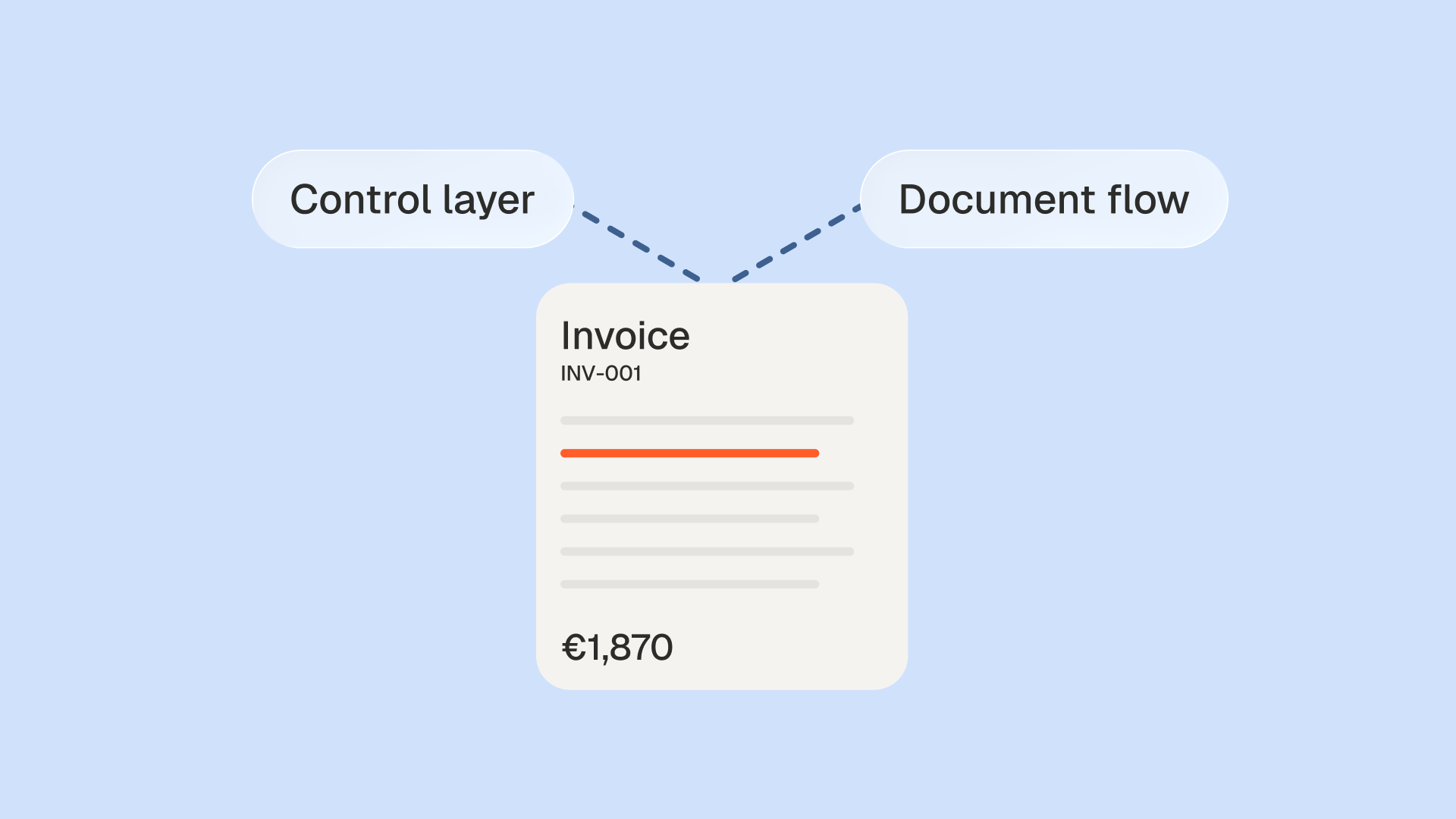
Second, a control built into the payment tool follows that tool's roadmap. The timeline and terms for integrating Libeo into Shine's offer have yet to be specified. Whatever Shine decides, a control layer that pays nothing stays where it is: it reads the invoices, the orders, the delivery notes and the price lists, and hands its verdict to whichever tool sends the money, Libeo today, something else tomorrow. It also sees the invoices that never go through Libeo, such as those paid by direct debit or from the ERP.
That is the job of Phacet's supplier billing control agent. It extracts each invoice line, compares it with your negotiated price lists and flags every gap before the invoice is paid, with the source and reasoning behind each flag. For the wider checklist of what to verify on an invoice, see our guide on invoice control before payment.
Phacet vs Libeo, side by side
| Job | Libeo | Phacet |
|---|---|---|
| Invoice capture | Collects and reads supplier invoices (PDF and Factur-X) | Extracts and structures invoice lines to check them; keeps no books |
| Approval | Custom approval circuits; payment sent only by a member with execution rights | Routes each invoice to the right approver with the result of every check attached |
| Paying suppliers | Core job: transfers, as an ORIAS-registered agent of Swan | None: Phacet pays no supplier |
| Duplicates and bank details | Alerts for duplicates, credit notes, new and missing IBANs; automatic IBAN-SIREN check | Duplicate control before payment; checks every supplier bank detail change and scores the fraud risk |
| Invoice vs delivery note | Libeo AI, sold as an additional service | Delivery note matching agent, in the standard catalogue |
| Invoice vs contract or price list | Libeo AI, sold as an additional service | Price list and contract terms agents, in the standard catalogue |
| Who sets up line control | Libeo's technical teams, for each customer | Your team from the catalogue, or Phacet's experts; one to two weeks for a straightforward process |
| E-invoicing in France | Not an approved platform; relies on its partner SERES | Not an approved platform; works on top of yours |
| Published price | No amount on the pricing page; quote on request | Studio 299 euros a month; Studio Max from 999 euros a month |
| Status in October 2026 | Acquisition by Shine (Cegid group) announced; product and pricing unchanged | Available, 14-day trial on Studio |
Method: the Libeo column is built from Libeo's product pages, pricing page, legal notice and its help centre article on preparing a payment; the Phacet column from Phacet's agent and pricing pages. All read on 28 October 2026. "Additional service" is Libeo's own wording.
Read the table as two layers rather than two rivals. The upper rows describe moving money, which is Libeo's job. The lower rows describe checking the invoice before the money moves. Phacet's delivery note matching agent compares each invoice line with the purchase order and the delivery note, and every result stays traceable to the PDF page or ERP row it came from.
How much does Libeo cost compared with Phacet?
Two prices for Libeo circulate online, and neither appears on Libeo's site. Blog du Modérateur's undated product sheet lists three plans at 49, 99 and 159 euros a month. Tipalti's comparison page gives a fixed 29 pounds a month. Libeo's own pricing page, read on 28 October 2026, shows no amount at all: it offers a free, personalised quote, with modules chosen by need, and presents Libeo AI separately. Treat any published Libeo price as outdated until a quote says otherwise.
Phacet publishes its prices on the Phacet pricing page. Studio costs 299 euros a month with 45,000 credits and one user. Studio Max starts at 999 euros a month with 120,000 credits and five users. Factory starts at 2,500 euros a month, billed annually, with agents built by Phacet's experts. Studio comes with a 14-day trial and no credit card. The two budgets do not cover the same job: Libeo's subscription pays your suppliers, Phacet's checks the invoices before someone pays them.
Is Libeo an approved e-invoicing platform?
No. Libeo does not appear on the list of approved platforms published by the French tax administration (page updated on 13 October 2026, list read on 28 October 2026). Libeo describes SERÈS as its partner approved platform, and SERES does appear on that list, with a registration number issued on 11 December 2025. Directories variously write SERES, Docaposte or "Docaposte SÉRÈS"; the official list names SERES.
The point matters because the obligation is live. Since 1 September 2026, every company in France, whatever its size, must receive its invoices electronically whenever its supplier is required to issue them that way. Shine, Libeo's new owner, has been on the same list since 21 May 2026. Our reading: once the integration is defined, the platform that routes Libeo customers' e-invoices could change. Nothing has been announced, so check which platform receives your invoices today and ask before your next renewal.
What Libeo users praise and criticise
Libeo's reviews say more about paying than about checking. We read the 41 reviews on Trustpilot and the four on Capterra (July to September 2024) on 28 October 2026, without counting stars.
- Praise: reviewers say Libeo pays suppliers directly and lets them automate payments, and many mention time saved; Capterra reviewers also describe a responsive support team.
- Reading errors: a September 2025 review lists invoices processed as credit notes, misread amounts and wrong due dates.
- Re-entry: an October 2024 review describes suppliers created again and amounts excluding and including VAT re-typed each time.
- Payment friction: 2024 reviews mention entering bank credentials for each transfer and difficulties with the payment partner.
- E-invoicing routing: a September 2026 review says the company's supplier invoices were routed to a platform it had not chosen.
In the 45 reviews we read, none credits Libeo with catching a wrong price, a short delivery or a contract breach. That is consistent with what the product sells by default. Our reading: a reading error that nobody compares with the order or the delivery note does not stay a reading error. It becomes a payment, and the payment tool will execute it exactly as prepared.
What line-by-line control catches: the Astotel case
At Astotel, a group of 18 hotels in Paris, purchasing checks used to rely on sampling: Valérie, the group's purchasing director, picked a few invoices at random to compare prices between hotels. On one reference of smoked salmon, for the same quantity, she found up to 6 euros per kilo of difference between two hotels. Once a Phacet agent checked every line against the negotiated price list, one supplier alone showed up to 400 euros of errors a month, nearly 5,000 euros a year.
"I save up to two days per month and catch mistakes I would never have spotted on my own." Valérie, Purchasing Director, Astotel.
Astotel's invoices were already digitised and approved. The errors were not in the workflow; they were in the lines. That is the layer a payment platform, however well run, is not designed to read by default.
Keep Libeo, replace it, or add a control layer?
- Libeo pays well, and your losses come from prices and quantities. Keep Libeo for payments and add line control on top. You can ask Libeo for a Libeo AI quote, or use Phacet's agents, such as the contract terms control agent, which hand their verdict to Libeo before the payment is prepared.
- You want e-invoicing, a business account and supplier payments in one place. Watch how Shine integrates Libeo. Shine is an approved platform, and FrenchWeb reports that the timeline and terms of the integration have yet to be specified.
- You are leaving Libeo. Choose the payment tool first, then keep invoice control in a separate layer, so it does not have to be rebuilt at the next change of tool or owner.
In all three cases, the question for your team is the same: who checks that an invoice is right before anyone agrees to pay it? Phacet's agents do that check and leave the approval with your team. The AI proposes, your approver decides, and every decision stays in the audit trail.
Frequently asked questions
What is Libeo used for?
Libeo is a French platform for managing and paying supplier invoices. It collects and reads invoices, routes them through approval circuits and pays suppliers by transfer, with alerts for duplicates and new IBANs. It mainly serves SMEs and accounting firms. Shine, a Cegid group company, has announced its acquisition, reported on 28 September 2026.
Is Libeo secure for payments?
Libeo is registered with ORIAS as a broker and non-exclusive agent in banking and payment services for the company Swan. It checks that a supplier's IBAN matches its SIREN number, flags new IBANs when a payment is prepared, and only sends a payment when a member with execution rights triggers it.
What happens if a supplier changes its IBAN in Libeo?
When a payment is prepared, Libeo shows a "new IBAN" alert, and an admin can give a team member the specific right to validate IBANs entered during preparation. Libeo also checks the IBAN against the supplier's SIREN. Whatever the tool, confirm any bank detail change by calling the supplier on a number you already hold.
How do you match a delivery note with a supplier invoice?
Compare each invoice line with the delivery note for the same order: product reference, quantity received and unit price. Flag lines billed but not delivered, quantities above what was received and prices above the agreed rate. Then hold the payment until the supplier issues a credit note or the buyer confirms the difference.
What is the best alternative to Libeo?
It depends on the job you want to replace. To pay suppliers and route invoices, look at payment and pre-accounting platforms, including Shine's own offer once the integration is defined. To check invoices before payment, add a control layer such as Phacet, which pays no supplier and works on top of Libeo or another payment tool.
The takeaway
Libeo's acquisition by Shine leaves the product unchanged for now and the roadmap open. Use the pause to separate two decisions. The first is which tool pays your suppliers, and that may change as Shine integrates Libeo. The second is which layer checks your invoices before they are paid, and that one should not have to change with it. To see what line-by-line control finds on your own invoices, book a demo with one supplier family.
Sources, all read on 28 October 2026: Libeo's product pages, pricing page, legal notice and help centre article on preparing a payment (6 August 2026); FrenchWeb and Presse-citron on the Shine deal (28 September 2026); Cegid's release on the completion of the Shine acquisition (Business Wire, 8 June 2026); the French tax administration's list of approved platforms (updated 13 October 2026) and its e-invoicing calendar; Regulation (EU) 2024/886 on EUR-Lex; Tipalti's Libeo alternatives page (updated 28 June 2026) and Blog du Modérateur's Libeo product sheet (undated); Trustpilot and Capterra reviews of Libeo; the Astotel customer story on phacetlabs.com (11 June 2025). Quotations from French sources are our translations.

Latest Resources

Unlock your AI potential
Go further with your financial workflows — with AI built around your needs.


