AI accounting software: what it does and where Phacet sits
Published on :
July 6, 2026

Nicolas Marchais is co-founder and CEO of Phacet. After seven years at Spendesk, he built Phacet as the agentic layer that orchestrates across ERP, banking and email systems. Reliable, auditable, cross-system, what he calls a Finance Workforce.

Most teams discover the same thing once they start shopping for AI accounting software: the label covers at least four very different kinds of tools. Some record your transactions. Some speed up the month-end close. Some move payments faster. And a few are general assistants that can help with anything, including accounting.
This guide maps that landscape, defines what AI accounting software actually does, and shows you the one layer almost every tool skips: the control that verifies your numbers before they hit your books or your bank account. That layer is where Phacet sits.
What is AI accounting software?
AI accounting software uses artificial intelligence, mainly machine learning and large language models, to automate accounting work that used to be manual: capturing invoices, categorizing transactions, reconciling accounts, and generating reports. It goes beyond rules-based automation because it learns from your data and adapts instead of following fixed scripts.
The practical difference matters. Traditional accounting automation repeats the same predefined action every time. An AI agent reads context, handles cases it has not seen before, and explains what it did. That shift from fixed rules to adaptive reasoning is what people mean when they say "AI" rather than "automation."
What AI accounting software typically handles:
- Data capture: reading invoices, receipts, and statements, then extracting the right fields
- Categorization: coding transactions to the right accounts based on learned patterns
- Reconciliation: matching transactions across bank feeds, the ledger, and source documents
- Reporting: drafting financial statements, variance explanations, and dashboards
- Anomaly detection: flagging unusual amounts, duplicates, or out-of-policy spend
That list looks complete. It is not. Notice that every item optimizes for speed: faster capture, faster coding, faster close. Almost none of them answer a different question that finance teams actually lose sleep over: is this number right before I post it or pay it?
The four layers of AI accounting software
The reason "best AI accounting software" lists feel confusing is that they rank tools from different layers of the stack side by side, as if a general ledger and a chatbot solved the same problem. They do not.
Here is the landscape organized by what each layer is built to do.
Read the last column. Each layer leaves a gap, and the gaps line up: tools that record do not verify, tools that close work after the data is already booked, tools that pay optimize throughput rather than price accuracy, and generalist assistants have no audit trail and no connection to your systems. The pattern is consistent across every layer. Speed is covered. Control is not.
The layer everyone skips: control before the data hits your books
Most AI accounting software treats control as a feature: an anomaly flag here, an audit log there. It is rarely the organizing idea, and it almost never happens before money moves.
Control before payment means verifying each line of a document against what was actually agreed, while you can still do something about it. Concretely, that is three things working together:
- Line-level price compliance: checking each invoice line against the negotiated price list, so a 4% drift on one product does not slip through. See invoice price compliance.
- 3-way matching: reconciling the purchase order, the delivery note, and the invoice before approval, not after. See 3-way matching.
- Pre-payment anomaly detection: surfacing duplicates, quantity mismatches, and unusual amounts before the payment run, not in next month's review. See pre-payment invoice checks.
This is the difference between recording an error correctly and catching it before it costs you. A faster close still closes on the wrong number if nothing verified the number on the way in. That is why continuous control before payment is the layer the rest of the market leaves open.
Where Phacet sits
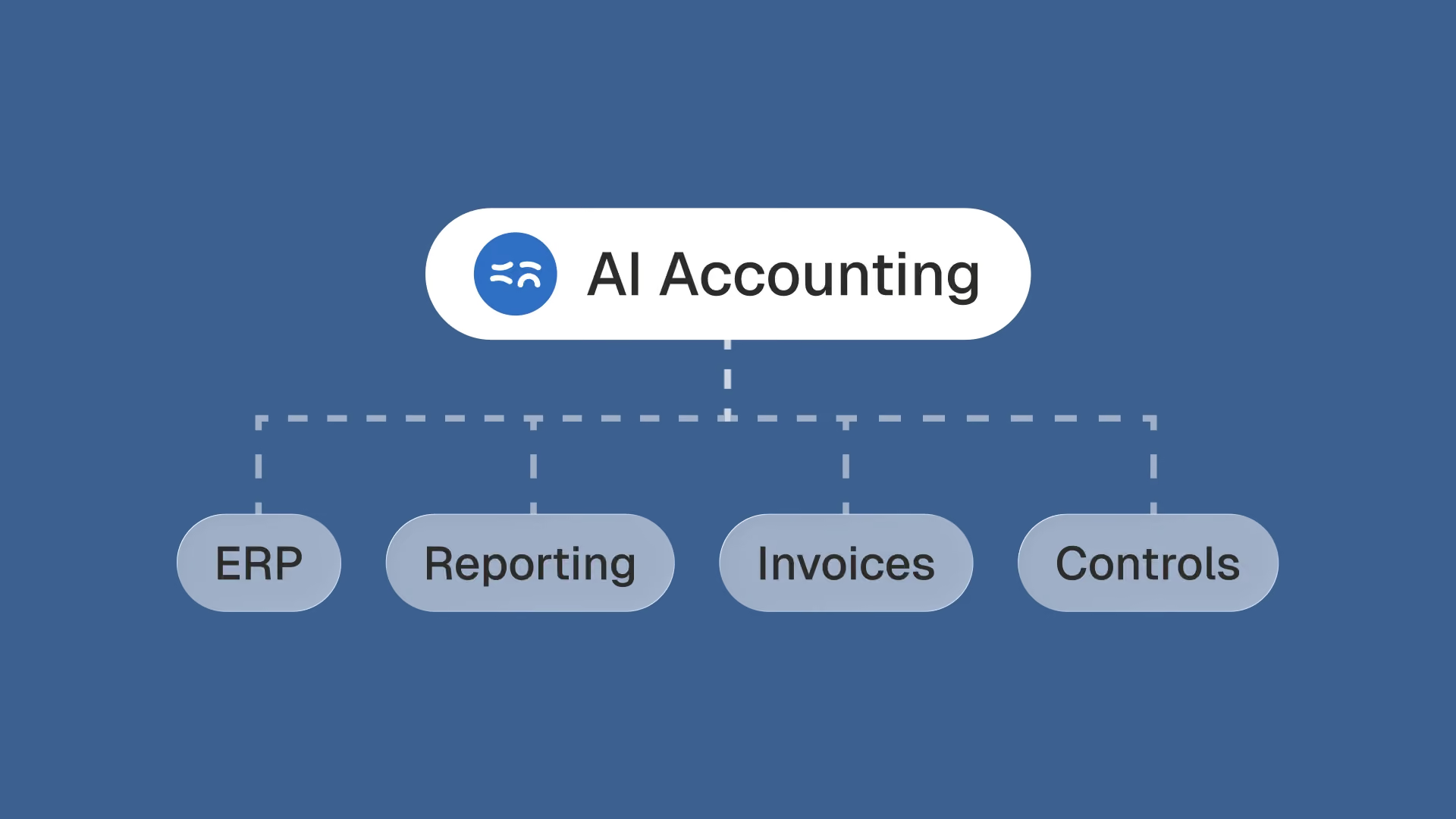
Phacet is not another general ledger and it does not replace your ERP. It is a control layer that sits on top of the system you already run, whether that is Sage, NetSuite, Pennylane, or QuickBooks. It reads your invoices, prices, and bank flows, verifies them line by line, and writes a clean, traceable result back.
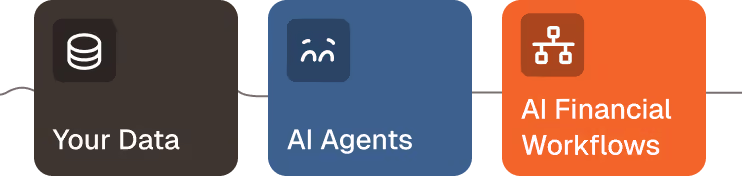
Every Phacet agent works the same way, in three steps:
- Structure: it turns documents and raw data into auditable tables, extracting and standardizing each field with a confidence score.
- Control: it matches, reconciles, and verifies every flow against your rules, with the reasoning shown at each step.
- Analyze: it surfaces the anomalies and the explanations on top of data you can actually trust.
The point of difference is in step two, and it is what separates Phacet from both the AI ledgers and the generalist assistants.
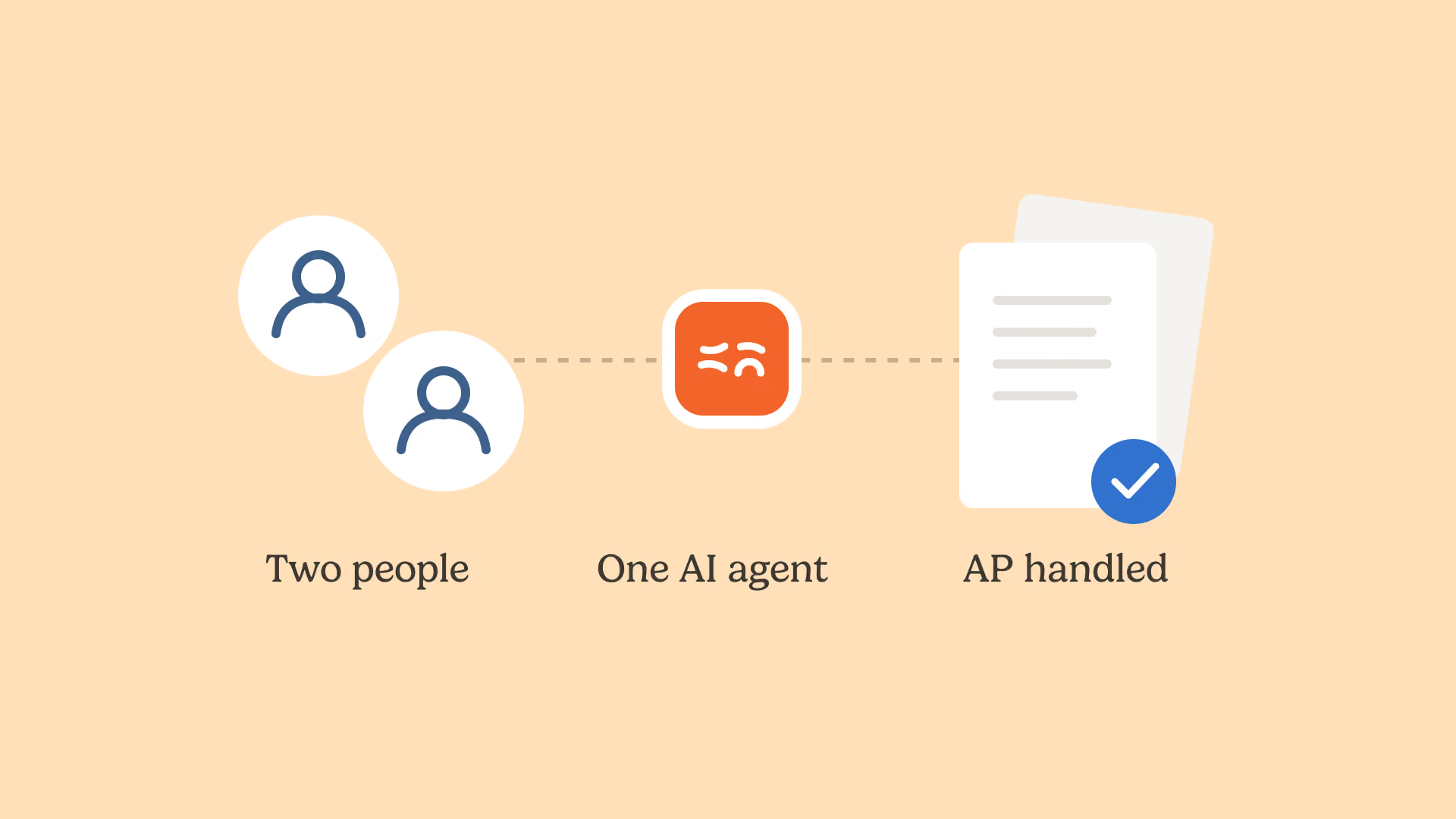
A few concrete agents make it tangible. One 3-way matching agent reconciles the purchase order, delivery note, and invoice automatically. Another controls supplier billing and reduces overpayments by checking each line against the agreed price. A third reconciles bank transactions and detects unmatched flows. All of this runs across your accounts payable and internal controls workflows, with a native audit trail behind every decision.
The proof is in production, not in theory. At Astotel, a group of 18 Paris hotels, a Phacet price-control agent surfaced close to 5 000€ a year of billing errors on a single supplier, errors a sampling-based check would never have caught. "I save up to two days a month, and I spot errors I would never have seen on my own," says Valérie, Directrice Achats. At Smartbox, the European gift-box leader operating across 14 countries, payment-to-invoice reconciliation reached four times the previous productivity, with each use case live in six weeks.
Can ChatGPT or Claude do my accounting?
Short answer: they can help with accounting tasks, but they are not accounting software, and they are not built for control.
General assistants like ChatGPT and Claude are excellent at one-off analysis, drafting, and answering questions. What they do not do is connect to your ERP, your bank, or your supplier price lists. They do not produce an audit trail. They have not been trained on your accounting rules, and they were not built to run the same controlled check, the same way, every week. The moment you need a verifiable, repeatable result that an auditor or an expert-comptable can review, a generalist model is the wrong tool. This is the practical line between an AI agent and traditional SaaS or a chatbot: an agent is specialized, connected, and traceable.
Will AI replace accountants and controllers?
No. AI accounting software replaces the manual, repetitive part of the work, not the judgment.
The useful framing is augmentation. The agent proposes, the human decides. AI handles the volume, capturing, matching, and flagging, so accounting teams and financial control move from processing data to deciding on exceptions. The role shifts from data entry to analysis, and the work becomes more valuable, not less. Keeping a human in the loop is also what makes the output trustworthy: a controlled, auditable result still passes through a person who owns the decision.
Which layer do you actually need?
The right tool depends on where your biggest pain lives, not on which list ranks highest.
- If you have no system of record yet, you need a ledger or ERP (an AI-native one if you are starting fresh).
- If your close drags on, you need close automation on top of your existing books.
- If invoices and approvals are the bottleneck, you need AP and spend tooling.
- If your problem is that you cannot trust the numbers, that prices drift, that errors are caught too late, that nothing is verified before payment, you need a control layer.
Most goods-heavy businesses in food and beverage, hospitality, retail, and construction already have an ERP. What they lack is line-level control on top of it. That is the gap Phacet was built to close, with accounts payable controls that run before payment rather than after.
The bottom line
AI accounting software has split into layers: tools that record, tools that close, tools that pay, and assistants that help. Each one earns its place by making something faster. The layer that stays open is control: knowing your numbers are right before they reach your books or your bank.
That is where Phacet sits. It does not replace your ERP, it verifies what flows into it, line by line, with the reasoning shown and the audit trail kept. With 40+ ready-to-use agents built on 100+ real deployments, and a first agent in production in under two weeks, the control layer is no longer the part you have to build yourself.
FAQ
What is AI accounting software?
AI accounting software uses machine learning and large language models to automate accounting work such as capturing invoices, categorizing transactions, reconciling accounts, and generating reports. Unlike rules-based automation, it learns from your data and adapts to cases it has not seen before.
What is the best AI accounting software?
There is no single best tool, because AI accounting software spans four layers: AI-native ledgers and ERPs, close automation, AP and spend tools, and generalist AI assistants. The best choice depends on your biggest pain point. If the problem is trust and control rather than speed, a control layer that verifies data before it is posted or paid is what you need.
Can ChatGPT do my bookkeeping?
ChatGPT can help with isolated tasks like data analysis or drafting, but it is not bookkeeping software. It does not connect to your ERP or bank, does not produce an audit trail, and is not trained on your accounting rules, so it cannot deliver a verifiable, repeatable result on its own.
Can AI replace accountants?
No. AI replaces the manual and repetitive parts of accounting, not professional judgment. It captures, matches, and flags exceptions, which lets accountants and controllers focus on analysis and decisions while a human stays in the loop on every output.
Does AI accounting software replace my ERP?
Not necessarily. AI-native ledgers and ERPs aim to be your system of record, but a control layer like Phacet sits on top of the ERP you already run (Sage, NetSuite, Pennylane, QuickBooks) and verifies the data flowing into it, with no migration required.
Latest Resources
Unlock your AI potential
Go further with your financial workflows — with AI built around your needs.