How Qonto turned 1,500 employees into actors of the AI revolution?
When Nicolas Marchais speaks with Steve Anavi, co-founder of Qonto, the conversation moves away from features and roadmaps and starts with Jean Piaget. Steve uses the psychologist's theory of assimilation versus accommodation to explain why most companies get AI adoption wrong: they simply layer AI onto existing processes, rather than rethinking the system itself. At Qonto, the choice was accommodation, applied both to the product, with two new AI agents, The Operator and The Analyst, and to the internal organization of a 1,500-person company.
Published on :
July 2, 2026
%20(1).avif)

.avif)
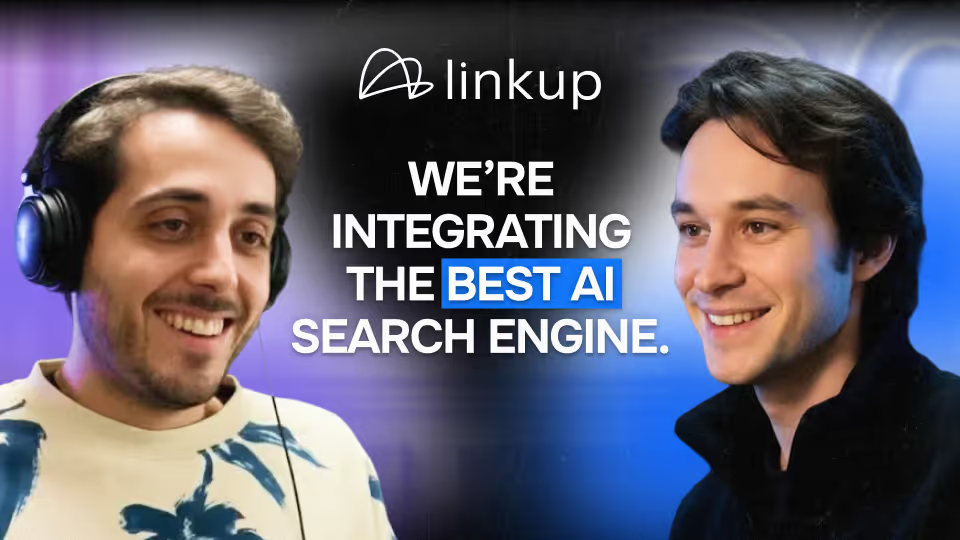
In this episode, Nicolas Marchais welcomes Steve Anavi, co-founder of Qonto, one of Europe's leading business finance solutions for SMEs.
Today, Qonto serves 600,000 SME clients across several European countries and employs more than 1,500 people. The company has just launched its first AI agents for end users, The Operator and The Analyst, marking a new step in how founders and CFOs interact with their financial data.
Steve Anavi co-founded Qonto out of a simple frustration: before Qonto, he was an entrepreneur, and the machine was not working for him. It should have been. Today, Qonto serves 600,000 SME clients across several European countries, employs more than 1,500 people, and has just launched its first AI agents for end users. In this episode, Steve does not talk about features. He talks about philosophy. And he starts with Jean Piaget.
It is an accommodation problem
The problem Qonto is trying to solve has not changed since day one. The 26 million European SMEs all share the same hidden tax: eight hours per week spent on administrative and financial tasks. AI is, according to Steve, the new weapon to bring that number down further. But how you integrate that weapon makes all the difference.
This is where Piaget comes in. The Swiss psychologist theorized two modes of learning: assimilation, which consists of fitting a new discovery into the existing system, and accommodation, which consists of changing the system itself to welcome the new thing. Steve illustrates: if you only have triangles and you discover a rectangle, assimilation means trying to fit the rectangle into the triangle. The result is that the rectangle ends up looking like a triangle again. Accommodation means modifying the system before bringing the rectangle in.
"The technological rupture that AI forces on us is accepting that it is an accommodation problem."
Most companies opt for assimilation: they layer AI features onto existing processes, hoping the technology improves what was already there. Qonto made a different choice, conscious and documented, both internally and in its product offering. The two recently launched agents, The Operator and The Analyst, are not layers placed on top of an existing interface. They redefine how a founder or CFO interacts with their data: on one side, faster execution of repetitive tasks; on the other, conversational analysis of financial data. Two new entry points into the product, not two new features.
Kaizen as the engine of internal transformation
The same accommodation logic applies inside the company. Steve describes two complementary pillars, which he considers inseparable.
The first pillar is Kaizen. At Qonto, continuous improvement has long been decentralized to teams. Every employee is invited to spend thirty minutes to an hour a day changing the way they work. With AI, this practice has taken on a new dimension. The direction is set in the Founder's Memo, the reference document updated every three months by leadership: Qonto wants to be an AI-first company. The logistics follow, with access to tools and contracts with vendors. Then the teams get on with it.
"The operator knows better than anyone what needs to change, in what order, to find the gains that help them succeed better in their job."
The most striking example from the episode: the person in charge of Qonto's chatbot, running their own Kaizen, realizes that the best support is no support. They approach the team building The Operator and propose replacing the chatbot with an agent that takes the action itself rather than answering a question. This is a ground-level initiative, not a management decision. It is accommodation at the individual scale.
The second pillar is what Steve calls company projects. When a local improvement touches something deeper, when it involves more than twenty people or challenges a systemic logic, leadership provides the resources to move faster and further. Qonto currently has eight such projects running, all of them originating from the ground up. Steve spends six to eight hours a week on the ground identifying them, qualifying them, and giving them what they need. The two pillars feed each other: without Kaizen, company projects would have no raw material. Without company projects, Kaizen efforts would remain local and insufficient.
What AI does not replace
The gain on code output is real and measurable. The volume of code produced at Qonto each week has grown substantially, well beyond ten percent. Product and engineering teams have gone from three-pizza teams to two-pizza teams, to use Steve's expression: smaller, tighter, more effective. The internal engagement score increased by close to a point in a matter of months in these teams.
But perhaps the most surprising observation is this: Qonto is hiring fewer developers and more engineers. The distinction is not semantic. What Steve values today is mental craftsmanship: system architecture, managing dependencies between services, design trade-offs. Not writing code, which agents increasingly handle. This shift applies across every function.
"We are not selling replacements in our app. We are making extensions available, because we know the human will allocate their time to more important things."
There is also one domain where Steve is explicitly cautious: taste. He uses the phrase non-artificial intelligence to describe everything that makes you choose one watch over another, one phone over another, one product over a competitor. This less rational component, difficult to model, cannot be delegated to a model. At Qonto, taste has never been discussed more internally than since AI arrived. That may be the most unexpected consequence of the transformation: the more the machine handles execution, the more the human is sent back to what makes their own contribution irreplaceable.
Key takeaways
Qonto is not ahead on AI because it deployed the right tools. It is ahead because it chose accommodation over assimilation. Changing the way you think before integrating the technology. Letting teams initiate the transformation rather than waiting for it to come from the top. And staying vigilant about what technology cannot do in place of the human. It is a fairly simple program to articulate. It is considerably harder to hold across 1,500 people.
Explore more from Phacet


Unlock your AI potential
Go further with your financial workflows — with AI built around your needs.