Why Agicap tested an AI assistant and then removed it?
When Nicolas Marchais speaks with Sébastien Beyet, CEO and cofounder of Agicap, the conversation begins with a paradox that is quite unusual in the software ecosystem. Agicap did build an AI assistant inside its product. But after testing it with customers, the company ultimately decided to remove it. This decision goes against the current trend, where almost every SaaS company is adding a chatbot to its interface.
Published on :
March 9, 2026



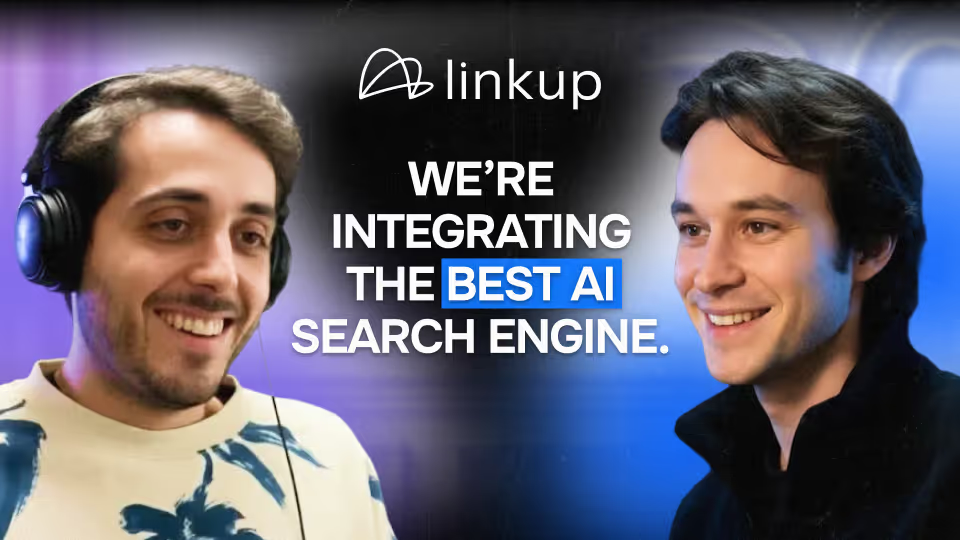
In this episode, Nicolas Marchais welcomes Sébastien Beyet, CEO and co-founder of Agicap, one of the European leaders in treasury management software.
With more than 8,000 client companies across Europe and the United States, Agicap helps finance teams monitor, forecast, and optimize their cash flow. For several years, the platform has already integrated artificial intelligence components to automate the processing of financial data.
For Sébastien Beyet, the reasoning is simple. What matters is not adding visible AI features, but delivering measurable value in everyday workflows.
“There was an expectation and a strong initial adoption driven by curiosity, but very few recurring uses among our customers.”
Agicap: a product built around financial data
Founded in 2016, Agicap has become a leading treasury management platform for SMEs and mid-sized companies in Europe. The software connects bank accounts, ERPs, and other financial data sources to provide companies with a consolidated view of their cash position and forecasts. Today, Agicap supports around 8,000 companies and operates across several European markets as well as the United States. From the beginning, the product has been built around a core challenge: processing large volumes of heterogeneous financial data.
“Our customers have on average around twenty bank accounts, sometimes multiple ERPs, and several forecasting sources. All of this data has to be aggregated, cleaned, and processed.”
This complexity explains why artificial intelligence has been part of the product’s DNA long before the recent wave of generative AI.
AI existed at Agicap long before LLMs
Unlike many SaaS companies that discovered AI with ChatGPT, Agicap had already integrated several machine learning components into its product years earlier. These models were used across different stages of the treasury management cycle: aggregating financial data, cleaning and categorizing transactions, generating forecasts, and optimizing cash management.
“If we talk about automation and automated data processing, we are already talking about artificial intelligence, even with more traditional technologies.”
When large language models emerged, the challenge for Agicap was not discovering AI, but identifying where these new models could meaningfully improve the product.
A pragmatic approach to AI adoption
When LLMs arrived, Agicap did not immediately overhaul its product roadmap. Instead, the company adopted an experimental approach. A small dedicated team explored the technology, tested different use cases, and evaluated where the models could create real value.
“We tested very concrete use cases to see what actually worked and what didn’t.”
This internal research phase highlighted several promising applications. One example was improving OCR systems to analyze complex financial documents. Another was improving transaction categorization. In these scenarios, LLMs provided more accurate results while requiring less historical data.
“It understands the meaning of words better, so we need less historical data to get good results.”
However, not all experiments were successful. And one of the most obvious ideas turned out to be one of the least effective.
The failed AI assistant experiment
Like many SaaS platforms, Agicap experimented with a conversational assistant. The idea was straightforward: allow users to ask questions in natural language instead of navigating through dashboards and reports. On paper, the concept seemed obvious. In practice, real usage remained low.
“It was one of the experiments that didn’t work well. We tried it, but eventually decided to put it aside.”
Users were curious at first, but they did not return to the feature regularly.
“There was initial curiosity-driven adoption, but very little recurring usage.”
In a domain as sensitive as treasury management, reliability and traceability are essential. And conversational AI often struggles to provide results that are easy to explain.
“In a field as sensitive as finance, the risk of hallucination was simply not acceptable.”
Why AI assistants struggle in finance
The issue is not purely technical. It is also tied to the role of financial professionals. A treasurer or CFO does not simply consume numbers. They must also be able to explain assumptions and justify decisions. A model that generates accurate results but cannot explain how it reached them quickly becomes difficult to use.
“Even if a forecast is 99 percent accurate, if it cannot be explained, it’s not really usable.”
Professional accountability plays a central role. In many financial scenarios, AI can help analyze data or prepare scenarios, but the final decision must remain human.
“What we expect from AI is to advise and prepare the work, but we want to stay in control.”
Where AI actually creates value
After these experiments, Agicap refocused its AI strategy on more operational use cases. Instead of trying to replace users, the technology is now used to automate repetitive tasks that consume a large portion of finance teams’ time. This includes transaction categorization, bank reconciliation, extracting information from financial documents, and automatically generating dashboards.
“We focused on tangible value, the kind that is measurable for our users.”
These use cases may be less spectacular than a conversational assistant, but they integrate far more naturally into existing workflows.
The first agents are already appearing in the product
Agicap has also started introducing more agent-like systems into its platform. One example is the automatic generation of dashboards based on natural language requests. A user can describe the analysis they want, and the system retrieves the relevant data and builds the visualization.
“The tool knows where to find the right data and the right KPIs to automatically build the view requested.”
The key difference with conversational assistants is that the output is visible, auditable, and easy to verify. This transparency significantly improves adoption.
AI adoption differs between Europe and the United States
With 8,000 customers across multiple markets, Agicap has also observed cultural differences in AI adoption. In terms of product usage, the differences remain limited. But they appear clearly in purchasing behavior.
“In the United States, AI comes up much earlier in the sales cycle.”
Some American companies now allocate specific budgets for AI initiatives, which influences how software solutions are evaluated and purchased.
How to organize a company for AI adoption
For Sébastien Beyet, integrating AI into a company cannot rely on a handful of specialists alone. But it also cannot be fully decentralized. At Agicap, the approach relies on three pillars: a small team of experts dedicated to exploring AI, a broader adoption across the organization, and clear leadership support from management.
“You need a team of experts exploring the technology while encouraging broader adoption across the company.”
The company has also adjusted its approach to building AI solutions internally. Instead of developing everything from scratch, Agicap now prioritizes using existing tools when appropriate.
“For standard use cases, it’s often better to rely on existing tools and focus internal development on highly specific problems.”
Conclusion
The story of Agicap’s abandoned AI assistant reveals something important about the current evolution of AI in software. Not every exciting idea translates into real value. In fields like finance, AI must first be reliable, explainable, and integrated into existing processes. That is why Agicap has chosen a quieter but more effective strategy. Instead of adding a visible chatbot, the company focuses on using AI to automate repetitive tasks and help finance teams spend more time on what truly matters: analysis and decision-making.
Explore more from Phacet
%20(1).png)

Unlock your AI potential
Go further with your financial workflows — with AI built around your needs.