
Track your DSO and receivables every week
Billing and collections cross-checked every week to calculate DSO and spot late-paying customers.

DSO tracking
DSO, or days sales outstanding, measures how many days it takes, on average, to collect an invoice. Tracked weekly, with receivables broken down by customer, it is the indicator that tells you whether cash is coming in on schedule.
Three blind spots keep coming back: a DSO calculated once a month, so always late, receivables that mix overdue and current invoices, and a customer who slips without anyone noticing before the reminder. The calculation often starts again from an export, every time.
Phacet automates this tracking with its AI skills in data matching and automated reporting. The agent cross-checks your invoices and collections, calculates DSO and the aged balance, and alerts you to customers who drift.
When to use this agent?
Ideal for finance leaders, treasury teams and founders who want to:
- Know their DSO every week, not once a month.
- See receivables by customer and by age.
- Chase the right customers at the right time.
AI skills involved

Automatically match your data across files, tools and systems
Phacet cross-references your data across sources - invoices vs. payments, POs vs. receipts, bank lines vs. GL entries, CRM deals vs. billing records. It tells you exactly what matches, what's missing, and what's off. No VLOOKUP, no manual comparison.

Validate every line against your rules, thresholds and references
Define your rules once - negotiated prices, spending caps, expense policy, contract conditions, approval thresholds - and Phacet applies them to every single row, every time. Every discrepancy is flagged with the exact reason, ready for review.

Spot duplicates, outliers and suspicious patterns in your data
Phacet scans your full dataset to surface what shouldn't be there - duplicate payments, abnormal amounts, unknown suppliers, unusual timing patterns, RIB changes. It catches what rules alone can't predict, without requiring you to define every possible scenario upfront.
Business impact

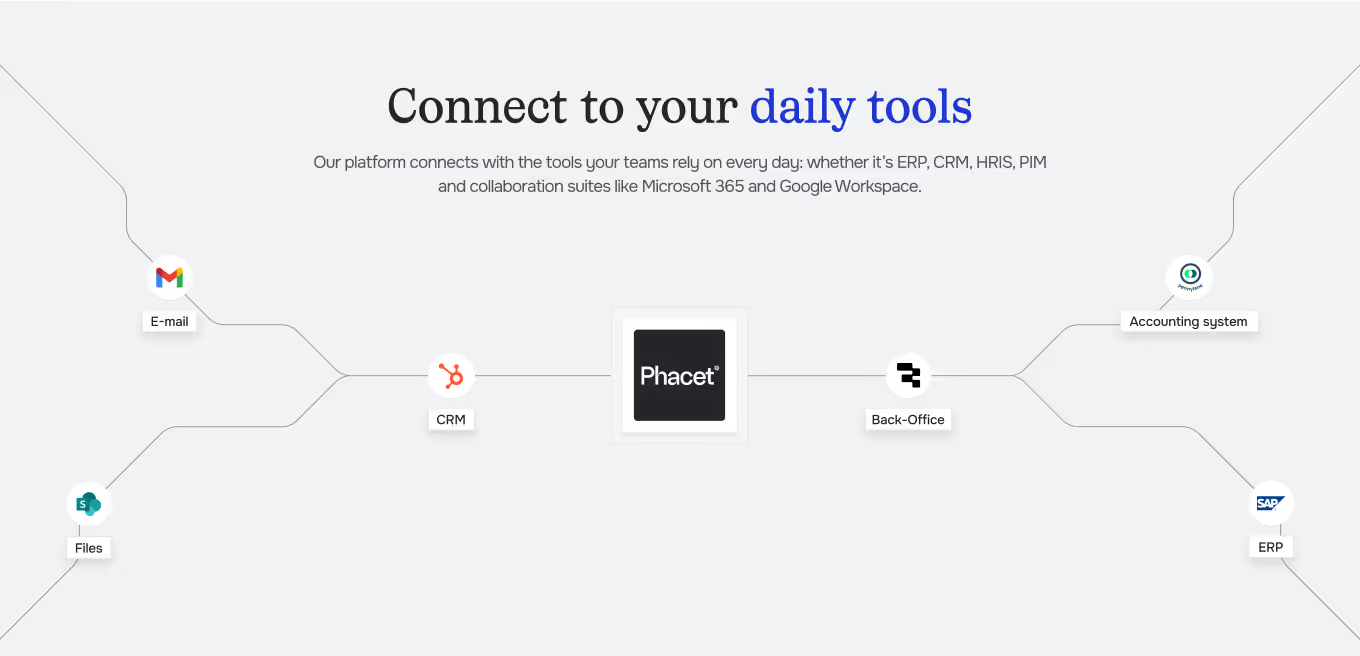
Integrated with everything


Steps to get Started
Connect your systems
Connect your billing tool (Hyperline, Stripe, Chargebee…) and your accounting tool (Pennylane…).
Set your thresholds
Define your payment terms and alert thresholds by customer.
Match & calculate
Phacet cross-checks invoices and collections, then calculates DSO and the aged balance.
Get your report
Every week, DSO, receivables and customers to chase land in your inbox.
Unlock your AI potential
Do more with your existing resources using tailored AI solutions.
Frequently Asked Questions



GUIDE
The AI CFO guide
For accounting teams, accounting firms and CFOs of SMEs and mid-sized companies who want to know where to start.