AI agents for accounting: build autonomous finance team
Published on :
January 5, 2026


Nicolas Marchais is co-founder and CEO of Phacet. After seven years at Spendesk, he built Phacet as the agentic layer that orchestrates across ERP, banking and email systems. Reliable, auditable, cross-system, what he calls a Finance Workforce.

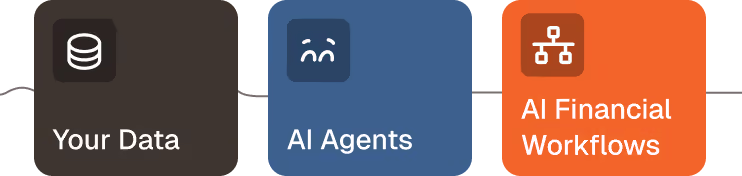
Key takeaway: AI agents function as autonomous digital workers, seamlessly planning, acting, and collaborating to complete end-to-end accounting tasks. They drastically reduce manual effort, cutting errors and freeing professionals to focus on strategic client advisory. This transformation shifts accounting from transactional to value-driven, enabling scalable operations and proactive financial management.
Accountants spend countless hours on repetitive tasks like data entry, bank reconciliations, expense reporting, and VAT filings, leading to costly mistakes, compliance risks, and team burnout. AI agents accounting firms address this by deploying autonomous digital workers that centralize and automate complex processes like VAT declarations and 3-way matching, seamlessly handling end-to-end workflows while drastically reducing manual effort and enhancing accuracy. These intelligent systems free your team to focus on strategic client partnerships and advisory roles, delivering proactive, real-time financial insights that drive scalable growth and improve client satisfaction, creating a true competitive edge for your firm.
- The new era of accounting: from automation to autonomous agents
- Core use cases: how AI agents streamline accounting firm operations
- The tangible benefits: moving beyond productivity
- The human impact: evolving roles and skills in the AI-powered firm
- Implementing AI Agents: a practical approach to adoption and risk management
- Embrace the future of accounting with AI partners
The new era of accounting: from automation to autonomous agents
Beyond generative AI: introducing the "digital worker"
AI agents are not just chatbots. They're digital workers with defined roles. They autonomously process VAT returns by reading invoices, validating data, and coordinating processing steps. Unlike generative AI, they act without constant human input, representing a true shift for accounting firms.
These agents handle complex workflows such as bank reconciliations and missing document collection. By reducing manual effort, teams focus on high-value advisory work. This transformation enhances client service and operational efficiency significantly.
Real-time financial analysis and forecasting are now possible. Agents access historical data, apply financial models, and generate structured reports. This proactive approach improves strategic decision-making for firms.
Continuous audit readiness is maintained through automated transaction tracking. Anomalies are flagged instantly, reducing compliance risks and ensuring accurate reporting. Firms gain confidence in their financial integrity.
They also support scalable operations without increasing headcount. This efficiency allows firms to grow while maintaining quality and compliance standards.
What is an agentic AI in an accounting context?
Traditional automation follows rigid rules. Generative AI creates content but doesn't act. AI agents make context-based decisions. For example, when processing an invoice, they validate details, reject errors, or request human input. This ensures accuracy and compliance.
For accounting firms, Phacet's AI agents automate verification processes, improving client servicing and compliance. They integrate data from ERP and CRM systems to provide real-time insights. Scaling operations is possible without adding staff. These autonomous tools ensure precise audit readiness and reduce manual errors. This reliable foundation supports long-term growth and client trust.
What is the purpose of an AI agent?
Core use cases: how AI agents streamline accounting firm operations?
Automating high-volume and repetitive financial tasks
Accounting teams waste nearly 40% of time on manual invoice processing. AI agents extract data from PDFs, emails, and scanned receipts using OCR for multilingual e-invoices like PEPPOL. This eliminates errors and delays, centralizing workflows.
- Automated invoice processing: extracts data from diverse formats and languages (French, German, Spanish), capturing VAT codes and compliance details. Manages partial deliveries and multiple POs per invoice.
- Bank statement reconciliation: automates matching for ambiguous statements across currencies. Suggests GL accounts for unmatched items, reducing manual effort.
- Expense report verification: real-time checks against policies (e.g., travel limits), flagging non-compliant expenses pre-payment.
80+ compliance checks cut errors 95%, freeing staff for strategic work. Centralized processes reduce processing time 90% with minimal training. Finance managers analyze cash flow and forecast needs, enabling proactive client advice to boost trust and revenue.
Managing end-to-end workflows for enhanced reliability
AI agents manage VAT declarations by coordinating document review, data entry, and validation. They auto-update for tax law changes, ensuring compliance without manual work. Supports global clients with cross-border transactions.
Our 3-way matching automation compares POs, receipts, and invoices to prevent overpayments and fraud. Verifies quantities, prices, and deliveries to ensure valid transactions, eliminating duplicates and disputes.
AI-powered bank reconciliation tracks cross-entity transactions in real time, handling multi-currency conversions. Reduces reconciliation time 70% and provides unified cash visibility for multinational clients.
The tangible benefits: moving beyond productivity
Drastically reduce manual work and improve accuracy
AI agents automate repetitive tasks like data entry and bank reconciliations. This reduces manual effort and eliminates human errors. The immediate effect is a drastically reduced time spent on manual tasks. Firms save time and reduce costly corrections.
Leading accounting firms report significant error reductions using AI. PwC achieves 20-50% productivity gains in financial processes. Teams shift focus to strategic analysis instead of manual checks. This drives better business decisions.
Without automation, firms face costly mistakes and audit delays. AI ensures consistent accuracy, protecting financial integrity. This is critical for compliance and stakeholder trust. Reducing errors saves time and resources.
Agents follow precise rules and learn continuously, minimizing inconsistencies. Financial data becomes more trustworthy for decision-making. This builds confidence among stakeholders and improves overall reliability.
AI agents verify transactions in real-time, catching discrepancies before they escalate. This autonomous verification process enhances audit readiness. Firms avoid last-minute fixes and ensure smooth financial reporting.
Scale operations and enhance client servicing
AI agents enable firms to manage more clients without increasing staff. Automating routine tasks frees experts for strategic advice. This transforms accounting into a true client partnership. Services become more personalized and valuable.
44% of firms using AI deploy it daily for client servicing. Real-time data analysis provides proactive insights, improving satisfaction and retention. Clients receive faster, accurate responses to their needs.
Big 4 firms like Deloitte and EY leverage AI for scalable audits. This ensures consistent quality as client bases grow. Compliance and audit readiness improve significantly, reducing risks.
With AI, firms scale operations smoothly. Experts focus on high-value advisory roles, not manual work. This drives sustainable growth and client loyalty. The result is a stronger advisory partnership.
Adopting AI agents reduces workload while scaling services. Clients benefit from timely, accurate insights. This positions firms as proactive partners in financial success.
The human impact: evolving roles and skills in the AI-powered firm
AI agents transform accounting roles by automating repetitive tasks like bank reconciliations and tax preparation, shifting focus to strategic oversight. Professionals now manage digital workers to ensure accuracy and compliance. This enhances efficiency, scalability, and client service quality while reducing operational risks, a fundamental shift in how accounting firms operate today.
From task executor to AI supervisor
Accountants now supervise AI agents handling complex tasks such as monthly close processes, VAT declarations, and payroll processing. Human oversight focuses on validating outputs and resolving exceptions, cutting data entry time by up to 80% and minimizing costly errors. This transition ensures compliance with GAAP and IFRS standards while freeing professionals for high-value advisory work.
Industry data shows 83% of firms with 10+ employees use AI tools, with 68% reporting improved fraud detection. Supervising AI enables real-time compliance monitoring and streamlined audit trails. Transparent, traceable processes reduce regulatory risks and build client trust through consistently accurate financial reporting.
The new skill set for the future "AI accountant"
Future accountants must master four key skills to thrive alongside AI:
- Workflow orchestration: design automated processes using no-code platforms like Phacet, enabling non-technical staff to build custom solutions without coding expertise.
- AI output validation: critically assess results against regulatory standards to prevent compliance gaps and ensure data integrity for financial statements.
- Exception handling: resolve complex scenarios like multi-currency discrepancies or unusual tax cases that AI cannot autonomously address.
- Strategic analysis: transform cleaned data into actionable insights for client tax optimization, cash flow forecasting, and growth strategies.
With 81% of firms investing in AI training by 2026, accountants are evolving into strategic advisors. This shift allows scalable operations without increasing staff, maintaining service quality during growth. Autonomous verification ensures audit-ready reports, while human oversight guarantees ethical decision-making. Firms embracing this collaboration model deliver personalized, data-driven advice, securing their position as trusted partners in a digital-first economy.
Implementing AI agents: a practical approach to adoption and risk management
A step-by-step guide to integrating AI agents
Integrating AI agents into accounting workflows requires a strategic, phased approach. Start with high-impact tasks like bank reconciliation, invoice processing, and monthly closes. This delivers quick efficiency gains with minimal disruption. Automating tax prep cuts processing time by 50%, freeing teams for strategic advisory work. This builds trust for broader implementation.
Seamless integration with ERP, CRM, and banking systems via APIs ensures real-time data flow. Eliminates manual transfers, reduces errors, and enables secure, scalable automation without adding staff.
- Identify high-impact tasks: prioritize bank rec, invoicing, and monthly closes for 15+ hours saved monthly.
- Connect tools: integrate ERP, CRM, banking via APIs for real-time data flow and reduced silos.
- Involve teams: show AI augments roles, not replaces. Training builds confidence and collaboration.
- Test, measure, scale: start with a pilot, track metrics, then scale. Example: 30% fewer invoice errors.
Track time saved and error rates. Data-driven scaling maximizes ROI and justifies expansion to new workflows.
Managing the "risk of intelligence" with supervised delegation
Managing AI risks requires shifting from system failures to judgment errors. AI agents verify transactions but require human approval for unusual entries. Supervised delegation maintains accuracy and compliance while preserving human oversight.
Phacet’s platform delivers end-to-end transparency with auditable decision trails. Every action is traceable, simplifying regulatory reviews and building client trust in AI-driven processes.
Data security is paramount. Phacet uses AES-256 encryption, role-based access controls, and third-party audits. Our guide details enterprise-grade protection for GDPR compliance and sensitive financial data.
Accounting firms using supervised delegation achieve 40% faster audits and 30% fewer compliance errors. AI handles routine verification, freeing professionals for strategic advisory. This balance drives sustainable growth and client satisfaction in competitive markets.
Embrace the future of accounting with AI partners
Your firm’s next strategic advantage
AI agents transform accounting firms from service providers into strategic advisors. They automate tasks like VAT filings and bank reconciliations, reducing errors from 7% to 2% and saving a full week each month. Teams shift focus to high-value client interactions and strategic forecasting, driving greater business impact and client satisfaction. This evolution moves firms beyond compliance toward proactive advisory services.
Real-time financial analysis provides actionable insights for proactive decisions. CPA.com reports confirm that firms leveraging AI increase revenue by up to 50% without hiring additional staff. Clients benefit from faster, accurate reporting and enhanced compliance, building stronger trust and long-term relationships. These improvements position firms as trusted strategic partners.
Start building your autonomous finance team
Deploy Phacet’s AI agents in under five days. Integrate seamlessly with QuickBooks, ERPs, and other systems to automate invoice processing and bank reconciliations. No technical expertise or new infrastructure is required, ensuring quick adoption and minimal disruption. Your team can start realizing benefits immediately.
Every action is traceable with detailed logs and human validation. SOC2-certified and GDPR-compliant, Phacet ensures data security while scaling operations. Explore how to build your autonomous finance team today at Phacet AI platform.
AI agents are redefining the accounting profession, evolving from routine automation to strategic partnership. These digital workers autonomously manage complex tasks, enhance accuracy, and free professionals to focus on strategic client insights. The future is human-augmented intelligence, seamless, secure, and scalable.
FAQ
What exactly are AI agents in accounting firms?
AI agents are digital workers designed to handle accounting tasks autonomously. Unlike traditional software, they plan, act, and collaborate across workflows. For example, they process invoices, reconcile bank statements, and even escalate issues when needed.
How do AI agents differ from generative AI like ChatGPT?
Generative AI creates content, but AI agents take action. ChatGPT might draft a report, while an AI agent verifies expenses, reconciles accounts, and adjusts entries automatically. It’s a shift from passive responses to active problem-solving.
What are the top use cases for AI agents in accounting?
AI agents excel at automating high-volume tasks like invoice processing, bank reconciliations, and expense reports. They also manage end-to-end workflows such as VAT filings, where multiple agents collaborate, extracting data, validating, and overseeing the process.
Will AI agents replace accountants?
No, they transform roles. Accountants shift from data entry to supervising AI agents and focusing on client strategy.
How can accounting firms start implementing AI agents?
Begin with small, high-impact tasks like bank reconciliations. Integrate with existing tools, train teams on supervision, and test incrementally. "Start simple, measure gains, then scale," advises a tech lead. Security is key, ensure data encryption and audit trails.
Latest Resources
Unlock your AI potential
Go further with your financial workflows — with AI built around your needs.