Financial close automation software: how to choose
Published on :
May 18, 2026

Nicolas Marchais is co-founder and CEO of Phacet. After seven years at Spendesk, he built Phacet as the agentic layer that orchestrates across ERP, banking and email systems. Reliable, auditable, cross-system, what he calls a Finance Workforce.

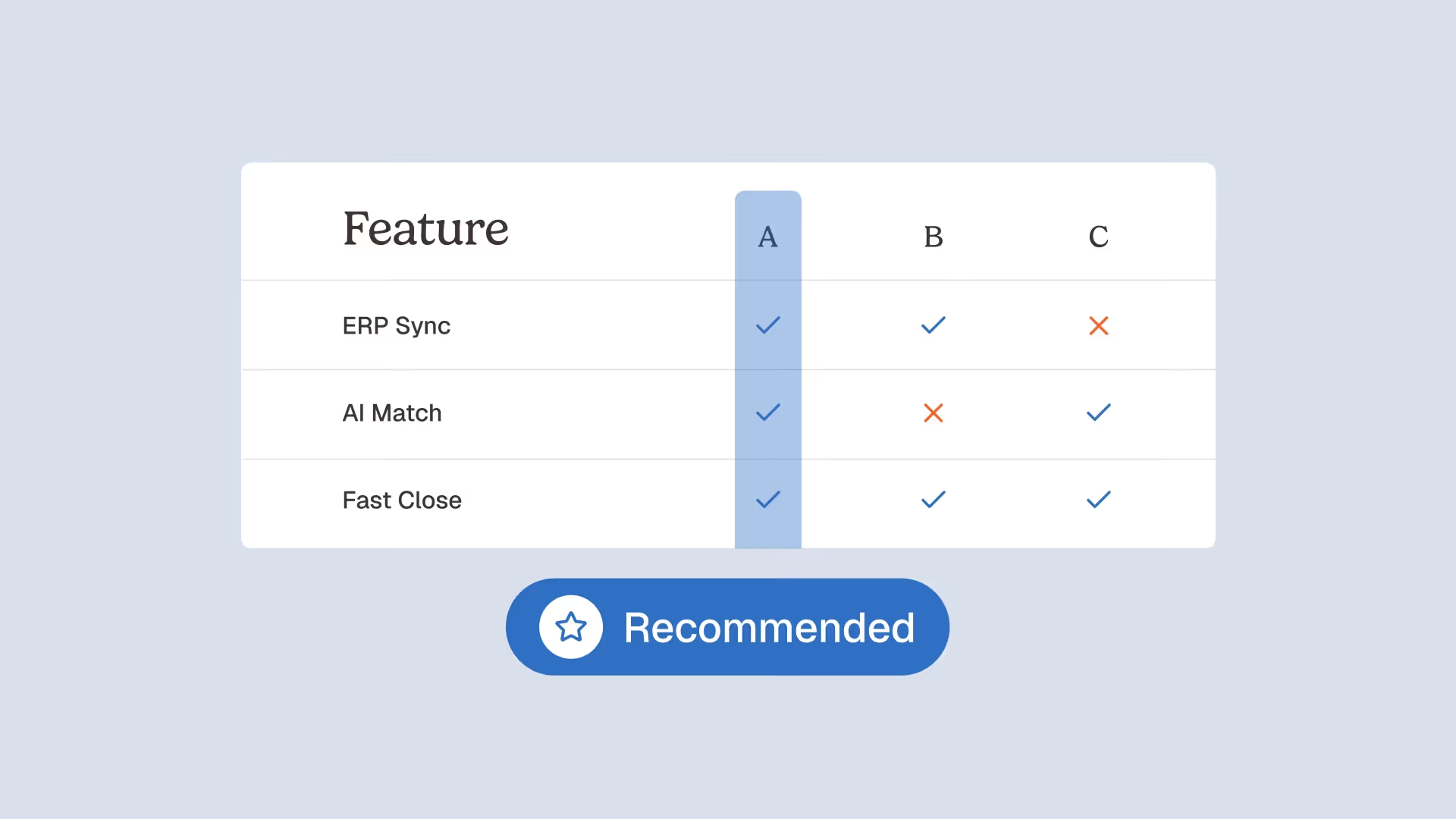
Most "top 10 financial close automation software" guides answer the wrong question. They give you a feature checklist, score every vendor against it, and crown a winner. The problem: the checklist treats every buyer as if they had the same need. They don't. A 14-site bakery group, a SaaS scale-up, a 500-FTE manufacturer, and a multi-entity holding all need fundamentally different things from a close platform.
The market itself is fragmenting in 2026. Industry reviewers like ChatFin and Maxima.ai report that close automation reduces close time by 50% on average, with implementation timelines ranging from 2–4 weeks (FloQast) to 3–6 months (BlackLine, OneStream). The same feature ("automated reconciliation") means very different things at Trintech, HighRadius, ChatFin, and Phacet. The marketing language overlaps; the architectures don't.
This article gives you the four architectural questions to answer about your own situation before you compare a single vendor, the four buyer segments those questions define, the vendors that genuinely fit each segment, and the evaluation method to confirm the fit before signing.
Why feature comparison fails
Pick five vendor pages at random in this category. You will find the same dozen features listed everywhere: automated reconciliation, journal entry automation, close checklist, variance analysis, audit trail, multi-entity consolidation, AI-assisted review, ERP integration. Each vendor highlights the same surface promises with slightly different word choices.
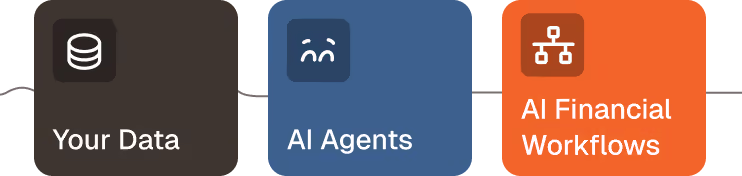
The architectures diverge because the underlying philosophy is different. A close management platform organizes the work and tracks who does what. A close execution platform does parts of the work itself. A close orchestration platform coordinates the chain of events end to end. An agentic close platform restructures the upstream work so the close-day work shrinks. These are four different products solving four different versions of the close problem, and a feature checklist hides the difference.
The 4 architectural questions to answer first
Before you open a single vendor page, answer the following four questions about your close. The answers will narrow the market from "all 20 vendors" to "the 3 or 4 that actually fit your situation."
Question 1: is your close bottleneck coordination, or is it execution?
Coordination bottleneck: you have multiple controllers, each owning part of the close, and the friction is "who is doing what, when, and what's blocked." The work itself is well understood. The issue is visibility and accountability across the team.
Execution bottleneck: the close drags because the actual reconciliation work is slow. Transactions don't match. Journal entries take hours to prepare. Bank statements pile up. The team is doing the work, but the work itself is the cost driver.
The first segment needs a close management tool (FloQast, Numeric, Adra). The second needs a close automation tool (BlackLine, Trintech, HighRadius). The third, growing rapidly in 2026, needs an agentic close tool (ChatFin, Phacet).
Question 2: are you closing inside one ERP, or across many systems?
Single-ERP close: all of your close-relevant data lives in one ERP (SAP, Oracle, NetSuite, Sage). The reconciliations are mostly intra-system.
Cross-system close: your close-relevant data is spread across the ERP, the bank, the AP system, the expense tool, the payroll system, the billing platform, multiple operational systems.
This is the architectural reason Phacet operates as a layer over the existing finance stack rather than inside an ERP. A migration to a new ERP costs hundreds of thousands of euros. An orchestration layer across the existing stack costs an order of magnitude less and ships in weeks. See our agentic platform glossary entry.
Question 3: are you compressing a sprint, or eliminating it?
Compressing the sprint: you want to run the same close-week work faster. The 30-day backlog still hits J+0, and the goal is to chew through it in 5 days instead of 10.
Eliminating the sprint: you want the close-day work to be minimal because the reconciliations, accruals, and exception flagging happened during the period. The goal is not a faster sprint, it's less sprint to run.
The teams that hit J+5 are almost always in the second segment. The teams that hit J+8 to J+10 are usually in the first. See our shorten month-end close analysis.
Question 4: how many entities, how much intercompany, and how clean is the chart of accounts?
Single entity, clean chart: one legal entity, one currency, no intercompany flows, a chart of accounts that hasn't drifted in years. The close is conceptually simple.
Multi-entity, intercompany-heavy, drifting chart: several entities, currencies that need translation, intercompany flows across legs, a chart of accounts that has accumulated drift over years of M&A and reorganization.
A single-entity team buying OneStream pays for consolidation capability it doesn't use. A multi-entity team buying FloQast hits a wall on the intercompany work FloQast doesn't really handle.
The 4 buyer segments defined by those questions
Segment A: mid-market, single ERP, coordination focus
Profile: 100–500 FTEs, one ERP (often NetSuite or Sage Intacct), one or two legal entities, close that runs 8–12 days because of coordination friction more than execution friction.
What fits: FloQast (best-in-class close management UX, fastest implementation), Numeric (lighter-weight alternative), Adra (Trintech's mid-market line).
What doesn't fit: enterprise suites like BlackLine or OneStream (overkill, multi-month implementation). Pure execution tools like HighRadius if the actual bottleneck is coordination.
Expected close timeline after implementation: J+6 to J+8, mostly through better orchestration.
Segment B: enterprise, intercompany-heavy, multi-entity
Profile: 1,000+ FTEs, multiple legal entities, multiple ERPs, currency translation, complex intercompany flows.
What fits: BlackLine (the incumbent, strong on reconciliation depth and audit trails), OneStream (best when consolidation is the primary problem), Workiva (best when the last-mile is statutory reporting), Trintech Cadency (best when risk-based governance is the primary concern).
What doesn't fit: mid-market close management tools (insufficient consolidation depth). Lightweight agentic tools without the multi-entity infrastructure.
Expected close timeline after implementation: J+5 to J+8, driven by consolidation efficiency and exception handling.
Segment C: mid-market, cross-system, execution bottleneck
Profile: 50–500 FTEs, multiple entities or sites, finance data spread across ERP / bank / AP / payroll / billing systems. The close drags because the cross-system reconciliation work is slow and the team is small.
What fits: agentic close platforms (Phacet, ChatFin, Vic.ai) that restructure the upstream work so the cross-system reconciliation happens continuously. Phacet operates as an orchestration layer across the existing stack. Typical first deployments include the bank reconciliation agent and the intercompany reconciliation agent.
What doesn't fit: enterprise suites (too expensive, too slow to implement). ERP-native modules (can't reach across the stack). Pure close management tools (don't address the execution gap).
Expected close timeline after implementation: J+3 to J+5 if the seven shifts from the continuous close model are implemented. First agent in production in under two weeks.
Segment D: multi-entity holding with reporting complexity
Profile: holding company structure, statutory reporting requirements across jurisdictions, M&A activity, SEC or AMF filing obligations.
What fits: Workiva (connected reporting from GL to statutory output), OneStream (unified consolidation and reporting), Trintech Cadency for risk-based governance.
What doesn't fit: mid-market tools, ERP-native modules, lightweight agentic tools without statutory reporting integration.
Expected close timeline after implementation: depends more on filing deadlines than on close mechanics. The lever is the GL-to-statutory pipeline, not the reconciliation pace.
A side-by-side comparison that makes the architectural difference visible
Once you know your segment, the comparison becomes useful rather than overwhelming. The table below maps the major vendors against the four architectural dimensions.
| Vendor | Primary architecture | Sweet spot | Implementation timeline | Where it falls short |
|---|---|---|---|---|
| BlackLine | Close execution (reconciliation + workflow) | Enterprise, deep AP reconciliation, audit-heavy | 3–6 months | Limited cross-system orchestration outside the close itself |
| FloQast | Close management (coordination + UX) | Mid-market, NetSuite-centric, fast rollout | 2–4 weeks | Leaves execution work largely in spreadsheets |
| HighRadius | Close automation (R2R, reconciliation) | Mid-to-large, AP-heavy, AI-forward stack | 2–4 months | Strong on R2R, less on the rest of the close |
| Trintech (Adra / Cadency) | Risk-based close execution | Adra: mid-market. Cadency: enterprise with governance pressure | 1–3 months (Adra), 4–6 months (Cadency) | Governance-first, less focus on speed of close |
| OneStream | Unified consolidation + close | Multi-entity, M&A-active, complex consolidation | 4–6 months | Suite breadth, not close-day speed |
| Workiva | Connected reporting (GL to statutory) | Multi-entity, SEC/AMF filing, audit-heavy | 3–6 months | Strong downstream, lighter upstream |
| ChatFin | Agentic close (continuous reconciliation) | Mid-market, cross-system, willing to adopt agentic ops | 1–3 months | New market, smaller deployment base |
| DOKKA | Close management with AP linkage | Mid-market with AP upstream consolidation | 2–4 weeks | Light on consolidation and intercompany |
| Numeric | Close management (modern UX) | Mid-market, NetSuite-centric, modern team | 2–4 weeks | Coordination-focused, not execution |
| Phacet | Agentic platform (40+ specialized agents, including close-relevant ones) | Mid-market multi-site, cross-system, continuous-close target | Under 2 weeks for first agent | Newer entrant in the close-specific market |
Two vendor categories are particularly easy to miscategorize. ChatFin and Phacet are both agentic platforms, but ChatFin is positioned as a close-automation specialist, while Phacet is a broader catalog of 40+ AI finance agents where close-related agents are a subset. HighRadius and BlackLine are both enterprise platforms, but HighRadius leans more agentic with its LiveCube approach, while BlackLine remains more workflow-orchestrated.
A 4-step evaluation method that replaces "watch the demo"
Once you've narrowed the market to 3 to 5 vendors in your segment, the standard process (book a demo, watch the slides, ask about pricing) is the wrong one. The demo shows the polished surface. It does not test whether the platform works on your data.
Not your average tasks, your hardest. The ones that always push the timeline. For most multi-entity teams, that's intercompany reconciliation and accruals validation. For multi-site retail or hospitality, it's cost-center coding and supplier reconciliation. Write them down. The vendor evaluation rides on those two tasks, not on the demo flow. See also: pre-close validation and continuous close control.
Not the vendor's sample data, your own. Most vendors offer a pilot environment. Use it to run your two hard tasks against the platform. Skip the showcase features. Test the boring, painful ones. If the vendor can't handle a 2-week pilot on your data, that itself is a signal.
Ask the vendor to open any reconciliation decision and show you: (a) the inputs the system considered, (b) the matching logic that ran, (c) the confidence score, (d) the timestamp, (e) the user (or agent) that approved it. The platforms that produce a native audit trail will surface this in seconds. The ones that don't will scramble.
Ask the vendor where the system stops and the human starts. What confidence threshold triggers a human review? What happens to a rejected match? Who owns the exception? Vendors that have thought this through will answer concretely. Vendors that pitch full autonomy as the goal usually have not thought it through.
What production looks like across three real customers
The French Bastards
A Parisian artisanal bakery group that doubled its boutique count from 7 to 14 sites without adding finance headcount. Their close challenge was Segment C: multi-site, cross-system, execution bottleneck. Each new boutique added another cost center to reconcile, another POS feed to integrate, another supplier set to onboard. A close management tool would have organized the chaos. An agentic platform restructured the upstream work so the close-day chaos shrank.
"On voit Phacet comme un vrai partenaire. Vous nous poussez des idées auxquelles je n'aurais pas pensé." - Marie-Céline, Head of Finance
La Nouvelle Garde
A group of 10 Parisian brasseries that eliminated roughly 1,800 manual operations per year and intercepted 28,000€ of attempted fraud, while reducing the time spent in Gmail and Pennylane by 70%. Their close challenge was Segment C with an extra dimension: continuous controls (fraud detection) needed to run alongside continuous reconciliations. The agentic model handles both because every agent runs continuously and exposes its reasoning.
"Phacet est comme un membre de l'équipe, qui opère 24h/24." — Théo Richard, CFO
Astotel
18 Parisian hotels with continuous supplier billing variance checks. Their close challenge was also Segment C, with a strong vertical-specific layer. The supplier billing control agent recovered 5,000€ per year on a single supplier through line-by-line variance checks.
"Je gagne jusqu'à deux jours par mois, et je repère des erreurs que je n'aurais jamais vues seule." — Valérie, Directrice Achats
FAQ
What is financial close automation software?
Financial close automation software is the category of tools that reduce manual effort in the period-end close: reconciliation automation, journal entry auto-posting, variance analysis, checklist orchestration, audit trail. The category includes close management tools (FloQast, Numeric, Adra), close execution tools (BlackLine, Trintech, HighRadius), agentic platforms (Phacet, ChatFin, Vic.ai), and consolidation suites (OneStream, Workiva, Oracle EPM). Choosing the right one depends on what your specific bottleneck is.
How long does close automation software take to implement?
Implementation timelines vary widely. Lightweight close management tools like FloQast and Numeric typically go live in 2–4 weeks. Mid-market execution tools (Adra, HighRadius for narrow scope) take 1–3 months. Enterprise suites (BlackLine, OneStream, Trintech Cadency) take 3–6 months. Agentic platforms with a per-agent model (Phacet) deploy the first agent in under two weeks, with the full close-impacting set in one to three quarters. The longer timelines correlate with broader scope and more integration complexity, not necessarily with better outcomes.
What's the difference between close management and close automation?
Close management tools (FloQast, Numeric, Adra) coordinate the close work: who is doing what, what's due when, what's blocked. They organize execution but leave most preparation in spreadsheets. Close automation tools (BlackLine, Trintech, HighRadius) automate parts of the actual close work: reconciliation matching, journal entry posting, variance analysis. The right tool depends on whether your bottleneck is coordination or execution.
How does agentic close automation differ from traditional close automation?
Traditional close automation runs the same close-day work faster. Agentic close automation restructures the upstream work so it happens continuously through the period, leaving close-day with a minimal backlog. Traditional close automation typically reaches J+8 to J+10; agentic close automation can reach J+3 to J+5. See our month-end close risks analysis.
Should we choose ERP-native modules or a separate close platform?
ERP-native modules work best when most of your close-relevant data is already in the ERP and the close is largely intra-system. Separate close platforms work best when the close work involves multiple systems that the native module can't see across. A useful test: list the data sources your close depends on. If more than three are outside your main ERP, a separate close platform usually wins.
Are these tools regulated?
The tools themselves are not directly regulated as a category, but the close outputs they produce are. SOX, French Loi Sapin II, GAAP, IFRS, sector-specific accounting standards, and internal control frameworks all apply to the closed books regardless of which tool was used. The audit trail is what makes the close defensible. Vendors that don't produce a native audit trail become a problem in regulated contexts even if their feature page checks every other box.
The shortest test for whether a close automation evaluation is on track: ask the vendor not "what does your tool do?" but "what kind of close problem do you fit best?" The vendors with a clear answer are the ones with a real positioning.
The four architectural questions are the minimum filter. Answer them honestly and the market shrinks from 20 vendors to 3 or 4 that genuinely fit. Then run a 2-week pilot on your own data with your two hardest close tasks.
Phacet operates in Segment C: mid-market, cross-system, execution bottleneck, continuous-close target. The platform is a catalog of 40+ specialized AI agents, bank reconciliation, intercompany flows, accruals validation, and lettrage that run continuously rather than at close time. First agent in production in under two weeks.
The wrong tool kills a close. The right tool, chosen against the right diagnostic, makes the close a non-event.
Latest Resources
Unlock your AI potential
Go further with your financial workflows — with AI built around your needs.