Construction accounts payable: how to control subcontractor invoices across 4 dimensions construction ERPs treat in silos
Published on :
May 18, 2026

Nicolas Marchais is co-founder and CEO of Phacet. After seven years at Spendesk, he built Phacet as the agentic layer that orchestrates across ERP, banking and email systems. Reliable, auditable, cross-system, what he calls a Finance Workforce.

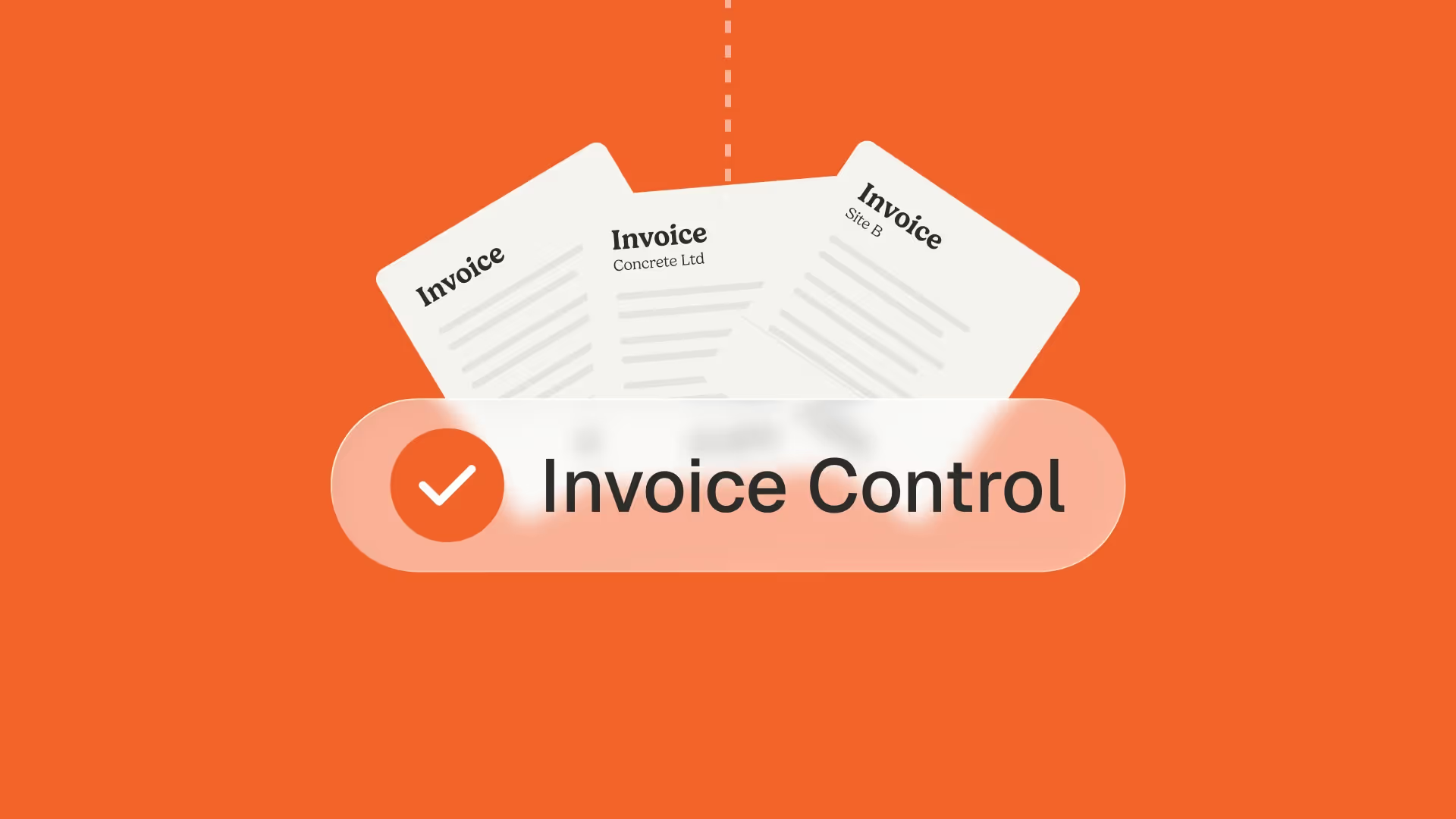
A subcontractor invoice in construction is not just an invoice. It is a financial document with retainage that must be calculated against the contract terms, a legal document with lien waiver implications, a tax document with autoliquidation or 1099 implications depending on jurisdiction, and a project document tied to a specific change order, RFI, or schedule-of-values line. Every one of those dimensions has to clear before payment, and every one of them is checked by a different person, in a different system, against a different reference. The construction AP bottleneck is not the volume of invoices. It is the convergence of those four checks on each one.
Construction ERPs (Foundation, Sage 300 CRE, Trimble Viewpoint Vista, CMiC, Procore) and point solutions (Stampli, GCPay, Planyard, Siteline) address pieces of the problem. Foundation handles retainage tracking and 1099 compliance. Sage 300 CRE handles AIA billing and certified payroll integration. GCPay specializes in pay applications and lien waivers. Stampli accelerates invoice approval workflows. Each tool solves real pain. None of them converge the four dimensions automatically. The controller still does that convergence by hand, invoice by invoice, on a screen that shows three of the four checks but never all four.
This article maps the four control dimensions that have to clear before a subcontractor invoice is paid, what fails inside the construction ERP and the point solutions when they handle pieces of these dimensions in isolation, and how an agentic orchestration layer makes the four checks converge automatically without forcing migration off the existing construction accounting stack.
Why construction AP is architecturally different from standard AP
Most B2B SaaS articles on accounts payable treat the topic generically: an invoice arrives, it gets coded, it gets matched to a PO, it gets approved, it gets paid. Construction AP looks deceptively similar from the outside. Underneath, four structural differences make the workflow harder.
Subcontract complexity beats supplier simplicity. A standard supplier relationship is governed by a single agreement, often a master services agreement plus pricing list. A subcontract is governed by the agreement plus the change orders plus the RFIs plus the schedule-of-values plus jurisdictional notice requirements plus prevailing wage obligations. Every invoice has to be checked against a moving reference, not a static one.
Payment is progressive and partial, not transactional. A standard invoice represents a discrete delivery. A subcontract invoice represents a percentage of completion against a defined scope, with retainage held back and released according to contract milestones. The controller has to confirm not "did we receive these goods?" but "did the contractor complete this much of this scope, and how much retainage stays on?"
Compliance documents have expiration dates and pay-stop logic. A subcontractor's Workers' Compensation, general liability, contractor license, and (in France) attestation de vigilance Urssaf all have expiration dates. If one expires, payment has to stop. Most construction ERPs track these dates in a vendor master, but the link to AP is rarely automatic, so payments routinely go out to subcontractors whose coverage has lapsed.
Lien risk is everywhere, and waivers are conditional. Every payment to a subcontractor without a corresponding lien waiver from that subcontractor (and their lower-tier subs) leaves lien exposure on the project. Conditional waivers, unconditional waivers, primary tier and lower tier, by job and by date: the documentation chain is its own workflow that runs parallel to AP and that has to clear before payment is safe.
Each of these four differences would justify a dedicated tool. The construction industry has built one for each. None of them converge.
The 4 control dimensions that have to clear before payment
Every subcontractor invoice should pass through four control layers before it is approved for payment. The four layers are independent in logic, but they have to converge on the same invoice.
Dimension 1: financial control (does the math hold?)
The first layer checks the financial integrity of the invoice itself. The invoiced amount has to match the percentage of completion claimed against the schedule of values. Retainage has to be calculated correctly (typically 5% to 10% in US contracts, 5% in France for marchés publics under the retenue de garantie regime). Tax must be applied correctly: standard VAT, autoliquidation under article 283 2 nonies CGI for subcontracting work in France, or sales tax with use-tax considerations in US states.
Failure mode: the construction ERP applies the retainage rule based on the subcontract setup, but if the subcontract was set up incorrectly (or amended verbally without a change order), the retainage is wrong. The math passes the ERP validation and fails the controller's mental check three steps later.
Convergence requirement: the financial check has to cross-reference the original subcontract, every change order, the most recent application for payment, and the current schedule of values, in one pass. Phacet's 3-way matching agent handles the structural matching, and the supplier billing control agent catches the line-by-line variance that ERPs miss when a subcontract has been amended.
Dimension 2: contractual control (does the invoice respect what was signed?)
The second layer checks the invoice against the contract. The subcontract specifies the unit rates, the labor categories, the equipment rates, the change-order pricing logic, and the penalty clauses for delays. Each line of the invoice has to map back to an element of the contract.
Failure mode: the contract is in a PDF, the invoice is in the ERP, and the matching is done by a project manager (not the controller) who knows the contract by memory. When the project manager rotates or leaves, the contractual knowledge leaves with them. Invoices then get approved against an implicit memory of the contract, not the contract itself.
Convergence requirement: the contract terms control agent reads the contract once, extracts the relevant clauses (unit rates, change-order rules, penalty structure, payment terms), and validates every subsequent invoice against the extracted clauses. The controller sees the contract reference next to the invoice line in contract intelligence view. Project manager knowledge is no longer the single point of failure.
Dimension 3: legal and fiscal control (does it clear regulatory requirements?)
The third layer checks the legal and fiscal compliance of the payment. In France, this includes the subcontractor's attestation de vigilance URSSAF (valid for 6 months from issue date), the attestation fiscale if the contract exceeds the regulatory threshold, and the subcontractor's declaration to the main contractor under the loi 75-1334 du 31 décembre 1975. In the US, this includes 1099 reporting compliance, certified payroll for prevailing wage projects, and state-specific contractor license validation.
Failure mode: the compliance documents are tracked in a vendor master with expiration dates, but the link from "this document expired yesterday" to "stop the payment that's about to go out" is often manual. The vendor master flags it, the AP team doesn't see the flag in their AP queue, and the payment goes out anyway.
Convergence requirement: the contract renewal deadline monitoring agent tracks every compliance document expiration and surfaces an alert in the AP workflow (not in a separate vendor master screen) when a subcontractor invoice arrives with an expired document. The check happens at payment time, not in a quarterly audit.
Dimension 4: documentary control (is the supporting file complete?)
The fourth layer checks that the supporting documentation file is complete. For a subcontractor invoice, this typically includes the BL chantier (delivery slip from the construction site, often signed by the site manager), the situation de travaux (statement of work completion), the lien waiver from the subcontractor for the previous payment, the lien waivers from any lower-tier subcontractors who worked under this sub, the proof of payment to those lower-tier subs (if applicable), and any specific permits or compliance attestations required by the project.
Failure mode: the documentation is collected by different people (site managers, project managers, AP clerks) into different folders (SharePoint, email attachments, the ERP document repository, paper files at the site office). The completeness check happens at the moment of approval, and missing documents trigger a back-and-forth that delays payment by days.
Convergence requirement: the documentary file completeness agent maintains a checklist per invoice type (regular subcontractor invoice, final invoice with retainage release, change-order invoice, mobilization invoice) and verifies that each required document is present before the invoice reaches the AP queue. Missing documents trigger an automated request to the responsible party, not a manual call from the controller.
What construction ERPs and point solutions actually solve (and don't)
A clear-eyed look at the market shows which tool addresses which of the four dimensions. The table below summarizes the coverage.
| Tool / Category | Dimension 1: Financial | Dimension 2: Contractual | Dimension 3: Legal/Fiscal | Dimension 4: Documentary |
|---|---|---|---|---|
| Foundation (construction ERP) | Strong (retainage, job costing) | Partial (subcontract setup, no contract reading) | Partial (vendor master tracking, manual link to AP) | Partial (document repository, no completeness verification) |
| Sage 300 CRE (construction ERP) | Strong (AIA billing, retainage) | Partial (subcontract management module) | Partial (1099 compliance, certified payroll) | Weak (document storage, no per-invoice checklist) |
| Trimble Viewpoint Vista (construction ERP) | Strong (job costing, commitments) | Partial (subcontract module) | Partial (compliance tracking) | Weak (no integrated checklist) |
| CMiC (construction ERP) | Strong (OCR + 2/3-way matching) | Partial | Partial | Partial (mobile approvals, OCR scanning) |
| GCPay (point solution) | Partial (pay applications) | Weak (no contract reading) | Weak (compliance docs not connected to pay) | Strong (lien waivers, compliance documents) |
| Stampli (point solution) | Partial (PO matching, AI extraction) | Weak | Weak | Weak |
| Planyard (point solution) | Strong (budget integration, OCR matching) | Partial (subcontract linkage) | Weak | Weak |
| Siteline (point solution, sub side) | Strong (pay apps for subcontractors) | N/A (sub side) | N/A | Strong (lien waivers, compliance) |
The pattern is clear: each tool solves one or two dimensions well and leaves the others to manual work or to integration with another tool. The convergence problem is not solved by any of them. It is solved by the controller, manually, on every invoice.
The architectural answer is an orchestration layer that runs the four checks together, not a new vertical-specific ERP that bundles them in a single product. Migrating from Sage 300 CRE or Foundation to a new platform costs hundreds of thousands of euros and 12 to 18 months. Adding an orchestration layer on top of the existing ERP takes weeks and one or two specialized agents per dimension.
How Phacet agents make the 4 dimensions converge
Each Phacet agent structures the input (extracts and normalizes the data from the invoice, the contract, the compliance documents), controls against a reference (the subcontract, the vendor master, the documentary checklist), and exposes its reasoning with a confidence score. Every step is timestamped in a native audit trail, which makes the construction AP workflow reliable, controllable, and auditable by design rather than as an afterthought.
The combination of agents for construction AP:
- The accounting inbox agent ingests every subcontractor invoice and routes it to the right project and the right cost center.
- The contract terms control agent reads the subcontract and validates each invoice line against the contracted rates and clauses.
- The 3-way matching agent matches the invoice against the schedule of values and the situation de travaux.
- The supplier billing control agent flags any line-item variance against the contracted unit rates.
- The documentary file completeness agent verifies that the BL chantier, the lien waiver, and any required attestations are present.
- The contract renewal monitoring agent blocks payment if any compliance document has expired.
- The fake IBAN fraud detection agent catches the supplier-impersonation fraud that is particularly prevalent on construction sites where subcontractors change banking details mid-project.
Each agent surfaces its results in Tables (a tabular view where each row is an invoice with its source documents, extracted contract clauses, validation outcomes per dimension, and any flagged exceptions). When an agent isn't certain, the AI Match component surfaces the proposed match with its reasoning so a controller can validate in the Vue Détail view. The agents do not replace the construction ERP. They sit between the subcontractor inbox and the ERP, doing the convergence work that the controller used to do manually, and routing only the genuine exceptions to human review.
The first agent goes into production in under two weeks. A meaningful coverage of the four dimensions typically takes one to two quarters, depending on the integration complexity and the cleanness of the subcontract repository at the start.
Where construction AP stalls without the convergence layer
Three signals reliably indicate a construction AP team operating without the convergence layer:
Senior controllers spend more time on AP than on project margin analysis. When the four-dimension check is done by hand on every invoice, the senior team gets pulled into transactional AP review instead of doing margin analysis on completed projects. This is the most common signal in mid-market construction businesses (50 to 500 ETP). The cost is not just the AP delay, it is the strategic work that doesn't happen.
Payment delays correlate with retainage release moments. If your subcontractor relationships get tense at retainage release (final invoice on a job), it is usually because the four-dimension check has accumulated unresolved exceptions that all surface together at the end. The convergence layer handles the exceptions one at a time, in flight, instead of letting them pile up to the final invoice.
The vendor master has more expired compliance documents than active ones. When compliance tracking is disconnected from AP, expired documents accumulate in the vendor master without anyone in AP knowing. A simple test: query the vendor master for compliance docs that expired more than 30 days ago and that the AP team is still actively paying. If the answer is more than 5% of active subcontractors, the documentary control dimension is broken.
These signals are diagnostics, not features. Solving them requires the four-dimension convergence to be automated, which requires the orchestration layer to be agentic. Rule-based RPA handles parts of dimension 1 and dimension 4. Generative AI assistants (Claude, ChatGPT, Dust) help with ad-hoc contract reading. Neither produces a native audit trail or runs continuously on every invoice. The agentic platform pattern combines both, with the audit trail and human-in-the-loop architecture that finance needs in production.
What production looks like across multi-site operations
While Phacet doesn't yet publish a named construction case study, the multi-site, multi-cost-center, exception-heavy pattern is the same one that runs in three production deployments illustrative of the architectural fit.
The French Bastards
A Parisian artisanal bakery group that doubled its boutique count from 7 to 14 sites without adding finance headcount. The pattern: every new site multiplies the AP volume by one, every new subcontract (in construction's case) multiplies it by one, every new compliance document expires on its own clock. The decoupling between site count and finance team size is exactly what a construction business needs as projects compound.
"On voit Phacet comme un vrai partenaire. Vous nous poussez des idées auxquelles je n'aurais pas pensé." -- Marie-Céline, Head of Finance
Astotel
Astotel operates across 18 Parisian hotels with continuous supplier billing variance checks on every invoice. The supplier billing control agent recovered 5,000 euros per year on a single supplier through line-by-line variance checks. The capability transfers directly to construction: line-by-line variance against a subcontract is structurally the same problem as line-by-line variance against a supplier contract.
"Je gagne jusqu'à deux jours par mois, et je repère des erreurs que je n'aurais jamais vues seule." -- Valérie, Directrice Achats
La Nouvelle Garde
A group of 10 Parisian brasseries that intercepted 28,000 euros of attempted fraud while reducing the time spent in Gmail and Pennylane by 70%. Construction sites are a particularly fertile ground for fake-IBAN fraud: subcontractors send "updated bank details" mid-project, and the urgency of the construction schedule reduces the controller's verification time. The same fraud detection logic applies with even higher stakes.
"Phacet est comme un membre de l'équipe, qui opère 24h/24." -- Théo Richard, CFO
FAQ
What is construction accounts payable, exactly?
Construction accounts payable is the AP function for businesses that pay subcontractors, suppliers, and equipment vendors on construction projects. It differs from standard AP in four structural ways: progressive billing tied to schedule-of-values completion, retainage held back per contract, lien waiver and compliance documentation requirements, and project-specific tax rules (autoliquidation in France for subcontracting, 1099 in the US for unincorporated subs). The combination makes construction AP one of the most operationally complex AP functions in any industry.
Why doesn't a construction ERP solve subcontractor invoice control by itself?
Construction ERPs (Foundation, Sage 300 CRE, Trimble Viewpoint Vista, CMiC) handle the financial dimension well (retainage, job costing, schedule of values) and the documentary dimension partially (document repositories without per-invoice completeness verification). They handle the contractual dimension only at the subcontract setup level, not at the per-invoice validation level. They handle the legal/fiscal dimension by storing expiration dates in a vendor master, not by blocking payment in the AP queue when a document expires. The convergence of the four dimensions on each invoice is still manual, even with a best-in-class construction ERP.
What's the difference between an AP point solution and an orchestration layer?
AP point solutions (Stampli, Planyard, GCPay, Siteline) automate one slice of the construction AP problem: pay applications, lien waivers, OCR extraction, approval workflows. They are valuable on their own slice. An orchestration layer (Phacet's 40+ specialized AI agents include the construction-relevant ones) sits on top of the existing ERP and runs the convergence work across the four dimensions, without replacing the ERP. The two are complementary: the point solutions excel on their slice, the orchestration layer makes the slices converge.
How does this work with retainage and lien waivers specifically?
For retainage, the 3-way matching agent validates the retainage amount against the subcontract and the cumulative pay applications, and flags any deviation before the invoice reaches the ERP. For lien waivers, the documentary file completeness agent verifies that the conditional waiver for the previous payment and any required lower-tier waivers are attached, and blocks the AP queue if they aren't. The two checks run on every invoice, not just on retainage release or on final invoices.
What about French-specific regulations (URSSAF, autoliquidation, loi 75-1334)?
The contract renewal monitoring agent tracks the attestation de vigilance URSSAF expiration (renewed every 6 months) and blocks payment if it has lapsed. The contract terms control agent validates the autoliquidation TVA application under article 283 2 nonies CGI on each subcontracting invoice. The loi 75-1334 declaration of subcontracting to the main contractor is tracked as a documentary requirement in the completeness agent. The three checks run together on each subcontractor invoice before it leaves AP for ERP entry.
How long does it take to deploy this for a construction business?
The first agent (typically the accounting inbox agent for intake) is in production in under two weeks. The contract terms control agent and the supplier billing control agent take an additional two to four weeks each, depending on the cleanness of the existing subcontract repository. A full deployment covering all four control dimensions on every subcontractor invoice takes one to three quarters, depending on the entity count and the integration with the existing construction ERP.
The question "how do we control subcontractor invoices?" is really a question about how to make four control dimensions converge on the same invoice without manual review on every one. Construction ERPs do one or two dimensions well. Point solutions do one slice well. The convergence is done by the controller, manually, on every invoice. That is the bottleneck.
The architectural answer is an orchestration layer of agents that runs the four checks together, exposes its reasoning per check, captures the audit trail, and routes only the genuine exceptions to human review. The layer sits on top of the existing construction ERP, not in place of it, which avoids the migration cost and the 12-to-18-month switchover.
Phacet operates in this layer. The 40+ specialized AI agents include the construction-relevant ones: contract terms control, documentary file completeness, 3-way matching, supplier billing control, fake IBAN fraud detection, and compliance deadline monitoring. The first agent is in production in under two weeks.
Construction AP doesn't break because the volume is too high. It breaks because four independent checks have to converge on every invoice, and nothing in the current toolkit makes them converge. The orchestration layer is what closes that gap.
Latest Resources
Unlock your AI potential
Go further with your financial workflows — with AI built around your needs.