

Invoice fraud detection AI: how AI detects fraudulent invoices before payment approval
Published on :
April 27, 2026

Nicolas Marchais is co-founder and CEO of Phacet. After seven years at Spendesk, he built Phacet as the agentic layer that orchestrates across ERP, banking and email systems. Reliable, auditable, cross-system, what he calls a Finance Workforce.

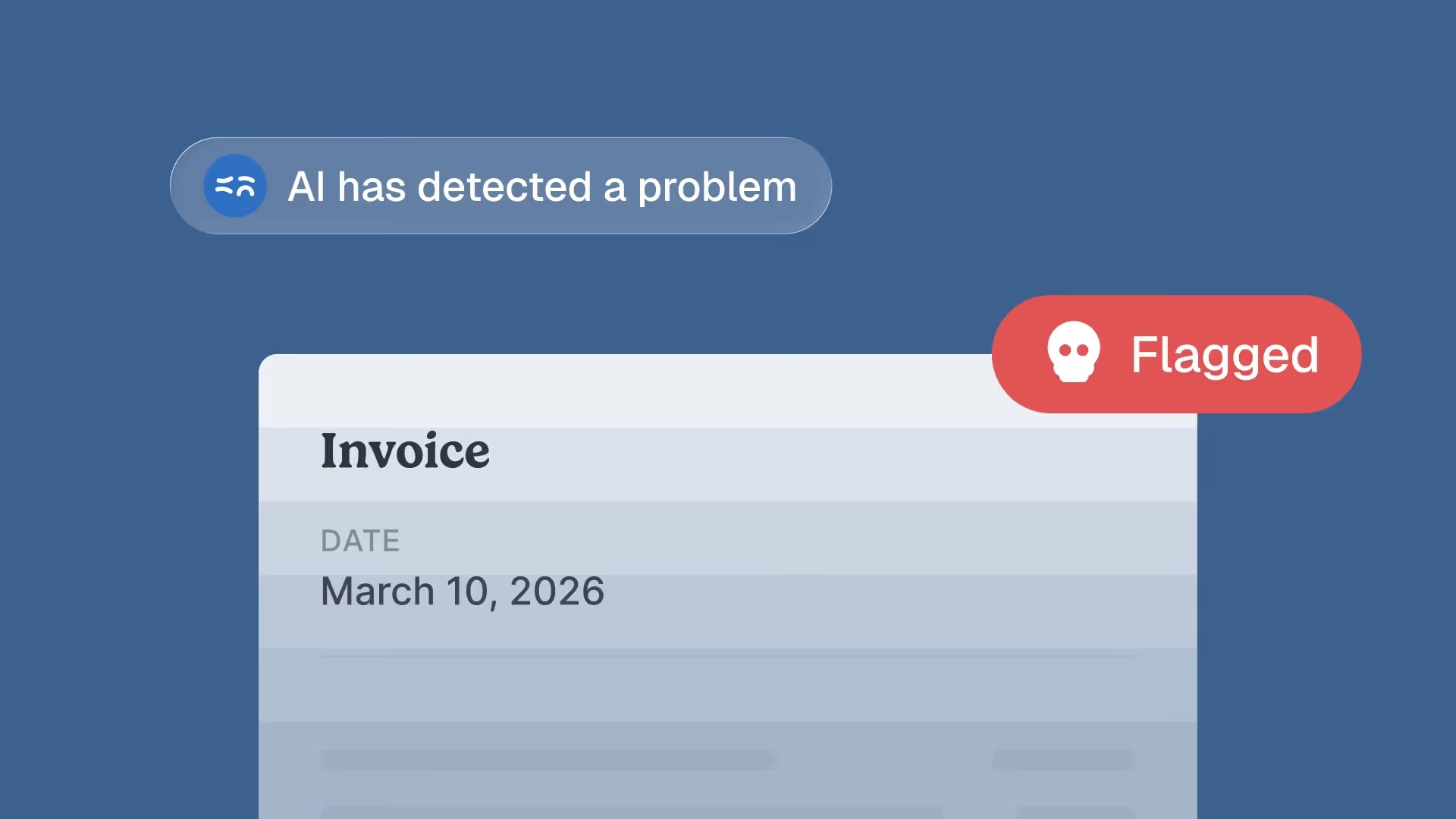
Invoice fraud is the fastest-growing category of business financial crime, and the one most likely to succeed precisely because the AP workflow it exploits was designed for efficiency, not adversarial conditions. The standard invoice approval process assumes that invoices arriving from known suppliers, referencing real transactions, for plausible amounts, should be paid. Fraudsters design their attacks to satisfy exactly those assumptions.
The result is a category of financial loss where the attack succeeds not because the controls failed but because the relevant controls were never triggered. A fraudulent invoice that convincingly mimics a legitimate supplier's format, references a real purchase order, and arrives at a plausible moment in the billing cycle will pass a standard approval workflow without generating a single alert.
AI-powered invoice fraud detection addresses this by extending the detection surface beyond what manual review can cover, applying checks that are impractical at human speed, across data dimensions that no individual reviewer has in view simultaneously. This article explains the five fraud patterns that AI detection specifically targets, why they bypass manual controls, and what the detection architecture must look like to catch them before payment is authorised.
Why invoice fraud succeeds against manual controls
Manual invoice approval works by plausibility: does this invoice look right? Is the supplier name familiar? Does the amount seem reasonable? Is the purchase order reference valid?
These are necessary checks. They are not sufficient. The specific failure of manual controls against invoice fraud is not that reviewers are careless, it is that the information required to detect the fraud is not present in the document the reviewer sees.
Three information gaps define what manual review cannot catch:
The payment destination gap.
An invoice shows a supplier name, a description, and an amount. The reviewer approves based on these visible fields. The bank account number to which payment will be directed is a separate field, often the last field in the payment run configuration, that the approving manager never sees. A Business Email Compromise (BEC) attack that changes the IBAN on a legitimate invoice is invisible to a manual approval process unless the reviewer specifically cross-references the IBAN against the supplier master record for every invoice they process. Almost no manual process does this consistently.
The population comparison gap.
Whether an invoice is a duplicate, either exact or modified to evade detection, is not visible in the invoice itself. It is only visible in the context of the full invoice population: all invoices from this supplier in this period, at this amount, with these line items. A manual reviewer who approves 50 invoices per day cannot simultaneously hold the full invoice history in mind to compare each new document against every previous one. Duplicate fraud exploits this cognitive limitation directly.
The behavioural anomaly gap.
Whether an invoice is statistically unusual, the first invoice from this supplier in six months, an amount that is three times the supplier's average invoice, a payment term that differs from this supplier's standard terms, requires comparison against historical baseline data that a manual reviewer doesn't have available during the approval review. This anomaly is only visible in the context of a reference population, which requires data analysis capabilities beyond what humans can apply in real time.
AI invoice fraud detection addresses all three gaps simultaneously. It applies population-level comparison for duplicate detection. It cross-references every payment destination against the supplier master. It applies statistical models that identify behavioural anomalies against the supplier's historical profile. And it does this for every invoice, every time, without the human attentional limits that fraud exploits.
5 invoice fraud patterns that AI detection targets
Pattern 1 - Business email compromise with modified payment details
The most financially damaging fraud pattern. A fraudster, either after compromising the supplier's email account or impersonating it convincingly, sends an invoice with modified bank account details. The invoice content (amount, description, PO reference, line items) is identical to a legitimate invoice the supplier would have sent. Only the IBAN or bank account number has been changed to a fraudulent account.
The attack is effective because it passes every content-based check: the supplier is real, the transaction is real, the amount is plausible, the PO reference is valid. The fraud is in the payment routing field, which a manual reviewer almost never cross-references against the master record during the approval review.
AI detection of BEC fraud requires a supplier master validation check applied to every invoice at the point of ingestion, before the invoice reaches the approval queue. The payment details on every incoming invoice are compared against the authorised payment details in the supplier master. Any mismatch, even a single digit difference in the IBAN, generates an immediate exception flagged as high-priority before the invoice progresses.
La Nouvelle Garde's €28,000 fraud interception was precisely this pattern: fraudulent invoices with modified IBANs that would have passed a standard approval review without pre-payment supplier master validation. The detection that saved €28,000 was not a special alert or an investigation, it was the routine IBAN comparison that ran on every invoice as part of the standard pre-payment control stack.
Pattern 2 - Near-duplicate invoices designed to evade ERP detection
ERP duplicate detection catches exact matches: the same invoice number from the same supplier. It does not catch near-duplicates, invoices that have been modified slightly to avoid triggering the exact match rule.
Common near-duplicate patterns: invoice number incremented by one digit (INV-1042 vs INV-1041 that was already paid), the same invoice amount with a different date, the same line items with a different invoice reference number, or an invoice that covers a period that overlaps with one already processed. Each of these passes standard ERP duplicate detection because the invoice number is different.
Near-duplicate detection requires population-level comparison: comparing the incoming invoice not just against "has this exact invoice number been processed?" but against the full invoice population from this supplier, across multiple dimensions simultaneously, amount, date, line items, PO reference, period covered.
AI near-duplicate detection applies this population comparison at ingestion, before the invoice reaches the approval queue. The Jinchan Group's 5x improvement in anomaly detection after deploying Phacet's pre-payment validation reflects this pattern, the near-duplicates that the ERP was systematically missing were being caught at the point of extraction, before posting occurred.
The 3-way matching agent applies this population-level duplicate detection as part of the pre-payment validation stack. For the technical detail on why 3-way matching alone doesn't catch near-duplicates, see the accounts payable controls article.
Pattern 3 - Fictitious supplier invoices for plausible services
An invoice for a service that the business might legitimately purchase, consulting, cleaning, IT support, logistics, from a supplier that exists in the master data (or very closely resembles one that does) but is not associated with an actual purchase. The invoice amount is below the approver's escalation threshold. The service description is generic enough to be plausible. The timing is consistent with the billing cycle.
This pattern targets organisations where a subset of transactions are approved on the approver's judgment alone, without matching against a purchase order. If no PO is required for services below a certain threshold, the approver's only check is "does this seem like something we'd buy from someone like this?", which a well-designed fictitious invoice satisfies.
Three-way match validation before approval approval is the primary control for this pattern. Pre-payment controls that require a confirmed PO and delivery record before any invoice can enter the approval queue eliminate the threshold exploit: if there is no PO, there is no approval. The 3-way matching agent implements this check at the pre-approval stage, routing invoices without confirmed PO and delivery records to an exception path rather than the standard approval workflow.
AI adds a second detection layer for this pattern: statistical anomaly detection that identifies when an invoice from a known supplier is statistically unusual relative to that supplier's historical profile. An invoice from "Acme Consulting" that is five times larger than any previous Acme Consulting invoice, or arrives in a period when no project with Acme is active in the procurement system, is a statistical anomaly that warrants escalation even if the three-way match check was somehow satisfied.
Pattern 4 - Insider-facilitated fraud using legitimate credentials
Not all invoice fraud is external. Insider-facilitated fraud, where an employee with access to the payment system creates or approves fraudulent invoices, exploits access rights rather than external deception. The invoice passes all external validation checks because it was created using legitimate credentials and knowledge of internal processes.
AI detection of insider fraud applies behavioural pattern analysis to the approval workflow itself: who approved this invoice (and is this within their normal approval pattern?), what is the supplier's relationship history with the approver's department, does this invoice share characteristics with other invoices that have been approved by this person without escalation? These patterns require aggregated behavioural data across multiple dimensions, which AI can process continuously but which is impractical for any manual review process.
The explainable decision control principle is particularly important here: every automated detection that flags a potential insider pattern must produce a clear explanation of which specific characteristics triggered the flag, not just "anomaly detected" but "this invoice was approved by the same person who approved four other high-value invoices from this supplier in the last 60 days, all without escalation, all in a period when no active project with this supplier is registered in the procurement system." The explanation enables the human reviewer to assess the flag accurately rather than either dismissing it as a false positive or escalating it without sufficient context.
Pattern 5 - Overbilling and price inflation that mimics legitimate charging
The boundary between fraud and billing error is disputed territory in supplier relationships, but the financial impact is identical: the organisation pays more than it should. Whether the overbilling is intentional (a supplier systematically charging above the contracted rate on the assumption that price deviations below a threshold won't be checked) or accidental (a billing system applying an outdated price list), the detection mechanism is the same.
Price deviation detection at the line level — comparing each invoice line against the contracted rate for that product or service — identifies overbilling before payment. This requires the contracted rate reference to be structured and queryable, not buried in a PDF contract. The agent for extracting key terms from contracts at scale transforms contract documents into structured data that the price validation layer can query automatically: price per unit, volume discount thresholds, effective dates, all extracted and available for comparison at the point of invoice validation.
Systematic overbilling detection — identifying not just individual price deviations but patterns of systematic deviation from the same supplier — is where AI adds specific value beyond rule-based checking. A supplier with a 3% price deviation on line 2 of every invoice over a six-month period may not trigger any single-invoice alert, but the pattern across the population is a clear fraud or compliance signal. This kind of temporal pattern detection is what AI models do naturally and what no manual review process can apply at the required scale.
Vivason's €180,000 annual overcharge identification followed exactly this pattern: not a single large fraud, but a systematic billing deviation that compounded undetected across hundreds of invoices until population-level analysis made it visible.
What AI does that rule-based fraud detection cannot
Earlier invoice fraud detection systems were rule-based: define the patterns you know about, configure rules to detect them, alert on matches. This approach has two structural limitations that AI detection overcomes.
Rule-based systems only detect what the rules anticipate.
A rule that flags invoices with IBAN changes catches the BEC pattern where the IBAN is changed. It does not catch the BEC pattern where the sort code is unchanged but the account number is modified. It does not catch the pattern where the fraudster gradually migrates the IBAN over three invoices rather than changing it in a single step. Every rule can be bypassed by a variant the rule designer didn't anticipate, and fraudsters, by definition, iterate on patterns that bypass existing controls.
AI detection learns from the full data population rather than from a predefined rule library. When a new fraud pattern emerges, a variant of near-duplicate fraud that uses a different modification strategy, the AI model updates its anomaly detection based on what is statistically unusual relative to the baseline, not based on whether a specific rule was written to cover the new variant.
Rule-based systems produce binary outputs.
A rule either triggers or it doesn't. An invoice is flagged or it isn't. There is no mechanism for the detection system to communicate that invoice A is a medium-confidence anomaly that warrants investigation while invoice B is a high-confidence anomaly that should be blocked before the approver sees it.
AI detection produces confidence-scored outputs that enable tiered responses: high-confidence fraud indicators block the invoice before approval, medium-confidence anomalies surface for human review with the specific indicators highlighted, and low-confidence statistical anomalies are logged for pattern monitoring without generating an exception. This tiered response eliminates both the false-negative problem (fraud that passes all rules) and the false-positive problem (legitimate invoices blocked because they matched a rule that was too broad).
The exception-based finance review model that Phacet deploys applies this tiered response architecture: the approver receives a curated exception queue containing only the invoices that require genuine human judgment, with the specific fraud indicators pre-populated, rather than either a flood of rule-triggered alerts or no alerts at all.
The human-AI collaboration model in fraud detection
A critical design principle in AI invoice fraud detection is that AI is the detection layer, not the decision layer. The human approver makes every payment decision. The AI provides the evidence that makes the decision informed.
This distinction matters for two reasons.
False positives require human judgment.
AI fraud detection will flag some legitimate invoices, statistical anomalies that are genuinely unusual but not actually fraudulent, supplier master discrepancies caused by a bank change that was legitimately communicated but not yet processed. Allowing the AI to block payments autonomously would create operational disruption from false positives. Routing flags to human review with the specific anomaly highlighted allows the human to apply the contextual judgment that distinguishes a legitimate anomaly from a genuine threat.
Fraud decisions require accountability.
The decision to block a payment, and the decision to approve a payment despite a fraud flag, are decisions that require a human to take accountability for the outcome. An AI system that blocks payments without human sign-off, or that approves payments after clearing its own flag, creates accountability gaps that are both operationally and legally problematic.
The human-in-the-loop control model concentrates human review on the invoices that the AI has identified as requiring it, with the full detection context provided. The approver is not looking for fraud from scratch, they are confirming or overriding an AI determination that comes with specific, explainable evidence. This is both more efficient (review is concentrated on the relevant cases) and more reliable (the human decision is informed by detection capabilities they couldn't apply manually) than either fully manual review or fully autonomous AI decision-making.
The audit trail that Phacet's detection agents generate captures every detection flag, the specific evidence that triggered it, the human reviewer's determination, and the resolution outcome. This documentation serves two purposes: it is the evidence record for fraud cases that are escalated to internal investigation or law enforcement, and it is the feedback signal that improves the AI model's detection accuracy over time. Human corrections "this was a false positive because the bank change was legitimately communicated by email on this date", update the model's understanding of what legitimate anomalies look like for this supplier, reducing future false positives on the same pattern.
The 5 layers of AI invoice fraud detection
A comprehensive AI fraud detection stack applies five detection layers in sequence. Each layer catches a different category of fraud pattern; together, they cover the full attack surface of invoice fraud.
Layer 1 - Document authenticity checks.
At ingestion, every invoice is assessed for document integrity: does the document structure, metadata, and formatting match the supplier's historical document pattern? Fraudulent invoices frequently show tells in document metadata, creation date after the invoice date, PDF software that differs from the supplier's usual billing system, font variations that indicate template modification. AI document analysis catches these anomalies at the point of ingestion, before any content-based checks run.
Layer 2 - Supplier master payment validation.
Every invoice's payment details (IBAN, bank name, account number) are compared against the authorised payment record in the supplier master. Any mismatch generates a high-priority exception. This is the primary BEC detection layer, the payment destination check that manual review almost never applies systematically. The pre-decision control principle applies here: this check must run before the invoice reaches the approval queue, not as a payment-run validation.
Layer 3 - Population-level near-duplicate detection.
The incoming invoice is compared against the full invoice population from this supplier, across multiple dimensions: invoice number, amount, line items, date, period covered. Near-duplicates with any combination of matching dimensions are flagged with the specific match characteristics highlighted. This layer catches the duplicate fraud variants that ERP-level exact-match detection misses.
Layer 4 - Three-way match and PO validation.
The invoice is matched against the purchase order and delivery confirmation records. Invoices without a confirmed PO and delivery record generate an exception. Invoices with a PO mismatch (wrong price, wrong quantity, superseded order) generate a targeted exception identifying the specific discrepancy. This layer catches fictitious supplier invoices and invoicing errors simultaneously, both the fraud case and the billing error case produce the same three-way match failure and are routed through the same exception path.
Layer 5 - Behavioural and statistical anomaly detection.
The invoice is compared against the statistical profile of this supplier's historical invoicing pattern: typical invoice frequency, typical amount range, typical line item structure, typical payment terms. Invoices that deviate from the baseline in statistically significant ways, anomalous amounts, unusual timing, atypical line item combinations, are flagged with the specific anomaly characteristics identified. This layer catches the slow-burn systematic fraud (gradual IBAN migration, systematic overbilling) and the one-off unusual invoice that warrants investigation.
For the broader financial anomaly detection context, covering transaction patterns beyond AP invoices, see the financial anomaly detection AI article, which covers the pattern detection logic in detail.
FAQ
What is AI invoice fraud detection?
AI invoice fraud detection is the application of machine learning and pattern recognition to identify fraudulent invoices, those that request payment for transactions that are fictitious, duplicated, or modified to redirect funds to unauthorised accounts, before the payment decision is made. It applies detection checks that are impractical at human speed across the full invoice population: IBAN validation against supplier master records, near-duplicate comparison across the invoice history, three-way match verification against purchase orders and delivery records, and statistical anomaly scoring against the supplier's historical billing pattern.
What is the difference between invoice fraud and invoice error?
Invoice fraud is an intentional misrepresentation designed to cause the organisation to make a payment it would not have authorised if fully informed. Invoice error is an unintentional billing mistake, a wrong price, an incorrect quantity, a duplicate submission from a billing system glitch. The detection mechanisms for both are similar (price validation, duplicate detection, three-way matching), and the financial impact is identical. In practice, organisations benefit from a detection stack that catches both: the same controls that prevent fraud also prevent costly billing errors from passing to payment.
What is Business Email Compromise (BEC) and how does AI detect it?
Business Email Compromise (BEC) is a fraud attack where a fraudster impersonates a known supplier, either by compromising the supplier's email account or by sending from a lookalike domain, and requests payment of an invoice with modified bank account details. The invoice itself is convincingly formatted and references a real transaction. AI BEC detection cross-references the payment details on every incoming invoice against the authorised payment record in the supplier master. Any IBAN or bank account discrepancy generates an immediate high-priority exception before the invoice reaches the approval queue.
Why doesn't ERP duplicate detection catch all duplicate invoice fraud?
ERP duplicate detection matches exact invoice numbers from the same supplier. It does not match near-duplicates, invoices where the invoice number has been incremented by one digit, where the same amount appears with a different date, or where the same line items appear under a different reference. These near-duplicate variants are designed specifically to bypass ERP-level detection. AI near-duplicate detection compares incoming invoices against the full invoice population across multiple dimensions simultaneously, catching the variants that exact-match detection misses.
Does AI fraud detection produce too many false positives to be practical?
AI fraud detection that is tuned for the organisation's specific supplier relationships and invoice patterns produces false positive rates that are operationally manageable, typically 1-3% of invoice volume flagged for human review, of which a significant proportion are genuine anomalies warranting investigation. Tuning happens through the human-in-the-loop feedback loop: when a reviewer determines that a flag was a false positive, the specific reason is recorded and the model adjusts its baseline for that supplier pattern. The false positive rate typically decreases over the first four to six weeks of deployment as the model learns the organisation's legitimate anomaly patterns.
How does AI fraud detection integrate with existing AP approval workflows?
AI fraud detection operates as a pre-approval layer: every invoice is processed through the detection stack before it enters the approval queue. Invoices that pass all detection checks proceed to the standard approval workflow with a detection confirmation attached. Invoices with fraud indicators are either blocked (high-confidence fraud patterns) or routed to an exception queue (medium-confidence anomalies) before reaching the approver. The approver's workflow is unchanged for clean invoices; for flagged invoices, the approver receives the exception with the specific fraud indicators highlighted and the resolution options pre-populated.
The attack surface that manual controls cannot cover
Invoice fraud succeeds not because AP teams are negligent but because the attack surface of modern invoice fraud is wider than any manual control can cover. No individual reviewer can simultaneously hold the full invoice history, the supplier master payment records, the purchase order database, and the statistical baseline for 50 active suppliers, and apply all four to every invoice they process.
AI fraud detection closes this coverage gap by operating continuously, at full population scale, across all four detection dimensions simultaneously. It does not replace the human judgment that makes the final payment decision, it provides the evidence that makes that decision reliable.
The finance team that deploys AI fraud detection does not eliminate fraud risk entirely. Fraud evolves, and new attack patterns will continue to emerge. But it does eliminate the specific vulnerability that makes invoice fraud the fastest-growing category of business financial crime: the assumption that invoices arriving through known channels, from known suppliers, for plausible amounts, can be safely approved without systematic cross-referencing against the reference data that distinguishes a legitimate invoice from a well-designed attack.
Phacet's pre-payment fraud detection layer, supplier billing control, 3-way matching, accounting inbox validation, and payment extraction and verification, applies all five detection layers as an integrated pre-decision control stack, with human-in-the-loop control for every flagged exception and a complete audit trail for every invoice processed. Book a demo to see what AI fraud detection looks like applied to your invoice population.

Latest Resources

Unlock your AI potential
Go further with your financial workflows — with AI built around your needs.


