

How restaurant groups enforce mercuriale pricing before payment
Published on :
March 9, 2026

Nicolas Marchais is co-founder and CEO of Phacet. After seven years at Spendesk, he built Phacet as the agentic layer that orchestrates across ERP, banking and email systems. Reliable, auditable, cross-system, what he calls a Finance Workforce.


A fresh produce supplier issues a new price list every Monday. By Thursday, it has generated invoices for three or four deliveries to each of a restaurant group's locations. By the time those invoices reach accounting the following week, the question of which mercuriale rate was applicable to which delivery, and whether the invoiced price matched it, requires checking the delivery date against the correct weekly version of the price list, line by line, for every SKU billed.
Most restaurant finance teams do not do this check. Not because they do not understand that mercuriale pricing is the single largest source of supplier billing discrepancies in fresh produce purchasing, it is. They do not do it because the check is operationally impossible at scale without a system that captures, versions, and queries weekly price lists automatically.
A restaurant group sourcing fresh produce from six suppliers, each with weekly mercuriales, generates 312 weekly price list versions per year that need to be archived, dated, and matched to delivery dates before a single invoice can be validated. At ten locations, processing an average of 30 produce invoices per week per site, that is 300 invoice validation events per week requiring a dated mercuriale reference. No manual AP process handles this systematically. The discrepancies that result, typically 2 to 5% of produce invoice value, accumulate silently across 52 billing cycles before anyone quantifies them.
This article explains how mercuriale pricing enforcement works mechanically, why standard AP tools and ERP configurations cannot handle it, and how restaurant groups have built pre-payment validation that catches mercuriale discrepancies at invoice receipt, before cash moves.
What a mercuriale is and why it creates a unique compliance problem
A mercuriale is a weekly price list issued by fresh produce suppliers, fruit and vegetable wholesalers, fish markets, meat distributors, that reflects current market prices for each product in their catalogue. Unlike fixed-rate annual contracts, mercuriale pricing responds to supply and demand conditions: a late frost that damages tomato crops, a port disruption affecting avocado imports, a seasonal peak that drives up soft fruit prices. The price for a given SKU can change week over week, and in volatile seasons, the change can be material.
For a restaurant group, mercuriale-based suppliers represent a distinct purchasing category: high frequency, high exposure, and high variability. A restaurant sourcing fresh produce several times per week from a wholesaler is generating invoices that reference a different price schedule every seven days. The commercial relationship is often governed by a framework agreement, "we supply at mercuriale rates plus or minus an agreed percentage", but the actual rate applied to each delivery is the mercuriale in effect on the delivery date, not a single contracted number.
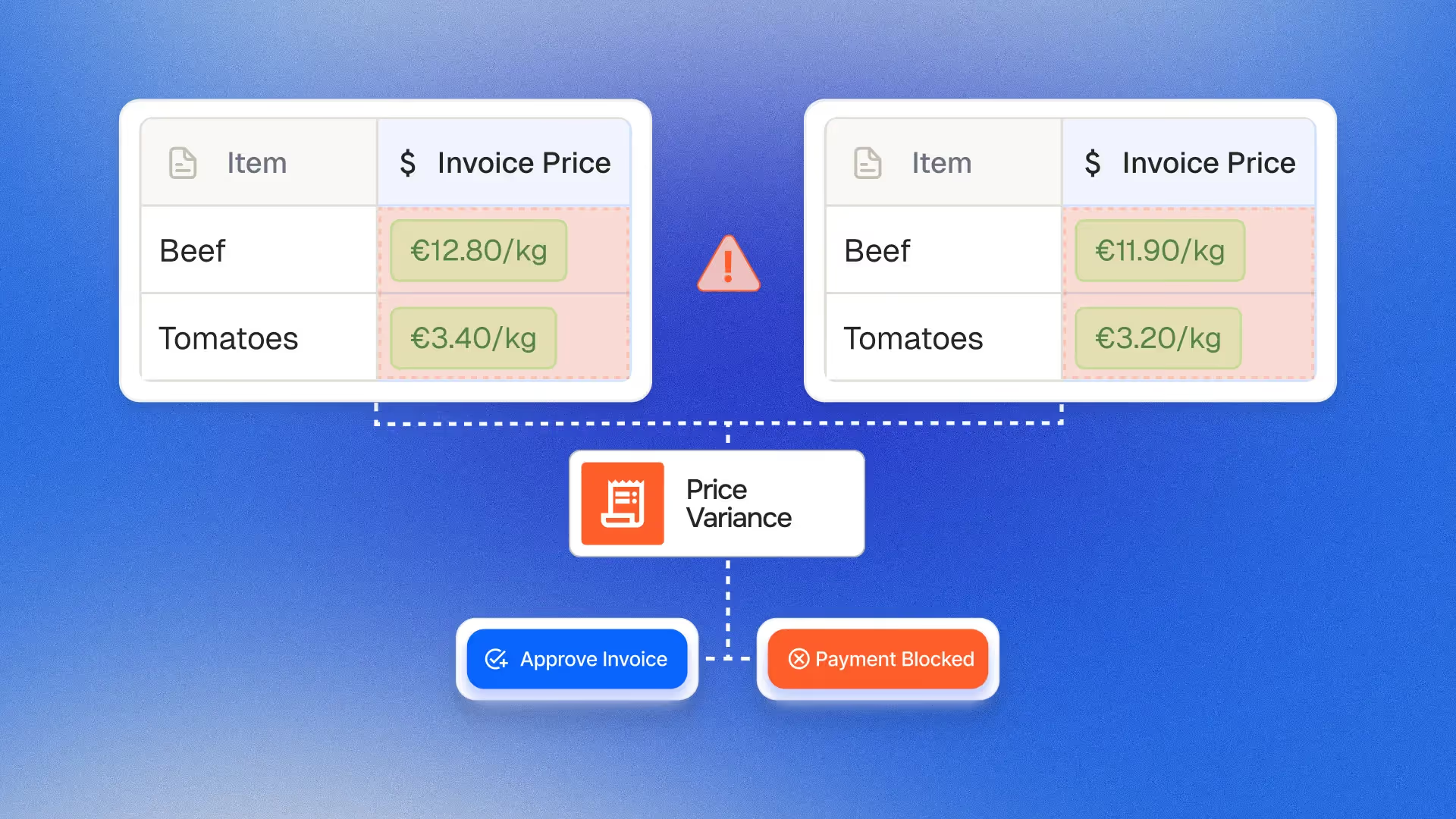
This creates a compliance problem that fixed-contract pricing does not. For a supplier billing at a contracted annual rate, the reference price is static: the finance team needs one data point to validate the invoice. For a mercuriale supplier, the reference price changes weekly, is valid only for a specific seven-day window, and must be matched to the exact delivery date of each invoice to determine whether the invoiced rate was correct. The validation is not harder in principle, it is harder because it requires dated versioning of reference data, not a simple lookup.
The version dating problem: which mercuriale applies?
The core technical challenge of mercuriale enforcement is version dating: establishing with precision which mercuriale was in effect on the date a delivery was made, and applying that specific version, not the current rate, not the annual average, to each invoice line.
The window mismatch risk
A produce supplier's mercuriale typically runs Monday to Sunday. Deliveries can occur any day of the week. An invoice generated on a Tuesday for a delivery made the previous Friday references the prior week's mercuriale, not the current one. If the supplier's billing system has already updated to the new week's rates, the invoice may be generated at the new rate rather than the rate applicable on the Friday delivery.
This is not necessarily fraud. It is a billing system timing error, the kind of error that systematically favours the supplier in rising price environments and systematically favours the buyer in falling price environments. In practice, invoice timing errors disproportionately produce overcharges, because suppliers are motivated to update their billing systems promptly when prices rise and less motivated to do so when prices fall.
The retroactive amendment problem
Suppliers occasionally issue amended mercuriales mid-week, a quality downgrade on a product arrival, a promotional adjustment for a volume commitment, an urgent correction to a pricing error. An amended mercuriale replaces the original for a subset of SKUs without invalidating the rest. The invoice that arrives after an amended mercuriale was issued needs to be validated against the amended version for the relevant SKUs and against the original for all others.
Without a system that captures both versions and tracks their amendment dates and affected SKU ranges, there is no way to apply the correct reference to a mixed invoice, the finance team either uses the original (potentially wrong for amended SKUs) or the amended version (potentially wrong for unamended SKUs). The error is small per invoice line but systematic across all invoices generated after the amendment.
The framework margin on top of the mercuriale
Most commercial relationships between restaurant groups and their produce suppliers are not raw mercuriale pricing, they include a negotiated adjustment on top of the weekly rate. A supplier might offer "mercuriale minus 3% for all purchases above €3,000/month" or "mercuriale plus €0.15/kg for premium quality grade." This margin sits on top of the mercuriale and compounds the versioning problem: the reference price for any given invoice is the applicable weekly mercuriale rate for that SKU, adjusted by the framework margin, for the correct delivery date.
Validating this requires not one reference data point per invoice line, but two: the dated mercuriale rate and the framework adjustment. If either is wrong, wrong week, wrong SKU mapping, wrong adjustment tier, the validation produces a false result. This is precisely the gap that pre-decision control at invoice receipt is designed to close, by applying both layers of the reference price automatically before any invoice advances to payment approval.
Why standard AP tools cannot handle mercuriale enforcement
The AP tools and ERP configurations that work adequately for fixed-rate supplier invoice validation fail on mercuriale pricing for structural reasons that cannot be worked around through configuration alone.
ERPs are not built for weekly reference data versioning
An ERP's supplier master data holds a price record for each supplier-SKU combination. Updating that record requires a data entry step, someone adds the new week's rate, the old rate is overwritten or archived in a dated record. At weekly cadence, with six produce suppliers each updating 200 to 500 SKUs per week, maintaining current mercuriale data in an ERP master requires 1,200 to 3,000 data entry operations per month before any invoice is validated. No AP team does this in practice.
The consequence is that ERP-level price checks on produce invoices are either disabled (because the reference data is not current) or run against stale reference prices that may be one to three mercuriale versions out of date. An invoice generated at this week's rate is flagged against last month's rate, producing false positive errors that train the team to dismiss the alerts, defeating the purpose of the check.
Sampling cannot cover mercuriale exposure windows
As discussed in our article on invoice sampling vs. 100% validation, produce invoice errors are not randomly distributed. They concentrate in predictable exposure windows: the Monday-to-Tuesday window when new mercuriales take effect and billing systems lag behind, mid-season price spikes where the gap between current and prior week rates is largest, and the end of month when reconciliation pressure increases invoice processing speed.
A 20% sampling rate applied randomly across produce invoices will capture these exposure windows approximately 20% of the time. A systematic check that runs on every invoice captures them at 100%. For produce billing, where discrepancies are small per invoice but recurrent across 52 weekly cycles per supplier, the difference between 20% and 100% coverage is the difference between partial mitigation and actual enforcement.
Manual spot-checking cannot match multi-SKU invoice complexity
A produce invoice from a major fresh wholesaler can contain 40 to 80 line items. Validating each line requires retrieving the correct mercuriale version, identifying the applicable SKU code in the supplier's nomenclature, applying the framework margin, and comparing to the invoiced unit price. A manual spot-check that checks five lines on a 60-line invoice and finds them correct provides false reassurance about the 55 unchecked lines, and the billing errors that occur most systematically are often on the low-value, high-frequency lines that spot-checkers skip in favour of the high-value items.
Jinchan Group's experience illustrates what systematic line-level validation reveals. Moving from manual review to automated validation multiplied their anomaly detection rate by 5x, not because new problems appeared, but because the problems that had always been present became consistently visible for the first time. Read the complete Jinchan case study for the operational detail.
Building a mercuriale enforcement system: the technical requirements
Effective pre-payment mercuriale enforcement requires three infrastructure components that standard AP tools do not provide and that cannot be substituted by manual process at scale.
Component 1 — Automated mercuriale capture and versioning
The reference data system must receive supplier price lists as they are issued, timestamp each version with its validity period, and archive previous versions without overwriting them. This means connecting to the channels through which mercuriales are delivered, typically email attachments in PDF or Excel format, and extracting the price data into a structured, queryable layer automatically.
The extraction needs to handle supplier-specific formatting: each produce wholesaler structures their price list differently, uses their own product codes, and organises categories according to their internal catalogue. Once extracted, the data must be mapped to the buyer's product reference to enable cross-supplier comparison and cost allocation by category.
The versioning logic must preserve each week's data independently, tagged with the start and end dates of its validity window. When an invoice arrives dated for a past delivery, the system retrieves the mercuriale that was active on that specific date, not the current week's data, not a rolling average, but the point-in-time price that was applicable when the goods changed hands. This is the data architecture that the supplier billing control agent at Phacet maintains for restaurant group clients.
Component 2 — Date-accurate invoice-to-mercuriale matching
With a versioned reference layer available, the matching engine needs to apply the correct mercuriale version to each invoice line based on the invoice's delivery date, not the invoice date, not the receipt date, but the delivery date, which is the legal reference point for the applicable price.
This requires reliable delivery date data. In restaurant environments where delivery notes are often handwritten and not digitised, the delivery date may need to be extracted from the invoice itself (where it appears as "livraison du" or similar), from a connected delivery management system, or from a digitised delivery note record. Phacet's human-in-the-loop validation model covers cases where the delivery date is ambiguous: the invoice is flagged for a human reviewer to confirm the correct date before the automated check runs, rather than applying a default that may be wrong.
For each line on each invoice, the matching engine retrieves the mercuriale unit price for that SKU on that delivery date, applies the framework margin from the supplier agreement, and computes the reference price. The comparison to the invoiced price produces a variance in both absolute value and percentage.
Component 3 — Tolerance calibration by product category
Not all produce categories warrant the same tolerance threshold. Fresh fish and seafood, where daily price movements can be significant and quality grading affects the applicable rate, may require tighter tolerances than dry produce or ambient goods. Exotic or seasonal fruits, where supply disruptions can justify rapid price adjustments, may need broader tolerance windows to avoid false positives during genuine market events.
Configuring tolerances by category, and adjusting them in response to observed false positive rates during calibration, is the step that makes the difference between a validation system that generates useful signals and one that generates noise. The goal is not to flag every invoice line that differs from the reference by any amount, but to flag lines where the deviation is outside what can be explained by legitimate rounding, quality adjustment, or timing variance. Most Phacet deployments for restaurant groups calibrate to below 5% false positive rates on produce invoices within three to four weeks of live operation, by combining a percentage tolerance (1 to 3% depending on category volatility) with an absolute minimum threshold (e.g., deviations below €0.50 per unit auto-approve regardless of percentage).
What mercuriale enforcement reveals: the seasonal exposure pattern
One of the most consistent findings when restaurant groups implement systematic mercuriale validation is the seasonal distribution of billing discrepancies. The exposure is not uniform across the year, it concentrates in predictable windows that correspond to produce market volatility cycles.
Spring and early summer see the highest discrepancy rates for soft fruits, salad leaves, and early-season vegetables. Price movements are rapid as first-harvest supply arrives and weather conditions affect quality and volume simultaneously. Invoice-to-mercuriale gaps of 4 to 8% are common in this window, and they generate the highest absolute overcharges of the year because purchase volumes are also elevated.
August and September create a second exposure window for Mediterranean produce categories, tomatoes, peppers, courgettes, where late-summer price corrections arrive quickly. A group that does not update its reference data in real time will be checking August invoices against July prices, when the gap between them may be 10 to 15% on some categories.
Year-end and January are the highest-risk period for dried goods and protein categories, where seasonal demand spikes and supply concentration create pricing conditions that mercuriale issuers update frequently. Restaurant groups that slow down finance operations over the holiday period are particularly exposed: the mercuriale reference data needs to continue updating even when the AP team is at reduced capacity.
For groups that use Phacet's margin tracking capabilities, the seasonal discrepancy pattern becomes visible as a cost pressure event rather than a random AP problem, allowing procurement to anticipate the high-exposure windows and engage suppliers proactively before the billing season begins, rather than discovering overcharges retrospectively in the following month's accounts. For a broader view of how invoice validation connects to food cost control across multiple locations, see our article on restaurant invoice validation for multi-location groups.
Implementing mercuriale enforcement: from first supplier to full coverage
Most restaurant groups implement mercuriale enforcement in two phases, a priority supplier phase covering the highest-exposure produce relationships, and a full-coverage phase extending to all mercuriale-based suppliers once the infrastructure is validated.
Phase 1 — Priority suppliers (weeks 1–3).
Select the two or three produce suppliers that represent the highest weekly billing volume and the most volatile price movements. Connect their delivery channels to Phacet's mercuriale capture layer and configure the SKU mapping for their catalogues. Begin running automated validation on their invoices, monitoring false positive rates, and calibrating tolerance thresholds by product category. By week three, most groups are achieving 95%+ automatic validation clearance on priority suppliers.
Phase 2 — Full produce coverage (weeks 4–8).
Extend the mercuriale capture and validation configuration to the remaining produce suppliers. Apply the tolerance calibration learnings from Phase 1 to accelerate the calibration period for subsequent suppliers. By the end of Phase 2, every produce invoice from every mercuriale-based supplier is validated automatically at receipt, before routing to the payment workflow.
The audit trail generated throughout the implementation records every validation decision, which mercuriale version was applied, what the computed reference price was, what the invoiced price was, and how the variance was classified. This documentation becomes the evidential base for supplier conversations about systematic billing discrepancies and provides the data for renegotiating framework margin terms at the next contract review.
La Nouvelle Garde implemented this validation architecture across its 14 restaurant locations, achieving full mercuriale enforcement coverage within weeks of deployment. The result was not just billing accuracy improvement, it was the creation of a live database of supplier pricing behaviour that the finance team had never previously had access to, enabling data-driven procurement decisions rather than relationship-based ones. The full La Nouvelle Garde case study covers the implementation timeline and the commercial conversations it enabled.
For groups operating within the hospitality sector more broadly, hotels with F&B operations, event venues, resort restaurants, the same mercuriale enforcement architecture applies to the produce purchasing relationship regardless of the operational context. Astotel deployed comparable controls across its multi-property portfolio and reduced overall supplier invoice error rates from 7% to 2%, including its produce supplier base. See the Astotel case study for the hospitality implementation perspective.
For more on how Phacet serves the food and beverage sector specifically, see the F&B automation industry page.
FAQ
What is a mercuriale in food purchasing?
A mercuriale is a weekly price list issued by fresh produce suppliers, typically fruit and vegetable wholesalers, fish suppliers, and meat distributors, that reflects current market rates for each product in their catalogue. Prices change week by week based on supply conditions, seasonality, and market demand. Restaurant groups and food service operators source from mercuriale-based suppliers under framework agreements that specify a relationship to the mercuriale rate (e.g., mercuriale minus 3%), with the actual invoiced price determined by the current week's list rather than a fixed annual contract.
Why is mercuriale pricing harder to validate than fixed-contract pricing?
Fixed-contract pricing requires one static reference point per supplier-SKU combination. Mercuriale pricing requires 52 reference points per year per supplier-SKU, one for each weekly price list version, and each must be correctly matched to the delivery date of each invoice. The validation is not harder in concept, but the data infrastructure required is fundamentally different: you need a system that captures, timestamps, and archives every weekly price list and retrieves the correct version for each delivery date automatically. Standard AP tools and ERP configurations do not provide this.
What is the typical financial exposure from mercuriale pricing discrepancies?
Based on Phacet client data across restaurant and food service groups, mercuriale billing discrepancies typically represent 2 to 5% of produce invoice value when first measured systematically. For a restaurant group spending €500,000 annually on fresh produce, that represents €10,000 to €25,000 in potential annual overcharges, most of which accumulate through small, recurring deviations rather than large individual errors. The exposure is highest during seasonal price volatility windows: spring (soft fruits, salad), August-September (Mediterranean produce), and year-end (proteins, dried goods).
How do you determine which mercuriale version applies to a specific invoice?
The applicable mercuriale version is determined by the delivery date, not the invoice date or receipt date. Most mercuriales run Monday to Sunday. An invoice for a delivery made on Friday references the mercuriale that was valid for that week, even if the invoice is generated and received the following week when a new mercuriale has taken effect. Reliable enforcement requires extracting the delivery date from the invoice or delivery note and matching it to the correct archived version of the supplier's price list. Where the delivery date is ambiguous, the document routes to human review rather than applying an assumed date.
How do tolerance thresholds work for mercuriale validation?
Tolerance thresholds define the acceptable variance between an invoiced price and the reference mercuriale rate before a flag is triggered. They are typically set as a combination of a percentage threshold (e.g., 1 to 3% of unit price) and an absolute minimum (e.g., €0.30 per unit), so that very small absolute deviations do not generate exceptions while meaningful overcharges are consistently flagged. Thresholds are configured per product category to reflect the different volatility characteristics of produce categories, tighter for stable-price items like condiments, broader for high-volatility categories like exotic fruits or premium seafood.
Can mercuriale enforcement work when suppliers use different price list formats?
Yes. Phacet's extraction layer processes price list documents in any format, structured Excel files, PDF tables, email-embedded tables, scanned documents, and maps the extracted data to a standardised internal reference structure. Supplier-specific SKU nomenclature is mapped to the buyer's product reference codes during initial configuration. Once the mapping is established for a given supplier, new weekly price lists are processed automatically without requiring manual reformatting or data entry.
What happens when a supplier issues an amended mercuriale mid-week?
Amended mercuriales are captured and processed as supplementary versions covering their specific effective dates and the affected SKU range. The system maintains both the original and the amended version, tagging each with its validity period. When an invoice is validated, the system applies the amended version for SKUs that fall within the amendment's scope and dates, and the original version for all other SKUs on the same invoice. The validation outcome and the specific version applied are recorded in the audit trail for each line.
How does mercuriale enforcement connect to food cost reporting?
Validated mercuriale invoice data is the prerequisite for reliable food cost reporting at the category level. When each produce invoice has been checked against the correct dated reference price and discrepancies resolved before payment, the cost data that flows into food cost reports reflects actual contract-compliant purchasing costs rather than whatever the supplier invoiced. This eliminates the noise that uncontrolled billing discrepancies introduce into food cost percentages, making the reported cost figure a genuine management metric rather than an approximation affected by billing variability.
From weekly price lists to controlled food costs
Mercuriale pricing is not an edge case in restaurant purchasing. It is the standard pricing model for the product category that drives the highest food cost variability, fresh produce. And it is the category where systematic enforcement is hardest to build manually, because the reference data changes every seven days across every supplier relationship simultaneously.
The finance teams that enforce mercuriale pricing before payment are not those with the most experienced accountants or the most rigorous spot-checking procedures. They are the ones that built a data infrastructure that receives weekly price lists automatically, archives them with correct version dates, and applies the right reference to every invoice line at the moment the invoice arrives, before any payment is approved, before any discrepancy compounds into a second billing cycle.
That infrastructure is what Phacet delivers for restaurant and food service groups: automated mercuriale capture, dated versioning, line-level comparison, and exception-based resolution, so that every produce invoice is validated against the price that was actually in effect on the day the goods were delivered, not whatever rate the supplier's billing system happened to apply. Book a demo to see how mercuriale enforcement works across your supplier base and location structure.


Latest Resources

Unlock your AI potential
Go further with your financial workflows — with AI built around your needs.


