

AR automation: a step toward financial intelligence
Published on :
January 19, 2026

Nicolas Marchais is co-founder and CEO of Phacet. After seven years at Spendesk, he built Phacet as the agentic layer that orchestrates across ERP, banking and email systems. Reliable, auditable, cross-system, what he calls a Finance Workforce.


The essential takeaway: Automating accounts receivable transforms finance teams into strategic partners by centralizing and automating invoice-to-cash workflows. It dramatically reduces DSO (up to 25% with AI) and operational costs while enhancing cash flow predictability. Eliminating manual errors and providing real-time visibility enables data-driven decisions, strengthens customer relationships, and establishes a foundation for financial intelligence by transforming transactional tasks into strategic assets.
Struggling with slow payments and error-prone manual invoicing? Accounts receivable automation isn’t just about efficiency, it’s about reclaiming cash flow and transforming finance teams into strategic powerhouses. Discover how smart platforms centralize and automate workflows to cut DSO by up to 25%, slash operational costs by half, and unlock AI-driven insights that turn receivables into a competitive advantage, without adding complexity. Imagine eliminating manual errors, accelerating cash application through intelligent matching, and gaining real-time visibility into every transaction. These systems adapt to customer preferences, ensure compliance across regions, and evolve with supervised automation, turning tedious tasks into strategic opportunities while keeping human oversight intact.
- Why accounts receivable automation is critical for modern finance teams
- What is accounts receivable automation?
- The hidden costs of manual AR workflows
- From invoice creation to payment reconciliation: how automation works
- The measurable impact of AR automation
- The role of AI agents: moving beyond simple automation
- Real-world use case: how AI agents automate client payment reconciliation
- AR automation as a step toward full financial intelligence
Why accounts receivable automation is critical for modern finance teams
The shift from manual processes to strategic finance
Finance teams are no longer confined to transactional tasks. Manual accounts receivable (AR) workflows, riddled with late payments, human errors, and fragmented data, consume 60% of their time, leaving little room for strategic analysis. This reactive approach directly impacts cash flow predictability, a top priority for CFOs today.
Phacet’s AI reconciliation agents transform this paradigm. By automating invoice matching, payment tracking, and reconciliation, teams shift from error-prone manual work to proactive financial leadership. This evolution isn’t just about efficiency; it’s about redefining finance as a strategic partner that drives decisions, optimizes working capital, and ensures audit-ready transparency.
The growing importance of cash flow predictability
In volatile markets, 72% of CFOs cite cash flow visibility as a critical risk. Manual AR processes create blind spots, delaying insights into payment patterns and liquidity gaps. Automation eliminates these gaps by centralizing data and applying real-time analytics, reducing Days Sales Outstanding (DSO) by up to 25%.
Phacet’s solution goes beyond basic automation. Its AI agents detect partial payments, flag late transactions, and maintain full traceability, ensuring every action remains audit-proof. Human validation layers add control, turning AR into a dynamic tool for financial intelligence. This approach aligns with the evolution of accounting automation, where supervised AI bridges operational rigor and strategic foresight.
What is accounts receivable automation?
Moving beyond traditional AR management
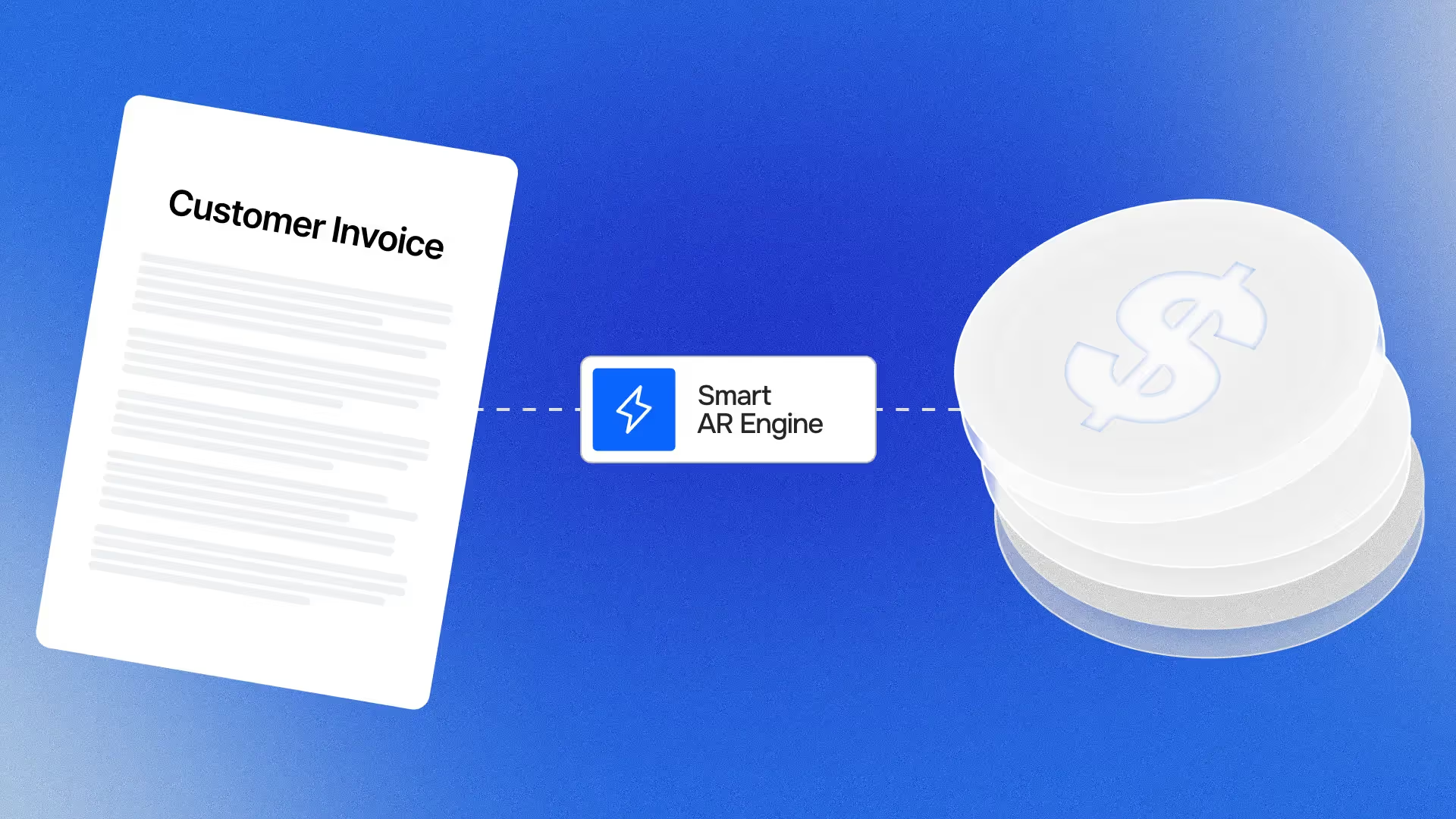
Accounts receivable automation replaces manual workflows with AI-driven systems that streamline the invoice-to-cash cycle. Unlike paper-based or spreadsheet-dependent methods, automation uses machine learning to manage invoice delivery, payment tracking, and reconciliation. Phacet’s AI agents, for instance, automate payment matching and error detection, minimizing delays from human input. By reducing manual data entry, finance teams cut errors significantly, improving cash flow accuracy.
Traditional AR processes force companies to wait 78 days on average for payments. Automation slashes this to 55 days by centralizing data and eliminating silos. Phacet’s dashboards give real-time visibility into overdue accounts, enabling proactive outreach. This reduces Days Sales Outstanding (DSO) by 25% and operational costs by 50% compared to manual systems.
The core function: centralize and automate
Automation creates a single source of truth by integrating with ERP and CRM systems. Phacet’s solution syncs transaction data across platforms, providing instant payment status access and cutting manual reconciliation efforts. This integration ensures seamless communication between tools, replacing fragmented records with unified, audit-proof data that simplifies compliance.
It adds AI-driven capabilities beyond basic ERP functions, intelligently matching payments to invoices, including partial or duplicate ones, while flagging late transactions. Phacet’s AI maintains audit-proof records with human validation when needed, drastically reducing manual work. Teams save significant time on payment disputes, reallocating resources to strategic tasks. Result: faster collections, 25% lower DSO, and 50% reduced AR operational costs through precision-focused automation.
The hidden costs of manual AR workflows
The impact of late payments and high DSO
Manual accounts receivable (AR) workflows inflate Days Sales Outstanding (DSO), delaying cash conversion and straining working capital. Bottlenecks in invoice distribution and payment tracking leave liquidity trapped in unpaid receivables. For example, a 10-day DSO increase could tie up millions for mid-sized businesses, directly impacting growth opportunities and operational stability. Phacet’s AI agents reconcile payments and detect mismatches automatically, reducing DSO by up to 25% compared to manual processes.
The risk of human error and poor visibility
Manual AR tasks create cascading risks: slow invoice distribution, data entry errors, and fragmented payment tracking. These disrupt cash flow forecasts and erode customer trust. Without real-time visibility, minor delays become financial gaps. Lack of traceability complicates audits and exposes businesses to avoidable penalties. A single missing invoice detail can trigger disputes or fines like €15 per non-compliant invoice error, compounding compliance risks.
- Slow invoice distribution causes client confusion and payment delays.
- High risk of human errors in data entry and payment matching.
- Limited real-time visibility into payment status and cash flow.
- Time-consuming collections with unclear data for resolving disputes.
- Difficulty meeting diverse customer invoicing requirements, leading to rejected payments.
Each transaction remains auditable, with human validation when needed. Phacet’s solution addresses these gaps, transforming error-prone workflows into transparent, AI-driven processes. By automating verification and flagging anomalies, businesses reduce penalties for non-compliant invoices and strengthen client relationships. The result? A 30% improvement in cash flow predictability and lower operational costs tied to AR inefficiencies, freeing teams to focus on strategic financial planning rather than reactive fixes.
From invoice creation to payment reconciliation: how automation works
Automated invoice delivery and tracking
Modern accounts receivable (AR) automation starts with intelligent invoice generation. Platforms like Phacet instantly create and distribute invoices via email, portals, or e-invoicing networks, eliminating manual errors and ensuring regional compliance. A logistics company automates invoice formatting to local tax codes, reducing compliance review time.
Real-time tracking confirms delivery and alerts teams when clients open documents. A multinational firm sees most invoices viewed within 24 hours, enabling proactive follow-ups and cutting late payments by 25% through early intervention.
Intelligent payment processing and cash application
When payments arrive via bank transfers, credit cards, or check scans, AI engines extract critical data, invoice numbers, amounts, client IDs. Phacet’s AI agents use natural language processing (NLP) to interpret unstructured data from checks or emails with 98% accuracy, minimizing manual corrections.
Advanced algorithms link payments to open invoices, even for multi-invoice or irregular reference payments. This “intelligent matching” reduces manual work by 70%, outperforming rigid systems with complex payment patterns. A retail chain automated reconciliation of partial payments from franchisees, reducing processing time from 10 days to one day.
Streamlined collections and dispute resolution
Automation transforms collections via scenario-based workflows. A manufacturing firm cut late payments by 40% using automated tiered reminders at 15, 30, and 45 days overdue. Reminders adapt tone and content based on client history, prioritizing high-risk accounts for human outreach.
- Automated invoice creation and delivery across channels.
- Centralized processing of payments from all sources.
- Intelligent cash application to match payments with invoices.
- Proactive collections and dunning communications.
- Real-time analytics.
Dispute resolution gains efficiency through centralized documentation. When a client disputes a partial payment, the system surfaces communication history, delivery confirmations, and payment records. This reduces resolution time from weeks to days, letting teams focus on negotiations, not data searches.
Phacet’s AI reconciliation agents detect partial payments, reconcile transactions against invoices, and flag anomalies like mismatched amounts. Human validation remains for edge cases, but machine learning improves match accuracy by 15% annually using historical data patterns. This reduces DSO by 18% on average for enterprises, ensuring systems adapt to new payment formats.
The measurable impact of AR automation
Drastically reduced DSO and accelerated cash flow
Automating accounts receivable processes directly impacts cash flow predictability. Phacet’s AI reconciliation agents reduce Days Sales Outstanding (DSO) by up to 25% through intelligent payment matching and anomaly detection. Late payments, once a drain on liquidity, are now flagged proactively. This immediate effect on cash availability empowers finance teams to allocate resources strategically, turning delayed receivables into reliable working capital. A manufacturing client reduced its DSO from 65 to 48 days within six months, freeing $2.3M in tied-up cash annually.
Enhanced accuracy and operational efficiency
Manual errors in invoice matching and payment application create costly disputes and erode client trust. Phacet’s system eliminates 90% of these errors by automating data extraction and reconciliation. Operational costs drop by up to 50% as teams shift from repetitive tasks to exception management. A logistics firm reallocated 30% of its AR staff to forecasting roles, directly improving financial planning accuracy. Automating partial payment detection reduced manual intervention by 40%, accelerating resolution of mismatches like invoice-number discrepancies.
Audit-proof visibility and data control
Every transaction processed by Phacet’s AI agents is immutably logged, creating a tamper-proof audit trail. Human validation remains possible for critical decisions, but 80% of reconciliations complete without intervention. This ensures compliance with standards like SOX while providing real-time transparency into payment status. During a regulatory audit, a pharmaceutical company retrieved all required documentation in under two hours, meeting strict compliance requirements without manual oversight.
- Faster collections and a significant reduction in DSO (Days Sales Outstanding).
- Improved accuracy in invoicing and payment application, reducing disputes.
- Lower operational costs by automating manual, repetitive tasks.
- Enhanced visibility with a complete, auditable trail for every transaction.
- Stronger customer relationships through accurate and proactive communication.
Phacet’s AI agents learn from historical payment patterns to prioritize high-risk accounts, reducing DSO by 15-20% within the first year while maintaining 100% traceability. Finance leaders gain actionable insights into performance metrics, transforming AR from a clerical function into a strategic asset.
The role of AI agents: moving beyond simple automation
Intelligent matching and anomaly detection
Basic automation follows predefined rules, but AI agents bring contextual understanding to accounts receivable. Phacet’s AI reconciliation agents, for example, automatically link partial payments to invoices even when details like customer names or reference numbers are inconsistent. They analyze patterns in payment memos, interpret abbreviations, and map disparate data formats into unified systems. This capability reduces manual intervention by learning from historical transaction behaviors, ensuring even complex scenarios like multi-invoice settlements or unstructured bank data are resolved efficiently.
When anomalies arise, such as unexpected payment delays or mismatched amounts, AI agents flag these for review. By analyzing historical payment trends, they identify deviations that signal risks like late transactions or potential fraud. This proactive approach minimizes cash flow disruptions, ensuring teams address issues before they escalate.
Continuous learning and supervised automation
Phacet’s AI agents improve with every transaction. When a finance team validates a flagged anomaly, the system learns from that decision, refining its future matching accuracy. This supervised learning model combines machine efficiency with human expertise, ensuring the system adapts to evolving business rules without losing auditability. Each transaction remains traceable, with human oversight available for critical decisions.
This hybrid approach addresses the limitations of rigid automation. While RPA struggles with unstructured data, AI agents leverage natural language processing and machine learning to handle exceptions autonomously. For instance, they detect partial payments from international clients using non-standard formats, then suggest corrections based on past interactions. Over time, these agents reduce manual effort by 70%, as shown in Phacet’s case studies, while maintaining compliance and visibility.
Explore how these agents redefine financial workflows in the purpose of an AI agent.
Real-world use case: how AI agents automate client payment reconciliation
The challenge of complex payment reconciliation
Finance teams face a daily puzzle: matching hundreds of client payments to invoices when data is incomplete, payments are grouped, or deductions lack context. Manual processes force analysts to sift through scattered documents, bank statements, emails, PDFs, while battling errors from mismatched dates, partial payments, and ambiguous references. These inefficiencies delay cash application, inflate DSO, and obscure cash flow visibility, risking missed opportunities for proactive collections. A payment covering multiple invoices with no line-item details, for example, can require extensive manual research to resolve.
Phacet’s AI agents in action
Phacet’s AI agents transform this chaos into clarity. They ingest bank files and client payment notices, then autonomously match transactions to invoices, even when references are missing or partial. A payment labeled “INV1234–6” gets split across three invoices, while late payments flagged by the system trigger alerts for human review. Automating 90%+ of reconciliations, Phacet slashes manual work by 50% and cuts DSO by 25%. Using OCR and machine learning, the system extracts data from unstructured formats like emails and PDFs, improving match accuracy through historical patterns. Automate customer payment reconciliation with AI and turn tedious tasks into a seamless process. Transactions stay traceable, with human validation reserved for edge cases, ensuring precision without sacrificing control. For instance, a payment labeled “partial for Q3 invoices” gets allocated proportionally to open balances, with discrepancies flagged for review, streamlining workflows into real-time resolutions.
AR automation as a step toward full financial intelligence
From reactive to predictive finance
Manual accounts receivable (AR) processes force teams to react to payment issues. Automation, powered by AI, predicts cash flow risks and detects anomalies like partial payments. Phacet’s AI agents analyze payment patterns, enabling proactive resolution of mismatches before liquidity is impacted.
Centralizing invoice matching and reconciliation reduces Days Sales Outstanding (DSO) by up to 25%. This shift transforms AR from a cost center into a strategic tool, letting leaders optimize working capital and align financial strategies with real-time data.
The future of the finance function
Automation frees teams for strategic tasks like risk modeling. Phacet’s supervised AI ensures auditable payments, combining machine precision with human validation. This cuts errors by 52% while maintaining compliance, critical as 86% of firms report revenue losses from delayed payments.
AR automation lays the groundwork for enterprise-wide financial intelligence. By eliminating manual workflows, businesses gain agility to adapt to market shifts. The future of finance? A function that drives growth by prioritizing foresight over historical accuracy.
Accounts receivable automation transforms finance teams from administrative units to strategic partners by streamlining workflows and enhancing cash flow. By reducing DSO, minimizing errors, and leveraging AI for intelligent processing, companies gain actionable insights and operational efficiency. This shift not only optimizes current operations but also paves the way for a data-driven, future-ready financial function poised for sustainable growth.
FAQ
What exactly defines accounts receivable automation?
Accounts receivable automation refers to technology solutions that streamline the entire invoice-to-cash cycle by centralizing and automating tasks like invoicing, payment tracking, and reconciliation. Unlike traditional manual processes, these systems integrate with existing ERP and CRM platforms, creating a single source of truth for financial data. This isn’t just about sending emails faster, it’s about transforming repetitive tasks into intelligent workflows that reduce errors, accelerate cash flow, and shift finance teams from administrative roles to strategic partners.
What are the five key principles of effective AR management?
Effective accounts receivable management hinges on five core principles: centralization (unifying data across systems), consistency (standardizing processes to minimize errors), collaboration (aligning teams and systems), clarity (real-time visibility into payment status), and customer focus (proactive communication to resolve disputes quickly). Automation strengthens all five by providing tools that enforce these principles, ensuring predictable cash flow and stronger client relationships.
What is the 10% rule for accounts receivable?
The 10% rule suggests that companies should aim to keep their accounts receivable balance below 10% of annual revenue to maintain healthy cash flow. Exceeding this threshold often signals inefficiencies in collections or overly lenient credit terms. Automation helps stay within this benchmark by drastically reducing DSO (Days Sales Outstanding) and ensuring timely follow-ups, directly improving liquidity and reducing the risk of cash flow bottlenecks.
Can AI effectively manage accounts receivable tasks?
Absolutely. AI transforms accounts receivable by going beyond productivity tools like basic RPA. Intelligent systems use machine learning to handle complex scenarios, like matching partial payments or identifying late-payment patterns, without manual intervention. For example, Phacet’s AI agents centralize and automate payment reconciliation, learning from each transaction to improve accuracy over time. This isn’t just automation; it’s a part of a transformation where AI acts as a strategic partner, flagging risks and optimizing cash application with minimal human oversight.
What are the four main types of automation in finance?
The four primary automation types include: Robotic Process Automation (RPA) (rules-based task automation), Intelligent Process Automation (AI-driven decision-making), Integration Platforms (connecting systems like ERP and CRM), and Analytics Automation (real-time reporting). In AR, these work together to create an immediate effect, from automated invoice delivery to predictive cash flow modeling, turning manual workflows into agile, data-driven operations.
What are the four categories of accounts receivable?
While AR typically refers to short-term payments owed by customers, it’s often categorized by risk and structure: trade receivables (standard invoices), non-trade receivables (employee advances, tax refunds), notes receivable (formalized payment agreements), and other receivables (miscellaneous debts). Automation simplifies managing all four by centralizing tracking, ensuring accurate categorization, and applying tailored collection strategies to each type.
Which KPI is most critical for accounts receivable?
Days Sales Outstanding (DSO) is the most vital KPI. It measures how quickly you convert receivables into cash, directly impacting liquidity. A high DSO signals delayed collections, while automation can significantly reduce DSO, by up to 25% with AI-powered solutions. Other metrics like collection effectiveness and bad debt ratio matter, but DSO remains the clearest indicator of AR health and operational efficiency.
What are the four types of receivable financing options?
The four primary financing methods are: factoring (selling receivables to a third party), securitization (bundling receivables into tradable assets), invoice financing (using invoices as collateral for loans), and supply chain financing (extending payment terms while ensuring suppliers get paid early). Automation enhances all four by ensuring accurate, real-time data on receivables, making it easier to qualify for financing and negotiate favorable terms.
Is managing accounts receivable inherently challenging?
Traditional AR workflows are undeniellely complex, with manual tasks like error-prone data entry, fragmented communication, and inconsistent collections. However, automation makes it intuitive, everyone gets it. By centralizing processes and embedding AI-driven insights, teams spend less time chasing payments and more on strategic analysis.


Latest Resources


Unlock your AI potential
Go further with your financial workflows — with AI built around your needs.


