

How finance teams can enforce negotiated supplier pricing at invoice level
Published on :
March 9, 2026

Nicolas Marchais is co-founder and CEO of Phacet. After seven years at Spendesk, he built Phacet as the agentic layer that orchestrates across ERP, banking and email systems. Reliable, auditable, cross-system, what he calls a Finance Workforce.

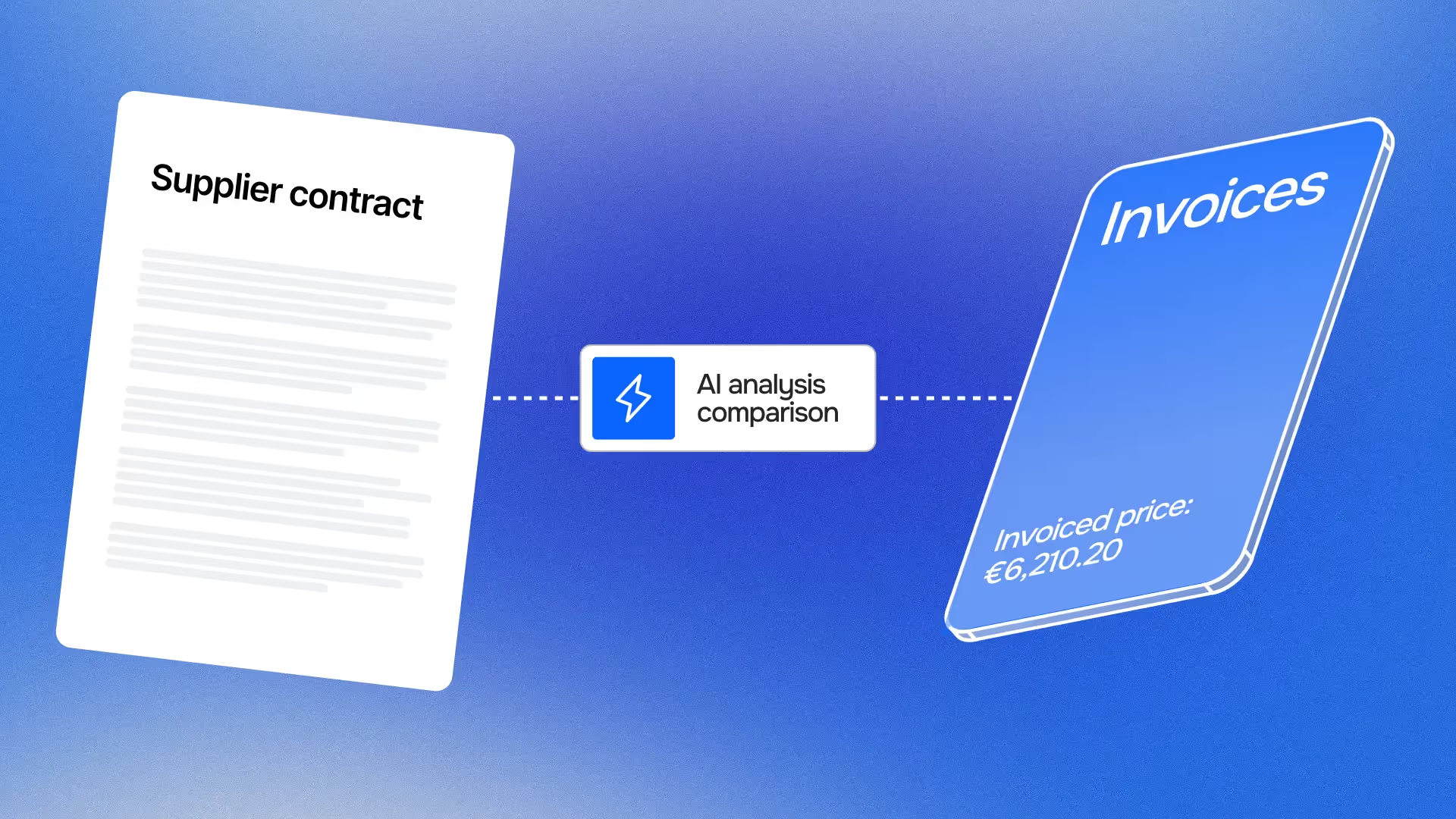
Procurement teams negotiate hard. They benchmark supplier markets, model volume scenarios, push for early-payment discounts, and document every agreed rate in signed contracts. Then the contracts go into a folder, the invoices start arriving, and nobody systematically checks whether what gets billed matches what was agreed.
This is the supplier pricing compliance gap, and it is not a marginal problem. Research from the Institute of Finance and Management consistently shows that companies recover only 60–80% of their negotiated procurement savings at payment time, with the remainder eroded by billing discrepancies that go undetected until an audit, if they are ever found at all. The savings are real on paper. They are partial in practice.
The gap exists because the two functions that should close it operate in separate systems with separate priorities. Procurement owns the negotiation and the contract. Finance owns the payment. The step between them, verifying that each invoice line reflects the contracted rate, every time, for every supplier, is owned by neither. This article explains why supplier pricing compliance falls through the organizational seam, what it costs when it does, and how to enforce it systematically at invoice level before any payment is approved.
The organizational gap between procurement and finance
The failure of supplier pricing compliance is rarely a technology problem. It is an ownership problem. The contract that specifies agreed pricing lives in procurement. The invoice that may or may not honour that pricing is processed by finance. The check that would confirm whether the two align sits in the gap between them.
Procurement negotiates, then moves on
Once a supplier contract is signed, procurement's attention shifts to the next negotiation cycle, a new vendor relationship, or a sourcing project. Contract management teams may track expiry dates and renegotiation timelines, but day-to-day enforcement of pricing at invoice level is not a standard procurement responsibility in most organizations. That enforcement is assumed to happen somewhere in the AP process, but it rarely does systematically, because AP teams are built around payment processing speed, not compliance verification.
The practical effect: negotiated rates exist in contracts that the AP team processing invoices has rarely read in full and cannot feasibly consult on every billing cycle.
ERP systems record, they do not validate
When an invoice is entered into an ERP, the system records the amount as stated on the document. It may flag the amount against a purchase order if 3-way matching is configured, but it does not compare the unit price against a negotiated rate schedule unless that rate schedule has been explicitly loaded into the ERP master data, which is a significant configuration burden that most organizations do not maintain at the granularity needed for effective line-item compliance.
This is what Project Truth identifies as the ERP gap: ERP systems are excellent at recording transactions. They are not built to validate that each transaction honours the terms under which it was contractually authorised. The validation layer that sits between the contract and the payment is the gap Phacet closes.
The contract lifecycle compounds the problem
Supplier pricing agreements are not static. Rates change at renegotiation. Volume discounts activate when purchase thresholds are crossed. Promotional terms expire. Index-linked pricing adjusts quarterly. At any given moment, the "current" rate for a given supplier and product may differ from what appears in the original contract, what was loaded into the ERP during the last data refresh, and what the supplier's billing system is applying.
Managing these version changes accurately, ensuring that the right rate applies to the right invoice at the right point in time, requires a rate reference system that updates in sync with the commercial agreement lifecycle. Without it, compliance checking defaults to the most recent contract version available to whoever happens to review an invoice, which may not reflect the rate actually in force.
What supplier pricing non-compliance actually costs
The financial exposure from supplier pricing non-compliance is material, and it is consistently underestimated, because most of it is never measured. Organizations that quantify the problem typically do so through retrospective audits, which by definition find overcharges that have already been paid and must be recovered rather than prevented.
The unrecovered fraction of negotiated savings
Every pricing agreement creates an expected savings compared to a pre-negotiation baseline. If procurement negotiates a 3% reduction on a €2M annual supplier relationship, the expected saving is €60,000. If the supplier's billing system applies the new rate on 85% of invoices and the original rate on the remaining 15%, due to a data entry error, a system update timing issue, or a product category misconfiguration, the actual saving realised is €51,000. The €9,000 gap is real money that was negotiated but never collected.
Multiply this across a supplier base of 50 to 200 vendors, each with their own pricing structure, contract version, and billing system accuracy, and the aggregate unrecovered savings become significant. Industry analysis from Hackett Group indicates that organizations with structured invoice compliance programmes recover 2–4× more of their negotiated savings than those relying on manual spot-checking.
The compounding effect of silent drift
The most expensive form of supplier pricing non-compliance is not the dramatic overcharge that triggers immediate attention. It is the small, persistent deviation that accumulates across billing cycles without triggering any review mechanism.
A supplier who invoices at €52.30 per unit instead of the contracted €51.00 generates a 2.5% per-unit overcharge. On a single invoice for 100 units, that is €130. On 200 monthly invoices across a 12-month billing relationship, it is €31,200, paid, undetected, and requiring a credit note recovery process to retrieve once found.
Vivason's experience illustrates this at scale: €180,000 in annual overcharges accumulated through precisely this mechanism, individually invisible deviations from contracted rates, compounding across a supplier base with no systematic compliance check at invoice level.
The audit cost of late discovery
When pricing compliance failures are discovered retrospectively, through an annual audit, a supplier statement reconciliation, or a finance director's spot-check, the recovery process adds cost on top of the original financial loss. Finance teams report 4 to 8 hours of work per supplier dispute: identifying the specific invoices affected, calculating the overcharge, documenting the discrepancy against the contract, initiating the credit note request, and reconciling the correction once received.
For an organization that discovers 30 pricing discrepancy cases through an annual audit, that is 120 to 240 hours of finance team time, on top of the overcharges themselves, that could have been eliminated by systematic pre-payment enforcement. Prevention is not just cheaper than cure; at scale, it is categorically different in resource requirement.
The five structural reasons pricing agreements break down at invoice level
Understanding why negotiated pricing fails to reach invoice-level enforcement is essential for designing a compliance system that addresses root causes rather than symptoms.
1. Supplier billing system misconfiguration
The most common mechanism. When a new contract rate is agreed, the supplier must update their billing system to apply it. This update is frequently delayed, partially applied, or applied to the wrong product category within the supplier's internal catalogue. The supplier is not necessarily acting in bad faith, the error sits in their data management process. But the financial effect on the buyer is identical to intentional overcharging.
Systematic compliance checking at invoice level detects this pattern within the first billing cycle after a rate change, allowing the buyer to flag the discrepancy and request a correction before further invoices are issued at the wrong rate.
2. Personnel changes on either side
Contract terms are often held in institutional memory rather than structured reference systems. When the procurement manager who negotiated a specific rate package moves to another role, or when the supplier's account manager changes, the detailed terms of the agreement may not transfer cleanly to their successors. Subsequent invoices drift toward the supplier's standard rate card rather than the negotiated schedule.
This is particularly common for special terms, promotional rates, loyalty discounts, rebate thresholds, that sit outside the main contract structure and require active knowledge to enforce.
3. Product catalogue fragmentation
Suppliers with complex catalogues, food distributors, logistics providers, professional services firms, may have hundreds or thousands of SKUs, each with its own pricing structure. A negotiated rate for a product family may apply consistently at the category level but inconsistently at the individual SKU level, depending on how the supplier's internal catalogue maps to the agreed reference.
The contract analysis capability required to resolve this mapping, identifying which contracted rate applies to which product code on which invoice line, is beyond what manual AP review can reasonably sustain at volume. It requires structured reference data that can be queried at SKU level in real time.
4. Multi-entity billing complexity
In group structures with multiple legal entities, the same supplier may hold a group-level framework agreement but bill individual entities at different rates, sometimes the group rate, sometimes a local rate, sometimes a rate inherited from a legacy relationship that predates the framework agreement. Without visibility across entities and a single reference for what the group rate should be, individual entity finance teams cannot identify when they are being billed outside the group-negotiated terms.
For multi-entity groups using Phacet's cross-entity validation, the framework rate becomes the reference applied across all entities simultaneously, not a contract document that individual AP teams consult inconsistently.
5. The approval pressure dynamic
Even when a finance team reviewer notices that an invoiced rate differs slightly from what they recall being contracted, the path of least resistance is often to approve and flag it for follow-up, especially under month-end pressure. Follow-up items that require a supplier conversation are easy to defer, and deferred items become historical overcharges. A systematic compliance check that flags discrepancies automatically and routes them to a structured review queue removes the approval-under-pressure dynamic from the equation: the invoice simply does not advance until the discrepancy is resolved.
How systematic invoice-level compliance enforcement works
Moving from aspirational pricing compliance to enforced pricing compliance requires three things that manual processes cannot provide at scale: a structured rate reference, a real-time comparison mechanism, and a decision-grade flag that stops the invoice before payment approval.
Structured rate reference: the foundation
Every compliance check depends on having the contracted rate available in a structured, queryable format at the moment of invoice processing. This means rate schedules extracted from contracts and loaded as reference data, not stored as PDF attachments, but parsed into a structure where each supplier, SKU, and time period has an explicit rate value that the comparison engine can retrieve in milliseconds.
Phacet's contract intelligence capability handles this extraction: contracts are ingested and key commercial terms, unit prices, volume tiers, applicable periods, surcharge structures, are extracted into a structured reference layer. Updates to contract terms flow into the reference layer when agreements change, keeping the compliance check current without manual data entry.
Real-time line-item comparison
With structured rate reference data available, the compliance check runs at invoice intake, not after ERP entry, not at month-end, but when the invoice arrives and before it enters any payment workflow. Each invoiced line is compared to the applicable contracted rate for that supplier, that product, and that date. Lines within the configured tolerance pass automatically. Lines outside tolerance generate a compliance flag.
The comparison is applied to every invoice line on every invoice from every supplier, not to a sample, not to invoices above a threshold, but to the complete billing population. This is what closes the gap between negotiated savings and realised savings: systematic coverage at the line level, applied consistently before any payment is authorised. For a deeper look at how line-level invoice checking integrates with delivery confirmation, see our article on 3-way matching automation and payment traceability.
Pre-decision flagging and structured resolution
A compliance flag generated at invoice intake routes the document to a structured review queue rather than the standard payment flow. The flag contains the specific information needed for resolution: the invoiced price, the contracted price, the variance amount, the contract clause the check applied, and the invoice reference. The reviewer can approve the variance with documented justification, reject the invoice line and initiate a credit note request, or contact the supplier directly with the discrepancy detail.
This is the pre-decision control model that makes compliance enforcement possible at scale: automation handles the comparison across 100% of invoice lines, human judgment applies to the exceptions that require it. The finance team reviews discrepancies rather than invoices, shifting from volume processing to exception resolution.
Jinchan Group demonstrated what this shift produces: moving to systematic pre-payment compliance checking multiplied their anomaly detection rate by 5x compared to manual spot-checking. The supplier billing errors that had been passing undetected became consistently visible, and consistently stopped before payment. Read the full Jinchan case study for the operational detail.
Building a supplier pricing compliance programme: the practical sequence
Supplier pricing compliance is not a one-time audit. It is a continuous control embedded in the invoice processing workflow. Building it follows a sequence that most finance teams complete in three to four weeks.
Step 1 — Map your compliance exposure.
Before configuring any automation, identify which supplier relationships carry the highest pricing compliance risk: high-value, high-frequency suppliers where a 1–2% billing deviation has material annual impact; recently renegotiated contracts where new rates are most likely to encounter implementation delays; complex pricing structures where volume tiers or index-linked adjustments create recurring calculation risk. This prioritisation guides where to invest configuration effort first.
Step 2 — Extract and structure rate references.
For priority suppliers, extract contracted pricing from source documents into a structured reference format: unit prices, applicable SKUs, validity periods, tier thresholds, surcharge terms. Phacet's extraction agents process supplier contracts and price lists directly, building the queryable rate reference without manual data entry. The supplier invoice automation workflow supports both initial loading and ongoing updates as contracts change.
Step 3 — Configure compliance rules by supplier category.
Define tolerance thresholds, the variance level at which a discrepancy triggers a flag versus auto-approves, for each supplier or supplier category. A commodity supplier billing daily at low unit values may warrant a tighter tolerance than a professional services firm billing quarterly at high amounts. Phacet's no-code rule configuration allows the finance team to set and adjust these parameters directly, without IT involvement.
Step 4 — Run calibration on live invoice traffic.
Over a two-to-four-week calibration period, the compliance rules run against real incoming invoices. False positive rates are monitored and thresholds adjusted, the goal is to maximise genuine discrepancy detection while minimising noise from rounding differences and legitimate rate variations. Most deployments reach a stable false positive rate below 5% within the calibration window.
Step 5 — Operate exception-based compliance.
Once calibrated, the compliance programme runs continuously on every incoming invoice. The finance team reviews the exception queue, typically 3–5% of total invoices, rather than processing the full volume. Each exception has the context needed for a fast, informed resolution. The audit trail records every compliance check, every outcome, and every resolution decision, providing the documentation base for supplier performance reviews and contract renegotiations.
Astotel completed this sequence across its hotel portfolio. The result: invoice error rate reduced from 7% to 2%, with pricing compliance enforcement running automatically on every supplier invoice across multiple properties. The Astotel case study covers the implementation detail and the supplier relationship changes that followed.
From compliance control to supplier performance intelligence
A supplier pricing compliance programme does not just prevent overcharges. Over time, the data it generates transforms how procurement and finance work together.
Every compliance check produces a record: which supplier, which product, which invoice, what was billed, what was contracted, what the variance was, and how it was resolved. Aggregated across a billing history, this data reveals supplier pricing behaviour at a level of precision no manual process can match.
Finance teams using Phacet's supplier billing control agent and margin tracking capabilities can identify suppliers whose billing accuracy has declined following a rate change, an early signal of a contract implementation problem worth addressing before it accumulates. They can quantify the compliance rate by supplier across the year and bring that data to renegotiations: not as a complaint, but as a documented performance baseline. They can also track realised savings against negotiated targets, closing the loop between what procurement secured on paper and what finance actually paid.
For organisations where margin visibility matters at product or category level, the supplier transaction labelling agent extends this analysis further, connecting validated, compliant invoice data to cost allocation and margin reporting in real time.
The shift is from reactive payment processing to active commercial governance. The contracts that procurement worked to negotiate become enforceable instruments rather than reference documents. The savings that were modelled become savings that are realised. And the finance team moves from approving payments to managing supplier relationships with data.
FAQ
What is supplier pricing compliance?
Supplier pricing compliance is the practice of verifying, at invoice level, that the price a supplier charges matches the rate agreed in the applicable contract, catalog, or pricing schedule, and enforcing a structured resolution process when discrepancies are found. It is the operational link between what procurement negotiates and what finance actually pays.
Why do negotiated supplier prices often fail to reach invoice level?
Three structural factors explain most compliance failures: supplier billing system misconfiguration when new rates are implemented, personnel turnover on either side of the commercial relationship, and the absence of a systematic comparison mechanism between contracted rates and incoming invoice prices. When compliance relies on manual review of a subset of invoices, most deviations pass undetected.
How does supplier pricing compliance differ from invoice price validation?
Invoice price validation is the technical control, comparing each invoiced price to a contracted reference and flagging discrepancies. Supplier pricing compliance is the broader discipline: it includes the organisational ownership of the check, the structured rate reference system that makes it possible, the tolerance thresholds and escalation workflow, the supplier dispute process, and the performance data generated for commercial governance. Compliance is the programme; validation is the control within it.
What percentage of negotiated savings do companies typically fail to realise?
Industry benchmarks suggest that organisations without structured compliance programmes realise 60–80% of their negotiated procurement savings at payment time. The 20–40% gap represents rates that were agreed but not applied consistently at invoice level. Organisations with systematic invoice-level compliance enforcement consistently recover a larger proportion of negotiated savings, because discrepancies are caught and corrected in the billing cycle they occur rather than discovered retrospectively.
How do you build a rate reference that stays current as contracts change?
Rate references must be managed as living data, not static documents. When contract terms change, renegotiation, volume tier activation, index adjustment, the rate reference needs to update to reflect the new terms before the next billing cycle. Phacet's contract intelligence capabilities extract and structure rate data from source documents and support incremental updates when terms change, keeping the compliance check current without requiring manual master data maintenance.
How should pricing compliance discrepancies be escalated?
The escalation path depends on the variance magnitude and the supplier relationship context. Small deviations within a configured tolerance should auto-approve with a logged note. Deviations above tolerance should route to an AP review queue with full context, invoiced price, contracted price, variance amount, contract reference. Systematic patterns, the same supplier consistently billing above contracted rates across multiple invoices, should escalate to procurement for a commercial conversation rather than being resolved invoice by invoice.
Can supplier pricing compliance work across suppliers with different contract structures?
Yes, provided the compliance system supports per-supplier rule configuration. A distributor with a weekly price list, a logistics provider with a tiered rate card, and a technology vendor with an annual SaaS agreement each require different comparison logic. Phacet's compliance rules are configured at supplier level, each relationship applies its own reference data and tolerance structure rather than a universal template that fits no one precisely.
How does pricing compliance data support supplier renegotiations?
Compliance data provides the factual foundation that subjective relationship-based negotiation often lacks. A supplier's billing accuracy rate over the previous 12 months, what percentage of invoices were within contracted rates, what the aggregate overcharge was, how quickly discrepancies were resolved, is objective performance data. Bringing this into a renegotiation reframes the commercial conversation: the buyer is not complaining about a few invoices but presenting a documented compliance history that informs the terms of the next agreement.
Closing the gap between contract and payment
A signed supplier contract is a statement of commercial intent. It specifies what was agreed. It does not enforce itself.
The gap between what is contracted and what is paid exists because the enforcement mechanism, systematic comparison of every invoiced price against the applicable rate, on every invoice, before every payment, has historically required more operational capacity than manual AP processes can sustain. The result is a compliance failure that is invisible in any individual invoice and significant in aggregate: the fraction of negotiated savings that never materialises, the overcharges that compound across billing cycles, the audit findings that arrive years after the discrepancies began.
Automated pre-payment compliance checking closes this gap not by reviewing more invoices manually but by changing what the review covers. Every invoice line is compared against its contracted rate at the moment of receipt. Discrepancies are routed to structured resolution before payment is authorised. The compliance record that accumulates feeds supplier performance management and renegotiation with data rather than impressions.
The companies that enforce their supplier contracts at invoice level don't have more finance headcount. They have a different architecture, one where the validation happens before the decision, consistently, on every transaction. Book a demo to see how Phacet enforces negotiated supplier pricing across your supplier base and billing volume.

Latest Resources
Unlock your AI potential
Go further with your financial workflows — with AI built around your needs.


