
Implement AI in finance: strategic steps for CFOs
Published on :
December 16, 2025


Nicolas Marchais is co-founder and CEO of Phacet. After seven years at Spendesk, he built Phacet as the agentic layer that orchestrates across ERP, banking and email systems. Reliable, auditable, cross-system, what he calls a Finance Workforce.

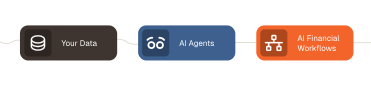
Key takeaway: AI in finance transforms data into strategic decisions using automated workflows and machine learning. This shifts finance teams from manual processing to high-value analysis, drastically reducing errors. Real-time compliance monitoring and predictive analytics deliver immediate efficiency gains and stronger risk management, enabling smarter business outcomes.
Finance teams are constantly overwhelmed by repetitive manual tasks, frequent data errors, and slow reporting cycles that stifle strategic growth and innovation. How can you effectively implement AI in finance to overcome these pain points and unlock new efficiencies? This guide explores concrete use cases such as automated bank reconciliations, real-time fraud detection, and predictive financial forecasting, demonstrating how AI agents slash processing times by up to 80% while improving accuracy and ensuring compliance. Learn how centralizing and automating core workflows transforms your finance team from task-focused administrators into strategic business partners, delivering immediate results that drive smarter decisions and sustainable business value beyond mere productivity.
- Beyond the hype: what AI really means for your finance department
- From theory to practice: key AI use cases for internal finance teams
- A strategic framework for implementing AI in your finance function
- Navigating the challenges: governance and risk management
- Your next steps toward an AI-powered finance team
Beyond the hype: what AI really means for your finance department
Defining AI in a financial context
AI in finance is practical technology, not science fiction. It leverages machine learning and NLP to analyze data, automate processes, and enhance decision-making. This turns raw financial information into strategic insights for your team, making it easier to implement AI in finance.
Machine learning, a core AI component, learns from data without explicit programming. Neural networks process large datasets to identify patterns and trends. This capability is essential for identifying subtle fraud patterns and managing financial risks effectively.
The focus is transforming data into smarter decisions. AI improves financial reporting, compliance, and forecasting accuracy. It augments human expertise, leading to more precise and timely financial insights. This allows teams to focus on strategic planning rather than manual data entry.
The shift to AI agents: your new digital team members
AI agents function as digital team members managing end-to-end workflows. They handle month-end closing, contract reviews, and invoice processing autonomously. Unlike rule-based automation, they adapt dynamically to changing data and complex scenarios.
Pet Lovers Centre automated 8,000 monthly invoices, reducing processing time by 70%. These systems detect anomalies and forecast cash flow issues before they escalate, preventing costly disruptions.
They integrate seamlessly with ERP systems, reconciling transactions across entities and currencies. This ensures accurate financial consolidation and significantly speeds up reporting cycles for leadership reviews.
AI agents optimize entire processes, not just individual tasks. Finance teams shift focus to strategic work while agents handle routine operations efficiently. This enables leaders to prioritize high-value strategic initiatives over manual chores.
Start with specific processes like accounts payable. Gradually scale implementation as teams build confidence in AI-driven workflows. Progressive deployment ensures smooth adoption and measurable results from day one.
From theory to practice: key AI use cases for internal finance teams
Automating core accounting and operational processes
AI transforms core accounting by automating data entry, slashing errors and accelerating processes. Phacet's automated bank reconciliation handles transactions seamlessly, reducing manual effort by 80% and ensuring accuracy.
3-way matching compares purchase orders, invoices, and receipts to prevent fraud and ensure compliance. This eliminates manual verification errors and strengthens internal controls.
Finance teams save hours each month with automated checks, allowing focus on strategic initiatives. Real-time data processing resolves issues immediately, preventing costly delays.
AI-driven accounting processes provide instant visibility into financial health. This enables faster decision-making and improved operational efficiency across the organization.
With AI, finance departments achieve 95% faster month-end closes, enhancing overall business agility.
This leads to more reliable financial data and confident decision-making.
Enhancing financial planning and analysis (FP&A)
AI enhances FP&A by analyzing vast datasets for precise forecasting, achieving up to 99.6% accuracy. Teams shift from manual data collection to strategic insights.
Predictive models uncover hidden trends, enabling agile strategic planning and proactive risk management. This transforms FP&A from reactive to forward-looking.
AI-driven insights help anticipate market shifts and adjust strategies before competitors react. Finance leaders gain confidence in data-backed decisions.
With AI, FP&A teams move beyond historical reporting to future-focused guidance. This drives sustainable growth and competitive advantage.
AI reduces forecasting errors by 40%, improving budget accuracy and resource allocation.
Finance leaders report 30% higher accuracy in quarterly forecasts using AI tools.
Streamlining reporting and compliance monitoring
AI centralizes and automates financial reporting, ensuring consistency and timely delivery. Real-time transaction monitoring detects AML violations instantly for compliance.
Extracting key data from contracts streamlines compliance checks and reduces manual effort. This minimizes regulatory risks and boosts operational efficiency.
Automated reporting eliminates inconsistencies and human errors in financial statements. This ensures stakeholders receive accurate, trustworthy information consistently.
- Automating monthly and quarterly financial statement generation
- Real-time monitoring of transactions for non-compliant activities
- Extracting key data from contracts and legal documents for compliance checks
- Simplifying audit trails by providing clean, structured data
Continuous monitoring keeps finance teams ahead of regulatory changes. The result is a more agile and compliant finance function overall.
AI-powered reporting reduces audit preparation time by 50%, freeing resources for strategic analysis.
AI ensures all reports meet GAAP and IFRS standards automatically.
A strategic framework for implementing AI in your finance function
A step-by-step adoption model
Finance leaders must adopt a structured, phased AI implementation approach. Rushing into deployment risks costly failures. Starting with high-impact use cases transforms finance strategically. A clear roadmap maximizes ROI.
- Identify high-impact starting points: automate high-volume tasks like invoicing and reconciliations. Automation cuts processing time by 80%, freeing teams for strategic work. Errors dropped from 15% to under 2% in three months.
- Launch focused pilot projects: deploy AI for one process in a controlled environment. Define KPIs like error rate. Pilots achieve 30-50% efficiency gains in weeks. Saved 200 hours monthly, cutting process time from 5 to 1 day.
- Select the right technology: use Phacet’s No-Code AI for drag-and-drop agent building. Ensure ERP integration to avoid silos. Deployment time drops 90%, enabling day-to-day deployments.
- Scale successes and manage change: expand to expense management post-pilot. Communicate benefits via workshops. Change management boosts adoption by 20%. Involve leaders early.
- Establish governance: prioritize security, compliance (SOX, GDPR), and explainability. Conduct audits. Cross-functional committees align with risk policies, building trust.
Moving from isolated tasks to integrated workflows
AI’s value lies in end-to-end workflows. Automate procure-to-pay: agents extract data via OCR, match POs and receipts, process payments with minimal oversight. This slashes manual work by 70% and processing time. IBM reports 33% fewer duplicate payments; Gartner predicts 50% of firms will use AI for supplier contracts by 2027. Teams shift to forecasting, enabling 50% faster closes and 40% higher accuracy.
Navigating the challenges: governance and risk management
Ensuring data security and confidentiality
Data security is critical for finance AI deployments. Robust encryption and strict access controls protect sensitive financial data. Tokenization in payment processing ensures card details are never stored, reducing breach impact. Zero-trust architectures enforce strict access controls, limiting data exposure. AES-256 encryption safeguards data at rest and in transit. Secure key management prevents unauthorized decryption.
Unsecured data risks regulatory penalties and reputational damage. Regular audits identify vulnerabilities proactively. These measures align with PCI-DSS and GDPR requirements, minimizing legal exposure. Learn more about best practices for securing sensitive data. Multi-factor authentication and data anonymization are essential for robust protection.
Managing regulatory uncertainty
Global AI regulations are evolving rapidly. The EU AI Act targets high-risk financial applications since August 2024. ACPR provides compliance guidance for European markets. The SEC requires robo-advisors to disclose AI-driven recommendations clearly. Financial institutions must navigate differing standards across Asia-Pacific and North America. The EU AI Act classifies credit scoring and investment advice applications requiring strict oversight. The UK's FCA emphasizes transparency in AI-driven trading algorithms.
Partner with vendors prioritizing regulatory adherence. Flexible systems adapt to new laws, reducing compliance risks. Cross-functional teams monitor global shifts proactively. This ensures alignment with evolving standards. Proactive compliance avoids penalties and maintains operational continuity.
Your next steps toward an AI-powered finance team
Embracing a culture of continuous improvement
AI implementation is part of a cultural transformation, not a one-time project. It shifts finance teams from reactive reporting to strategic decision-making.
Teams gain immediate motivation by focusing on high-value analysis instead of manual tasks. Phacet automates sub-ledger reconciliations and FP&A, achieving 70%+ automation and 50% time savings within weeks.
Early wins build trust and momentum. Continuous improvement refines processes, moving from transactional work to predictive insights.
Phacet's AI processes millions of data points instantly, uncovering opportunities and improving visibility. Teams gain proactive insights, not reactive reporting.
Applications like journal entries, fraud detection, and dynamic forecasting reduce errors. Reconciliations automation streamlines close processes.
AI agents augment human expertise, empowering teams as strategic advisors.
How to get started with your first AI agents
Start with low-risk pilots like expense reporting or reconciliations for quick ROI.
Measure time saved and accuracy to build confidence. Train teams and celebrate wins.
Phacet integrates seamlessly with your existing ERPs. Set up your profile for immediate gains.
Transform finance into a strategic partner with real-time insights. Secure, compliant deployments.
Dedicated support guides your team. Start small, scale confidently.
AI in finance isn't just hype, it’s a strategic transformation driving smarter decisions, real-time insights, and empowered teams. Start small with a pilot project today. Set up your Phacet profile and launch your first AI agents to unlock immediate value and build a future-ready finance function.
FAQ
What are the most impactful AI applications for finance teams right now?
AI is transforming finance by automating routine tasks and unlocking smarter decisions. Tools like intelligent bank reconciliation systems match transactions in seconds, slashing errors and saving hours weekly. As one finance leader shared, "It’s not just speed, it’s accuracy. We cut reconciliation time by 70% while ensuring every transaction was perfectly aligned." Similarly, AI handles 3-way matching for purchase orders, invoices, and receipts, preventing fraud and ensuring compliance. These tools don’t replace your team; they free them to focus on high-value strategic work.
How can I begin implementing AI in my finance department without getting overwhelmed?
Start small and focus on quick wins. Pick one high-impact process like invoice processing or bank reconciliation. Choose a no-code AI platform your team can adopt quickly, no technical expertise required. "We started with just six invoices a week," says a CFO at a mid-sized company. "Within a month, manual work dropped by 50%. That early success built confidence to expand." Set clear goals like time saved or error reduction. This phased approach avoids complexity and proves ROI before scaling further.
How does AI enhance financial planning and analysis (FP&A) processes?
AI turns raw data into actionable insights for FP&A teams. Predictive models analyze trends faster than humans, improving forecast accuracy by up to 15%. "We used to spend weeks on spreadsheets," notes a finance director. "Now, AI handles the data crunching, and we focus on why the numbers are changing." Real-time scenario modeling lets teams test strategies instantly, for example, simulating market shifts before committing resources. This shifts FP&A from reactive reporting to proactive strategy, driving better business outcomes.
What steps should I take to ensure data security when introducing AI tools in finance?
Data security starts with choosing the right partners. Look for vendors offering military-grade encryption and role-based access controls. "We only work with providers who meet our security standards," says a CFO. "It’s not just about the tech, it’s about trust." Implement strict data governance policies, like anonymizing sensitive information before processing. Train staff on security best practices and review audit logs regularly.
Latest Resources

Unlock your AI potential
Go further with your financial workflows — with AI built around your needs.


