

Automate financial reporting: Phacet AI for speed & accuracy
Published on :
January 26, 2026

Nicolas Marchais is co-founder and CEO of Phacet. After seven years at Spendesk, he built Phacet as the agentic layer that orchestrates across ERP, banking and email systems. Reliable, auditable, cross-system, what he calls a Finance Workforce.

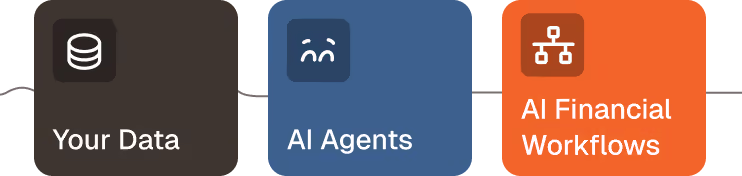
The essential takeaway: automating financial reporting isn't just about efficiency, it's about redefining the role of finance teams. By centralizing data and eliminating manual processes, companies achieve up to 40% faster reporting cycles while reducing error risks. This shift enables real-time strategic insights and ensures compliance, allowing CFOs to focus on growth-driving decisions rather than data collection.
Struggling with manual financial reporting that consumes hours, fragments data across systems, and risks costly errors? Automate financial reporting isn’t just about speed, it’s a strategic overhaul to centralize and streamline data, drastically reducing delays and human mistakes. By leveraging AI-powered automation, teams can slash reporting time by 40%, eliminate repetitive tasks like spreadsheet manipulation, and transform raw data into verified insights. This article reveals how modern solutions enable real-time dashboards, enhance compliance through immutable audit trails, and empower finance teams to shift from data collection to strategic analysis, driving decisions that fuel business growth while ensuring accuracy and scalability.
- The hidden costs of manual financial reporting
- What does it mean to automate financial reporting?
- The strategic benefits of automated reporting
- How AI agents elevate financial reporting automation
- A practical roadmap to automated reporting
- Empowering your finance team, not replacing it
The hidden costs of manual financial reporting
Fragmented data and endless consolidation
Finance teams waste hours collecting data from ERPs, PDF invoices, and Excel spreadsheets. Each system speaks a different language, forcing teams to spend 20-50 hours monthly reconciling accounts across 3-5 siloed systems. This manual labor isn’t just inefficient, it’s a strategic liability. Imagine a CFO realizing 40% of their team’s time goes to data wrangling, not analysis. For a pharmaceutical firm, this meant missing market opportunities as regional sales data clashed with central accounting systems, creating weeks of delays.
The persistent risk of human error
A misplaced decimal or duplicate entry can distort financial truths. Manual processes create 1 error per 100 cells in spreadsheets, triggering compliance risks and flawed decisions. One global retailer discovered $1.2M in revenue misstatements from a single Excel mistake during an audit. These errors aren’t just numbers, they erode stakeholder trust and expose companies to regulatory penalties. A 2023 study found 30% of firms faced compliance breaches from manual errors, resulting in fines averaging 2% of annual revenue.
Delayed closings and outdated insights
When monthly closings stretch beyond six days, executives operate on stale data. A tech company’s delayed Q1 report caused missed M&A opportunities while competitors acted faster. Manual processes create a 6-8 day closing cycle, costing 15% in operational agility. Invoicing delays alone can extend cash conversion cycles by 10-15 days, straining working capital. Worse, 94% of finance teams still rely on Excel for month-end closes, with 50% citing it as the primary cause of delays, tying up resources that could drive strategic growth.
What does it mean to automate financial reporting?
Automating financial reporting means centralizing and automating data extraction, validation, and consolidation across systems like ERPs, invoices, and accounting files. Unlike manual spreadsheets, automation replaces fragmented workflows with a unified “single source of truth,” eliminating manual entry, reducing delays in closings, and ensuring compliance through structured processing. The focus isn’t speed alone, it’s building a scalable foundation for reliable insights that grow with business needs.
Beyond spreadsheets: a paradigm shift
Manual reporting often aggregates data from disjointed sources, ERPs, CRMs, and accounting tools, causing inconsistencies and version-control chaos. Automation connects directly to these systems, extracting raw data in real time and standardizing it for analysis. For instance, automation can reduce revenue data aggregation from days to hours by syncing systems seamlessly. This shift creates a centralized data backbone, supporting strategic decisions and regulatory compliance without sacrificing governance.
From raw data to structured financial insights
Automation starts with data extraction, converting unstructured inputs, like invoice line items or bank statements, into a unified format. Algorithms then clean data, flagging anomalies (e.g., mismatched currency codes) and validating entries against rules. Finally, systems consolidate cleansed data into reports, dashboards, or audit trails. Phacet’s AI agents, for example, classify transactions and ensure transparent validation. This structured approach accelerates reporting while maintaining accuracy, cutting manual review cycles by up to 40% in some cases.
The foundation for reliable and scalable reporting
Automation’s true value is ensuring data integrity and traceability at scale. By embedding human-in-the-loop validation, systems like Phacet maintain oversight while accelerating workflows. For example, automation can generate consolidated financials in hours, not weeks, via automated currency conversion and intercompany reconciliation. This precision supports compliance with standards like DORA and GAAP, enabling real-time dashboards built on verified data. The result? Teams reclaim time for analysis, reduce errors, and future-proof reporting, all while maintaining governance through ISO-certified infrastructure.
The strategic benefits of automated reporting
Liberating finance teams for strategic partnership
Manual reporting keeps finance professionals trapped in data collection rather than analysis. When teams spend 60-70% of their time chasing spreadsheets and reconciling figures, they can't focus on interpreting what those numbers mean for business strategy. Automation changes this equation by handling repetitive tasks like data entry, validation, and basic analysis. This shift enables finance leaders to move from being data processors to trusted advisors, providing actionable insights that directly impact business growth and operational strategy. For example, a mid-sized enterprise reduced its monthly closing process from 12 days to 3 by automating journal entries and intercompany reconciliations, freeing analysts to model scenario planning for market expansion.
Achieving speed, accuracy, and faster decision-making
Automated systems process financial data 3-5x faster than manual workflows while maintaining precision. By automatically extracting and validating data from ERPs, accounting systems, and invoices, organizations eliminate human errors that often delay month-end closings. For instance, automated bank reconciliation that once took days now completes in minutes with AI-powered matching algorithms. This creates a continuous reporting environment where executives access verified financial metrics in real-time rather than waiting for periodic updates. Phacet’s anomaly detection flagged a 12% cash discrepancy in a client’s payment pipeline within hours, versus the 14-day average detection window under manual processes, enabling immediate corrective action that preserved $2.8M in quarterly liquidity.
Key outcomes of financial reporting automation
- Enhanced data integrity: ensure all reports originate from a single, verified source of truth. Phacet’s AI agents cross-reference transactions across systems to eliminate version-control issues between accounting, operations, and treasury teams.
- Improved compliance and auditability: generate complete audit trails automatically for every piece of data. With ISO 27001-certified infrastructure, Phacet maintains immutable logs of data modifications, reducing compliance reporting time by 40% for SOX-regulated clients.
- Increased operational efficiency: drastically reduce manual work and accelerate reporting cycles. One multinational corporation reduced its quarterly reporting preparation from 28 days to 6 by automating 83% of its intercompany journal entries and tax provision calculations.
- Empowered strategic analysis: free up finance professionals to focus on insights that drive business growth. A client’s FP&A team now spends 3x more time on predictive modeling for M&A opportunities after automating 75% of their routine reporting workflows.
How AI agents elevate financial reporting automation?
Going beyond basic automation with intelligent agents
Traditional financial reporting automation follows rigid rule-based processes, often struggling with unstructured data from invoices or accounting files. AI agents transcend these limitations by interpreting complex data patterns, classifying transactions, and autonomously extracting key financial details. Unlike basic automation, these agents learn from historical data to handle exceptions, such comme classifying expenses across departments or detecting revenue anomalies in ERPs.
Phacet’s AI agents don’t just execute predefined tasks, they analyze context and adapt workflows. For example, they automatically standardize supplier invoices with varying formats, flagging irregularities for review. This purpose of an AI agent lies in transforming raw data into actionable insights while maintaining traceability, a shift from reactive to proactive financial management.
Ensuring reliability with human-in-the-loop validation
Automation gains trust through transparency. Phacet’s system integrates human expertise at critical junctures: when an AI agent encounters an unusual cash flow pattern or a mismatched ledger entry, it triggers alerts for manual verification. This hybrid approach ensures anomalies receive human judgment while routine tasks proceed autonomously. Over 80% of finance leaders report improved accuracy when combining machine speed with human oversight.
For CFOs, this model reduces risk without sacrificing efficiency. Imagine a scenario where an agent identifies a potential intercompany reconciliation error, instead of proceeding, it surfaces the issue with supporting data. Finance teams validate or adjust, and the system learns from each interaction. This continuous feedback loop strengthens accuracy over time, turning occasional exceptions into refined automation rules.
Maintaining security and full audit trails
Compliance isn’t optional in financial reporting. Phacet’s infrastructure, ISO 27001-certified, encrypts data at rest and in transit while logging every transformation step. When an AI agent categorizes a $250,000 receivable, the system records its source, processing logic, and final classification. Regulators and auditors get immutable audit trails showing how numbers evolve from raw data to boardroom-ready reports.
This transparency extends to governance. Every validation step, whether human or machine-driven, gets timestamped and attributed. If a manual override occurs, the system documents the reason, ensuring accountability. The result? A 40% reduction in audit preparation time while maintaining compliance with standards like IFRS and SOX, according to Phacet client benchmarks.
A practical roadmap to automated reporting
Manual financial reporting creates hidden costs: fragmented data, error risks, and delayed insights. Teams spend 40% of their time on repetitive tasks like data entry, leaving less room for strategic analysis. This isn't just inefficient, it's a barrier to agility in a volatile market.
Step 1: evaluate your current financial processes
Start with an audit of your reporting workflows. Where do bottlenecks occur during monthly closings? Which tasks, like invoice reconciliation or interdepartmental data collection, consume disproportionate time? Map error-prone manual steps, such as spreadsheet-based revenue tracking that requires double-checking by three team members. This audit reveals where automation will create immediate impact, such as reducing 3-day data consolidation cycles to 4-hour automated runs.
Step 2: adopt a progressive automation strategy
Don't overhaul everything at once. Begin with a high-impact process like bank reconciliation. Automating this task eliminates manual cross-checking of thousands of transactions while maintaining human oversight: Phacet's AI agents flag anomalies for team review, reducing validation time by 70%. This change management approach builds trust in automation before expanding to complex processes like intercompany eliminations or regulatory filings.
Step 3: choose the right technology partner
Select platforms that combine AI-driven data processing with governance. Phacet's no-code automation allows finance teams to build workflows using drag-and-drop interfaces, connecting ERPs like SAP or Oracle with accounting software. Key implementation practices include:
- Assess current workflows to identify inefficiencies and bottlenecks.
- Ensure data quality by establishing clear governance policies from the start.
- Train and support staff to facilitate the adoption of new tools and processes.
- Continuously monitor and optimize automated workflows based on feedback and performance data.
Phacet's ISO 27001-certified infrastructure ensures data security, while its audit trails meet DORA compliance requirements. For example, one finance team reduced dashboard creation time from 12 hours to 45 minutes by automating data standardization through Phacet's AI agents, enabling real-time cash flow tracking across 15 subsidiaries.
AI-powered financial reporting isn't about replacing human expertise, it's about augmenting it. By handling data extraction, anomaly detection, and consolidation, automation frees teams to focus on scenario modeling and strategic decision-making. The result? A 30% faster closing process, 25% fewer reporting errors, and compliance readiness that turns audits from crisis points into routine checkpoints.
Empowering your finance team, not replacing it
From reporting to real-time strategic guidance
Imagine a finance team generating real-time dashboards where every metric reflects standardized, verified data. Phacet’s AI agents automatically classify transactions, detect anomalies, and validate entries against audit trails, ensuring accuracy. Human oversight remains critical: teams review flagged exceptions, ensuring compliance while shifting focus from data entry to strategic analysis. This transforms monthly reporting cycles into continuous decision-making, enabling CFOs to act on live insights rather than historical snapshots.
Building a more agile and data-driven finance function
Automation isn’t just about speed, it’s a strategic enabler. By consolidating ERPs, invoices, and accounting files into a unified system, Phacet eliminates fragmented data silos that delay closings. Time spent on manual reconciliation drops dramatically, freeing teams to prioritize forecasting and risk analysis. With ISO 27001-certified infrastructure, data integrity and compliance become inherent, not afterthoughts. This isn’t efficiency for efficiency’s sake; it’s about creating a foundation for data-driven agility in a volatile market.
The future is collaborative: human expertise powered by AI
AI doesn’t replace human judgment, it amplifies it. Phacet’s agents handle repetitive tasks like data extraction and anomaly detection, while finance professionals focus on contextual analysis and strategic decisions. This partnership reduces errors and accelerates reporting cycles without sacrificing governance. For example, a team using Phacet reduced monthly closing time by 40%, reallocating saved hours to scenario modeling and stakeholder communication. The future of finance lies in this balance: technology manages scale and precision, while humans drive value and innovation.
Financial reporting automation is a strategic evolution empowering finance teams with value-driven insights. Combining human expertise and AI-driven precision enables faster, reliable reporting and agility. The future of finance thrives on this collaboration: technology manages complexity, people drive strategy. Ready to transform? Start your journey today.
FAQ
Is it possible to automate financial reporting?
Yes, financial reporting can be fully automated using dedicated software that centralizes and automates data collection, consolidation, and report generation. Modern systems connect directly to ERP, CRM, and accounting platforms to eliminate manual tasks like data entry and spreadsheet management. This shift drastically reduces time spent on repetitive work while ensuring accuracy and compliance. For CFOs, this isn’t just about efficiency, it’s part of a broader transformation that empowers teams to focus on strategic analysis instead of data gathering.
Can MS Excel handle financial statement automation?
Excel offers basic automation through formulas, macros, and templates, but its capabilities are limited. While it can streamline simple tasks, manual intervention remains necessary for data consolidation across systems, error checking, and complex reporting. This creates data silos and risks of human error. For scalable, reliable automation, businesses increasingly adopt specialized tools that integrate with existing systems, offering features like real-time data updates and audit-ready outputs, far beyond what spreadsheets can deliver.
Does AI play a role in financial reporting?
Absolutely. AI elevates financial reporting by interpreting complex data patterns, automating classification of transactions, and extracting insights from unstructured documents. Unlike traditional automation, AI agents learn from data, enabling real-time anomaly detection and predictive analytics. Platforms like Phacet combine AI with human-in-the-loop validation, ensuring reliability while maintaining transparency. This approach isn’t about replacing humans, it’s about augmenting expertise with tools that handle repetitive tasks, freeing teams for strategic work.
Can ChatGPT perform financial analysis or reporting?
ChatGPT can assist with formatting, summarizing data, or explaining financial concepts, but it lacks the governance and integration needed for enterprise-grade reporting. Its outputs depend on training data and require human validation for accuracy. For organizations, purpose-built solutions are better suited, they offer secure, auditable workflows, automated data extraction from live systems, and compliance-ready outputs. Think of ChatGPT as a tool for specific tasks, not a replacement for structured financial automation platforms.
What are the four types of automation relevant to finance?
The four types, fixed, programmable, flexible, and integrated, each apply differently to financial reporting. Fixed automation handles repetitive tasks (e.g., invoice processing). Programmable automation adapts to changing rules, like dynamic regulatory requirements. Flexible automation connects multiple systems (ERPs, CRMs) for unified data flows. Integrated automation combines all three, creating end-to-end workflows. For finance teams, this progression, from basic task automation to fully integrated ecosystems, aligns with a strategic shift toward real-time insights and agile decision-making.
Can Excel automatically generate reports?
Excel can auto-generate reports using pivot tables, Power Query, and templates, but these outputs often require manual tweaks and cross-system validation. For example, while Excel might pull data from a single source, true automation demands seamless integration across ERPs, CRMs, and accounting platforms. Without this, teams still face risks of outdated data or misaligned formats. Modern tools address this by centralizing data sources and embedding compliance rules, making Excel’s manual steps obsolete for enterprise-scale reporting.
How does automation transform the finance function?
Automation redefines the role of finance teams, moving them from data gatherers to strategic partners. By eliminating repetitive tasks like manual reconciliation, it creates capacity for deeper analysis, identifying cost-saving opportunities, forecasting trends, or advising on growth strategies. This shift extends beyond productivity: it’s about building a finance function that’s agile, data-driven, and aligned with future-ready practices like AI collaboration and real-time decision support.

Latest Resources

Unlock your AI potential
Go further with your financial workflows — with AI built around your needs.


