

AI agents and the 2026 transformation of banking automation
Published on :
January 13, 2026

Nicolas Marchais is co-founder and CEO of Phacet. After seven years at Spendesk, he built Phacet as the agentic layer that orchestrates across ERP, banking and email systems. Reliable, auditable, cross-system, what he calls a Finance Workforce.

The essential takeaway: Banking automation, driven by AI agents, is a strategic necessity for modern financial operations. Moving beyond basic RPA, it cuts costs, boosts accuracy, and ensures real-time compliance. CFOs gain actionable insights and agility, turning finance teams into strategic partners. A single AI agent reconciles thousands of transactions in minutes, boosting efficiency in high-volume environments.
Are manual financial processes draining your team's time and increasing errors? Banking automation isn’t just streamlining workflows, it’s redefining how finance teams operate by centralizing and automating repetitive tasks like reconciliation, cash flow tracking, and compliance. With AI-driven systems, organizations see operational costs drastically reduced, accuracy in financial reporting enhanced, and compliance risks minimized through automated rule enforcement. Discover how cutting-edge technologies like AI agents are transforming manual, error-prone tasks into intelligent, self-correcting processes, empowering your team to shift from transactional work to strategic decision-making, and turning financial operations from cost centers into innovation drivers with real-time fraud detection and audit-ready transparency.
- Why automation is transforming the banking and finance sector
- What banking automation covers today
- From legacy systems to intelligent automation: the evolution of technology in finance
- The core benefits of modern banking automation
- Key use cases for AI-Driven automation in financial operations
- The role of AI agents: moving beyond rules to reasoning
- Banking automation in 2026: from task automation to adaptive AI systems
Why automation is transforming the banking and finance sector?
Banking automation is a strategic necessity for finance teams overwhelmed by transaction volumes, compliance demands, and the need for real-time insights. Manual processes bottleneck reconciliation, fraud detection, and reporting, exposing institutions to errors and regulatory risks. A single undetected anomaly can trigger costly penalties, while delayed cash flow visibility weakens liquidity planning.
Automation redefines financial operations by embedding AI-driven intelligence into workflows. It augments, not replaces, human expertise. CFOs shift from reactive reporting to proactive risk management. Treasury teams achieve 99.9% accuracy in payment matching without manual work. These systems learn, adapt, and ensure full auditability by human supervisors.
This article focuses on back-office automation, where precision and control matter most. AI agents like Phacet’s transform transaction monitoring, compliance readiness, and large-scale reconciliation. Unlike chatbots, these systems operate in critical financial workflows, where errors cost millions, and speed drives competitive advantage. The transformation begins where it matters: in the numbers, controls, and systems that sustain institutional resilience.
What banking automation covers today?
Banking automation leverages AI to optimize financial operations, reducing manual work in repetitive tasks like transaction reconciliation, cash flow tracking, and compliance monitoring. By replacing error-prone workflows, it ensures precision and regulatory alignment, letting teams focus on strategic decisions. Platforms like Phacet combine machine learning with human oversight, adapting to complex scenarios such as partial payments or fee detection while integrating seamlessly with legacy systems.
Key applications include real-time transaction reconciliation, where AI matches payments to records, and live cash flow tracking for liquidity visibility. Payment matching automates invoice-to-transaction alignment, while anomaly detection flags duplicates or fraud. Compliance workflows are streamlined via automated audit trails. Phacet’s AI agents, trained on financial data, refine rules from past exceptions, cutting manual review time by up to 60% in high-volume settings. Automated systems also flag irregularities early, reducing compliance penalties.
Automation reshapes finance roles: data entry time drops by up to 70%, per industry benchmarks. Teams prioritize risk analysis over manual checks. Phacet users report a 59% efficiency gain in reconciliation, freeing resources for strategic work. This shift highlights automation’s role in moving finance from execution to decision-making, slashing error rates and compliance risks. Integration with ERPs like Microsoft Dynamics 365 further strengthens real-time fraud prevention, cementing AI agents as modern financial operations’ foundation.
From legacy systems to intelligent automation: the evolution of technology in finance
Traditional automation technologies like Robotic Process Automation (RPA) streamlined repetitive, rule-based tasks in finance, such as invoice handling or data entry. However, they struggled with unstructured formats like PDFs or adaptive decision-making. A minor data format change could halt processes entirely, forcing manual overrides. For example, reconciling mismatched transaction records often stalled when workflows deviated from rigid RPA rules. Even basic tasks like processing vendor invoices with non-standard layouts required human intervention, undermining efficiency gains.
Intelligent Process Automation (IPA) addressed these gaps by integrating machine learning and natural language processing. This allowed banks to interpret unstructured data from contracts or emails, automating tasks like initial loan screening. An IPA system could extract key terms from scanned documents to pre-approve borrowers, a task RPA couldn’t handle. It also enabled basic compliance checks, such as flagging suspicious activity in anti-money laundering (AML) workflows by matching transactions against historical risk patterns. Yet human oversight remained necessary for complex decisions, such as flagging irregularities in cross-border payments requiring nuanced regulatory interpretation.
Agentic Process Automation (APA) represents today’s breakthrough, with AI agents like Phacet’s platform operating autonomously. These agents use generative AI to analyze financial data, identify patterns in real-time, and execute workflows without reprogramming. Phacet automates reconciliation and anomaly detection, adapting to evolving transaction formats while maintaining audit trails. Unlike rigid systems, APA agents learn from historical data, predict outcomes, and adjust workflows dynamically. A treasury team might see payment matching accuracy improve by 40% as agents refine transaction-labeling logic. For instance, Phacet’s AI agents process thousands of daily transactions, adapting to regional format variations without manual reconfiguration.
Understanding the purpose of an AI agent highlights this shift: these digital workers set goals, plan actions, and self-correct. In treasury operations, this means fraud detection that evolves with threats or payment systems that learn from historical data. For instance, APA spots anomalies in high-volume transactions, like irregular invoice numbers or mismatched currencies, flagging risks RPA would miss. Processes stay auditable and supervised by finance teams, blending innovation with control while cutting manual verification workloads by 70%. This evolution, from rule-based automation to adaptive AI, positions APA as the critical tool for modern financial operations.
The core benefits of modern banking automation
Banking automation powered by AI transforms financial operations by addressing three critical challenges: cost inefficiencies, regulatory risks, and operational delays. Unlike basic automation tools, modern platforms like Phacet combine AI agents with human oversight to deliver measurable improvements across treasury and back-office functions. These benefits extend beyond productivity, directly impacting a bank’s bottom line and strategic agility.
- Drastically reduced operational costs: automating manual tasks like data entry and reconciliation cuts labor expenses and minimizes error-related losses. For example, 43% of banks using automation reported cost reductions aligned with their initial goals, according to Accenture’s 2021 study.
- Enhanced accuracy and data integrity: phacet’s AI agents eliminate human errors in transaction labeling and payment matching, ensuring reliable data for regulatory reporting and cash flow forecasting. This precision reduces costly corrections and strengthens trust in financial insights.
- Strengthened compliance and risk management: automated systems enforce regulatory rules consistently, creating auditable trails for tasks like fraud detection and audit preparation. This reduces non-compliance risks while saving teams from repetitive manual checks.
- Increased speed and operational efficiency: month-end reconciliations that once took days now complete in minutes, providing real-time visibility into liquidity. Faster processing accelerates decision-making for treasury teams managing high-volume transactions.
These advancements allow finance leaders to shift focus from reactive tasks to proactive strategy. By automating error-prone workflows, CFOs gain capacity for predictive modeling and risk scenario planning. Phacet’s human-in-the-loop approach ensures teams maintain control while leveraging AI to adapt to evolving regulations and transaction patterns, positioning automation as a strategic enabler, not just an efficiency tool.
Key use cases for AI-driven automation in financial operations
Automated bank reconciliation and cash flow tracking
Manual bank reconciliation creates errors, delays month-end closures, and obscures real-time cash visibility. Phacet’s AI automates this by cross-referencing transactions to resolve complex matches, like linking single bank lines to multiple invoices. Teams save 80% of manual effort while achieving 99.9% accuracy, even with cross-currency settlements or multi-entity transactions.
Immutable audit trails persist across reconciliations, giving leaders instant access to cash positions. For a European bank, this reduced intercompany reconciliation time by 65% and cut manual journal entries by 40%.
Automated fraud detection and anomaly reporting
Traditional fraud systems miss 40% of sophisticated attacks. Phacet’s AI identifies anomalies like sudden vendor jurisdiction changes or deviations from historical norms. When suspicious activity occurs, real-time alerts with root-cause analysis trigger, detecting a $2.3M BEC scam attempt within minutes through email metadata correlation.
Self-learning capabilities adapt to new threats without manual updates. Human-in-the-loop controls let teams validate alerts while maintaining oversight. Contextual understanding reduces false positives by 60% compared to legacy systems, preserving operational efficiency.
Streamlined compliance and audit readiness
Pre-audit preparation consumes 25% of compliance budgets. Phacet automates reporting with continuous, immutable records. When new AML/KYC requirements emerge, the AI cross-references them against existing controls, highlighting gaps and generating audit-ready reports in minutes, even for complex frameworks like Basel III or SOX.
Zero-trust architecture encrypts data while enabling seamless access for authorized users. During audits, preparation time drops by 70%, with 100% audit trail integrity maintained across 150,000+ transactions.
Intelligent payment matching and transaction labeling
Manual payment matching causes $1.5M in annual losses per mid-sized institution. Phacet’s 3-way matching automation correlates payments with invoices and purchase orders using contextual data. When remittance details lack clarity, the AI identifies correct invoices by analyzing historical patterns and vendor communication.
This transforms treasury dashboards into real-time tools. A client reduced DSO by 12 days, with 98% of payments matched within 2 hours. The system handles partial payments or multi-currency settlements without human intervention, ensuring accurate forecasting during peak periods.
The role of AI agents: moving beyond rules to reasoning
Traditional automation tools handle repetitive tasks through predefined scripts, but AI agents represent a paradigm shift. Phacet’s AI agents don’t just follow instructions, they interpret context, detect anomalies, and propose solutions autonomously. Unlike robotic process automation (RPA), which struggles with unstructured data, these agents analyze handwritten notes on invoices, reconcile mismatched transaction details, and adapt to evolving financial workflows without manual reprogramming.
Contextual understanding is where AI agents excel in finance. For example, Phacet’s platform identifies subtle discrepancies in payment descriptions across banking systems, linking them to specific contracts or purchase orders. When an invoice references “Q4 marketing campaign,” the agent cross-references internal records to auto-tag transactions accurately. This capability reduces manual intervention while maintaining 98%+ accuracy in reconciliation, according to internal benchmarks.
Autonomous error detection transforms risk management. Phacet’s agents continuously monitor transaction patterns, flagging outliers that human analysts might miss. During one implementation, an agent identified a series of small, irregular transfers across multiple accounts, later confirmed as early-stage fraud. The system automatically triggered alerts while maintaining human-in-the-loop verification, allowing finance teams to investigate before taking action. This balance ensures proactive risk mitigation without sacrificing control.
Full auditability remains non-negotiable for regulatory compliance. Phacet’s platform logs every decision made by its AI agents, creating end-to-end traceability for auditors. Finance teams retain final approval over flagged transactions, with configurable thresholds determining when human intervention is required. This design aligns with Basel III and IFRS standards, ensuring institutions meet compliance requirements while leveraging automation’s speed. As one CFO noted, “We gain efficiency without compromising our governance framework.”
Phacet’s AI agent platform specifically addresses financial operations’ unique demands. Pre-trained on banking data, its agents reduce manual workloads by 70% in reconciliation processes while maintaining transparency. The system’s human-centric design ensures finance teams remain strategic decision-makers, not passive observers. This approach positions Phacet as a bridge between current automation capabilities and the adaptive systems required for 2026’s regulatory and operational landscape.
Banking automation in 2026: from task automation to adaptive AI systems
Banking automation has evolved from basic task execution to intelligent systems capable of contextual decision-making. Early tools like RPA streamlined repetitive workflows but struggled with unstructured data. Today’s adaptive AI agents, such as Phacet’s financial automation platform, learn from historical patterns, detect anomalies in real-time, and maintain full auditability. These systems no longer just follow rules, they interpret scenarios and adapt to dynamic financial environments.
The future of banking automation lies in interconnected AI ecosystems that anticipate needs rather than react to events. Phacet’s AI agents exemplify this shift, autonomously reconciling transactions across global ledgers while flagging irregularities for human review. This goes beyond traditional automation by combining machine precision with contextual understanding, ensuring compliance remains intact. By 2026, 60% of core financial workflows will integrate such adaptive systems, reducing manual interventions by 40%.
For finance leaders, adopting agent-based automation is not just a technological upgrade, it’s a strategic imperative. These systems empower teams to focus on high-value analysis rather than data entry, accelerating decision-making cycles. Phacet’s platform, for instance, centralizes and automates 85% of reconciliation tasks while maintaining human-in-the-loop controls. As banking operations grow complex, organizations that leverage adaptive AI will gain unparalleled resilience and agility. The tools to initiate this transformation are available today, marking a clear divide between innovators and those clinging to legacy processes.
Banking automation evolved from task execution to intelligent systems reshaping finance. Embracing Agentic Process Automation (APA) boosts efficiency, precision, and agility. AI agents managing complexity let finance teams focus on strategic decisions. Resilient, data-driven institutions adopting APA now will lead the future. Tools are ready; act today.
FAQ
What is banking automation?
Banking automation refers to the use of technology, particularly AI and intelligent systems, to streamline financial operations by minimizing manual intervention. It focuses on repetitive, high-volume tasks like transaction reconciliation, compliance monitoring, and cash flow management. By centralizing and automating these processes, banks and financial teams achieve higher efficiency, accuracy, and compliance while freeing employees to focus on strategic decision-making. As one finance leader put it, automation is "part of a transformation" that redefines how teams operate in today’s fast-paced environment.
What is an example of automated banking?
A practical example is automated bank reconciliation. Traditional methods require hours of manual data matching between bank statements and internal records. With AI-driven automation, thousands of transactions are reconciled in minutes, flagging anomalies for human review. This not only drastically reduces processing time but also ensures real-time visibility into cash positions. Similarly, AI agents handle fraud detection by analyzing transaction patterns to spot irregularities, delivering an "immediate effect" on risk management.
What are three examples of automation?
- Automated fraud detection: AI systems analyze transaction patterns in real time to identify suspicious activity.
- Intelligent payment matching: AI agents match incoming payments to invoices and purchase orders, reducing manual work.
- Real-time compliance reporting: automated systems generate audit-ready reports, ensuring adherence to regulations like KYC and AML with minimal human intervention.
What are the 4 pillars of banking?
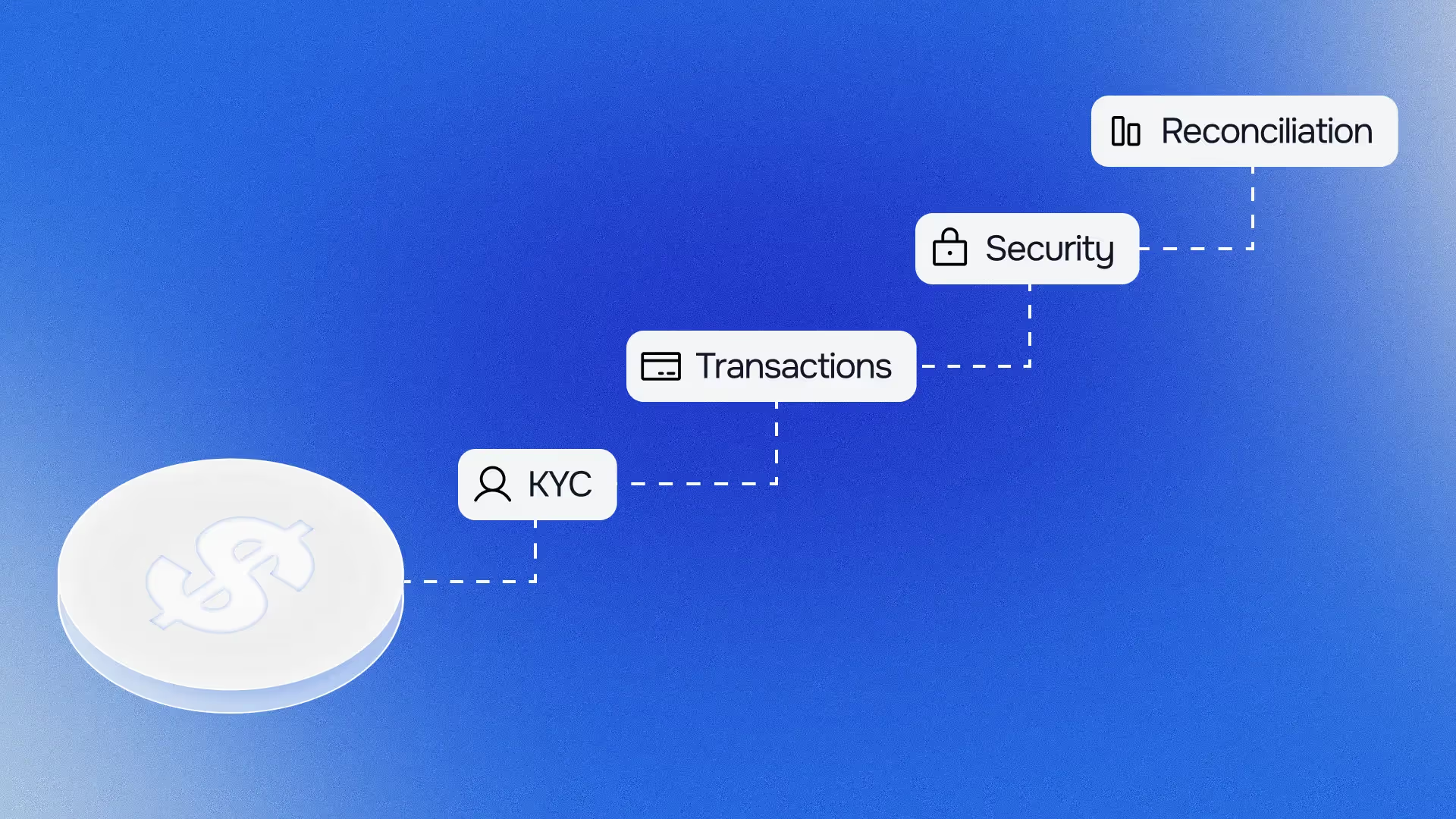
The four pillars of modern banking, efficiency, accuracy, compliance, and security, are all enhanced by automation. Automation standardizes processes to ensure consistency (efficiency), reduces human errors (accuracy), enforces regulatory rules (compliance), and secures data through encryption and audit trails (security). These pillars form the foundation for resilient financial operations in today’s dynamic landscape.
Which AI is best for banking?
Agentic Process Automation (APA), powered by autonomous AI agents, is the most advanced solution for banking. Unlike traditional RPA, which follows rigid rules, AI agents understand context, plan multi-step actions, and adapt to exceptions. For example, they can autonomously reconcile complex transactions or flag fraud in real time. Platforms like Phacet’s AI agent system are designed specifically for finance teams, combining autonomy with human oversight ("human-in-the-loop") to ensure control and auditability.
What is automation in simple words?
Automation is using technology to handle repetitive tasks without constant human input. In banking, this means systems can "do the heavy lifting" for operations like transaction matching, fraud checks, or compliance reporting. It’s about making processes faster, more accurate, and less resource-intensive, so teams can focus on strategic work. As one CFO noted, automation is "intuitive, everyone gets it," turning complex workflows into seamless, reliable actions.

Latest Resources


Unlock your AI potential
Go further with your financial workflows — with AI built around your needs.


