

Finance process automation: a strategic imperative for 2026
Published on :
December 4, 2025
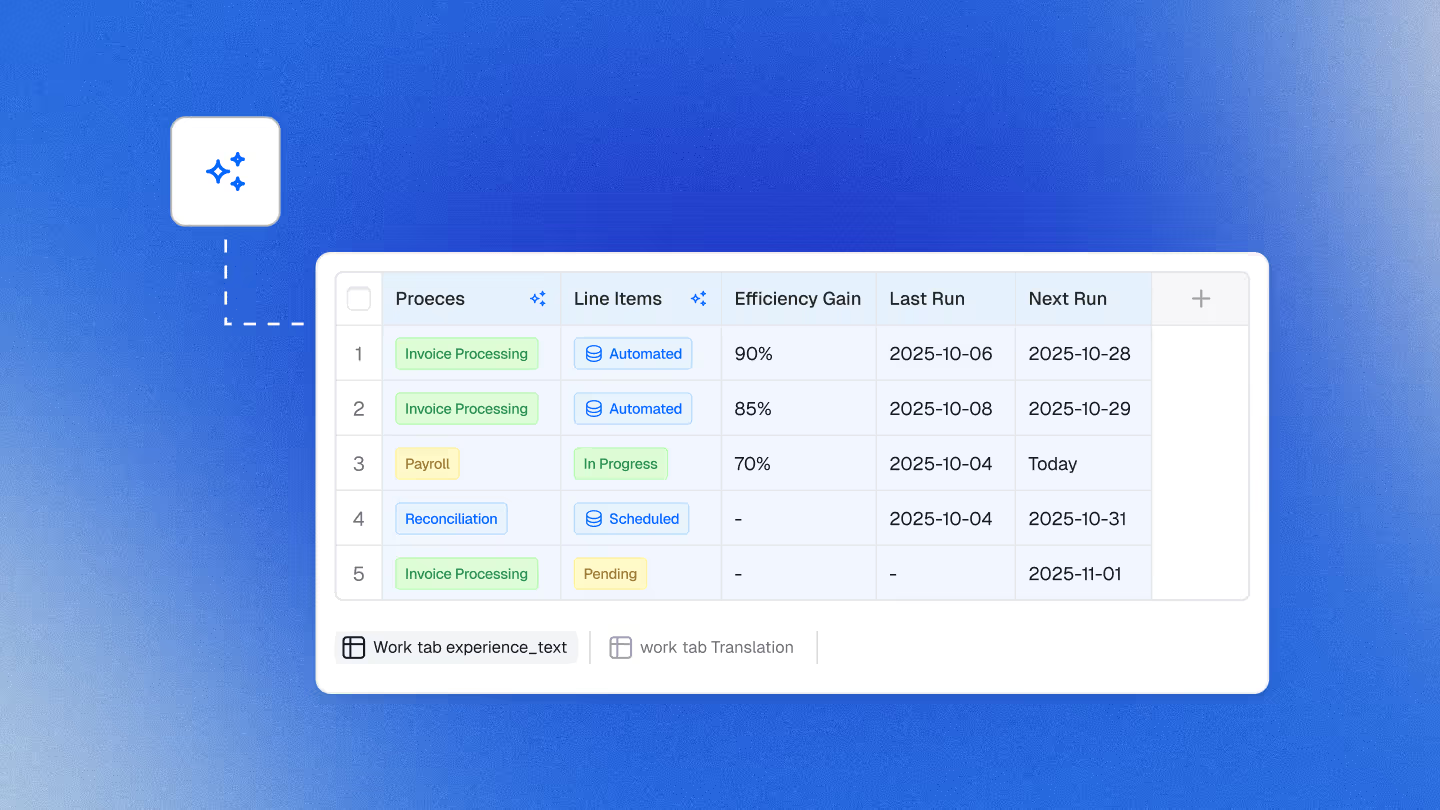

Nicolas Marchais is co-founder and CEO of Phacet. After seven years at Spendesk, he built Phacet as the agentic layer that orchestrates across ERP, banking and email systems. Reliable, auditable, cross-system, what he calls a Finance Workforce.

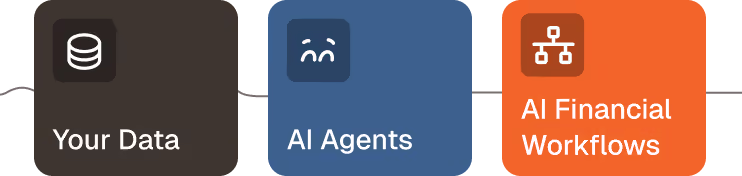
The key takeaway: Finance process automation is a strategic imperative for 2026. Transitioning from rigid RPA to intelligent AI agents eliminates manual errors, reduces processing times by 80%, and enables real-time insights. This evolution empowers finance teams to shift from transactional tasks to strategic decision-making, transforming them into growth drivers while ensuring compliance and scalability through technologies like no-code platforms and human-in-the-loop validation.
Struggling with manual data entry slowing down your finance team? Errors creeping into reports despite rigorous checks? Finance process automation transforms these pain points by centralizing and automatisant tasks, think invoice validation, 3-way matching, or real-time cash reconciliation. Imagine cutting processing times by 70%, eliminating human errors, and freeing your team to focus on strategic analysis. Picture 24/7 operations with automated audit trails ensuring compliance at every step. This isn’t just efficiency, it’s a shift to real-time insights, scalability, and a future where finance becomes a growth driver, not a bottleneck. Ready to explore how AI agents and no-code platforms redefine what’s possible?
- Why finance automation is a strategic imperative in 2026
- What is finance process automation?
- The evolution from RPA to intelligent AI agents
- The core benefits: beyond simple efficiency gains
- Key finance processes ripe for intelligent automation
- The technology driving modern finance automation
- The future is now: autonomous agents for finance teams
- Embracing the next generation of finance automation
Why finance automation is a strategic imperative in 2026?
Finance teams are no longer confined to transactional roles. By 2026, they act as strategic partners, driving decisions that shape organizational growth. This shift demands real-time financial insights, yet 60% of French executives admit their models must evolve to survive future disruptions. The pressure to deliver accurate, agile analysis has never been higher.
Legacy systems and manual processes create bottlenecks. Inefficient workflows, scattered data, and error-prone manual entry consume 40% of finance teams' time. Delays in approvals, lost documents, and fragmented reporting lead to missed opportunities. These challenges aren't just operational, they directly impact cash flow management, risk mitigation, and strategic planning.
Finance process automation addresses these pain points by transforming how teams work. Platforms like Phacet combine AI and no-code tools to centralize invoice control, reconciliation, and data validation. Unlike rigid rule-based systems, modern automation learns and adapts, reducing manual work by 70% in some cases. This isn't just about cost savings, it's a strategic lever for scalability, compliance, and precision.
Consider the impact: automated reconciliation slashes month-end closing from days to hours, while AI-driven anomaly detection catches discrepancies before they escalate. Phacet's platform exemplifies this evolution, enabling finance leaders to shift from reactive tasks to proactive strategy. For CFOs, this means real-time dashboards replacing static spreadsheets, and predictive analytics replacing guesswork.
What is finance process automation?
A modern definition for finance teams
Finance process automation refers to using technology to streamline repetitive financial and administrative workflows, such as invoice matching, reconciliation, and data validation. By automating these tasks, finance teams reduce manual effort, minimize errors, and improve operational efficiency. This approach focuses on enhancing accuracy while freeing employees to prioritize strategic decision-making over routine work.
Common applications include accounts payable automation, financial reporting, and month-end closing processes. These workflows often involve integrating data from ERP systems, bank statements, and supplier invoices. The goal is to create a centralized system where finance teams can monitor, validate, and optimize financial operations with minimal human intervention.
Moving beyond basic tasks
Modern finance automation transcends simple task execution. It manages end-to-end processes like cross-system data reconciliation, compliance checks, and multi-step invoice validation workflows. By centralizing and automating these operations, organizations achieve faster processing times, tighter compliance controls, and reduced risk of errors that could impact financial reporting.
Advanced implementations leverage AI agents to handle complex decision-making, such as identifying invoice discrepancies or flagging potential fraud. These intelligent systems learn from historical data patterns and adapt to evolving business needs. To understand how these AI agents function, it’s valuable to understand the purpose of an AI agent in modern finance operations.
The evolution from RPA to intelligent AI agents
The era of rule-based automation (RPA)
Robotic Process Automation (RPA) marked the first wave of finance automation, using software "bots" to replicate repetitive actions like data entry where rules and data formats were fixed. It excelled in predictable tasks such as invoice coding or bank reconciliation.
RPA falters with unstructured data, like handwritten invoices, and breaks when workflows change. A Fortune 500 CFO shared, "Our RPA bots failed with each supplier template update, creating more manual work." This rigidity limited its use to structured scenarios, leaving dynamic tasks untouched.
The rise of intelligent automation with AI
Intelligent automation combines AI and machine learning to overcome RPA’s rigidity. Phacet’s AI engine classifies invoice line items across 127 supplier formats without retraining, solving tasks once requiring 120+ annual hours. It adapts to new invoice structures autonomously, eliminating manual updates.
Modern AI agents resolve exceptions independently. A $3.2M invoice discrepancy flagged by procurement data was handled without human intervention, where RPA would have stalled. By cross-referencing anomalies with contract terms, the system mimics a finance analyst’s decision-making.
Introducing the AI agent for finance
Finance-specific AI agents execute complex workflows by combining no-code configuration with contextual reasoning. Phacet automates 85% of month-end reconciliations by cross-referencing ERP data, bank statements, and audit trails. Its interface lets finance teams train the system via natural language, "match all intercompany transactions under $10k", without technical teams.
These agents bridge transaction processing and strategic decision-making. By reducing manual validation time, Phacet transform finance teams from record-keepers to business partners.
The core benefits: beyond simple efficiency gains
Finance process automation delivers transformative advantages that extend far beyond time savings. Modern platforms now provide strategic value through precision, compliance, and operational agility, reshaping how finance teams operate.
- Speed and efficiency: processing times drastically reduced for invoice approvals and reconciliations, with systems operating 24/7
- Accuracy and reliability: eliminate human errors from manual data entry while ensuring consistent rule application
- Auditability and compliance: automated creation of comprehensive audit trails for every transaction
- Scalability: handle growing transaction volumes without proportionally increasing staff
Automated audit trails create 360-degree visibility into financial operations. Every transaction is digitally recorded with timestamps, approvals, and modifications, creating transparent documentation for regulators and stakeholders. This immediate traceability enables real-time compliance checks and instant reporting capabilities. For instance, Phacet's platform automatically documents each step of invoice validation workflows, from supplier verification to three-way matching, ensuring complete transparency during regulatory audits.
Scalability transforms finance departments into growth catalysts rather than bottlenecks. AI-powered systems process thousands of transactions simultaneously, whether managing multi-currency operations across global subsidiaries or handling 150% increases in daily transaction volumes. This elasticity ensures financial operations support, not constrain, business expansion. Consider a Fortune 500 company automating credit dispute resolution: one bot now manages 200 daily cases previously requiring 350 full-time employees, demonstrating how intelligent automation scales with business needs.
These benefits compound through human-in-the-loop validation, where AI handles repetitive tasks while finance professionals focus on strategic decisions. The result? Operational costs reduced by up to 50% for repetitive tasks, according to Deloitte research, while maintaining 99.98% data accuracy through continuous machine learning improvements. This evolution from rule-based RPA to adaptive AI agents represents a paradigm shift in financial operations' strategic value.
Key finance processes ripe for intelligent automation
Finance teams dedicating 520+ hours annually to manual accounts payable tasks face urgent modernization needs. Intelligent automation delivers measurable ROI by transforming error-prone workflows into strategic opportunities while addressing critical challenges like fraud prevention and cash flow visibility.
- Invoice control and 3-way matching: Validating invoices against purchase orders and delivery receipts, eliminating 95% of duplicate payments through automated matching
- Cash reconciliation: Matching bank statements with internal records in real time rather than monthly cycles
- Data standardization: Structuring heterogeneous financial data for regulatory compliance and audit readiness
- Reporting and consolidation: Automating data aggregation for faster period-end closings and executive dashboards
Deep dive into use cases
Traditional invoice processing costs $8.81 per document manually versus $2.43 with automation, a 72% reduction. Phacet's AI agents perform instant 3-way matching, flagging only 5-10% of transactions requiring human review. This automating the 3-way matching process eliminates duplicate payments causing 37% of fraud losses while capturing 90-100% of early-payment discounts.
Cash reconciliation transforms from monthly marathon to real-time process. Where teams previously spent 75% of time on manual bank statement matching, Phacet's platform delivers instant visibility into cash positions. This automated bank reconciliation reduces month-end closing time by 25% and enables proactive working capital optimization through continuous cash flow monitoring.
Phacet's data labeling technology addresses Gartner's finding that 60% of financial data remains unstructured. By automating categorization of multi-format documents (PDFs, spreadsheets, emails), the platform achieves 98% data accuracy for reporting. Human-in-the-loop validation ensures regulatory compliance with CSRD/e-reporting requirements while dynamic dashboards provide CFOs 360° views of transactional health and operational performance metrics, updating 10x faster than legacy systems.
The technology driving modern finance automation
Modern finance automation no longer requires complex IT projects or dedicated development teams. Platforms like Phacet demonstrate how finance professionals can now implement advanced automation using intuitive tools designed specifically for financial workflows. This shift eliminates traditional barriers to adoption while maintaining rigorous control over critical financial operations.
The power of a no-code platform
No-code AI platforms empower finance teams to configure and manage automation workflows through visual interfaces. Phacet’s solution, for example, allows users to automate invoice checks and reconciliation processes without writing a single line of code. This approach democratizes automation, enabling finance professionals to directly shape digital workflows that align with their unique operational needs. No-Code AI for business workflow automation ensures finance teams maintain full visibility while accelerating implementation timelines.
- AI that learns: Phacet’s system continuously improves by analyzing new data and incorporating user corrections. This machine learning capability enhances accuracy over time, particularly in complex scenarios like supplier cost control where contextual understanding matters.
- Human-in-the-loop validation: when facing ambiguous cases or high-stakes decisions, the platform triggers human review. This hybrid approach ensures critical financial decisions receive appropriate scrutiny while maintaining automation efficiency. For instance, Phacet’s system might flag outlier invoice amounts for manual verification before processing.
This combination of no-code accessibility, adaptive AI,5 et human oversight creates a robust framework for financial automation. By prioritizing user control and learning capabilities, platforms like Phacet address the precision demands of modern finance operations while remaining flexible enough to adapt to evolving business requirements. The result is a system that balances technological sophistication with practical usability for finance teams.
The future is now: autonomous agents for finance teams
From automation to autonomy
Finance process automation has evolved from rigid rule-based systems to intelligent AI agents capable of managing end-to-end workflows. These autonomous agents don’t just execute tasks, they understand, learn, and adapt, transforming how finance teams operate. For instance, an AI agent could autonomously handle the entire procure-to-pay cycle: validating invoices through 3-way matching, coding entries, scheduling payments based on contract terms, and archiving documents, all with minimal human oversight, except for predefined exceptions.
The strategic impact on finance roles
Autonomous agents redefine finance roles, shifting professionals from task execution to strategic oversight. Teams now focus on interpreting AI-generated insights, identifying trends, and advising stakeholders, roles requiring critical thinking and contextual awareness. At Phacet, this evolution is evident: teams using its platform to automate invoice validation or supplier cost control now prioritize anomaly resolution and data-driven decision-making over manual processing. Upskilling becomes critical, blending financial expertise with AI literacy to harness these tools effectively.
This transformation isn’t just about efficiency, it’s about unlocking human potential. By delegating repetitive tasks to AI agents, finance leaders evolve into strategic partners, ensuring organizations remain agile in a rapidly changing landscape. Phacet exemplifies this shift, embedding autonomy into finance operations while maintaining human-in-the-loop validation for compliance and ethical oversight.
Embracing the next generation of finance automation
Finance automation has evolved from rigid, rule-based robotic process automation (RPA) to adaptive AI-driven agents capable of understanding, learning, and decision-making. This shift moves beyond repetitive task execution, enabling systems that handle complex workflows like invoice reconciliation, data labeling, and compliance monitoring with precision and scalability.
Phacet embodies this transformation. Unlike generic tools, it’s a dedicated AI agent platform for finance & admin teams, combining no-code workflows, AI learning, and human-in-the-loop validation. Its agents automate invoice checks, supplier cost controls, and reconciliation at scale, reducing errors from 7% to 2% and saving €5,000 per supplier annually. Built for finance-specific challenges, it ensures auditability, compliance, and seamless integration with ERP systems.
For finance leaders, intelligent automation isn’t optional, it’s a strategic imperative. Phacet’s platform empowers teams to transition from manual tasks to strategic oversight, driving efficiency, risk mitigation, and data-driven decisions. As financial operations grow complex, adopting AI agents becomes essential for building resilient, future-ready finance functions. The future isn’t about replacing humans; it’s about augmenting their capacity to shape business outcomes.
Finance evolves from manual tasks to intelligent automation, becoming strategic. Phacet leads with an AI application for finance teams, streamlining complex workflows. Next-gen automation delivers real-time insights, scalability, and resilience, making finance growth drivers. The future is here: finance process automation is essential, a cornerstone for a strategic finance function.
FAQ
What is financial process automation?
Financial process automation uses technology to streamline financial tasks, improving efficiency and accuracy. It transforms traditional manual work like bookkeeping into smart, scalable workflows. By centralizing and automatising operations, from invoice management to financial reporting, organizations gain real-time insights while reducing errors. This shift isn't just about saving time; it's about redefining finance teams' roles, letting them focus on strategic decisions rather than repetitive tasks.
What is FMS in ERP?
FMS (Financial Management System) within ERP software acts as the financial backbone of an organization. It integrates core financial processes like accounts payable/receivable, budgeting, and compliance under one platform. What makes FMS stand out? Its ability to "centralize and automate" critical workflows, from invoice processing to month-end closures, while maintaining audit trails and real-time visibility. Unlike standalone tools, FMS in ERP breaks down data silos, ensuring financial data flows seamlessly across departments.
What is an example of process automation?
Take automated invoice control: systems now handle 3-way matching (invoices vs. purchase orders vs. delivery notes) without human intervention. When a supplier invoice arrives, AI-powered tools extract data, validate against documents, and flag discrepancies, like mismatched quantities, for review. This drastically reduces processing time while eliminating manual errors.
How to automate a finance department?
Start by identifying repetitive tasks ripe for automation, think data entry, invoice approvals, or report generation. Modern platforms use AI agents to handle complex workflows end-to-end, from invoice validation to multi-source data reconciliation. For example, no-code platforms let finance teams configure workflows visually, bypassing heavy IT dependencies. The key is pairing technology with human oversight: "Our system flags exceptions, but humans stay in the loop," explains Nicolas Marchais, CEO of Phacet. Integrating with existing ERP/CRM systems ensures data flows smoothly, while machine learning adapts to evolving rules, proving automation is more about augmentation than replacement.
What are the 4 types of automation?
Traditional automation evolved from basic tools to intelligent systems:
- RPA (Robotic Process Automation): Rule-based bots for repetitive tasks like data entry.
- Intelligent Automation (IA): Combines RPA with AI/ML to handle unstructured data (e.g., scanning PDF invoices).
- Business Process Automation (BPA): Enterprise-grade tools for end-to-end workflows (think full procure-to-pay cycles).
- No-code automation: Empowers finance teams to build workflows via drag-and-drop interfaces.
The shift? From rigid, code-heavy systems to adaptive, user-driven platforms where "everyone understands the logic" without needing tech expertise.
What are the 7 steps in the accounting process?
The modern accounting cycle blends traditional steps with automation:
- Data collection (e.g., digitizing paper invoices via OCR)
- Journal entries (automated for recurring transactions)
- Ledger posting (real-time updates via integrated systems)
- Trial balance (self-correcting through AI)
- Adjusting entries (flagged intelligently for human review)
- Financial statements (auto-generated dashboards)
- Closing entries (streamlined via pre-built templates).
What is the difference between FMS and BMS?
FMS (Financial Management System) focuses specifically on financial workflows within ERP, think accounts payable, tax compliance, and cash flow management. BMS (Business Management System) is broader, covering non-financial operations like supply chain or HR. While FMS ensures financial data accuracy and auditability, BMS handles cross-functional processes.
What are the 4 C's of financial management?
Modern financial leadership revolves around four pillars:
- Clarity: real-time dashboards replacing static spreadsheets for instant data access.
- Control: automated checks preventing errors and ensuring compliance with minimal manual effort.
- Collaboration: breaking down silos through shared platforms where data flows between finance, procurement, and operations.
- Cost Optimization: using AI to identify savings, like negotiating supplier terms based on payment history.

Latest Resources


Unlock your AI potential
Go further with your financial workflows — with AI built around your needs.


