
How AI is reinventing the finance function – with Rodolphe Ardant, founder of Spendesk
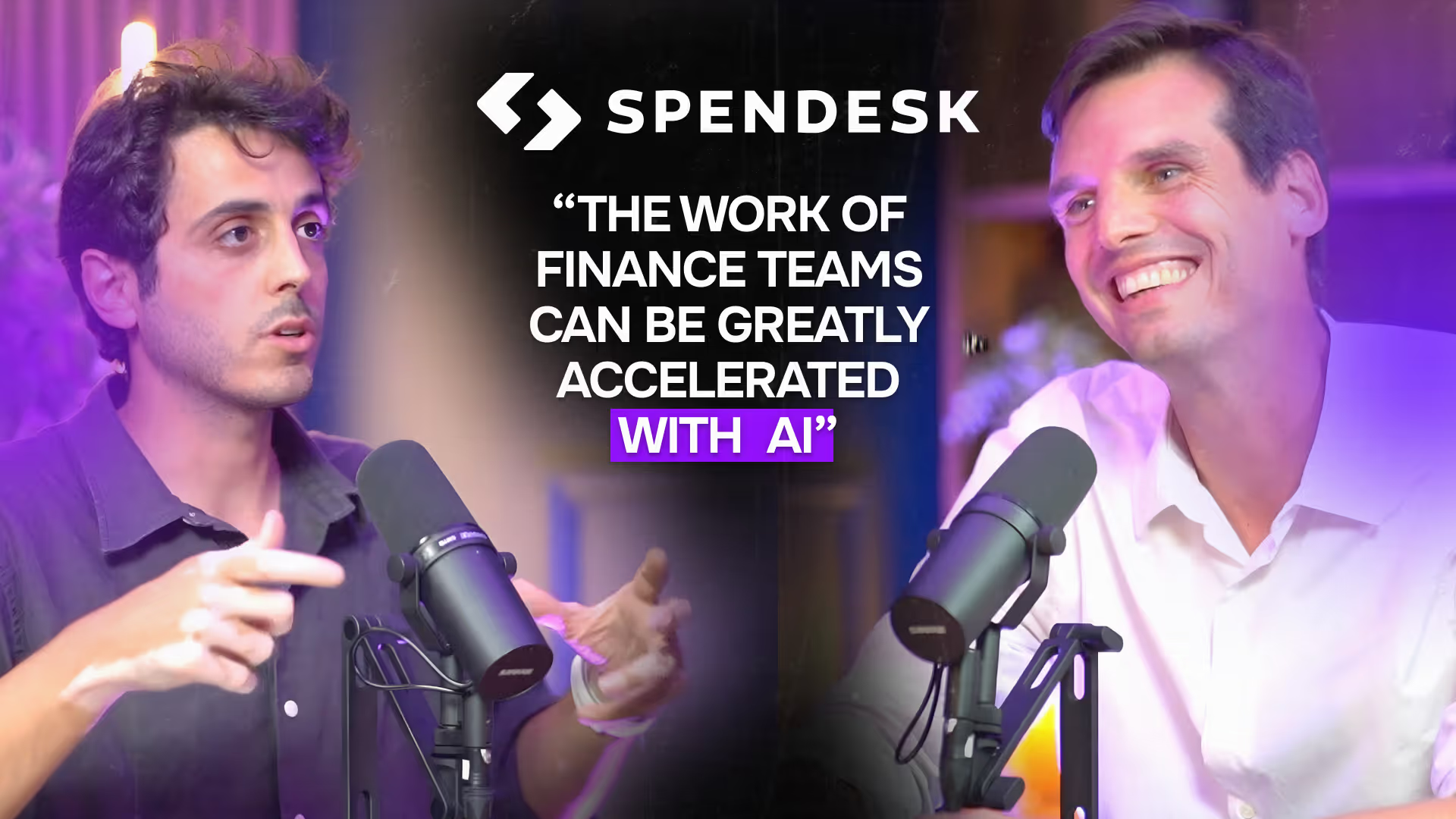
In this episode of *My First AI*, Nicolas sits down with Rodolphe Ardant, founder and CEO of Spendesk — a European scale-up managing more than €20 billion in annual spending. Together, they explore a central question: how artificial intelligence is transforming the finance function — from automating tasks to reshaping entire organizations.
Published on :
September 11, 2025

.avif)
In this episode of *My First AI*, Nicolas sits down with Rodolphe Ardant, founder and CEO of Spendesk — a European scale-up managing more than €20 billion in annual spending. Together, they explore a central question: how artificial intelligence is transforming the finance function — from automating tasks to reshaping entire organizations.
The founding vision: freeing the finance function
Founded in 2016, Spendesk was born from a simple observation: finance teams are often trapped in their own processes.
Employees spend countless hours validating, re-entering, and controlling data across multiple disconnected tools.
“Our mission is to remove constraints — to free people so they can make the decisions they’re supposed to make.”
From day one, Spendesk positioned itself as a bridge between banks and ERPs — a one-stop platform to manage all company expenses, from employee cards to supplier invoices.
AI at the core of the product
Unlike most companies discovering AI in 2023, Spendesk has been experimenting with it since the very beginning.
As early as 2017, the team built machine learning models to automate document classification and accounting entries.
That’s how Marvin, Spendesk’s first internal agent, was born.
“Back in 2017, our models were already extracting VAT and categorizing expenses automatically.”
But the rise of large language models (LLMs) marked a turning point.
Spendesk began replacing traditional components — like OCR — with generative models that are faster, cheaper, and far more accurate.
“We replaced our OCR with an LLM that reached 99% accuracy for a fraction of the cost.”
This shift moved Spendesk from automation to intelligence — from tools that execute to systems that understand and anticipate.
The finance function in the age of AI agents
For Rodolphe, the impact of this shift goes far beyond technology.
It’s the very structure of financial work that is being redefined.
“The finance function will become highly automated. Human value won’t come from processing anymore, but from supervision and decision-making.”
Tomorrow, accountants won’t enter data — they’ll supervise autonomous agents that do it for them.
FP&A teams won’t spend days consolidating spreadsheets — they’ll focus on analyzing, predicting, and acting.
“Humans will no longer produce financial data. They’ll supervise AI assistants that run continuously.”
This shift makes work more strategic — but also more demanding.
In finance, reliability isn’t optional. An AI “hallucination” isn’t just a bug — it can have real consequences.
Transforming a company from within
Adopting AI is not just a product move. It’s a cultural transformation.
At Spendesk, it happened around three pillars: leadership, education, and experimentation.
“The organization has to be ready, willing, and capable.”
The movement started bottom-up.
Employees curious about AI began testing ChatGPT and building small automations for their teams.
Then, the company built an internal infrastructure: secure access to models, AI champions in each department, and a clear experimentation framework.
“People at Spendesk use AI every day — but in a safe, structured environment where data and reliability come first.”
Today, this mindset drives everything — from product to hiring.
The company rewards initiative, embraces fast learning, and even celebrates failed experiments as part of the process.
Real use cases and measurable impact
Some impacts are already visible.
One internal agent, Ask Product, centralizes all product knowledge for sales, support, and product teams.
“Before, you had to ask three people to know if a feature existed. Now, everyone gets the answer instantly.”
The result: faster customer responses, better alignment, and less noise.
In customer support, AI has also reduced response times and improved satisfaction.
Meanwhile, sales and marketing teams now use AI agents to generate content, emails, and presentations tailored to each sales cycle.
Keeping humans at the center
Despite all these changes, Rodolphe insists on one principle: AI doesn’t replace people — it amplifies them.
Automation frees up time, but it’s up to each company to use that time wisely.
“The risk isn’t the technology. It’s not learning fast enough.”
For Rodolphe, success comes down to agility.
Even at scale, companies must keep the startup mindset — test, learn, iterate, rebuild.
“This isn’t a tool revolution. It’s a mindset revolution.”
What Spendesk teaches us
Spendesk shows that AI can be integrated not as a gimmick, but as a structural force — a driver of efficiency, learning, and continuous transformation.
In a world where finance teams are being redefined, AI is no longer an experiment. It’s a new paradigm.
“The faster we learn, the better it will be for everyone.”
Explore more from Phacet
%20(1).png)

Unlock your AI potential
Go further with your financial workflows — with AI built around your needs.


