

How AI Is Transforming the Enterprise
When you speak with Florian Douetteau, CEO and co-founder of Dataiku, you quickly understand that the story of artificial intelligence in the enterprise did not begin with ChatGPT.
Published on :
November 23, 2025
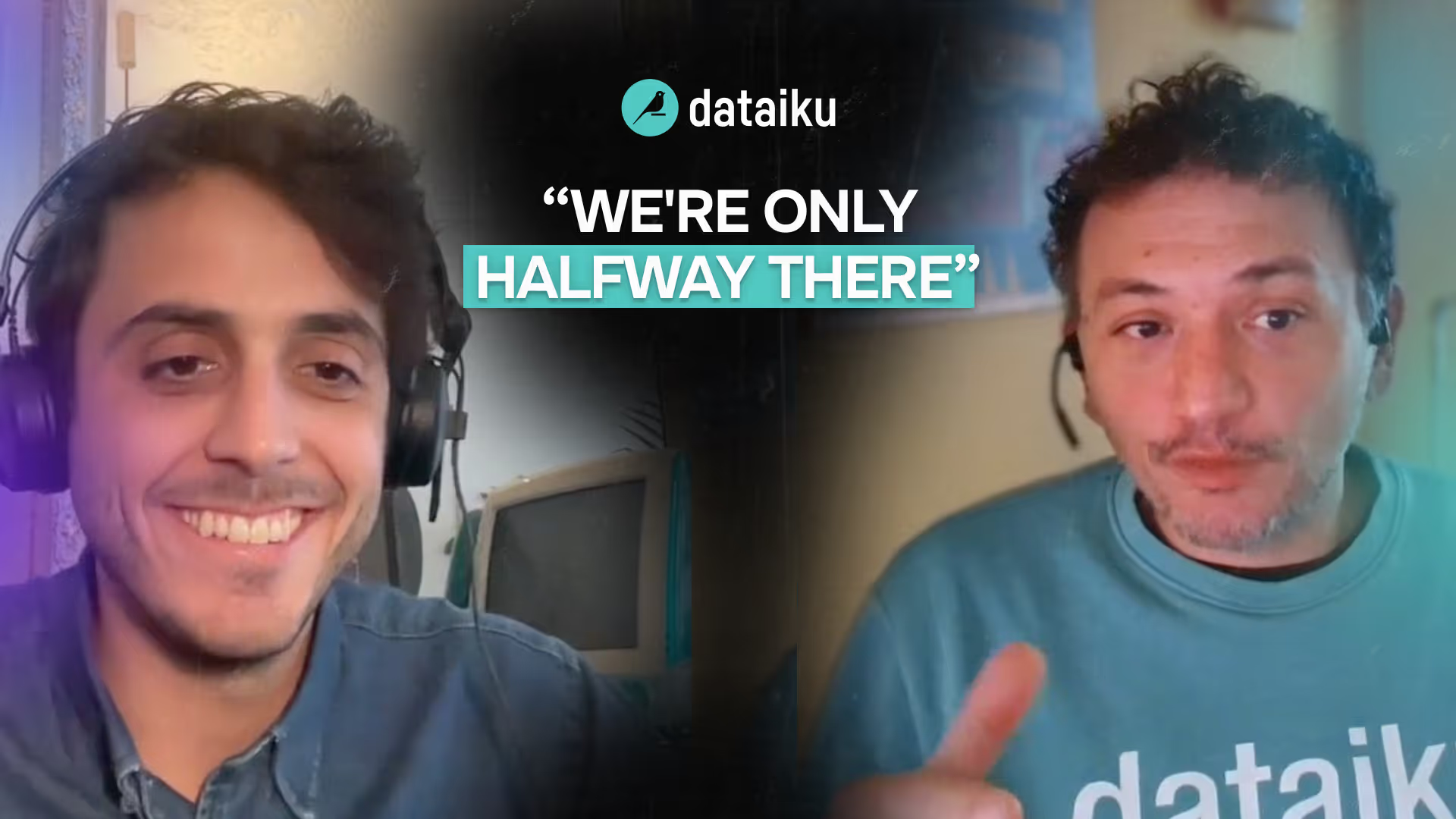


When you speak with Florian Douetteau, CEO and co-founder of Dataiku, you quickly understand that the story of artificial intelligence in the enterprise did not begin with ChatGPT.
For more than ten years, he has observed, built, and supported organizations in their use of data - long before generative models reached the mainstream.
His perspective is valuable: he has witnessed every technological wave, from the early days of machine learning to the rise of AI agents, and he has learned to distinguish structural trends from passing hype. The central question of this episode is simple: how is AI transforming today’s enterprise - concretely and sustainably?

A Transformation More Than Ten Years in the Making
When Florian founded Dataiku more than a decade ago, his intuition was straightforward: data transformation could not come solely from technical experts. It had to come from the business, from those who understand internal processes, edge cases, and everyday decision-making.
“My intuition was that transformation wouldn’t happen by hiring hundreds of data scientists, but by changing the work.”
At the time, companies were only beginning to organize their data. Cloud adoption was still emerging, deep learning was just taking off, and AI was largely predictive. Yet the core challenges were already there: optimizing production lines, improving customer targeting, forecasting demand, increasing quality.
Since then, each year has brought a new technological wave - storage, models, infrastructure, cloud, deep learning, then generative AI, and now agents.
For Florian, these waves form a long continuum:
“AI is a domain being built over 20 or 30 years. We’re only halfway there.”
The Invariants: Data, Processes, People
Even as technology evolves at high speed, the fundamentals remain surprisingly stable. For an AI project to have real impact, three pillars are essential: data, processes, people.
- Data, because it is the raw material.
- Processes, because a model is useless if it isn’t embedded in an operational flow.
- People, because real knowledge - the rules, exceptions, and tacit understanding - lives in their heads.
“Human expertise is perhaps the most important aspect. Understanding the real process and how to change it is never written anywhere.”
This leads to a strong conviction: the most impactful AI projects are not driven by IT alone, but by those who operate the business, empowered with the right tools.
The Agent Shift: Making AI Truly Actionable
Before generative AI, companies already had many use cases: demand forecasting, automated quality control, customer scoring, predictive maintenance…
But the models were constrained by one critical limitation: actionability.
A predictive model that isn’t embedded in a system remains a report. To drive impact, it must be integrated, industrialized, and adopted.
This is where agents change the equation.
“The agent paradigm unlocks use cases that were difficult to deploy before. It creates a new interface for action.”
Take the retail sector: historically, the online experience became better than the in-store experience because frontline teams lacked the right tools. Now, a store associate with an agent can access real-time inventory, understand recommendations, and guide customers with a level of precision that legacy systems didn’t allow.
It’s a subtle but massive shift: AI is no longer just predicting - it acts.
A Global Shift, Driven by Cultural Differences
Dataiku works with major enterprises around the world: banks, insurers, manufacturers, pharma companies, retailers… What Florian sees confirms some clichés, but not all.
“Large American enterprises can sometimes be 6 to 18 months ahead in terms of decision-making and investment.”
Yet the gap is not mainly geographical - it’s cultural:
- appetite for innovation
- willingness to experiment
- ability to make IT and business work together
- company-wide data and AI literacy
The most advanced organizations are those that have built an internal culture of data and AI, not those simply located in a specific region.
“The fundamental difference is more about company culture.”
Building a Transformation: From Quick Wins to Complete Redesign
With hundreds of potential use cases, where should companies begin? Florian identifies three levels:
1. Obvious quick wins (Level 1)
Using AI-powered tools for clear functions: customer service, call centers, software development.
These are useful and necessary - but not differentiating.
“It’s the new state of the art. It’s not fundamental transformation.”
2. High-impact business use cases (Level 2)
Building agents for complex processes that combine multiple sources of data.
This is where real value emerges.
3. Redesigning critical processes (Level 3)
Some functions - customer onboarding in banking, supply chain operations, clinical trial management - cost hundreds of millions because they rely on fragmented information flows.
“In 5 to 10 years, these major processes will be managed very differently.”
This level requires rethinking the organization, not just adding AI into the existing workflow.
A New Foundational Layer: Enterprise Reasoning
Over the past ten years, enterprises have invested massively in structuring their data.
For Florian, the next decade will focus on something else: formalizing reasoning.
“Decision-making is stuck inside people’s heads. That layer needs to be made explicit and managed.”
His conviction is strong: organizations will need to translate their culture, rules, and decision frameworks into a layer that guides their agents and AI systems. Not a generic or externalized layer - a faithful expression of their identity.
This is where Dataiku aims to play its role: providing the environment to build, govern, and maintain this new layer.
AI Is Also Changing How People Work
Inside Dataiku, AI is already transforming day-to-day work. Every employee is trained and certified on the platform, including non-technical roles.
“There’s an aspect of literacy, of play, of personal appropriation.”
Teams use the platform to automate tasks, prototype ideas, and accelerate their work.
At the organizational level, the impact is real but measured: Dataiku continues investing in people while integrating efficiency gains enabled by AI.
A New Ambition: AI as a Vector of Identity
Throughout the episode, one theme stands out: AI should not standardize enterprises - it should reinforce what makes them unique.
“The company must explicitly manage how it does business. It’s not just a temperature parameter in a model.”
Florian rejects the idea of a fully generic automation layer that absorbs emails and recreates processes. Instead, he advocates an AI that embodies the organization’s culture and principles.
Conclusion: A Transformation Already Underway
The transformation of the enterprise through AI is not a futuristic project.
It is already happening, driven by:
- the empowerment of business teams
- the rise of AI agents
- the formalization of enterprise reasoning
- and above all, a new culture of work
What Florian Douetteau shows is that this transformation is not a sudden break, but a continuous evolution more than a decade in the making.
And it is only just beginning.

Explore more from Phacet
%20(1).avif)

Unlock your AI potential
Go further with your financial workflows — with AI built around your needs.


