AI for finance teams: automate routine, elevate strategy
Published on :
February 16, 2026


Nicolas Marchais is co-founder and CEO of Phacet. After seven years at Spendesk, he built Phacet as the agentic layer that orchestrates across ERP, banking and email systems. Reliable, auditable, cross-system, what he calls a Finance Workforce.

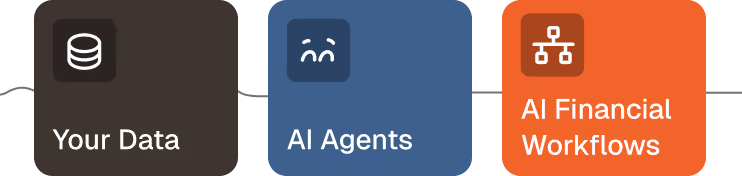
Key takeaway: AI revolutionizes finance teams by moving from reactive reporting to proactive strategic planning. It automates repetitive tasks, drastically reduces errors, and accelerates financial closings. With the ability to analyze millions of data points, AI detects issues 3-4 months earlier and provides actionable insights. This positions finance as a true business partner driving growth and efficiency.
AI for finance teams eliminates manual data entry, spreadsheet errors, and delays in reporting that hinder strategic decisions. By centralizing data and automating repetitive tasks like invoice processing and cash reconciliation, it transforms reactive analysis into proactive strategy with intuitive tools. This reduces errors by up to 90%, cuts month-end closing times by 50%, and provides real-time insights for smarter decisions. Finance teams shift focus to strategic forecasting, scenario planning, and business partnerships, driving growth. Companies achieve faster closings, higher accuracy, and measurable ROI, proving AI is critical for modern finance success.
- Why modern finance teams need more than just spreadsheets
- Beyond simple automation: the rise of AI agents in finance
- Practical use cases: how AI is already transforming core finance functions
- The tangible ROI of AI for finance teams
- Your roadmap to an AI-powered finance department
Why modern finance teams need more than just spreadsheets?
Finance teams are under growing pressure as data volumes surge and manual tasks pile up. Traditional tools like Excel can’t keep up with today’s complexity, leading to errors, delays, and stalled decision-making. Strategic discussions slow down as teams get buried in spreadsheets.
AI fundamentally shifts finance from reactive to proactive. By analyzing real-time data, it delivers instant insights and helps teams anticipate risks before they escalate. This transformation drives faster decisions, more accurate forecasts, and far more agile responses.
Automation takes over repetitive activities such as reconciliations and reporting, reducing errors by 32% and accelerating month-end closing by 25%. Each manual invoice error costs more than $50 to fix, and processing takes 3.2 days with automation compared to 10.3 days manually. Freed from low-value tasks, finance teams can finally focus on meaningful analysis.
Today, 88% of organizations already use AI in their business functions, and finance leaders report being able to work 70% faster thanks to it. Rather than eliminating roles, AI reallocates resources to more strategic activities, boosting productivity, innovation, and overall impact. McKinsey notes that this shift frees up 30–40% of team capacity for higher-value work.
Data quality remains a critical success factor. While 67% of executives point to weak data foundations as a barrier, the right infrastructure unlocks immediate ROI. With solid data, AI consistently delivers the same 30–40% capacity gains and enables finance to operate proactively rather than reactively.
AI agents are also emerging as a new layer of leverage, handling routine tasks with minimal human involvement. By 2028, 75% of finance leaders expect this to be standard. This allows teams to concentrate on strategy and innovation, provided security and governance remain strong. Companies that partner with specialized vendors see success rates rise by an additional 5%.
The impact is already clear: finance teams using AI report 90% immediate, measurable benefits. Compliance improves by 32% through automated checks, and real-time data integration leads to smarter, faster decisions, all without increasing headcount.
Beyond simple automation: the rise of AI agents in finance
Traditional RPA follows strict, predefined rules. It works well for simple, structured tasks but lacks the adaptability needed for modern finance operations. It can’t interpret unstructured data or adjust when conditions change. AI agents, by contrast, operate autonomously using machine learning to understand context. They orchestrate entire workflows end-to-end, process invoices directly from PDFs, and adapt to new scenarios without manual intervention. This shift enables finance teams to scale operations without adding headcount, even when handling complex activities like bank reconciliations or tax validation.
In finance, AI agents function as intelligent digital collaborators. They can run full processes such as Procure-to-Pay or cash flow forecasting, integrating seamlessly with ERP systems. These agents extract data from PDF invoices using OCR, validate it against purchase orders, and interpret unstructured information with accuracy. Because they continuously learn, they can adapt to new regulations or business rules without requiring manual updates. Their purpose is clear: reduce processing errors, enforce strict compliance with standards like SOX and GDPR, and free teams to focus on strategic work, leading to higher employee satisfaction and retention.
This approach doesn’t just speed up existing tasks; it reimagines finance workflows for maximum efficiency. Analysts move away from manual data manipulation and toward advisory roles. Finance becomes a proactive business partner, concentrating on high-value activities such as risk management, scenario modeling, and guiding leadership on growth opportunities. Centralized, automated processes reduce costs, increase scalability, and improve cash flow visibility, empowering smarter, data-driven decisions across the organization.
Take accounts payable as an example. An AI agent can sort incoming emails, extract invoice information using OCR and NLP, match it against purchase orders and receipts, flag discrepancies for review, and automatically process valid invoices. This end-to-end automation cuts processing time by up to 80%, prevents duplicate payments, and ensures suppliers are paid on time. Finance teams gain real-time visibility into cash flow, allowing proactive liquidity management and early detection of potential shortfalls. Month-end closing becomes significantly faster, and forecast accuracy can improve by up to 40%, strengthening overall financial planning.
Practical use cases: how AI is already transforming core finance functions
Financial planning & analysis (FP&A)
AI is transforming FP&A by analyzing millions of data points to deliver highly precise forecasts. It validates assumptions, detects budget variances in real time, and clearly explains discrepancies. Teams can generate multiple scenarios in minutes, accelerating strategic planning. Automated reports and dashboards give leadership clean, actionable insights.
Predictive models reduce forecasting errors by up to 50%, ensuring more reliable projections. Automated expense categorization and tighter budget control streamline the monthly close. Resource allocation becomes smarter and more efficient as AI optimizes decisions across multiple variables.
With AI-driven FP&A, organizations move toward continuous planning, adjusting instantly to market shifts. Real-time performance tracking highlights emerging trends before they impact the business, shifting finance from reactive to proactive and increasing ROI on financial tools.
Continuous learning algorithms further enhance forecast accuracy over time, keeping finance teams ahead of changing conditions. By integrating data from multiple sources, AI creates a single source of truth, strengthening visibility and decision-making across the entire organization.
Accounts payable and receivable automation
AI streamlines accounts payable by fully automating invoice processing. It extracts key data, matches invoices with purchase orders, and flags discrepancies instantly. With 3-way matching, a critical control to prevent incorrect payments, approval cycles become faster and far more reliable. (See how 3-way matching works in practice in this detailed use case from Phacet : 3-way matching automation).
AI handles the entire flow end-to-end:
- Automatically receive and sort invoices from email inboxes
- Extract and validate key fields such as supplier, amount, currency, and date
- Match invoices to purchase orders and receipts without human intervention
- Flag any discrepancies for quick human review and resolution
This reduces processing time by up to 70%, lowering operational costs and strengthening supplier relationships. Finance teams can shift away from repetitive reconciliation work to focus on higher-value activities.
Automated approval workflows ensure on-time payments while enforcing internal policies. The system’s self-learning capabilities continuously reduce exceptions and improve data quality, resulting in more reliable financial reporting across the organization. With consistent data matching, supplier disputes drop significantly and overall AP efficiency rises.
Treasury and cash management
AI transforms treasury management by providing real-time cash visibility. It automates bank reconciliations, anticipates liquidity needs using historical patterns, and turns cash reconciliation into a proactive process. Many companies are already adopting AI-powered cash reconciliation practices to streamline these workflows, as illustrated in this use case on automated cash reconciliation.
Organizations using AI for cash forecasting are 1.5× less likely to face liquidity crises. By dynamically analyzing market trends, AI significantly improves cash flow accuracy, enabling finance teams to optimize investments and reduce exposure to risk.
Real-time cash position updates empower teams to manage debt proactively and respond quickly to market shifts. This minimizes financing costs and maximizes returns on excess liquidity. Additionally, AI-driven models simulate economic scenarios, strengthening financial resilience and improving long-term planning.
The tangible ROI of AI for finance teams
Drastically reduce manual work and improve accuracy
AI automates core finance tasks such as reconciliations and journal entries, dramatically reducing manual workload and cutting reconciliation errors by more than 95%. Teams gain confidence in the accuracy of their data, strengthening both compliance and reporting quality.
According to Deloitte, 12.4% of finance professionals cite improved accuracy as one of the most significant benefits of AI. This level of precision reduces compliance risks, limits audit findings, and eliminates the need for repetitive manual checks.
AI also accelerates the financial close. Public.com, for example, shortened its closing cycle by two full days using Numeric’s AI platform. With real-time validations catching discrepancies early, teams avoid last-minute month-end pressure.
Automated workflows significantly enhance audit readiness as well. Every transaction becomes fully traceable back to its source data, reducing the time and effort required to prepare for audits while ensuring a cleaner, more transparent financial trail.
Enhance strategic decision-making with better insights
AI unifies fragmented data sources into a single, reliable view of the business. With this integrated visibility, finance teams can spot emerging issues 3–4 months earlier than with manual methods, allowing them to address risks before they escalate.
Real-time analytics deliver immediate insights into trends, anomalies, and performance shifts. Teams can adjust strategies instantly, strengthening operational agility and ensuring alignment with broader business objectives.
CFOs leverage these insights to make smarter decisions about resource allocation. Predictive models accurately forecast cash flow needs, ensuring liquidity is maintained and supporting strategic growth initiatives.
These same predictive capabilities identify cash flow shortages weeks in advance, enabling proactive budget adjustments. This early visibility helps prevent liquidity crises and fosters sustainable, long-term growth.
Scale finance operations without scaling headcount
AI acts as a force multiplier for finance teams, enabling them to handle growing workloads without adding headcount. This scalability is especially valuable for SMBs and fast-growing enterprises looking to do more with limited resources.
AI delivers impact across four core dimensions:
- Time savings – Automating repetitive tasks speeds up closing cycles and frees capacity
- Risk reduction – Fewer manual errors and earlier detection of anomalies
- Better decisions – Unified data and predictive analytics unlock deeper insights
- Cost efficiency – Higher productivity without increasing staff
This shift is accelerating: 85% of organizations increased their AI investments this year, allowing finance teams to move from manual execution to strategic analysis. The result is stronger team performance and tangible business impact.
Across industries, companies are seeing up to 40% productivity gains from AI automation. With routine work handled by intelligent systems, finance teams can focus on high-value strategic initiatives, enhancing resilience, improving planning accuracy, and fueling innovation across the organization.
How to choose the right AI solution for your team?
Focus on seamless integration and business value
Seamless integration with existing ERP and accounting systems is essential. A solution must address real business challenges, not just deliver technology for its own sake. Phacet’s platform centralizes and automates core finance operations, reducing errors and saving time. You can explore our approach to finance automation directly on Phacet.
Without smooth integration, teams risk costly mistakes and operational inefficiencies. A finance-centric platform delivers immediate value while minimizing workflow disruption. The goal is to enhance your current processes, not complicate them.
By automating repetitive tasks such as reconciliations and reporting, finance teams gain time for strategic work. This shift drives productivity and innovation. Manual data entry is replaced with real-time insights, enabling faster and smarter decision-making.
Prioritize robust security and compliance standards
Financial data security is non-negotiable. Providers must adhere to SOC 2, GDPR, and ISO 27001 standards. End-to-end encryption and detailed audit trails safeguard sensitive information, ensuring full compliance and reducing risk.
Overlooking security exposes organizations to data breaches, regulatory penalties, and reputational harm. It’s essential to choose a provider with strong, transparent security protocols to protect your most critical assets. Compliance is not optional, it’s a business imperative.
Proactive security measures reinforce trust with stakeholders and regulators. They demonstrate a commitment to financial data integrity and strengthen the organization’s overall resilience.
Evaluate the partnership and long-term support
Long-term support is crucial for sustained AI success. Your provider should offer deep finance expertise, responsive assistance, and comprehensive training. A strong partnership ensures a smooth implementation and helps maximize ROI.
Select a partner who truly understands your industry’s challenges. They should provide ongoing guidance and help you scale solutions as your organization grows. This ensures continued value well beyond the initial deployment.
Your roadmap to an AI-powered finance department
Start with high-impact, low-complexity processes such as supplier invoicing or bank reconciliation. These are the ideal pilots to prove the value of AI quickly, reduce risk, and secure internal buy-in. Specialized platforms like Phacet deliver far higher success rates, 67% vs. 33% for internal builds, because they’re designed specifically for finance teams.
With Phacet, automating accounts payable can cut processing time by 40%, reduce errors by 90%, and accelerate closing cycles. Some organizations detect issues 3–4 months earlier, achieving up to 15% productivity gains and 90% fewer manual errors in financial reporting.
AI handles repetitive tasks, while human oversight ensures accuracy and compliance. Phacet integrates human-in-the-loop workflows that validate exceptions, preventing costly mistakes in sensitive areas like AML, KYC, and ethical decision-making. This maintains accountability, provides explainability for stakeholders, and ensures regulatory alignment.
Teams using HITL benefit from higher precision, 25% fewer compliance violations, and 50% less audit preparation time, significantly improving overall operational efficiency.
AI turns finance from reactive to proactive, unlocking real-time insights, scenario planning, and sharper forecasting. Teams can finally focus on high-value work: strategic analysis, business partnering, and growth initiatives.
Yet, only 37% of finance teams reach true transformation because of skill gaps, while just 46% invest in AI training. Building your team’s capabilities is essential to unlock AI’s full potential and ensure long-term scalability.
With Phacet, getting started is simple. Configure your profile, connect your ERP, and launch your first AI agents in minutes, no heavy IT project required.
AI is reshaping the finance function, from manual reporting to strategic foresight. Start with a focused pilot on high-impact processes like invoice processing or cash reconciliation. With Phacet’s blend of automation and human oversight, you’ll gain faster decisions, fewer errors, and scalable growth.
Ready to lead the change? Launch your first Phacet AI agents today.
FAQ
How does AI transform financial planning and analysis for today’s finance teams?
AI shifts FP&A from reactive reporting to proactive strategy. By processing large datasets in real time, it delivers more accurate forecasts, instant scenario modeling, and early identification of performance shifts. This allows teams to spend less time on manual data work and more on providing strategic insights.
What are the key benefits of AI for finance teams beyond basic automation?
AI does more than accelerate existing workflows, it redesigns them. Intelligent agents can run end-to-end processes such as procure-to-pay, detect anomalies, and anticipate risks months in advance. This leads to smarter decisions, fewer errors, and stronger operational control across the finance function.
Will AI replace finance professionals, or does it work alongside them?
AI complements finance teams rather than replacing them. It handles repetitive and data-heavy tasks like reconciliations or invoice processing, while professionals focus on analysis, business partnering, and strategic planning. This collaboration boosts accuracy, productivity, and the strategic role of finance.
How do AI tools in finance ensure data security and compliance?
Leading solutions integrate strict security protocols from the ground up, including end-to-end encryption, granular access controls, and compliance with standards such as SOC 2 and GDPR. Automated anomaly detection and complete audit trails strengthen data integrity and regulatory compliance.
What’s the best way for finance teams to start using AI effectively?
The most effective approach is to start with a targeted pilot project, typically automating a high-impact process like accounts payable or cash reconciliation. From there, teams can expand gradually, focusing on smooth ERP integration and ongoing training to maximize adoption and long-term ROI.
Latest Resources


Unlock your AI potential
Go further with your financial workflows — with AI built around your needs.